
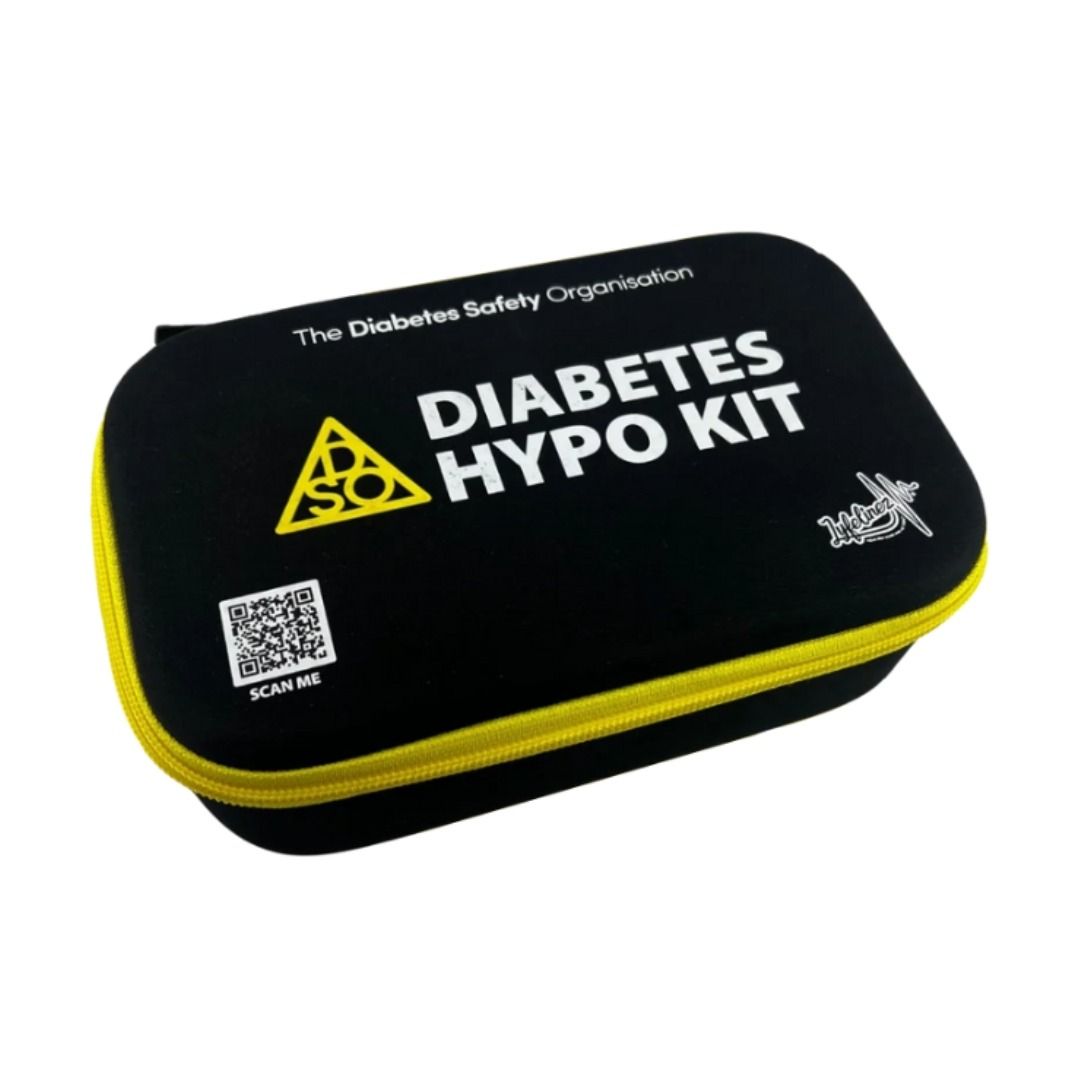
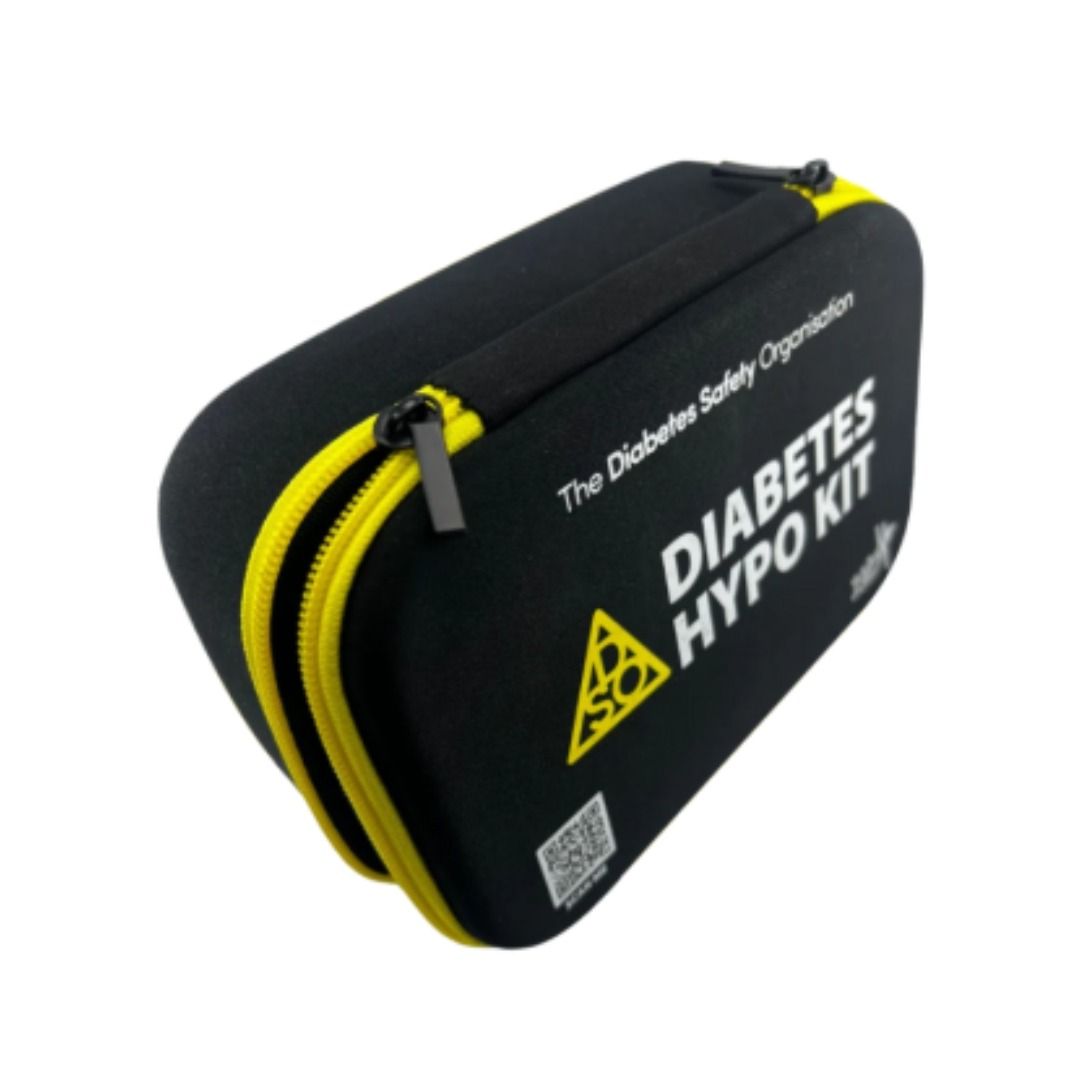
A compact, site-ready emergency kit for managing hypoglycaemic episodes in the workplace, developed by the Diabetes Safety Organisation for employers with a duty of care.
- QR-linked staff training: Scan the case to access certified DSO awareness training, no prior diabetes knowledge required.
- Fast-acting glucose shots: Three 60ml fruit-flavoured shots deliver rapid blood sugar recovery without the choking risk of sweets or gels.
- Suitable for Type 1 and Type 2: Covers all employees managing diabetes with insulin or glucose-lowering medication.
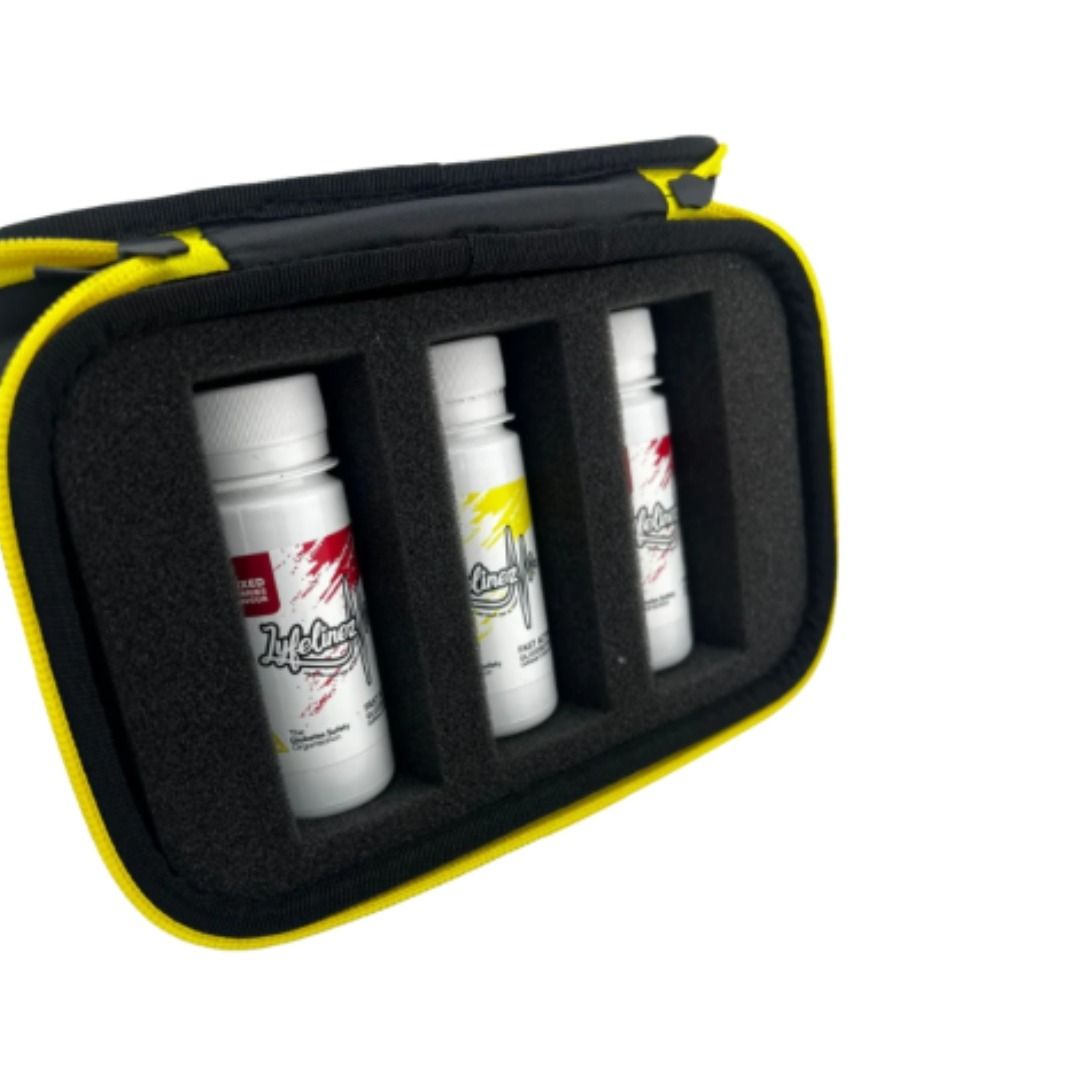
- Contents: 3 x 60ml fruit-flavoured glucose shots, foam-moulded carry case with yellow zip.
- Dietary: Caffeine-free and gluten-free formulation.
- Case size: Approximately 190mm x 110mm x 60mm, fits in a site first aid station or toolbox.
- Backed by: RoSPA, RHA, and DVLA.
DSO Site Diabetes Hypo Kit - 3 x 60ml Glucose Shots and Training
A compact, site-ready emergency kit for managing hypoglycaemic episodes in the workplace, developed by the Diabetes Safety Organisation for employers with a duty of care.
- QR-linked staff training: Scan the case to access certified DSO awareness training, no prior diabetes knowledge required.
- Fast-acting glucose shots: Three 60ml fruit-flavoured shots deliver rapid blood sugar recovery without the choking risk of sweets or gels.
- Suitable for Type 1 and Type 2: Covers all employees managing diabetes with insulin or glucose-lowering medication.
- Contents: 3 x 60ml fruit-flavoured glucose shots, foam-moulded carry case with yellow zip.
- Dietary: Caffeine-free and gluten-free formulation.
- Case size: Approximately 190mm x 110mm x 60mm, fits in a site first aid station or toolbox.
- Backed by: RoSPA, RHA, and DVLA.
- Buy 10 for £45.12 £37.60 each and save 10%
- Buy 20 for £38.57 £32.14 each and save 23%
| BULK DISCOUNT | 10 | 20 |
|---|---|---|
| Price | £37.60 £45.12 | £32.14 £38.57 |
Order 1x to earn 41 FASTPoints
Order to earn 41 FASTPoints
Log in to access trade discountsDSO Site Diabetes Hypo Kit
Developed by the Diabetes Safety Organisation, this kit is a purpose-built emergency response for hypoglycaemic episodes in workplace environments. It combines fast-acting 60ml glucose shots with a QR code that unlocks certified staff awareness training, giving employers a single, deployable solution for both immediate treatment and ongoing workforce preparedness. With 7% of the UK population now living with diabetes and modelled DSO data suggesting the construction sector alone may be losing over 64,000 hours weekly to non-severe hypos, keeping a kit on site is no longer optional best practice: it is a foreseeable risk that employers are legally required to manage under the Health and Safety at Work Act 1974.
Why choose the DSO Site Diabetes Hypo Kit
-
Certified training included at no extra cost: The QR code on the case links directly to DSO Level 1 awareness training, accessible to any member of staff. No booking, no login, no additional spend. First aiders and site managers can be prepared in minutes.
-
Glucose shots, not gels or sweets: A 60ml drink shot delivers a precise, measurable glucose dose that is straightforward to administer to a conscious casualty. It removes the ambiguity of "a few jelly babies" and reduces the risk of choking compared with solid formats.
-
Designed around site conditions: The rigid foam-moulded case protects contents against the knocks and compression a site first aid station or welfare unit routinely absorbs. The yellow zip makes it immediately identifiable in a cluttered kit bag or cabinet.
-
Covers both main diabetes types: The kit is clinically appropriate for Type 1 and Type 2 diabetics using insulin or glucose-lowering medication, covering the full range of employees who may be at hypo risk on your site.
-
Backed by recognised bodies: DSO endorsement is recognised by RoSPA, the Road Haulage Association, and DVLA, giving procurement and SHEQ teams a defensible basis for specifying this kit as part of a diabetes safety plan.
-
Supports employer legal compliance: Providing accessible hypo treatment and training is one of the clearest practical steps an employer can take to discharge their duty under the Health and Safety at Work Act 1974 and the Management of Health and Safety at Work Regulations 1999.
-
Compact and relocatable: At approximately 190mm x 110mm x 60mm, the case sits in a standard first aid station, welfare cabin, or vehicle glovebox without requiring a dedicated mounting point.
What's in the box
- 1 x DSO Diabetes Hypo Kit rigid foam-moulded carry case (black with yellow zip, QR code panel on lid)
- 3 x 60ml fruit-flavoured glucose shots (caffeine-free, gluten-free)
Specifications
| Specification | Detai |
| Product name | DSO Site Diabetes Hypo Kit - 3 x 60ml Glucose Shots and Training |
| Product code | HS040003 |
| Contents | 3 x 60ml fruit-flavoured glucose shots |
| Shot volume | 60ml per shot |
| Flavour | Fruit flavoured |
| Dietary | Caffeine-free, gluten-free |
| Suitable for | Type 1 and Type 2 diabetes (insulin/glucose-lowering medication users) |
| Case material | Rigid EVA foam-moulded shell |
| Case colour | Black with yellow zip |
| Approximate case dimensions | 190mm x 110mm x 60mm (L x W x D) |
| Training access | QR code on case lid — DSO Level 1 awareness training |
| Endorsements | RoSPA, RHA (Road Haulage Association), DVLA |
| Manufacturer | Diabetes Safety Organisation (DSO) |
| Pack quantity | 1 kit |
Who is this for?
This kit is specified by site managers, SHEQ advisors, and procurement teams on construction, civil engineering, utilities, and infrastructure projects where staff may be managing diabetes with insulin or medication. It is equally relevant to facilities managers responsible for welfare provision in manufacturing plants, logistics depots, and large commercial buildings. Any employer with a workforce of 12 or more is statistically likely to have at least one employee at hypo risk, making this a routine procurement rather than a specialist one.
Typical applications
-
Keeping a kit in the site welfare cabin or first aid station as part of a documented diabetes safety plan
-
Supplying dedicated kits to site vehicles, particularly for lone workers or remote-access crews where emergency services response times are extended
-
Equipping first aiders and appointed persons with a deployable kit during inductions, toolbox talks, and on-shift cover
-
Meeting the requirements of the Tackling Diabetes Safety Charter for employers who have signed up to DSO's framework
-
Providing rapid treatment during a hypoglycaemic episode before a first aider arrives, where colleagues have been trained via the QR code on the case
-
Inclusion in site-specific emergency response plans as a named resource for diabetic episodes
-
Procurement as a bulk supply for framework contracts covering multiple sites or projects
How to use
-
Recognise the signs of a hypoglycaemic episode: dizziness, confusion, shaking, sweating, pallor, or slurred speech in a conscious casualty.
-
Confirm the casualty is conscious and able to swallow before administering anything by mouth.
-
Open the kit case and remove one 60ml glucose shot.
-
Hand the shot to the casualty to drink, or assist them if needed. Do not force liquid on anyone showing reduced consciousness.
-
Allow 10 to 15 minutes for blood sugar to begin recovering. If symptoms do not improve, administer a second shot and call 999.
-
Once the casualty has recovered, they should eat a slow-release carbohydrate snack (such as a sandwich or biscuit) to stabilise blood sugar levels.
-
Record the incident in the site accident book and notify the casualty's next of kin or emergency contact as appropriate.
-
Restock the kit immediately after use. Do not leave a partially stocked kit in the first aid station.
Safety
-
The glucose shots are for use on conscious casualties only. Never attempt to administer a liquid to an unconscious person.
-
If the casualty loses consciousness at any point, place them in the recovery position and call 999 immediately.
-
Do not use the shots if the seal is broken or the use-by date has passed.
-
Store the kit away from direct sunlight and extreme heat, which can degrade the glucose solution.
-
The kit does not contain glucagon and is not a substitute for glucagon injection kits prescribed to individuals by their GP.
-
This kit is not a substitute for trained first aid provision. It is a supplement to, not a replacement for, a qualified first aider on site.
Maintenance
Check the use-by dates on all three glucose shots at each routine first aid cabinet inspection, typically monthly on active sites. Replace any shot within two months of expiry to ensure a full kit is always available. Wipe the exterior of the case with a damp cloth if exposed to dust or site debris. The foam insert is fixed; do not attempt to remove or modify it. After any use, reorder replacement shots promptly using the product code from the specifications table. Keep the QR code panel on the case lid clean and unobstructed so that the training link remains scannable.
Frequently Asked Questions
Q: How many people on a typical construction site are likely to be at risk of a hypo?
A: British Safety Council data suggests that for every 1,000 employees, approximately 82 will have diabetes and around 25 will be at risk of a hypoglycaemic episode. On a site of 50 workers, that equates to roughly four people with diabetes and potentially one or two at active hypo risk. That is a meaningful probability on any live project, not a theoretical edge case.
Q: Is this kit suitable for both Type 1 and Type 2 diabetes?
A: Yes. The glucose shots are appropriate for any employee experiencing hypoglycaemia caused by insulin or glucose-lowering medication, which covers the majority of Type 1 diabetics and a significant proportion of those with Type 2. The kit is not appropriate for hyperglycaemia (high blood sugar), which requires different medical management.
Q: What does the QR code training actually cover, and how long does it take?
A: The QR code links to DSO Level 1 awareness training, which covers how to recognise the signs of a hypo, what to do immediately, how to use the glucose shots, and when to call for further help. It is designed to be completed by any member of staff with no prior medical knowledge and takes around 15 to 20 minutes. There is no booking process and no cost beyond the kit purchase.
Q: Why are glucose shots preferable to glucose gel or sweets for a site environment?
A: Drink shots deliver a defined 60ml dose that is straightforward to quantify and administer. Sweets and gel create ambiguity around how much has actually been given, and gel can be difficult to administer cleanly in cold or wet conditions. A shot also carries a lower choking risk than solid sweets when a casualty is distressed or disoriented.
Q: Does providing this kit satisfy our legal duty of care under the Health and Safety at Work Act?
A: It is a material step towards it. The Health and Safety at Work Act 1974 requires employers to manage foreseeable risks so far as is reasonably practicable. Diabetes-related hypoglycaemia is a foreseeable risk on any site with staff at hypo risk. Providing a kit and ensuring staff are trained in its use, which this kit facilitates directly via the QR code, is the kind of documented, practical control measure that satisfies a regulator or coroner's inquiry. It does not substitute for a full risk assessment, but it is a defensible and auditable provision.
Q: What endorsements does the DSO kit carry?
A: The Diabetes Safety Organisation and its products are recognised by RoSPA (the Royal Society for the Prevention of Accidents), the Road Haulage Association, and DVLA. These endorsements are relevant to industries, including construction, road haulage, and plant operation, where a hypo during a safety-critical task carries significant consequences.
Q: How often do the glucose shots need replacing?
A: The shots carry a printed use-by date. On a low-activity site, inspect and rotate stock every three months as a minimum. On sites with a known diabetic worker, monthly checks are advisable. Replace the entire kit contents after any use rather than restocking individual shots, to maintain a known, complete provision.
Q: Can this kit be used in place of a prescribed glucagon injection kit?
A: No. The glucose shots treat mild to moderate hypoglycaemia in a conscious casualty. A glucagon injection kit is a prescription device for severe hypos where the casualty cannot swallow. Employees who have been prescribed glucagon by their GP should keep their own supply on site. The DSO kit is a first-response measure for the wider workforce and for cases where a personal kit is not immediately to hand.
Q: How does this kit fit within a site first aid needs assessment?
A: Under HSE guidance, a first aid needs assessment should reflect the specific hazards and workforce of a site. Where staff include individuals managing diabetes, the assessment should note this as a foreseeable risk and specify appropriate provision. A DSO kit, supported by the QR-linked training, is a documented and auditable response to that finding. It can sit within an existing first aid station without requiring additional cabinet space.
Q: Why order this from CMT Group rather than directly from a medical supplier?
A: CMT Group holds ISO 9001:2015 and ISO 14001:2015 accreditations, CHAS Elite status, and is a BSIF Registered Safety Supplier, meaning product quality and supply chain integrity are independently verified. Most of the products have same or next working day delivery across the UK mainland. For urgent site requirements, VIP dedicated delivery anywhere in the UK is available within two to three hours on a dedicated vehicle. CMT's EDGE procurement portal allows construction buyers to manage orders, track deliveries, and maintain spend controls across multiple sites and projects, with Punchout, EDI, and API integrations available for larger frameworks.
