Barriers, Temporary Fencing & Hoarding

Barriers, temporary fencing, and hoarding keep construction sites safe for workers, pedestrians, and the public. CMT Group supplies a comprehensive range of site barrier and fencing products including plastic barriers, metal pedestrian barriers, water-filled barriers, walkthrough barrier systems, temporary fencing and gates, site hoarding, acoustic and fence sheeting, stillages and accessories, and Fence-Lok ground anchoring systems, from leading brands including Securasite, Melba Swintex, and Skipper.
Read more Read less
Barriers and temporary fencing are a fundamental part of construction site setup, separating work areas from public access, controlling vehicle and pedestrian movement, protecting the public from construction hazards, and securing the site perimeter. Under the CDM Regulations 2015 and the Health and Safety at Work Act 1974, principal contractors must ensure appropriate measures are in place to prevent unauthorised access to construction sites and to protect members of the public from construction hazards. The correct barrier and fencing specification depends on the nature of the works, the proximity to the public, and the level of security and impact resistance required.
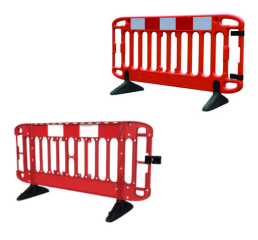
- ✓ Plastic barriers and Melba Swintex interlocking barriers for site perimeter and hazard demarcation
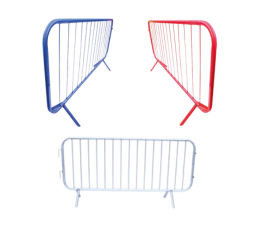
- ✓ Metal pedestrian barriers and Securasite crowd control barriers for public area management
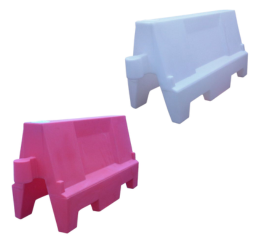
- ✓ Water-filled barriers for vehicle impact protection at roadworks and site entrances
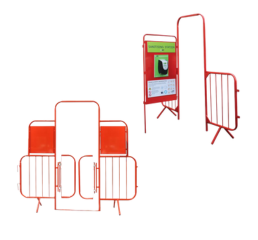
- ✓ Walkthrough barrier systems providing pedestrian access through barrier runs
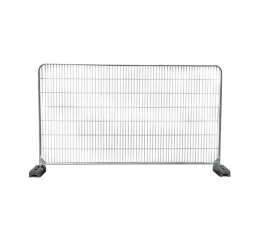
- ✓ Temporary fencing panels and gates including Heras-style mesh fencing
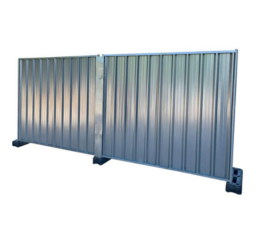
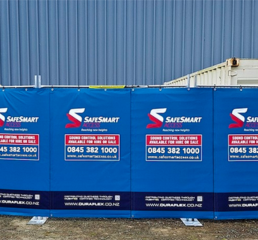
- ✓ Site hoarding and acoustic fence sheeting for noise attenuation and visual screening
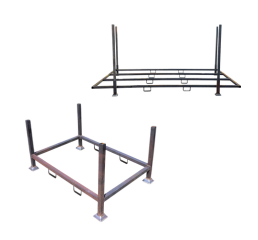
- ✓ Stillages and accessories for safe storage and handling of barriers on site
- ✓ Next day delivery standard. VIP 2-3 hour delivery on a dedicated vehicle also available
Temporary Fencing, Barriers, and Public Safety on Construction Sites
Temporary fencing and barriers are the physical interface between an active construction site and the public, and the specification of this equipment must match the risk level presented by the works. Where construction operations are adjacent to pedestrian areas, public footways, or busy roads, barriers must provide a robust and clearly visible separation that prevents accidental entry and protects the public from construction hazards. Lightweight plastic barriers are appropriate for low-risk internal site demarcation; metal pedestrian barriers are required for crowd management in busier public areas; water-filled barriers are required where there is a vehicle impact risk.
Securasite is one of the UK's leading brands in crowd control and pedestrian barrier systems, supplying robust metal barriers widely used at events, construction sites, and public area management operations across the UK. Melba Swintex is a leading manufacturer of plastic construction barriers, providing the highly visible red and white interlocking barrier systems used throughout the UK construction and highways sector. Both brands are stocked by CMT Group alongside Skipper retractable barrier systems for more flexible pedestrian access control.
Barriers and Temporary Fencing by Type
Our range covers the barrier and temporary fencing products needed for construction site perimeter security, public safety, and access control.
Choosing the Right Barrier or Temporary Fencing
The correct barrier or fencing type depends on the level of security and impact resistance required, the proximity to the public and traffic, the duration of the works, and any specific planning or local authority requirements for the site. Using lightweight plastic barriers in a situation that requires a more robust separation creates a safety risk that could result in enforcement action and, more importantly, in an injury to a member of the public or a worker.
For noise-sensitive sites adjacent to residential properties, adding acoustic fence sheeting to the temporary fencing perimeter is often a condition of the planning permission. For sites on soft ground or exposed to wind loading, Fence-Lok ground anchors provide stability that concrete feet and rubber bases cannot match. Stillages allow efficient storage and transport of barriers between sites and depots, reducing damage and improving handling safety.
| Application | Product | Key reason |
|---|---|---|
| Internal site hazard demarcation | Plastic barriers | Lightweight, highly visible, quick to deploy |
| Pedestrian management in busy urban areas | Metal pedestrian barriers (Securasite) | Robust, resists crowd pressure and impact |
| Roadworks vehicle impact protection | Water-filled barriers | Mass provides vehicle deflection resistance |
| Construction site perimeter security | Temporary fencing panels and gates | Deters climbing and unauthorised access |
| Urban site requiring visual screening | Site hoarding | Solid panel provides security and appearance |
| Noise-sensitive neighbours adjacent to site | Acoustic fence sheeting on temp fencing | Reduces noise transmission to neighbours |
| Fencing on soft or uneven ground | Fence-Lok ground anchor system | Stable in wind where feet and bases fail |
Barriers and Temporary Fencing Supplied Across the UK
Barriers and temporary fencing are among the first items to be installed on any construction site and the last to be removed, providing the continuous physical separation between the works and the public throughout the entire project duration. The specification of these products must meet the actual risk level of the site, comply with any planning conditions and local authority requirements, and be maintained in good condition throughout the project. Damaged, fallen, or inadequate barriers create immediate public safety risks and expose the principal contractor to enforcement action under CDM Regulations 2015 and the Health and Safety at Work Act 1974.
CMT Group has been supplying barriers, temporary fencing, and hoarding products to UK construction and highways contractors for over 20 years. Our range covers the full scope of barrier and fencing requirements from Melba Swintex plastic barriers and Securasite metal pedestrian barriers through to water-filled barriers, Heras-style temporary fencing, site hoarding, acoustic fence sheeting, stillages, and Fence-Lok ground anchor systems. We operate our own fleet of 100+ FORS Gold accredited vehicles covering 90% of the UK, with next day delivery standard on orders placed by 5pm by phone or 7pm online, and VIP 2-3 hour delivery on a dedicated vehicle dispatched within 30 minutes for urgent requirements.
Frequently asked questions
What is the difference between plastic barriers and metal pedestrian barriers?
Plastic barriers are lightweight, interlocking barriers made from high-density polyethylene, typically in red and white or yellow and black colourways. They are quick to deploy and reposition, highly visible, and suitable for low-level site demarcation and hazard marking where crowd pressure or vehicle impact is not a significant risk. Metal pedestrian barriers are galvanised steel barriers of the type used for crowd management at events and construction works in public areas. They are significantly heavier and more robust than plastic barriers, providing a stronger physical separation that resists crowd pressure and accidental impact. Metal barriers are the correct choice where works are adjacent to busy pedestrian areas, where crowd management is required, or where a more substantial visible barrier is needed to communicate the separation between the public and the works.
What are stillages used for in barrier operations?
Stillages are steel storage and transport frames designed to hold stacks of metal pedestrian barriers or temporary fencing panels securely during storage and vehicle transport. During transport, a stillage holds a defined number of barriers in a stable configuration on a flat-bed vehicle, preventing movement under braking and cornering that would otherwise create a load security risk and potentially damage the barriers. On site, barrier stillages allow large numbers of barriers to be stored compactly in a designated storage area and moved efficiently by forklift or pallet truck as they are needed for deployment. Using stillages significantly reduces the manual handling involved in barrier operations, improves site organisation, and extends the working life of barriers by preventing the damage that results from barriers being stacked and stored without proper support.
When do I need acoustic fence sheeting on a construction site?
Acoustic fence sheeting is typically required when a planning condition or local authority requirement specifies noise attenuation measures at the site perimeter, or when the contractor undertakes to limit noise impact on neighbouring properties as part of a Construction Method Statement or Noise Management Plan. Standard mesh temporary fencing provides no meaningful noise reduction. Attaching acoustic fence sheeting to the fencing panels creates a solid barrier face that reflects and absorbs noise, reducing the level of construction noise transmitted to neighbouring properties. The degree of noise reduction achievable depends on the specification of the sheeting, the height of the fence, and the proximity and orientation of the noise source to the fence. For sites undertaking noisy operations such as piling, breaking, or heavy plant operations adjacent to residential properties, acoustic sheeting is a practical and cost-effective noise management measure.
What is Fence-Lok and when should I use it?
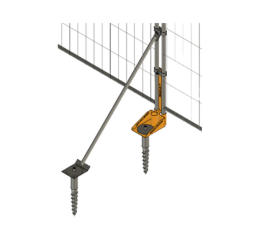
Fence-Lok is a patented ground anchor system for temporary fencing that replaces concrete feet and weighted rubber bases on soft ground sites. Ground spikes are driven into the soil at each panel junction to anchor the panel base rail, providing resistance to wind loading and pushing forces that would cause standard-footed temporary fencing to topple on exposed or uneven ground. Fence-Lok is particularly effective for temporary fencing installed on grass verges, gravel surfaces, or uneven ground where concrete feet are too heavy and unstable, and rubber bases are insufficient to resist wind loading. It is also faster to install and remove than concrete feet, making it cost-effective for short-duration and frequently reconfigured fencing setups. Fence-Lok is not suitable for paved or hardstanding surfaces where ground spike penetration is not possible.
Why buy barriers and temporary fencing from CMT Group?
CMT Group has been supplying barriers, temporary fencing, and hoarding to UK construction and highways contractors for over 20 years. We stock leading brands including Securasite crowd control barriers, Melba Swintex plastic barriers, and Skipper retractable systems, covering the full spectrum of site barrier requirements. As a FORS Gold accredited and CLOCS committed supplier, we understand the safety requirements of the construction and highways sector that our customers operate in. We operate our own fleet of 100+ FORS Gold accredited vehicles covering 90% of the UK, with next day delivery standard on orders placed by 5pm by phone or 7pm online, and VIP 2-3 hour delivery on a dedicated vehicle dispatched within 30 minutes for urgent site requirements.
Temporary Fencing vs Site Hoarding: Which Do You Need?
Temporary fencing and site hoarding both provide a perimeter barrier around a construction site but differ significantly in the level of security, visual screening, and public safety they provide. Temporary fencing using Heras-style galvanised mesh panels is the most widely used construction site perimeter solution in the UK. It is quick to install and strike, easy to reconfigure as the site boundary changes during the project, and relatively cost-effective for large perimeters. The open mesh construction allows visibility into the site, which can be an advantage for security monitoring but means it provides no visual screening of the works.
Site hoarding uses solid panels, typically timber or composite board on a steel or timber post framework, creating a complete visual barrier that screens the construction activity from public view. Site hoarding provides a higher level of security than mesh fencing as it cannot be seen through and is more difficult to climb or force. It is required by many local planning authorities for construction projects in urban areas, conservation areas, or locations where the visual impact of the works on the public realm is a planning consideration. Site hoarding also provides a surface for project branding, public information, and community engagement displays. The trade-off is higher cost and more time to install and strike compared to temporary mesh fencing. For most construction sites outside the urban core, temporary mesh fencing is sufficient. For urban, town centre, and high-profile projects, site hoarding is typically required.