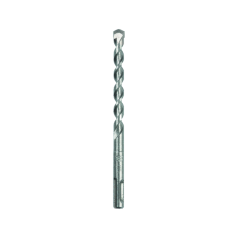
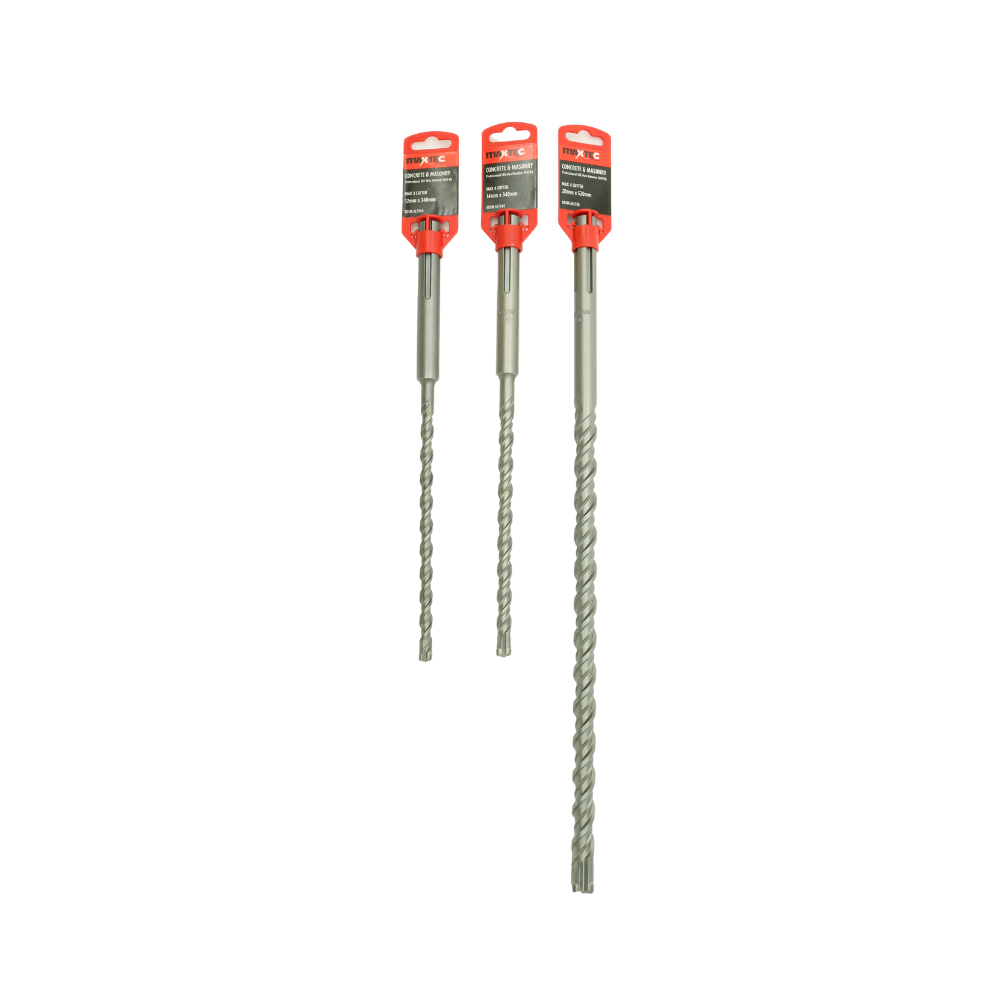


A heavy-duty 4-cutter SDS Max masonry drill bit built from 40Cr high-alloy steel, designed for drilling reinforced concrete, dense masonry, and natural stone with rotary hammer drills.
- Cross-head 4-cutter carbide tip: four cutting edges distribute impact force evenly, reducing jamming on rebar contact
- U-flute debris clearance design: aggressive spiral U-flute removes concrete dust
- Steel core: 40Cr high-alloy steel body resists torsional stress and flexion on long-reach drilling
- Diameter range: 12mm to 40mm across the full range
- Length range: 340mm to 1200mm overall length, working lengths from 190mm to 1050mm
- Shank type: SDS Max, 18mm shank diameter
MAXTEC SDS Max 4-Cutter Masonry Drill Bit - 40Cr Steel and U-Flute Design

A heavy-duty 4-cutter SDS Max masonry drill bit built from 40Cr high-alloy steel, designed for drilling reinforced concrete, dense masonry, and natural stone with rotary hammer drills.
- Cross-head 4-cutter carbide tip: four cutting edges distribute impact force evenly, reducing jamming on rebar contact
- U-flute debris clearance design: aggressive spiral U-flute removes concrete dust
- Steel core: 40Cr high-alloy steel body resists torsional stress and flexion on long-reach drilling
- Diameter range: 12mm to 40mm across the full range
- Length range: 340mm to 1200mm overall length, working lengths from 190mm to 1050mm
- Shank type: SDS Max, 18mm shank diameter
MAXTEC SDS Max 4-Cutter Masonry Drill Bit
The MAXTEC SDS Max 4-Cutter Masonry Drill Bit is engineered for heavy-duty drilling in reinforced concrete, dense masonry, natural stone, and artificial stone using SDS Max rotary hammer drills. The 40Cr high-alloy steel core and cross-head 4-cutter tungsten carbide tip are built for the sustained impact loads and high torque that SDS Max drilling generates, particularly on structural work where hole depth, diameter, and bore quality all matter. Available in diameters from 12mm to 40mm and overall lengths from 340mm to 1200mm, the range covers the full scope of anchor installation, service penetration, and through-hole drilling encountered on UK commercial construction, infrastructure, and civil engineering projects.
Why Choose the MAXTEC SDS Max 4-Cutter Masonry Drill Bit
-
Cross-head 4-cutter carbide geometry: The four cutting edges engage the material simultaneously around the full bore circumference. This distributes the impact load across four points rather than two, which produces a rounder, more accurate hole, reduces the lateral force that causes bit wander on entry, and significantly reduces the risk of jamming when the tip contacts embedded rebar mid-bore.
-
40Cr high-alloy steel core: The bit body is manufactured from 40Cr chromium-alloyed steel, which provides a measurably higher resistance to torsional stress than standard carbon steel cores. On long-reach drilling at 920mm or 1200mm, core rigidity directly affects hole straightness and the operator's ability to maintain direction without the bit flexing or deflecting under load.
-
Aggressive spiral U-flute: The wide U-profile flute channel moves broken concrete, dust, and debris out of the bore at a rate that narrower flute profiles cannot match. Keeping the bore clear during the cut is what maintains cutting speed, prevents the tip from overheating, and extends carbide life between replacements.
-
Low vibration drilling: The balanced 4-cutter geometry and precise carbide seating reduce transmitted vibration compared to standard 2-cutter configurations. On prolonged heavy-duty drilling sessions, reduced vibration directly affects operator fatigue and Hand-Arm Vibration Syndrome (HAVS) exposure under the Control of Vibration at Work Regulations 2005.
-
Full size range in a single product family: Fourteen diameters from 12mm to 40mm and multiple length variants per diameter mean contractors and procurement teams can specify the entire SDS Max drilling requirement from one product line and one supplier, simplifying ordering and stock management on site.
-
Compatible with all SDS Max rotary hammer drills: The 18mm SDS Max shank fits all rotary hammer drills accepting SDS Max tooling, including equipment from Bosch, DeWalt, Hilti, Makita, Milwaukee, and Metabo, with no adaptor required.
What's in the Box?
One MAXTEC SDS Max 4-Cutter Masonry Drill Bit in the specified diameter and length.
Specifications
| Specification | Detail |
|---|---|
| Product Name | MAXTEC SDS Max 4-Cutter Masonry Drill Bit |
| Product Code | SDSM |
| Shank Type | SDS Max (18mm Shank Diameter) |
| Tip Construction | 4-Cutter Cross-Head Tungsten Carbide Tip |
| Core Material | 40Cr High-Alloy Steel |
| Diameter Range | 12mm to 40mm |
| Overall Length Range | 340mm to 1200mm |
| Working Length Range | 190mm to 1050mm |
| Flute Design | Spiral U-Flute |
| Application | Reinforced Concrete, Natural Stone, Masonry, Artificial Stone |
| Operating Mode | Hammer Drill Mode (SDS Max Rotary Hammer Drills) |
| Supply | Sold Individually by Diameter & Length Variant |
Compatibility
| Material / Application | Status |
|---|---|
| Reinforced Concrete | ✓ Compatible |
| Plain Concrete | ✓ Compatible |
| Natural Stone | ✓ Compatible |
| Dense Masonry & Blockwork | ✓ Compatible |
| Artificial Stone | ✓ Compatible |
| SDS Max Rotary Hammer Drills | ✓ Compatible |
| SDS Plus Rotary Hammer Drills | ✗ Not Compatible |
| Rotary-Only Mode (No Hammer) | ✗ Not Recommended |
! How to Select the Right Length
Every MAXTEC SDS Max 4-Cutter Masonry Drill Bit has two measurements you need to know before ordering: overall length and working length.
The working length is the cutting section of the bit, measured from the carbide tip to the shank collar. This is the maximum depth the bit can drill into the material before the collar meets the surface and stops further progress. The remaining length is the shank, which sits inside the drill chuck and never enters the material.
Always select a working length that is at least 50mm greater than your required drilling depth. This margin keeps the flute clear of the bore at full depth so debris can continue to escape during the cut.
Example: if you need to drill a 350mm deep anchor hole, select the variant with a 400mm working length, not 200mm.
The working length for each variant is listed in the size table above. If you are unsure which length is correct for your application, contact the CMT Group sales team before ordering.
Size Reference Table
| Product Code | Diameter (mm) | Overall Length (mm) | Working Length (mm) |
|---|---|---|---|
| SDSM-12/340 | 12 | 340 | 200 |
| SDSM-12/540 | 12 | 540 | 400 |
| SDSM-14/340 | 14 | 340 | 200 |
| SDSM-14/540 | 14 | 540 | 400 |
| SDSM-16/340 | 16 | 340 | 200 |
| SDSM-16/540 | 16 | 540 | 400 |
| SDSM-16/920 | 16 | 920 | 780 |
| SDSM-18/340 | 18 | 340 | 200 |
| SDSM-18/540 | 18 | 540 | 400 |
| SDSM-18/920 | 18 | 920 | 780 |
| SDSM-20/320 | 20 | 320 | ≈180* |
| SDSM-20/340 | 20 | 340 | 200 |
| SDSM-20/520 | 20 | 520 | 380 |
| SDSM-20/920 | 20 | 920 | 780 |
| SDSM-20/1200 | 20 | 1200 | 1050 |
| SDSM-22/340 | 22 | 340 | 190 |
| SDSM-22/520 | 22 | 520 | 370 |
| SDSM-22/920 | 22 | 920 | 770 |
| SDSM-24/340 | 24 | 340 | 200 |
| SDSM-24/520 | 24 | 520 | 370 |
| SDSM-25/320 | 25 | 320 | ≈170* |
| SDSM-25/340 | 25 | 340 | 200 |
| SDSM-25/520 | 25 | 520 | 370 |
| SDSM-25/920 | 25 | 920 | 770 |
| SDSM-25/1200 | 25 | 1200 | 1050 |
| SDSM-28/370 | 28 | 370 | 220 |
| SDSM-28/520 | 28 | 520 | ≈370* |
| SDSM-28/570 | 28 | 570 | 420 |
| SDSM-28/920 | 28 | 920 | 770 |
| SDSM-30/370 | 30 | 370 | 220 |
| SDSM-30/520 | 30 | 520 | ≈370* |
| SDSM-30/570 | 30 | 570 | 420 |
| SDSM-30/920 | 30 | 920 | 770 |
| SDSM-32/370 | 32 | 370 | 220 |
| SDSM-32/520 | 32 | 520 | ≈370* |
| SDSM-32/570 | 32 | 570 | 420 |
| SDSM-32/920 | 32 | 920 | 770 |
| SDSM-32/1200 | 32 | 1200 | 1050 |
| SDSM-35/520 | 35 | 520 | ≈370* |
| SDSM-35/570 | 35 | 570 | 420 |
| SDSM-35/920 | 35 | 920 | 770 |
| SDSM-38/520 | 38 | 520 | ≈370* |
| SDSM-38/570 | 38 | 570 | 420 |
| SDSM-40/520 | 40 | 520 | ≈370* |
| SDSM-40/920 | 40 | 920 | 770 |
Who Is This For?
The MAXTEC SDS Max 4-Cutter Masonry Drill Bit is used by structural installers, civil engineers, groundworkers, and mechanical and electrical contractors on commercial construction, infrastructure, and civil engineering projects. It is the correct tool where SDS Plus tooling lacks the shank diameter, torque capacity, or reach to complete the work: large-diameter anchor holes, deep service penetrations through structural concrete walls and floors, and through-hole drilling in reinforced concrete where hole accuracy and bore quality affect fixing performance. It is also the standard choice for procurement teams specifying a complete drilling range for main contractor site operations where multiple hole sizes and depths are required across a single project.
Typical Applications
-
Drilling large-diameter anchor holes for resin studs, through-bolts, and heavy structural fixings in reinforced concrete bases, columns, and walls
-
Creating service penetrations through reinforced concrete floors and walls for conduit, pipework, and cable management runs
-
Through-hole drilling in bridge decks, retaining walls, and infrastructure structures for bolt and hanger installation
-
Deep drilling to 920mm or 1200mm working depth for pile cap anchors, deep foundation bolts, and long-reach service installations
-
Drilling fixing holes for structural steelwork connections into reinforced concrete frames and pad foundations
-
Anchor hole preparation in natural stone, granite, and dense masonry on heritage, restoration, and civil structures
-
Utility contractor drilling for cable and pipe runs through reinforced concrete basement and substructure walls
How to Use
-
Select the correct diameter to match the anchor, fixing, or conduit specification. Select the length variant with a working length that exceeds the required drilling depth by at least 50mm to allow full bore clearance.
-
Insert the SDS Max shank into the drill chuck. The bit clicks and locks without key tightening. Confirm the bit is fully seated and locked before starting.
-
Set the rotary hammer drill to hammer drill mode. Confirm the correct mode is engaged before making contact with the surface.
-
Mark the required drilling depth on the bit body using masking tape or a depth stop if your drill is fitted with one.
-
Position the tip at the marked drilling point. Apply light forward pressure and start at reduced speed to establish the entry point without the bit skating across the surface.
-
Once the entry point is established, increase to full operating speed and apply steady forward pressure. Allow the bit to do the work. Excessive downward force does not increase drilling speed and accelerates carbide wear.
-
Withdraw the bit fully every 100mm to 150mm of drilling depth to clear debris from the flute and allow heat to dissipate. On deep bores above 500mm, withdraw more frequently.
-
Reduce pressure and speed as the tip approaches the target depth. On through-hole drilling, back off pressure as the tip breaks through to avoid bit kick and surface spalling on the exit face.
-
Withdraw the bit cleanly on completion and inspect the carbide tip before the next use.
Safety and Maintenance
Safety during use:
-
Wear safety goggles rated to EN166 as a minimum throughout drilling operations. Concrete debris and stone fragments can be ejected from the bore at speed, particularly on entry and at breakthrough.
-
Wear anti-vibration gloves where drilling sessions exceed short durations. SDS Max drilling generates significant Hand-Arm Vibration (HAV). Under the Control of Vibration at Work Regulations 2005, employers must assess and manage HAV exposure. Anti-vibration gloves reduce transmitted vibration and delay the onset of fatigue.
-
Wear an FFP2 or FFP3 dust mask when drilling concrete. Concrete dust contains respirable crystalline silica (RCS), which is a known cause of occupational lung disease. Under COSHH regulations, dust suppression or respiratory protection is required when drilling concrete in any enclosed or semi-enclosed environment.
-
Confirm the correct drill mode is engaged before starting. SDS Max drills typically offer hammer-drill and chisel-only modes. This bit must be used in hammer-drill mode only.
-
Check for embedded services before drilling any structural concrete element. Use a cable and pipe detector on the drill line before starting. SDS Max drilling at 920mm or 1200mm depth can reach services that shorter bits would not encounter.
After use and storage:
-
Clear concrete debris and dust from the spiral U-flute after every use. Packed debris reduces flute efficiency and increases heat on the next operation.
-
Inspect all four carbide cutting edges after each use. Any chipped, worn, or missing carbide tooth should be noted before the bit is returned to service. A damaged cutting edge concentrates load on the remaining tips and accelerates the rate of failure across the full tip.
-
Allow the bit to cool fully before storing. Placing a hot bit directly into a tool bag or case alongside other tooling risks thermal stress on the carbide bond and contact damage to adjacent tools.
-
Store bits vertically where possible, tip upward, in a dry environment. Horizontal storage in a crowded tool bag is a common cause of carbide chipping that is unrelated to site use.
-
Check the SDS Max shank for wear, burring, or deformation at each inspection. A damaged shank does not seat correctly in the chuck and can cause the bit to slip under load or exit the chuck during drilling.
Frequently Asked Questions
Q: What is the difference between an SDS Max bit and an SDS Plus bit, and when do I need SDS Max?
A: The primary differences are shank diameter and torque capacity. SDS Plus has a 10mm shank, while SDS Max uses an 18mm shank, which is significantly stronger and transmits considerably more torque and impact energy from the drill to the bit. SDS Max is the correct choice when you are drilling larger diameters (generally above 20mm), deeper holes, or working in particularly dense or heavily reinforced concrete where an SDS Plus drill and bit combination lacks the power to maintain drilling speed or complete the bore without excessive wear. The MAXTEC SDS Max 4-Cutter Masonry Drill Bit is stocked from 12mm upward, but in practice it is on diameters above 20mm and lengths above 400mm where SDS Max delivers a performance advantage that justifies the larger drill platform.
Q: Why does a 4-cutter tip perform better than a 2-cutter tip in reinforced concrete?
A: A 2-cutter bit concentrates impact force on two opposing points of the bore circumference. When one of those points contacts embedded rebar, the entire impact load is redirected asymmetrically, which is what causes jamming and deflection. A 4-cutter cross-head distributes impact across four points simultaneously. On rebar contact, the remaining three cutting edges maintain engagement with the concrete matrix around the bar, keeping the bit stable and reducing the torque spike that stalls the drill or jams the bit in the bore. The result is more consistent progress through reinforced sections, less risk of bit breakage, and a rounder, more accurate bore throughout.
Q: What does the 40Cr steel core actually mean for drilling performance?
A: 40Cr is a chromium-alloyed steel grade with higher tensile strength and torsional rigidity than standard carbon steel. In a drill bit body, that matters most on long-reach applications. At 920mm or 1200mm overall length, a bit with a lower-grade steel core will flex under the combination of rotational torque and hammer impact, causing the bore to drift off-line and increasing fatigue stress at the shank. A 40Cr core resists that flex, keeps the bore straighter, and maintains the integrity of the shank-to-chuck connection under sustained high-torque drilling.
Q: How do I select the right length variant for my application?
A: Choose a working length that exceeds your required drilling depth by at least 50mm. This ensures the flute can still clear debris from the full depth of the bore without the shank entering the hole. For through-wall drilling, measure the full wall thickness including any render, screed, or facing material and add 50mm to that figure. For anchor holes, check the anchor manufacturer's required embedment depth and add the same margin. The MAXTEC SDS Max 4-Cutter Masonry Drill Bit is available in working lengths from 190mm up to 1050mm, covering the full range of anchor and service penetration depths encountered on UK construction sites.
Q: Can I use this bit on natural stone and granite as well as concrete?
A: Yes. The 4-cutter tungsten carbide tip is rated for natural stone, granite, dense masonry, and artificial stone in addition to plain and reinforced concrete. The carbide geometry that performs well in hard aggregate concrete also handles the abrasive cutting action required in granite and hard natural stone. The key consideration on very hard natural stone is heat management: withdraw the bit more frequently on granite and similar materials than on standard concrete to allow the tip to cool and maintain carbide integrity.
Q: Is this bit compatible with all SDS Max rotary hammer drills?
A: Yes. The 18mm SDS Max shank is a universal standard compatible with all rotary hammer drills that accept SDS Max tooling, including equipment from Bosch, DeWalt, Hilti, Makita, Milwaukee, and Metabo. SDS Max and SDS Plus are not interchangeable: this bit will not fit an SDS Plus chuck, and SDS Plus bits will not fit an SDS Max chuck. If you are unsure which shank type your drill accepts, check the drill collar markings or the tool specification plate on the body of the drill.
Q: What respiratory protection is required when using this bit on concrete?
A: Concrete dust contains respirable crystalline silica (RCS), which is classified as a Group 1 carcinogen. Under the Control of Substances Hazardous to Health (COSHH) Regulations 2002, employers must assess the risk and implement controls. For dry drilling in any enclosed or partially enclosed environment, a minimum FFP2 dust mask is required, with FFP3 recommended on prolonged operations or in confined spaces. On outdoor open-air sites with good natural ventilation and short drilling durations, the risk level is lower, but respiratory protection remains best practice. Water suppression or on-tool dust extraction are the preferred engineering controls where the drill and site setup permit.
Q: How often should I replace a worn carbide tip?
A: There is no fixed replacement interval because tip wear depends on material hardness, drilling depth, operating technique, and the number of rebar contacts the bit has made. The correct approach is to inspect the full 4-cutter tip after every significant use. Replace the bit when any of the following are present: visible carbide chipping on one or more cutting edges, a measurable reduction in drilling speed at full power on a material previously drilled without difficulty, or any lateral movement or rattle in the carbide-to-body joint. Continuing to use a bit with a damaged cutting edge is the most common cause of bore inaccuracy, drill stalling, and unnecessary wear on the rotary hammer chuck.
Q: Why order the MAXTEC SDS Max 4-Cutter Masonry Drill Bit from CMT Group?
A: CMT Group has supplied construction and infrastructure sites across the UK since 2010, operating a fleet of over 100 vehicles with FORS Silver Accreditation covering 90% of the UK mainland. The MAXTEC SDS Max 4-Cutter Masonry Drill Bit is available for next working day delivery on orders placed by 7pm online, or same-day delivery on confirmed stock. For projects on tight programmes, CMT's VIP dedicated delivery service dispatches on a dedicated vehicle within 30 minutes, reaching most UK locations within two to three hours. B2B trade accounts, volume pricing, and access to the EDGE procurement portal are available for contractors and procurement teams managing multi-project requirements across the MAXTEC range.