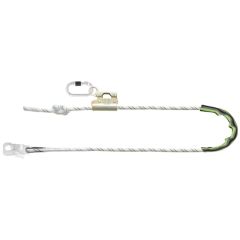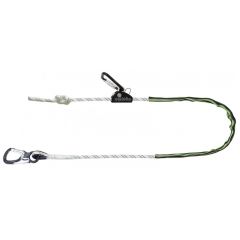

A 1.5m fixed-length restraint lanyard from Kratos Safety with 11mm polyamide kernmantle rope, steel scaffold hook, and steel snap hook, certified to EN 354:2010 with 22kN breaking strength.
- 22kN breaking strength: exceeds EN 354:2010 minimum requirement
- Steel scaffold hook: double-action FA 50 207 55, for scaffolding and structural steel
- Steel snap hook: double-action FA 50 202 17, for harness connection
- Visible stitch protection: transparent sleeve for pre-use inspection
- Abrasion-resistant thimble: protects loops from metallic contact
- Certification: EN 354:2010, UKCA marked
Kratos Restraint Kernmantle Rope Lanyard 1.5m - 22kN Steel Scaffold Hook and Snap Hook

A 1.5m fixed-length restraint lanyard from Kratos Safety with 11mm polyamide kernmantle rope, steel scaffold hook, and steel snap hook, certified to EN 354:2010 with 22kN breaking strength.
- 22kN breaking strength: exceeds EN 354:2010 minimum requirement
- Steel scaffold hook: double-action FA 50 207 55, for scaffolding and structural steel
- Steel snap hook: double-action FA 50 202 17, for harness connection
- Visible stitch protection: transparent sleeve for pre-use inspection
- Abrasion-resistant thimble: protects loops from metallic contact
- Certification: EN 354:2010, UKCA marked
- Buy 20 for £30.79 £25.66 each and save 7%
- Buy 50 for £28.27 £23.56 each and save 15%
| BULK DISCOUNT | 20 | 50 |
|---|---|---|
| Price | £25.66 £30.79 | £23.56 £28.27 |
Order 1x to earn 27 FASTPoints
Order to earn 27 FASTPoints
Log in to access trade discountsKratos Restraint Kernmantle Rope Lanyard 1.5m
The Kratos Restraint Kernmantle Rope Lanyard is a 1.5m fixed-length restraint lanyard designed to limit an operative's range of movement and prevent them reaching a fall hazard. It is not a fall arrest device. It is the correct specification for applications where the risk assessment confirms that, when the lanyard is correctly connected and tensioned, the operative physically cannot reach the fall hazard zone.
The 11mm polyamide kernmantle rope provides the flexibility and abrasion resistance suited to occasional and short-term restraint use. Steel connectors at both ends, a double-action scaffold hook for the anchorage connection and a double-action snap hook for the harness connection, provide robust gate security for site conditions where connector contact with scaffold tubes and steel structures is routine. The transparent covering sleeve over the sewn terminations keeps stitching visible for pre-use inspection under PUWER without removing any protective layer. Breaking strength exceeds 22kN, meeting EN 354:2010 requirements.
Why Choose the Kratos Restraint Kernmantle Rope Lanyard
-
22kN breaking strength: the EN 354:2010 minimum breaking strength requirement for restraint lanyards is 22kN. This lanyard meets that requirement, confirmed by the Kratos FA 40 503 XX technical data sheet. For procurement teams building a PUWER-compliant PPE register, the breaking strength figure at title level removes the need to cross-reference the specification table.
-
Steel scaffold hook and snap hook: both connectors use double-action gates requiring deliberate sequential movement to open. Steel construction provides greater resistance to deformation and gate damage from contact with scaffold tubes than aluminium alternatives, making this the more durable choice for regular site use.
-
Visible stitch protection: the transparent covering sleeve protects the sewn terminations while keeping them visible for pre-use inspection. This is the most important inspection point on any fixed-length rope lanyard and the feature that separates this product from basic lanyards with opaque end protection.
-
Abrasion-resistant thimble: fitted at both loops to protect the rope termination from wear caused by metallic contact at the connector connection point. On a lanyard used regularly against steel structures, the thimble is what extends the service life of the loop termination.
-
11mm kernmantle rope: the polyamide kernmantle construction provides good flexibility for clipping and unclipping during the working day, with a load-bearing core protected from abrasion and contamination by the outer braid. Kratos specifies 11mm kernmantle for occasional to short-term use, which is the typical usage pattern for a fixed 1.5m restraint lanyard.
What's Included
One Kratos 1.5m restraint kernmantle rope lanyard with steel double-action scaffold hook FA 50 207 55 at the anchorage end, steel double-action snap hook FA 50 202 17 at the harness end, abrasion-resistant thimbles at both loops, and transparent covering sleeve over sewn terminations.
Specifications
| Product name | Kratos Restraint Kernmantle Rope Lanyard 1.5m - 22kN Steel Scaffold Hook and Snap Hook |
| Product code | PP080025 |
| Kratos reference | FA 40 503 XX |
| Brand | Kratos Safety |
| Range | Essential |
| Lanyard type | Fixed-length restraint |
| Length | 1.5m |
| Rope construction | 11mm diameter polyamide kernmantle rope |
| Breaking strength | 22kN minimum |
| Anchorage connector | Steel double-action scaffold hook FA 50 207 55 |
| Harness connector | Steel double-action snap hook FA 50 202 17 |
| Loop protection | Abrasion-resistant thimble at both loops |
| Termination protection | Transparent covering sleeve for visible stitch inspection |
| Weight | 0.91kg |
| Certification | EN 354:2010 |
| HS code | 56090000 |
Compatibility
| Restraint to prevent access to fall hazard | ✓ Compatible |
| Scaffolding and structural steelwork | ✓ Compatible |
| Roof edge and elevated slab restraint | ✓ Compatible |
| Fixed ladder and mast access restraint | ✓ Compatible |
| Occasional and short-term use | ✓ Compatible |
| Use with full body harness | ✓ Required |
| Use as fall arrest device | ✗ Not suitable |
| Use where free fall is possible | ✗ Not suitable |
| Use without full body harness | ✗ Not suitable |
Who Is This For?
Construction operatives, scaffolders, roofers, and maintenance engineers who need to work near a fall hazard where the risk assessment confirms that a correctly connected and tensioned restraint lanyard will physically prevent access to the fall zone. Specified by safety managers where a full fall arrest system is not required because the hazard can be controlled entirely by limiting reach. The 1.5m fixed length is the standard specification for roof edge restraint, scaffold platform edge work, and elevated slab maintenance.
Typical Applications
-
Roof edge restraint where the anchor point is set back sufficiently to prevent the operative reaching the edge
-
Scaffold platform edge work where the operative is tethered to a fixed anchor within the platform
-
Elevated slab and terrace maintenance requiring a defined working zone
-
Fixed ladder and mast access where movement beyond a defined point must be restricted
-
Any application where the risk assessment confirms that restraint alone is sufficient and free fall cannot occur
How to Use
-
Confirm before starting that the anchor point position and lanyard length together prevent the operative reaching the fall hazard. Measure the distance from the anchor to the hazard edge. It must exceed the combined length of the lanyard plus the operative's reach.
-
Connect the steel snap hook to the lateral or dorsal D-ring of a certified full body harness as specified in the risk assessment. Confirm the gate is locked.
-
Connect the steel scaffold hook to the certified anchorage point. Confirm the double-action gate is fully closed and locked before moving away from the anchor.
-
Work within the defined restraint zone. The lanyard must remain taut against the anchor throughout the task. A slack lanyard does not provide restraint.
-
Never extend reach by leaning, stretching, or using tools to access beyond the restrained zone.
-
If the task requires moving to a position where the lanyard would go slack or where the fall hazard could be reached, the task must stop and the risk assessment must be reviewed. A restraint lanyard is not appropriate for that position.
RAPPEL: Lanyards without the energy absorber should never be used as a fall arrest system
How to choose?
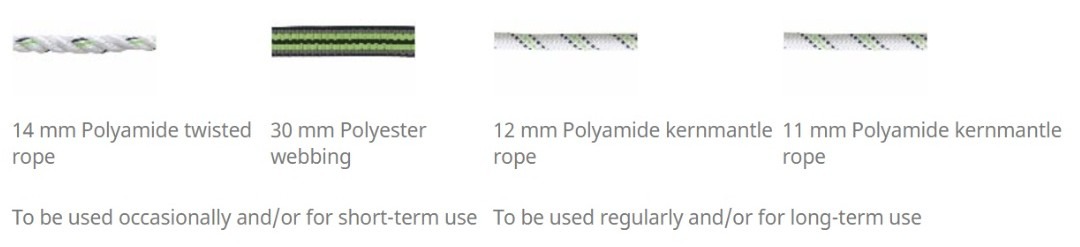
Whatever type of lanyard, the performances are identical, so it is above all a personal choice, but it must be based on the intensity of use.
When choosing the product it will be necessary to take into account the importance of connectors
Work positioning lanyard
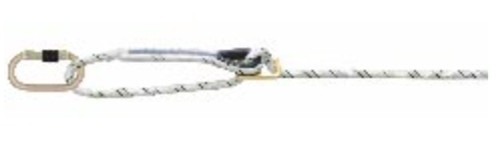
Lanyard with a ring type adjuster, used when the operator s position remains the same throughout the work to be done.
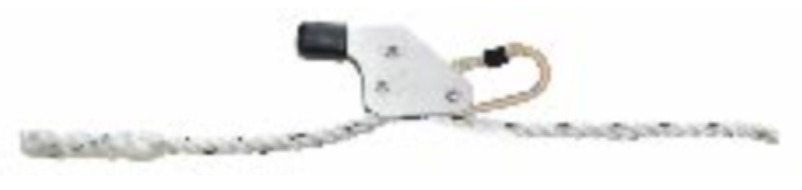
Lanyard with a progressive grip adjuster, used when the operator s position often changes throughout the work to be done.
Safety and Maintenance
Before every use:
-
Inspect the transparent sleeve at each termination to confirm stitching is fully intact and visible
-
Check the full rope length for cuts, abrasion, kinking, and contamination
-
Confirm both connector gates open, close, and lock correctly without stiffness
-
Confirm thimbles at both loops are in place and undamaged
-
Verify the anchor point position prevents access to the fall hazard before connecting
During use:
-
Never use as a fall arrest device
-
Never use where free fall is possible
-
Maintain tension in the lanyard throughout the task
-
Never connect both ends to the same structure in a loop configuration
After use and storage:
-
Clean with mild soap and warm water if contaminated, dry naturally away from heat
-
Store away from UV, chemicals, sharp objects, and heat sources
-
Annual formal inspection by a competent person required under PUWER
-
Withdraw from service if any stitching is damaged, rope fibres are visible, or connector function is compromised
Frequently Asked Questions
Q: What is EN 354:2010 and what does it require from a restraint lanyard?
A: EN 354:2010 is the current European standard for lanyards used as connection elements in restraint and work positioning systems. It requires a minimum breaking strength of 22kN for the complete assembly including connectors. It also specifies connector gate opening strength, loop termination requirements, and marking. On any UK construction site, restraint lanyards must meet EN 354:2010. The superseded 2002 version is no longer the current standard and products placed on the UK market should carry the 2010 certification.
Q: What is the difference between a restraint lanyard and a fall arrest lanyard?
A: A restraint lanyard limits the operative's range of movement to prevent them physically reaching a fall hazard. It works by keeping the operative tethered to an anchor point at a distance that makes the fall zone unreachable. It does not arrest a fall. A fall arrest lanyard, whether an energy absorbing lanyard or a retractable fall arrester, catches the operative if a fall occurs. The critical difference in practice is that a restraint system only works if the anchor point is positioned correctly. If the lanyard can go slack or the operative can reach the edge, the restraint system has failed and a fall arrest system is required instead.
Q: How do I confirm the anchor point is in the right position for restraint?
A: The total restrained distance from the anchor point to the fall hazard must exceed the combined length of the lanyard plus the operative's maximum reach in every direction they will move during the task. Measure from the anchor to the nearest fall hazard edge. That distance must be greater than 1.5m plus approximately 0.75m for outstretched reach, giving a minimum safe anchor setback of approximately 2.25m from the hazard edge for this lanyard. If the geometry cannot be achieved, restraint is not the appropriate control measure and a fall arrest system must be specified instead.
Q: Why does this lanyard use 11mm rope rather than 12mm?
A: Kratos specifies 11mm kernmantle rope for occasional and short-term use applications, and 12mm for regular and long-term use. A 1.5m fixed-length restraint lanyard is typically used for specific tasks where movement is limited and the lanyard is not under sustained load throughout the day. The 11mm rope provides the correct balance of flexibility and strength for this use pattern. Both diameters meet EN 354:2010 breaking strength requirements. If the lanyard will be in daily intensive use, consider the 12mm steel adjuster work positioning lanyard instead.
Q: Can this lanyard be used as a work positioning lanyard?
A: No. This is a fixed-length restraint lanyard certified to EN 354:2010. It has no adjustable element and cannot be set to a working position. A work positioning lanyard requires an adjuster mechanism to allow the operative to set their working distance from the structure and lean back against the lanyard. This lanyard is for restraint only. For work positioning, specify the Kratos Astra or the Kratos 12mm steel adjuster work positioning lanyard, both certified to EN 358:2018.
Q: What should I do if the transparent sleeve is damaged?
A: If the transparent sleeve is damaged to the point where the stitching at the termination cannot be fully seen, withdraw the lanyard from service before use. The sleeve's purpose is to protect the stitching while keeping it visible for inspection. If it is damaged or clouded, the pre-use inspection cannot be completed with confidence. Replace the lanyard before returning it to service.
Q: Why order from CMT Group?
A: CMT Group has supplied height safety PPE to UK construction sites since 2010, with a fleet of over 100 FORS Silver accredited vehicles covering 90% of the UK mainland. The Kratos Restraint Kernmantle Rope Lanyard is available for next working day delivery on orders placed by 7pm. CMT is a BSIF Registered Safety Supplier. Trade accounts, volume pricing, and EDGE portal access are available for safety managers and procurement teams ordering PPE across multiple projects.