Battery vs manual resin guns: which applicator is right for your anchoring work?
Most contractors own a manual resin gun. Most have also squeezed one to exhaustion halfway through a large anchoring job and wondered whether there is a better way. There is. This guide covers what actually separates battery and manual resin applicators, and helps you decide which is correct for the work you are doing.
View the Battery Resin Applicator Gun at CMT →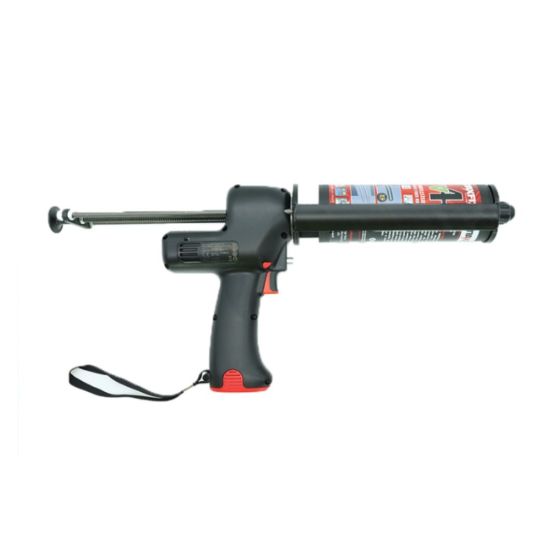
How chemical anchor resin guns actually work
Both battery and manual resin guns do the same mechanical job: they push a plunger through a two-component resin cartridge, forcing the resin components through a spiral mixing nozzle where they blend before emerging ready to dispense into a drilled hole. The mixing happens inside the nozzle, not inside the cartridge, which is why fitting a fresh nozzle and purging a short primer shot before each installation session matters.
What separates battery and manual guns is not what they do but how they generate the force to do it. A manual gun uses your hand. A battery gun uses a motor. That difference has direct consequences for output consistency, operator fatigue, installation speed, and the accuracy of the mixing ratio across a full working session.
The two-component resin cartridge
Chemical anchor resins are supplied in coaxial or side-by-side dual cartridges. The two components, resin and hardener, are stored separately and combine only when pushed through the mixing nozzle. The ratio at which they combine is critical: it is set by the relative diameters of the cartridge barrels and the nozzle geometry. For the ratio to be correct, the plunger must advance both barrels simultaneously and at a consistent rate. Any variation in plunger force can momentarily break the ratio and affect the cure characteristics of the mixed resin.
Before starting any anchor installation: Always dispense a short primer shot to waste after fitting a new mixing nozzle and before beginning work. The first portion of dispensed resin may not be correctly mixed. Dispensing this to waste confirms a uniform mixed colour before you apply resin to a fixing hole.
Manual resin guns: strengths and where they run into problems
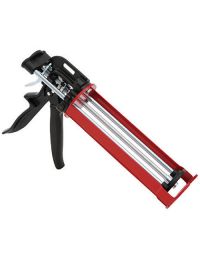
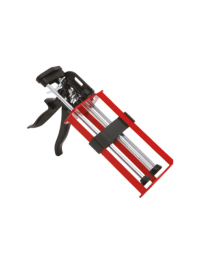
A manual resin gun is the standard tool for chemical anchor installation on UK construction sites. They are reliable, require no charging, need no battery management, and cost a fraction of a battery model. For the right volume and type of work, they are the correct choice.
Where a manual gun works well
- Low to medium volume installations of up to 15 to 20 anchors per session where hand fatigue is not a limiting factor
- Sites where access to charging is not available or practical
- Intermittent anchoring work where the gun may sit unused between sessions
- Contractors needing a lightweight, low-cost backup tool for occasional anchoring work
Where manual guns create problems
The limitation of a manual gun is built into its mechanism. The force that pushes the plunger through the cartridge comes entirely from the operator's hand. This creates three specific problems on higher-volume anchor work.
Fatigue changes trigger pressure
As hand and wrist fatigue accumulates across a session, trigger pressure reduces. Reduced pressure means slower plunger advance, which can alter the ratio of the two components passing through the nozzle. The consistency of the mixed output is not the same at fixing 40 as it was at fixing 1.
Viscosity increases at low temperatures
Chemical anchor resins become significantly stiffer at lower temperatures. In winter or in cold substrates, a manual gun can be extremely difficult to operate at a consistent rate. Battery-powered applicators maintain consistent motor force regardless of temperature.
High-viscosity resins are physically demanding
Vinylester resins are thicker than standard polyester formulations. Dispensing an entire 400 ml vinylester cartridge manually is genuinely tiring work. Contractors who do this regularly are accumulating repetitive strain load that compounds over a working career.
Repetitive strain and musculoskeletal risk: Sustained manual trigger operation of thick-viscosity resin cartridges generates significant repetitive force through the hand, wrist and forearm. On high-volume anchor installations, this is a recognised musculoskeletal risk. Battery-powered application removes the operator from this exposure.
Battery resin guns: what actually changes on-site
A battery-powered resin gun replaces hand force with a motor. The trigger activates the motor, which advances the plunger at a consistent rate regardless of operator fatigue, resin viscosity, or ambient temperature. The output is the same at fixing 60 as it was at fixing 1.
Manual applicator gun Standard
- Plunger force generated by hand and wrist
- Output rate varies with operator fatigue over a session
- Harder to operate in cold conditions with thick resin
- Sustained hand and wrist loading on high-volume work
- Lower purchase cost
- No battery management required
- Correct for low to medium volume work
Battery applicator gun 2026
- Motor-driven plunger force, consistent throughout session
- Output rate maintained from first to last fixing
- Consistent motor force regardless of resin viscosity
- Removes sustained hand and wrist loading
- Faster installation on high-volume anchor programmes
- Dosatron dosing for precise, repeatable output
- Correct for medium to high volume work
Overhead and confined space anchoring
Manual resin application overhead or in a confined space is particularly fatiguing. Holding a loaded 400 ml cartridge gun above shoulder height and maintaining consistent trigger pressure simultaneously is physically demanding. A battery gun, with its motor handling the plunger load, makes overhead anchoring significantly less demanding and allows the operator to focus on correct nozzle positioning and fill technique.
↑ Back to topWhat a dosatron dosing system does and why it matters
A dosatron system is a positive displacement dosing mechanism built into the gun's drive train. It controls the volume of resin dispensed with each trigger activation, independent of hand pressure variation. This is different from a standard battery gun that simply powers the plunger: a dosatron system actively controls output volume as part of its mechanical function.
Why this matters for anchor strength
Chemical anchor load ratings are based on the assumption that the resin was mixed at the correct ratio and dispensed without air voids or under-fill. A resin dispensed inconsistently may not meet those published values even if the hole was prepared correctly and the anchor was inserted within the open time.
A dosatron dosing system removes output variability from the equation. The resin exits the nozzle at a controlled, consistent rate on every trigger pull, which means the mixing nozzle receives consistent, even flow from both cartridge barrels throughout the installation session.
For engineer-specified anchors: Where an anchor has been designed by a structural engineer against published ETA or UKCA assessment data, consistent resin application is part of satisfying the design assumption. A dosatron-equipped battery gun provides a more defensible installation record than a manual applicator on these applications.
Which type is right for your job?
The correct choice depends on installation volume, resin type, working conditions, and whether consistency of output matters for the structural performance of the anchors being installed. Click any row for more detail.
| Scenario | Recommended type | Key reason |
|---|---|---|
| 1 to 15 anchors per session, standard conditions | Manual | Low volume, fatigue not a limiting factor, lower cost |
| 20 or more anchors per session | Battery | Fatigue accumulates and affects output consistency on manual guns |
| High-viscosity vinylester resin | Battery | Manual operation of thick resin cartridges generates significant hand loading |
| Cold conditions, winter working below 10°C | Battery | Resin viscosity increases at low temperature; consistent motor force maintains output rate |
| Overhead anchoring sustained for more than a few fixings | Battery | Motor handles plunger load; operator focuses on nozzle positioning and fill |
| Engineer-specified structural anchors | Battery with dosatron | Consistent output rate supports the mixing ratio assumptions in the anchor design |
| Occasional anchor work, infrequent use | Manual | No battery management required; simpler tool for low-frequency applications |
| Remote site with no charging access | Manual | No dependency on battery charge state; always ready to use |
| High-volume rebar dowel connection programme | Battery | Speed and consistency advantage compounds significantly across large programmes |
| Contractor pricing anchoring labour at fixed rate | Battery | Faster installation per anchor directly reduces labour cost on fixed-price work |
Getting chemical anchor installations right: the steps that matter
The choice of applicator gun is one factor in a correctly installed chemical anchor. The other factors apply regardless of whether a manual or battery gun is used.
Drill to the correct diameter and depth
The drill hole must match the resin manufacturer's specification for the anchor diameter. Too narrow and the anchor cannot be inserted to full embedment. Too wide and the resin volume is insufficient for the specified load.
Clean the hole correctly before dispensing
Blow out the hole with a compressed air pump, then brush with a wire brush sized for the hole diameter, then blow out again. This two-step sequence removes loose material and exposes clean substrate for resin bond.
Prime the nozzle before starting
After fitting a fresh mixing nozzle, dispense a short amount to waste until the mixed resin shows a uniform consistent colour. This purges the nozzle of any unmixed material from the start position.
Fill from the bottom up
Insert the nozzle to the base of the hole and apply resin whilst withdrawing the nozzle steadily as the hole fills. This eliminates the air pockets that form when resin is dispensed from the top down.
Insert the anchor within the open time
Insert the anchor element and set it to the correct depth before the open time window closes. Open time is temperature-dependent: shorter in warm conditions, longer in cold.
Do not disturb during cure
Do not move, load, or disturb the anchor until the full cure time has elapsed. Loading an anchor before full cure can displace it within the resin column before the bond has developed.
The CMT Battery Resin Tool Applicator Gun
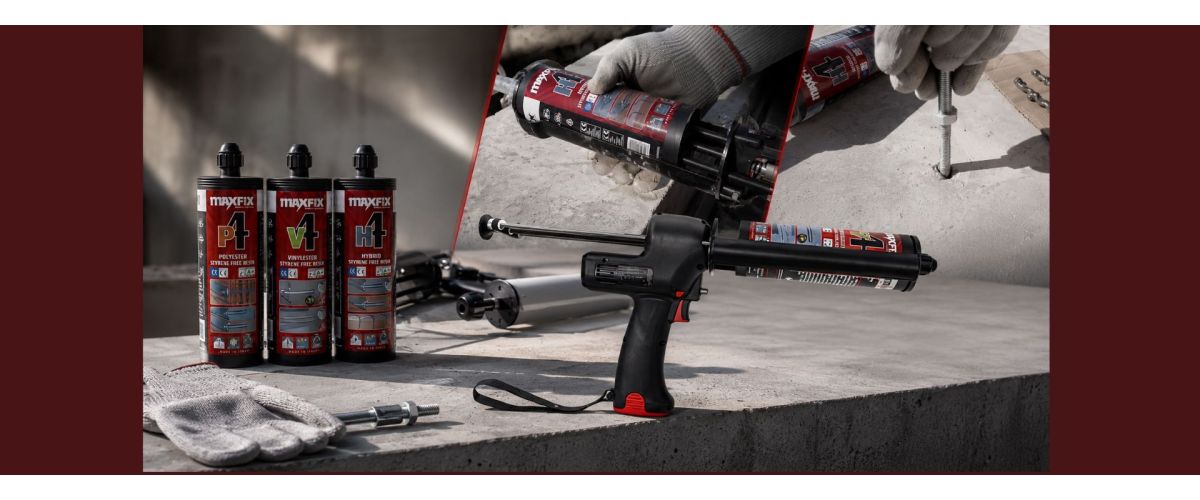
The CMT Battery Resin Tool Applicator Gun is a 7.2 V lithium-powered dispenser with a dosatron dosing system, designed for professional chemical anchor resin installation using 400 ml cartridges. The correct specification for contractors moving from manual application on medium to high-volume anchor work.
Battery Resin Tool Applicator Gun - 7.2 V and 400 ml
7.2 V lithium-powered resin dispenser with dosatron dosing system. Consistent, fatigue-free output for 400 ml chemical anchor cartridges. Supplied in a durable carry case.
- Dosatron dosing: precise, consistent resin output every trigger pull
- 7.2 V lithium battery: cordless operation, reduced operator fatigue
- Suitable for 400 ml chemical anchor cartridges
- Ergonomic balanced design for overhead and confined-space work
- Supplied in durable carry case for site transport and storage
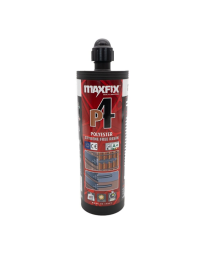
Compatible MAXFIX resin cartridges
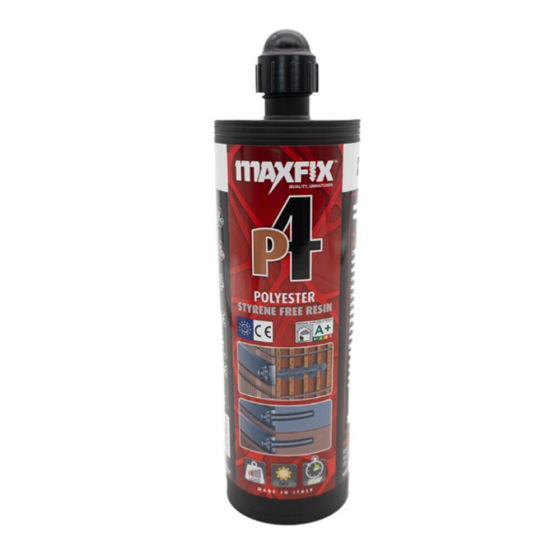
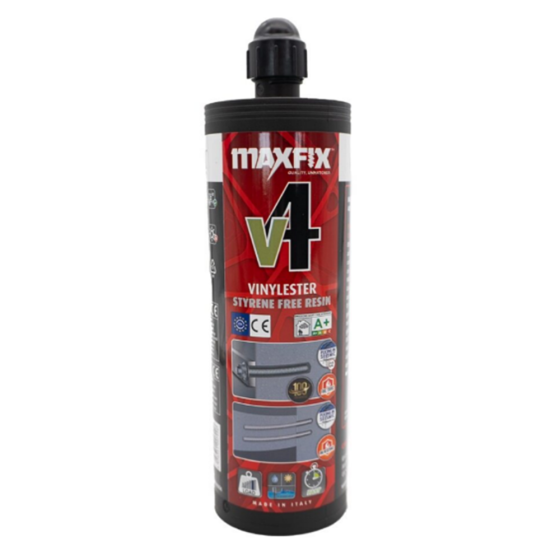
The Battery Resin Tool Applicator Gun is designed for use with MAXFIX 400 ml chemical anchor cartridges. All three variants below are compatible and cover the full range of fixing applications from general anchoring through to demanding structural and seismic-rated installations.