In this article
You ordered a drill bit set, reached for an M4 tap, and discovered the nearest available pilot size in your kit is 3.0mm or 4.0mm, not the 3.3mm you need. You used the 3.0mm, the tap bound, and the bit snapped. The set was cheap. The tap was not.
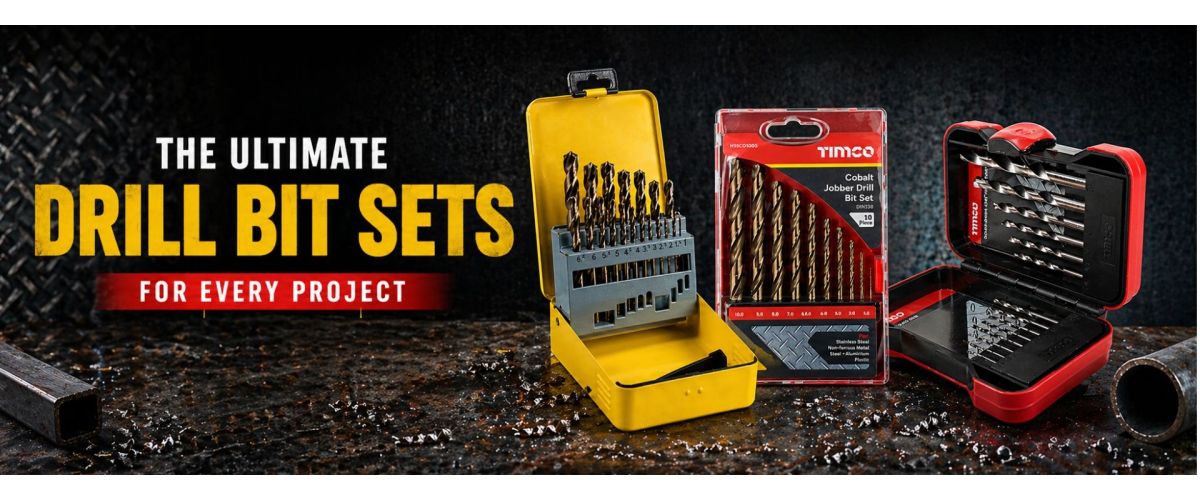
All three TIMCO HSS jobber drill bit sets run from 1.0mm to 10.0mm. On that basis alone, they look interchangeable. They are not. Steel grade, increment steps, and case construction separate them, and buying the wrong set for the application costs more in broken taps, wasted materials and rework than the price difference between any of them.
This guide explains what those differences actually mean, when each set is the correct specification, and which one belongs in a workshop, a site van, or a fabrication bay.
Why Most Buyers Specify the Wrong Drill Bit Set
Drill bit sets are routinely bought on piece count and price. Neither tells you how a set will perform or where it will fail. The three TIMCO HSS sets use different steel grades and different size increments, which means they are engineered for genuinely different applications.
Getting that wrong has a predictable sequence of consequences:
A 10-piece cobalt set and a 19-piece cobalt set use the same M35 grade steel. The increment steps are what separate them, and in a tapping operation, the wrong increment produces a broken tap every time.
What Actually Separates the Three Sets
Ignore piece count. These are the three specifications that determine which set belongs on which job:
Steel Grade
Standard HSS loses its edge under sustained heat. M35 cobalt HSS contains 5% cobalt, raising red hardness and keeping the tip intact through the heat generated by stainless steel and hard alloys. If the substrate is stainless, M35 is not optional.
Increment Steps
Metric tap pilot sizes are exact: 3.3mm for M4, 4.2mm for M5, 5.0mm for M6. A set with 1mm steps cannot produce those sizes. A set with 0.5mm steps covers all of them. For tapping or close-tolerance clearance work, this single specification determines whether the job is done correctly.
Case Construction
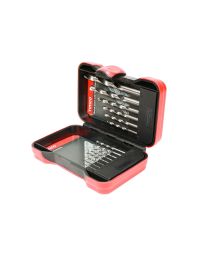
A metal carry case protects cobalt cutting edges from transit impact. A compact plastic case is the right trade-off for a site van or tool bag where weight and space matter more than long-term edge protection in storage.
Side-by-Side Specification
All three sets use DIN 338 geometry with a 135° split point. That is where the similarity ends. Hover any row to highlight it:
| Specification | 19-Piece Cobalt Best Overall | 10-Piece Cobalt | 15-Piece HSS |
|---|---|---|---|
| Product code | HSSCO19DS | HSSCO10DS | HSS15SET |
| Pieces | 19 | 10 | 15 |
| Range | 1.0mm – 10.0mm | 1.0mm – 10.0mm | 1.0mm – 10.0mm |
| Increment steps | 0.5mm | 1.0mm | Mixed |
| Steel grade | M35 cobalt HSS | M35 cobalt HSS | Standard HSS |
| Cobalt content | 5% | 5% | None |
| Stainless steel | Yes | Yes | Not recommended |
| Hard alloys | Yes | Yes | Not recommended |
| Full M2–M10 tap range | Yes | Gaps at 0.5mm sizes | Gaps at 0.5mm sizes |
| Case | Metal carry case | Plastic case | Plastic case |
| Point geometry | 135° split point | 135° split point | 135° split point |
| Standard | DIN 338 | DIN 338 | DIN 338 |
Each Set, Properly Explained
Three sets, three correct applications. Tap each card to expand the full specification and use case.
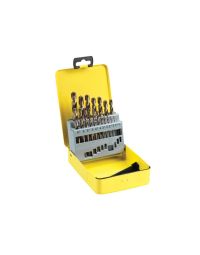
The 19-piece is the strongest option in the range for two reasons that work together: M35 cobalt grade and 0.5mm increments. M35 cobalt raises the material's red hardness, keeping the cutting tip intact at temperatures that would blunt a standard HSS bit on stainless steel within a few holes. The 0.5mm steps cover every metric tap pilot size from M2 through to M10, meaning the correct pilot diameter is always in the set and taps are not broken by improvisation.
The metal carry case is not cosmetic. It protects cobalt edges from transit damage and keeps all 19 bits indexed and retrievable under fabrication-bay conditions.
Best for: Fabricators, precision engineers, maintenance teams, tapping operations, stainless steel work, close-tolerance clearance drilling.
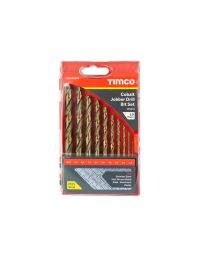
The 10-piece cobalt set carries the same M35 grade and the same 135° split point as the 19-piece. For the majority of construction site and installation tasks, it covers everything needed without the weight or bulk of the larger set. The ten sizes in 1mm steps from 1.0mm to 10.0mm handle the most common fixing clearance diameters, bracket holes, conduit entries and general metalwork a site fitter or mechanical contractor encounters in a working day.
Where the 10-piece earns its place over a standard HSS set is in its cobalt content. Stainless fixtures, hard alloy fasteners and structural steel components that would destroy standard HSS bits are handled without burning out. The compact plastic case keeps the set light and practical for a site van shelf or tool bag.
Best for: Contractors, site fitters, mechanical and electrical installation, maintenance engineers working with mixed metal substrates.
The 15-piece standard HSS set is built for drilling alloyed carbon and plain steel. Where the work is predominantly mild steel, carbon steel and standard alloys without stainless or hardened components, it delivers clean, accurate holes at a lower cost per set. The ground construction and 135° split point carry across from the cobalt sets, giving consistent DIN 338 geometry across all 15 sizes.
Without cobalt content, the bit will not sustain its edge through the heat that stainless generates. If the workshop occasionally sees stainless or hard alloys, step up to a cobalt set rather than burning through standard HSS bits on unsuitable material.
Best for: General workshop use, mild and carbon steel drilling, tradespeople who do not regularly work with stainless or hard alloys.
Shop the TIMCO HSS Range at CMT Group
Orders placed online by 7pm are dispatched for next working day delivery across UK mainland. Trade account holders access agreed pricing through the EDGE procurement portal.
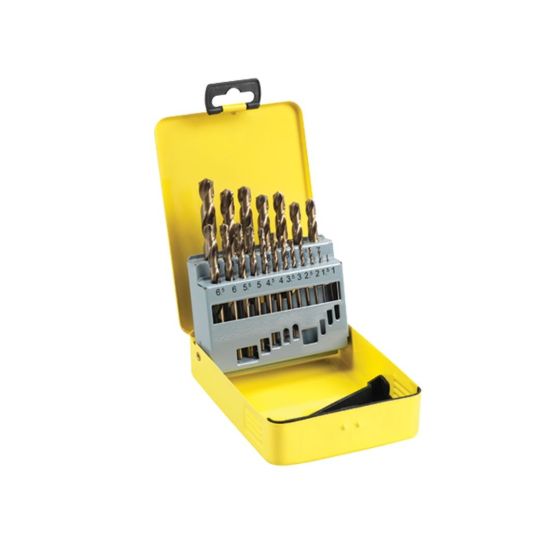
- M35 cobalt grade, 5% cobalt
- 0.5mm steps, full M2–M10 tap range
- Metal carry case
- Stainless steel and hard alloys
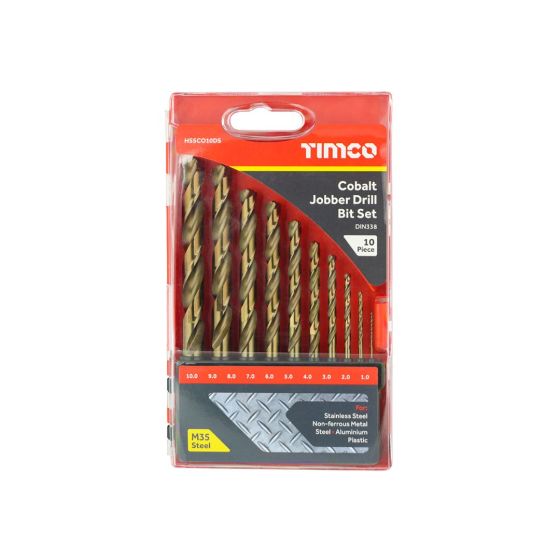
- M35 cobalt grade, 5% cobalt
- 1mm steps, compact plastic case
- 135° split point, self-centering
- Stainless steel and hard alloys
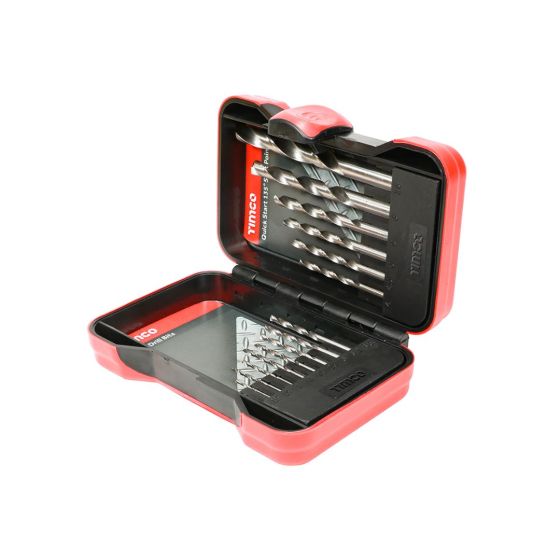
- Standard HSS grade
- 15 diameters, mixed increments
- Ground construction, DIN 338
- Mild steel and carbon steel
Three Questions That Settle the Decision
Answer these in order. The correct set follows from the answers, not from the piece count. Click each question to expand: