Vehicle Activated Signs: The Complete UK Guide
Everything construction site managers, local authorities, and traffic management teams need to know before specifying a VAS.
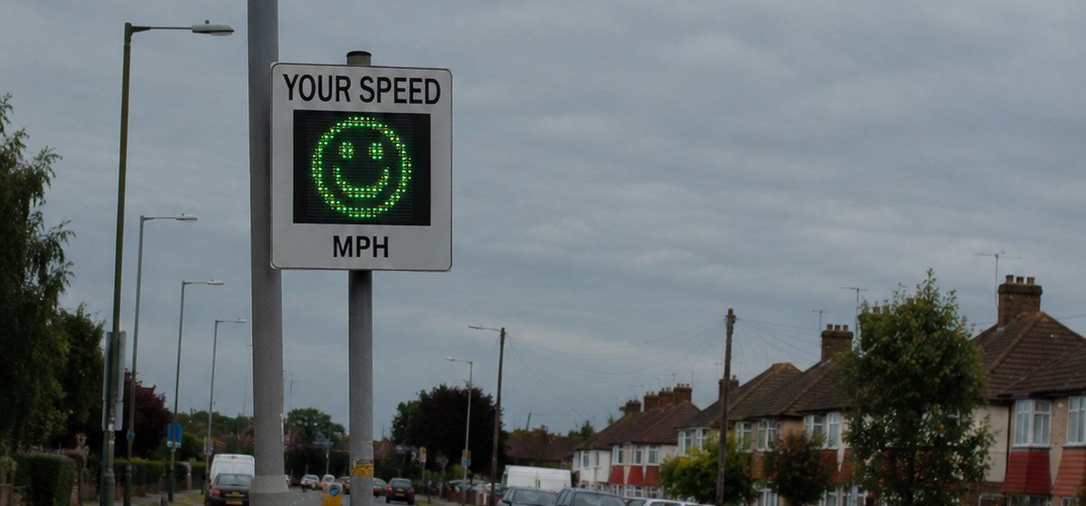
A vehicle activated sign deployed on a UK residential road, displaying a green smiley face to a compliant driver.
Speed-related incidents remain one of the leading causes of serious injury on UK construction sites and public roads. Traditional fixed signs are effective as background information but they do not respond to the driver in front of them. A vehicle activated sign does. It detects the approaching vehicle, measures its speed, and delivers an immediate, personalised response. That interaction is what makes VAS one of the most consistently effective traffic calming tools available to site managers and local authority teams.
This guide covers how vehicle activated signs work, where you can use them legally in the UK, how to choose between amber-only and multicolour models, what data recording means in practice, and how to specify and install them correctly.
What Is a Vehicle Activated Sign?
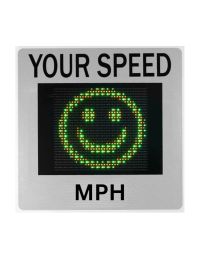
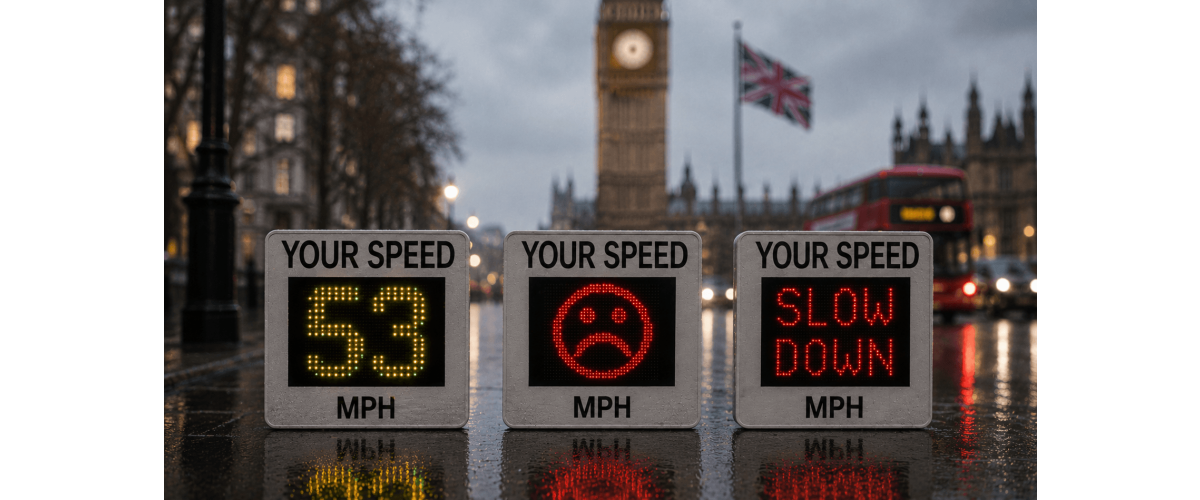
A vehicle activated sign, commonly abbreviated as VAS, is a radar-triggered LED display that detects the speed of an approaching vehicle and responds in real time. Unlike a static speed limit sign, a VAS only activates when a vehicle is present. When it does, it displays the vehicle's measured speed, a warning message, a symbol such as a smiley or frowning face, or a combination of all three.
In the UK, VAS are recognised within the Traffic Advisory Leaflet framework produced by the Transport Research Laboratory and are widely used by local authorities, parish councils, principal contractors, and facilities managers. They are classified as driver advisory systems and carry no enforcement powers. The data they collect and the speed reductions they produce form the basis on which authorities request further traffic calming, speed camera deployment, or speed limit reviews.
Key distinction: A vehicle activated sign is a driver advisory tool, not an enforcement device. It cannot be used to prosecute speeding motorists. However, the aggregated speed and volume data it produces is routinely submitted to police and highway authorities to support enforcement decisions and 20mph zone applications.
How Does a Vehicle Activated Sign Work?
The radar sensor transmits a continuous radio wave on the K-Band at 24 GHz across the road ahead. When a vehicle enters the detection zone, it reflects the wave back at a shifted frequency. The sensor calculates speed from this frequency shift, updating the display within approximately one second.
Detection ranges vary by vehicle size. Cars and vans are detected from 100 to 200 metres. HGVs and trucks are detectable from up to 300 metres due to their larger radar cross-section. The display then shows the relevant response: measured speed, a symbol, a text message, or a colour change depending on the model and threshold settings.
What is a multicolour VAS and why does it matter?
Research into driver response consistently shows that colour adds a second communication layer beyond the numeric speed value. A driver sees their speed and simultaneously receives a colour signal: green when acceptable, yellow when borderline, red when excessive. Adding smiley and frowning face symbols creates an emotional response layer on top. The combination produces a stronger and more sustained speed reduction than a numeric amber display alone.
Where Can You Use a VAS in the UK?
The answer depends on whether the road is public or private. These are two distinct categories in UK law with different permission requirements.
Public highway installation
On a public road, installation requires permission from the relevant highway authority. Parish and town councils must apply to their highway authority for approval and in some cases will need a Section 50 Road Opening Licence. Allow a minimum of ten working days for processing. VAS cannot be fixed to telegraph poles or concrete street lighting columns. A dedicated post, lamp post, or sign post is required.
Construction site and private road installation
On private roads, construction sites, quarries, ports, airports, and industrial estates, no highway authority approval is required. Under CDM Regulations 2015 and the Health and Safety at Work Act 1974, principal contractors have a legal duty to manage vehicle and pedestrian segregation on site. A Construction Traffic Management Plan is a condition of planning permission on most major projects. A VAS at a site entrance or haul road is a recognised and documentable measure within a CTMP.
Note for site managers: A Traffic Management Plan produced at project start and never updated is one of the most commonly cited compliance failures in HSE inspections. VAS deployment and speed threshold settings should be reviewed whenever site layout, access routes, or pedestrian routes change.
Amber vs Multicolour: Which VAS Should You Specify?
| Feature | Amber (single colour) | Multicolour (green / yellow / red) |
|---|---|---|
| Speed display | ✓ | ✓ |
| Smiley and frowning face symbols | ✓ | ✓ |
| Custom text messages | ✓ | ✓ |
| Colour-coded speed feedback | ✗ | ✓ |
| Integrated data recording | ✗ typically | ✓ up to 1.6M records |
| Browser-based data analysis | ✗ | ✓ |
| Cloud (4G) remote access | ✗ | ✓ |
| Suitable for authority reporting | Limited | ✓ full data export |
| Best suited for | Temporary or budget deployment | Permanent or data-required sites |
Power Supply Options
Modern VAS draw very little power. Active display consumption is less than 1W with standby draw below 0.1W, making multiple supply options practical.
- Solar: Reliable for most UK locations given the low active power draw. Avoid permanently shaded locations or positions under bridges where charge rates are insufficient.
- Battery: Suitable for short-term or mobile deployments. Optional twin-battery configurations extend operation between service visits.
- Mains power: Most reliable and lowest-maintenance option where a 12V supply is available. A qualified electrician must connect any incoming mains supply.
- Street lighting tap-off: Cost-effective for local authority installations adjacent to existing street lighting. Requires highway authority and lighting contractor coordination.
Data Recording: What It Means and Why It Matters
Data recording separates a display sign from a traffic monitoring tool. A VAS with integrated data recording stores every vehicle detection event with its measured speed, direction, time, and date. Over time this builds a dataset revealing speed distribution patterns, peak speeding periods, trend changes before and after interventions, and comparisons between locations.

For construction sites: Speed data provides objective evidence of driver behaviour for safety reports and incident investigations. If a threshold exceedance is linked to an incident, the data is contemporaneous and tamper-evident.
For local authorities: Aggregated speed and volume data is the primary evidence base for 20mph zone applications, speed camera requests, and speed limit reviews. A 24% reduction in peak speeds within one month of installation is a documented outcome from UK community deployments.
Leading models store up to 1.6 million traffic records onboard. On a busy road with 5,000 vehicle movements per day, that represents approximately 320 days of continuous data before any download is required. Access is via wireless app or browser dashboard with no additional software licence.
Installation: Key Considerations
- Permission: Confirm public or private road. Obtain highway authority approval before ordering for public highway deployment. Allow minimum ten working days.
- Location: Select a position with clear radar line of sight for at least 100 metres. Avoid locations where parked vehicles, vegetation, or road curvature interrupt the detection zone.
- Height and angle: Follow manufacturer guidance. K-Band sensors operate within a defined detection cone. Incorrect angle affects both range and accuracy.
- Post selection: Match your pipe clamp diameter to the post. Most VAS clamps cover 60 mm or 76 mm diameter posts.
- Power connection: For mains supply, use a qualified electrician. For solar and battery, follow the manufacturer's connection sequence.
- Configuration: Set speed thresholds, colour triggers, display messages, and time controls via the app. Test by driving past at known speeds before deployment.
- Method statement: Required for public highway installation under local authority licensing conditions.
Recommended Product
CMT Group supplies the GR36CL, a full-matrix multicolour LED vehicle activated radar speed sign that covers all specification requirements described in this guide.
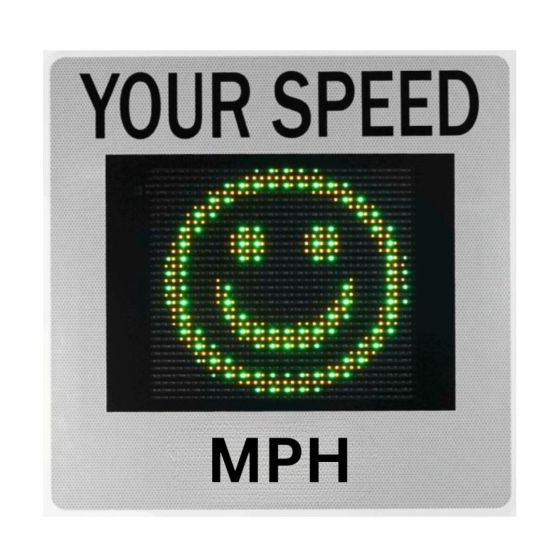
GR36CL Vehicle Activated Radar Speed Sign
Full-matrix multicolour LED VAS with integrated data recording, CE approved K-Band radar, and wireless configuration via STerminal 3 app. IP67 rated, 4 kg, under 1W active power.