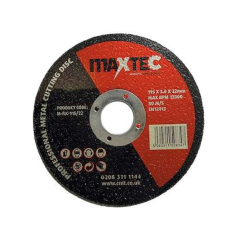
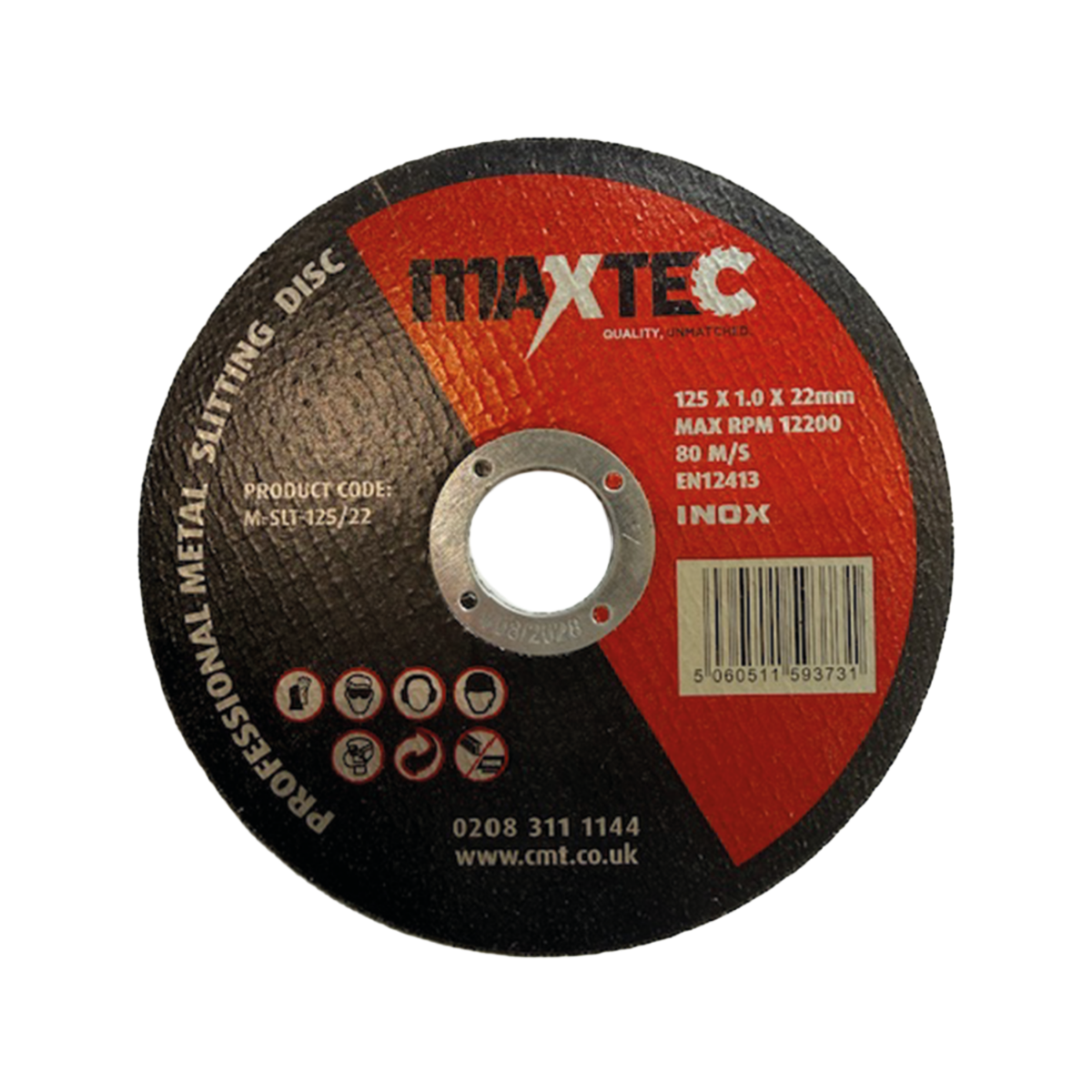
A Type F41 fine-grain cut-off wheel with a contamination-free bond, designed for clean, low-burr slitting of stainless and high-grade steel on angle grinders and cut-off machines.
- Iron, sulphur, and chlorine free: no stainless cut face contamination
- A60TBF fine grain, 2A reinforcement: cleaner edge, less heat and burr
- Thickness: 1.0mm (115/125mm variants), 1.85mm (230mm variant)
- Max speed: 80 m/s, up to 13,300rpm on the 115mm disc
- Sizes: 115mm, 125mm, and 230mm, 22.23mm bore throughout
- Compatibility: angle grinders and cut-off machines, 22.23mm arbor
- Standard: EN 12413, ISO 6103 and ISO 13942
MAXTEC Thin Metal Slitting Disc - Low-Burr Stainless Steel Cutting Wheel

A Type F41 fine-grain cut-off wheel with a contamination-free bond, designed for clean, low-burr slitting of stainless and high-grade steel on angle grinders and cut-off machines.
- Iron, sulphur, and chlorine free: no stainless cut face contamination
- A60TBF fine grain, 2A reinforcement: cleaner edge, less heat and burr
- Thickness: 1.0mm (115/125mm variants), 1.85mm (230mm variant)
- Max speed: 80 m/s, up to 13,300rpm on the 115mm disc
- Sizes: 115mm, 125mm, and 230mm, 22.23mm bore throughout
- Compatibility: angle grinders and cut-off machines, 22.23mm arbor
- Standard: EN 12413, ISO 6103 and ISO 13942
MAXTEC Thin Metal Slitting Disc - Low-Burr Stainless Steel Cutting Wheel
The MAX Thin Metal Slitting Disc is a Type F41 A60TBF cut-off wheel designed for clean, precise slitting of stainless steel, mild steel, sheet steel, and high-grade steel. At 1.0mm thick on the 115mm and 125mm variants, it removes less material per cut than a standard 3mm cutting disc, generates significantly less heat at the cut face, and leaves an edge that requires minimal dressing before welding or surface finishing. For fabricators, pipework contractors, and sheet metal workers who need a contamination-free cut on stainless and duplex steels, this disc is built around the specific demands of that application.
Why choose the MAXTEC Thin Metal Slitting Disc
-
Iron, sulphur, and chlorine free bond: these three contaminants are the primary cause of corrosion initiation and weld porosity on stainless steel cut faces. Eliminating them from the bond formulation is not optional on quality-critical stainless work, it is a specification requirement on most fabrication contracts.
-
A60TBF fine grain abrasive: the finer A60 aluminium oxide grain produces a cleaner cut edge with less tearing and a reduced heat-affected zone compared to the A30 grain used in standard cutting discs. This matters on thin-gauge stainless where warping and heat discolouration are a genuine risk.
-
1.0mm cutting thickness on 115mm and 125mm variants: at one third the thickness of a standard 3mm disc, the slitting wheel removes less kerf material, cuts faster through thin sections, and generates less friction heat along the cut line.
-
2A fibreglass reinforcement: two layers of woven fibreglass give the disc lateral stability despite its thin profile, resisting deflection and reducing fracture risk during straight cuts on tube, pipe, and sheet.
-
80 m/s rated across all sizes: all three variants operate within the speed envelope of standard professional angle grinders, with no speed-matching complications when switching between disc sizes on the same tool.
-
EN 12413 manufacture with ISO-controlled quality: unbalance tested to ISO 6103 and run-out controlled to ISO 13942, meeting the dimensional and rotational accuracy required for safe operation at professional cutting speeds.
-
Consistent cost-per-cut performance: the A60TBF grade and bond density are calibrated to maximise disc life on thin and medium-gauge steel sections, keeping disc consumption predictable on high-volume slitting work.
What's Included
- One MAX Thin Metal Slitting Disc in the selected size variant (115mm, 125mm, or 230mm)
Specifications
| Specification | Detail |
|---|---|
| Product Name | MAX Thin Metal Slitting Disc - Low-Burr Stainless Steel Cutting Wheel |
| Product Code | M-SLT |
| Type | F41 (Flat / Type 41 Cut-Off Wheel) |
| Grade | A60TBF |
| Abrasive | Aluminium Oxide (Corundum), Fine Grain |
| Reinforcement | 2A (Double Fibreglass) |
| Form | Cut-Off Wheel / Slitting Disc |
| Max Peripheral Speed | 80 m/s |
| Bond Composition | Free from Iron, Sulphur, and Chlorine |
| Standard | EN 12413 |
| Unbalance Control | ISO 6103 |
| Run-Out Tolerance | ISO 13942 |
| Code | Size (Dia x Thick x Bore) | Max RPM | Weight | Min Deconstruction Speed | Run-Out Tolerance |
|---|---|---|---|---|---|
| M-SLT-115/22 | 115 x 1.0 x 22.23 mm | 13,300 rpm | 24g (+/-2g) | 23,000 rpm | 0.6 mm |
| M-SLT-125/22 | 125 x 1.0 x 22.23 mm | 12,200 rpm | 27g (+/-5g) | 21,000 rpm | 0.6 mm |
| M-SLT-230/22 | 230 x 1.85 x 22.23 mm | 6,600 rpm | 164g (+/-2g) | 15,500 rpm | 1.0 mm |
Compatibility
| Material | Status |
|---|---|
| Stainless Steel | ✓ Compatible |
| Mild Steel | ✓ Compatible |
| High-Grade Steel | ✓ Compatible |
| Sheet Steel | ✓ Compatible |
| Alloy Steel | ✓ Compatible |
| Steel Pipe & Tube | ✓ Compatible |
| Stone / Masonry | ✗ Not Recommended |
| Aluminium | ✗ Not Recommended |
| Cast Iron | ✗ Not Recommended |
Who Is This For?
The MAXTEC Thin Metal Slitting Disc is aimed at fabricators, pipework contractors, sheet metal workers, and mechanical and engineering trades who regularly cut stainless steel, thin-gauge sheet steel, and high-grade steel sections. It is particularly suited to work where cut face quality matters before welding, polishing, or surface treatment, and where contamination from iron, sulphur, or chlorine in a standard disc bond would compromise the finished result. This is a professional specification disc for trades where the quality of the cut edge is as important as the speed of the cut.
Typical Applications
-
Slitting and cutting stainless steel tube, pipe, and bar in pipework and mechanical installations
-
Cutting thin-gauge stainless sheet for fabrication, cladding, and architectural metalwork
-
Cutting mild and high-grade steel sections where a clean, low-burr edge is required before welding
-
Trimming stainless steel kitchen equipment, catering installations, and food-grade fabrications
-
Cutting alloy steel components in engineering and manufacturing environments
-
Slitting steel strip and profile sections on fabrication benches
-
Detail cutting in confined spaces where a thin disc profile reduces the risk of fouling adjacent surfaces
How to Use
-
Select the correct disc variant for your angle grinder spindle size, confirming the 22.23mm bore matches your tool's arbor and that the tool's maximum RPM does not exceed the disc's rated operating speed for the selected variant.
-
Fit the disc with the correct guard in place. Ensure the flanges seat flat against both disc faces and the locking nut is tightened to the tool manufacturer's specification.
-
Inspect the disc visually before use for chips, cracks, or delamination. Do not use a disc showing any sign of damage, particularly on a 1.0mm slitting disc where edge integrity is critical.
-
Run the disc at full operating speed for at least 30 seconds before making contact with the workpiece, observing from the side.
-
Apply steady, light forward pressure along the cut line. A 1.0mm slitting disc requires less forward force than a standard cutting disc. Forcing the disc increases heat, deflection risk, and the likelihood of disc fracture.
-
Keep the cut line straight throughout the operation. Do not twist or lever the disc laterally in the cut.
-
On stainless steel, keep cuts short and allow the disc to cool between passes on thicker sections to avoid heat discolouration of the cut face.
-
After use, remove the disc from the tool and store flat in a dry environment away from impact risk.
Safety and Maintenance
Safety during use:
-
Eye protection is mandatory: use approved safety goggles or a full face shield to EN 166. A 1.0mm disc generates high-velocity fine particles and sparks across a wide arc during cutting.
-
Wear cut-resistant gloves to EN 388. The thin disc profile makes careful handling essential during fitting and removal.
-
Hearing protection to EN 352 is required. Angle grinders operating at cutting speeds consistently exceed 85dB(A).
-
Respiratory protection: cutting stainless steel generates fine metallic dust and fume classed as a respiratory irritant. Wear a minimum FFP2 mask to EN 149 where local exhaust ventilation is not in place. Prolonged exposure to stainless steel grinding dust warrants FFP3 protection.
-
Never exceed the maximum operating RPM for the selected disc variant. Over-speeding a 1.0mm slitting disc is particularly hazardous due to the reduced material cross-section.
-
Do not use this disc for grinding or side-loading operations. It is a cut-off wheel for straight slitting cuts only.
-
The Abrasive Wheels Regulations 1970, as incorporated into PUWER 1998, require that abrasive wheels are only mounted and operated by trained and appointed persons.
After use and storage:
-
Inspect the disc after each use for edge chips, cracks, or delamination of the fibreglass reinforcement layers.
-
Store discs flat in a dry, stable-temperature environment. The 1.0mm profile is particularly susceptible to warping if stored under pressure or in damp conditions.
-
Do not stack objects on top of stored slitting discs.
-
Dispose of worn or damaged discs as general factory waste in line with site waste management procedures.
Frequently Asked Questions
Q: Why does it matter that this disc is free from iron, sulphur, and chlorine when cutting stainless steel?
A: Stainless steel derives its corrosion resistance from a chromium oxide passive layer on the surface. Iron contamination from an abrasive bond embeds ferrous particles into the cut face, which corrode and break down that passive layer, leading to rust spotting and surface degradation. Sulphur and chlorine cause similar damage and can initiate stress corrosion cracking in certain stainless grades. On any stainless application where surface integrity, hygiene, or corrosion resistance matters, a contamination-free disc is a specification requirement, not a preference.
Q: What does EN 12413 mean and why does it matter on a UK site?
A: EN 12413 is the harmonised European standard for bonded abrasive products, covering safety requirements for the manufacture of resin-bonded cutting and grinding wheels. A disc manufactured to EN 12413 has been made to controlled specifications for dimensional accuracy, maximum operating speed, and structural integrity. For UK site use, specifying EN 12413 certified discs supports compliance with the Abrasive Wheels Regulations under PUWER 1998 and strengthens your risk assessment and method statement documentation.
Q: What is the difference between the A60TBF grade on this disc and the A30RBF grade on a standard cutting disc?
A: The key difference is grain size. A60 is a finer aluminium oxide grain than A30, which produces a cleaner cut edge with less tearing and a smaller heat-affected zone. The finer grain cuts with less aggressive material removal per pass, which is exactly what you need on thin-gauge stainless or high-grade steel where a rough cut edge requires additional dressing. The trade-off is that A60 discs wear faster on heavy structural sections, which is why the standard A30RBF disc remains the better choice for bulk cutting of mild and structural steels.
Q: Can I use the 230mm variant on the same angle grinder as the 115mm or 125mm variants?
A: Only if your angle grinder is rated for 230mm discs and fitted with the correct 230mm guard. Many 115mm and 125mm angle grinders are not designed to accept a 230mm disc, and fitting a larger disc to an undersized tool is a serious safety risk. Always verify your tool's maximum disc diameter and RPM rating before changing disc size.
Q: Is this disc suitable for cutting duplex or super duplex stainless steel?
A: The contamination-free bond formulation makes this disc suitable for duplex stainless grades from a contamination perspective. However, duplex and super duplex stainless steels are significantly harder than standard austenitic grades and will wear the disc faster. For high-volume cutting of duplex grades, contact CMT's trade team for specific product guidance before committing to a disc specification.
Q: How does the 1.0mm thickness affect cut quality compared to a standard 3mm cutting disc?
A: A thinner disc removes less material per cut, generates less friction, and cuts faster through thin sections. The reduced cross-section also means less heat input at the cut face, which directly reduces discolouration on stainless steel and minimises the heat-affected zone before welding. The trade-off is that the 1.0mm disc has less abrasive material available and will wear faster on heavy or repeated cuts through thick sections than a standard 3mm disc.
Q: Can this disc be used with coolant or cutting fluid?
A: No. This disc is designed for dry cutting operations only. Applying coolant or water to a resinoid bonded abrasive disc degrades the bond and compromises disc integrity. On stainless steel where heat discolouration is a concern, manage heat by keeping individual cuts short and allowing cooling time between passes rather than applying liquid coolant.
Q: How should slitting discs be stored to prevent damage before use?
A: Store discs flat in a dry environment at a stable temperature, away from direct sunlight, moisture, and sources of vibration or impact. The 1.0mm profile is particularly vulnerable to warping if stored vertically under its own weight for extended periods or in conditions of fluctuating humidity. Inspect every disc visually before fitting, even if stored correctly, as handling damage is not always obvious until the disc is examined closely.
Q: Why should I order from CMT Group rather than a general tool merchant?
A: CMT Group has supplied construction and industrial sites across the UK since 2010, operating a fleet of over 100 FORS Silver accredited vehicles covering 90% of the UK mainland. Orders placed online by 7pm qualify for next working day delivery, and a VIP dedicated delivery service dispatched within 30 minutes is available UK-wide for urgent site requirements. CMT's EDGE procurement portal gives construction buyers agreed contract pricing, role-based spending controls, and live delivery tracking with What3Words integration, removing the admin overhead from repeat consumable ordering.