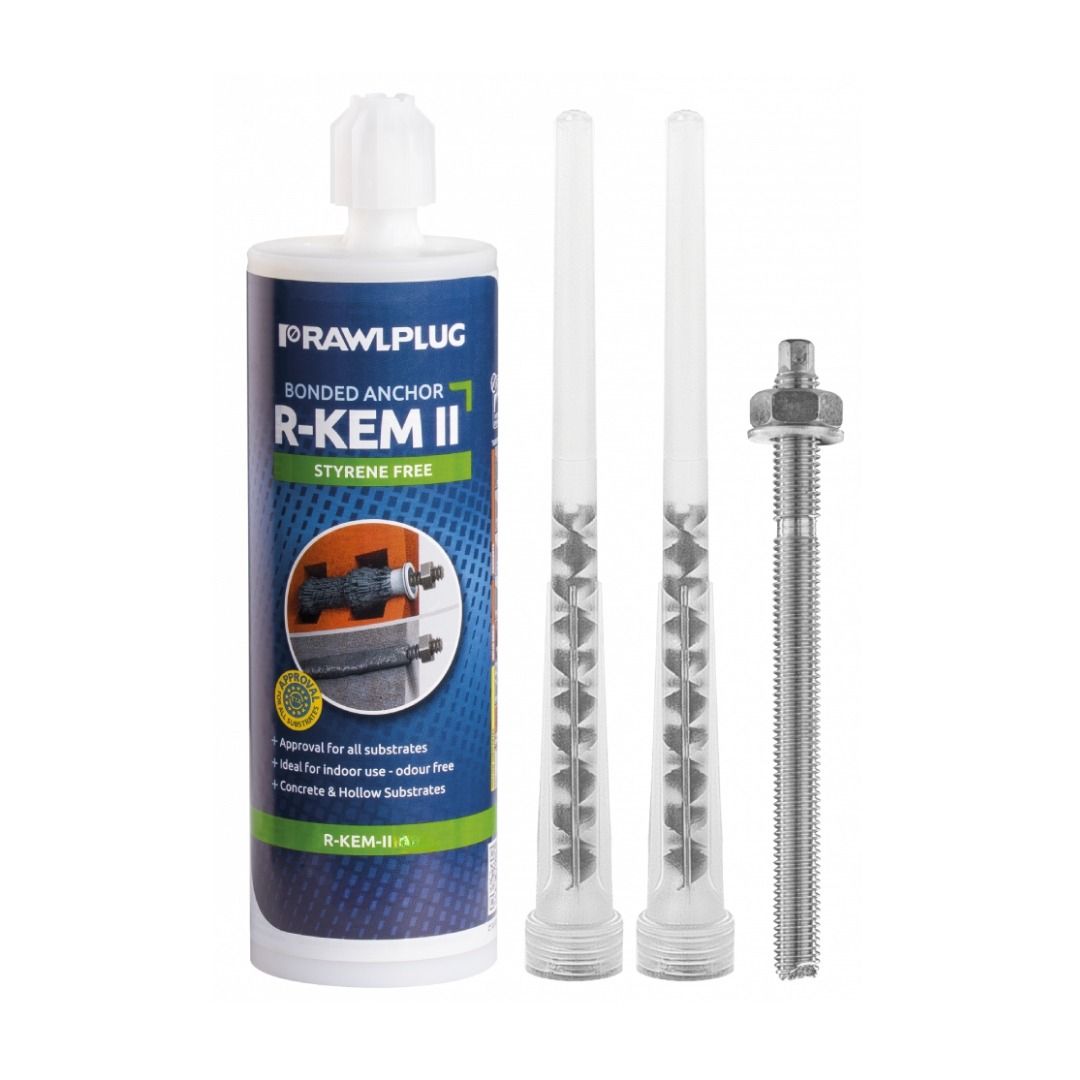

Styrene free polyester bonded anchor resin for general purpose fixing into non-cracked concrete and masonry, suitable for construction, groundwork, and renovation applications.
- ETA approved for 15 substrates, non-cracked concrete C20/25-C50/60 and natural stone
- Styrene free, low odour, suitable for indoor use and confined spaces
- Working life up to 100 years
- CE and UKCA marked, BBA approved
- Reusable, partial cartridges resealed with a new nozzle
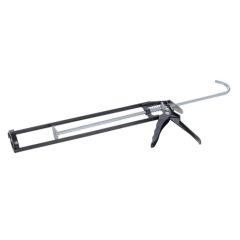
- Compatible with standard silicone gun, manual dispensing gun, and electric gun
Rawlplug R-KEM II Styrene Free Polyester Resin

Styrene free polyester bonded anchor resin for general purpose fixing into non-cracked concrete and masonry, suitable for construction, groundwork, and renovation applications.
- ETA approved for 15 substrates, non-cracked concrete C20/25-C50/60 and natural stone
- Styrene free, low odour, suitable for indoor use and confined spaces
- Working life up to 100 years
- CE and UKCA marked, BBA approved
- Reusable, partial cartridges resealed with a new nozzle
- Compatible with standard silicone gun, manual dispensing gun, and electric gun
Rawlplug R-KEM II Styrene Free Polyester Resin - Non-Cracked Concrete and Masonry
Styrene free polyester bonded anchor resin approved for general purpose fixing into non-cracked concrete, masonry, and natural stone across construction, groundwork, and renovation environments. European Technical Assessment for 15 substrates, CE and UKCA marked, and BBA approved, with a confirmed working life of up to 100 years under EAD 330499-01-0601. The styrene free formulation produces no styrene odour during installation, making it suitable for indoor use, confined spaces, and repeatedly occupied buildings where solvent smell from conventional polyester resins creates compliance and occupancy issues.
How a styrene free formulation changes what sites this anchor resin can go into
Conventional polyester resins contain styrene as a reactive diluent, which releases a strong chemical odour during curing. In occupied buildings, confined plant rooms, basements, stairwells, and internal fit-out environments, that odour forces either building evacuation or delayed installation, both of which add cost and programme time to the fixing package. Styrene free polyester eliminates the reactive diluent without compromising the resin chemistry, producing negligible odour during curing and allowing installation to proceed without evacuation or restricted access. The result is a general purpose anchor resin that can be used across the full range of construction environments without the site management overhead that conventional polyester creates.
Key Features
-
Styrene free, low odour formula: No styrene content means no reactive chemical odour during curing. Suitable for confined spaces, occupied buildings, internal fit-out, and any environment where solvent odour would require evacuation or restrict access to adjacent areas.
-
ETA approved for 15 substrates: European Technical Assessment under ETA-17/0394 and ETA-17/0528 covers non-cracked concrete C20/25-C50/60 and a wide range of solid and hollow masonry structures. Natural stone approval available after site pull-out testing confirms suitability.
-
100-year working life: Approved under EAD 330499-01-0601 with a confirmed working life of up to 100 years in non-cracked concrete, relevant for structural fixings where long-term anchor integrity is specified.
-
Reusable cartridge: A partly used cartridge can be resealed and reused after fitting a new nozzle. Reduces waste on multi-phase projects where fixing work is carried out in stages.
-
Patented self-opening system: Compatible with standard manual silicone guns and electric dispensing guns via the self-opening cartridge system. No additional adapters required for standard gun use.
-
BBA and VOC certified: British Board of Agrément approval alongside Rawlplug VOC emission and hygienic certification, supporting specification on projects with environmental or indoor air quality requirements.
Who Is This For
Trades and roles:
-
Groundworkers and concreters
-
Fixings and anchoring contractors
-
Structural engineers and site managers
-
Renovation and refurbishment contractors
-
Facilities managers and maintenance teams
-
Civil engineering operatives
Industries:
-
Construction and groundworks
-
Civil engineering
-
Facilities management and building maintenance
-
Residential and commercial renovation
-
Infrastructure and utilities
-
Industrial fit-out and plant installation
Specifications
| Specification | Detail |
|---|---|
| Product name | Rawlplug R-KEM II Styrene Free Polyester Resin |
| Parent SKU | R-KEM-II |
| Product type | Styrene free polyester bonded anchor resin |
| ETA option | Option 7 — non-cracked concrete and wide range of solid and hollow masonry structures |
| ETA references | ETA-17/0394 and ETA-17/0528 |
| EAD reference | EAD 330499-01-0601 (non-cracked concrete approval) |
| Substrate approval scope | 15 substrates |
| Primary substrates | Non-cracked concrete C20/25-C50/60, solid and hollow masonry structures |
| Natural stone | Approved after site pull-out testing confirms suitability |
| Concrete classification | Non-cracked concrete only — not approved for cracked concrete |
| Working life | Up to 100 years (non-cracked concrete) |
| Styrene free | Yes — low odour, suitable for indoor use and confined spaces |
| Dispensing compatibility | Standard manual silicone gun (SEAL01), manual dispensing gun (MET410), electric gun |
| Reusable | Yes — partially used cartridge can be resealed with a new nozzle |
| Certifications | CE, UKCA, BBA (British Board of Agrément), VOC emission tested, Hygienic Certificate, 100-year working life certification |
| Compound colour | Standard, stone, grey |
Compatibility
| Application or condition | Status |
| Non-cracked concrete C20/25-C50/60 | ✓ Approved — ETA Option 7 |
| Solid masonry (brick, block, stone) | ✓ Approved — ETA Option 7 |
| Hollow masonry (with mesh sleeve) | ✓ Approved — ETA Option 7 |
| Natural stone | ⚠ Approved after site pull-out testing confirms suitability |
| Indoor and confined spaces | ✓ Suitable — styrene free, low odour formula |
| Wet holes | ✓ Suitable — excluding sea water |
| Cold weather installation from -20°C | ✓ Suitable — winter version required |
| Cracked concrete | ✗ Not approved — ETA Option 7 covers non-cracked only |
| Overhead fixings in critical applications | ✗ Not recommended — use vinylester or epoxy for critical overhead use |
| Seawater environments | ✗ Not suitable for wet holes containing sea water |
| Diamond drilled holes | ✗ Not approved — use epoxy resin for diamond drilled applications |
Who Is This For
This bonded anchor resin is used primarily by fixings contractors, groundworkers, and structural operatives carrying out general purpose anchor installation into non-cracked concrete and masonry on UK construction and renovation sites. It is equally suited to facilities managers and maintenance teams carrying out fixing work inside occupied or partially occupied buildings, where the styrene free, low-odour formulation allows installation without evacuating adjacent areas. Site managers and structural engineers specifying bonded anchors for medium load applications in non-cracked concrete will find the ETA approval for 15 substrates, BBA certification, and 100-year working life directly relevant to their specification documentation.
Typical Applications
-
Installing threaded rods into non-cracked concrete bases and walls for equipment mountings, structural steel connections, and medium-load fixings on construction sites.
-
Fixing anchor bolts into masonry for balustrade base plates, handrail posts, and façade support brackets where mechanical anchors are not suitable due to edge distance constraints or substrate condition.
-
Post-installed rebar connections into non-cracked reinforced concrete for structural repair, extension, and reinforcement works.
-
Fixing window frames, door frames, and structural brackets into solid and hollow block masonry during building construction and renovation.
-
General purpose anchor installation inside occupied buildings, plant rooms, basements, and confined spaces where the low-odour styrene free formula removes the need for evacuation or forced ventilation during curing.
-
Cold weather fixing operations using the winter version, covering installation from -20°C in unheated structures or outdoor groundwork during winter months.
-
Fixing into natural stone substrates on heritage and renovation projects, following site pull-out testing to confirm suitability before commencing install
Common Mistakes
-
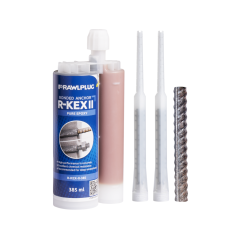
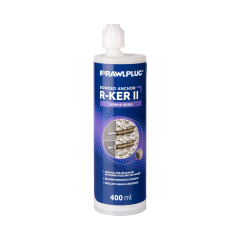
Using in cracked concrete: polyester resin is approved under ETA Option 7 for non-cracked concrete only. Using it in cracked concrete voids the approval and creates an unverified fixing. Specify the R-KER II hybrid or R-KEX II epoxy resin for cracked concrete applications.
-
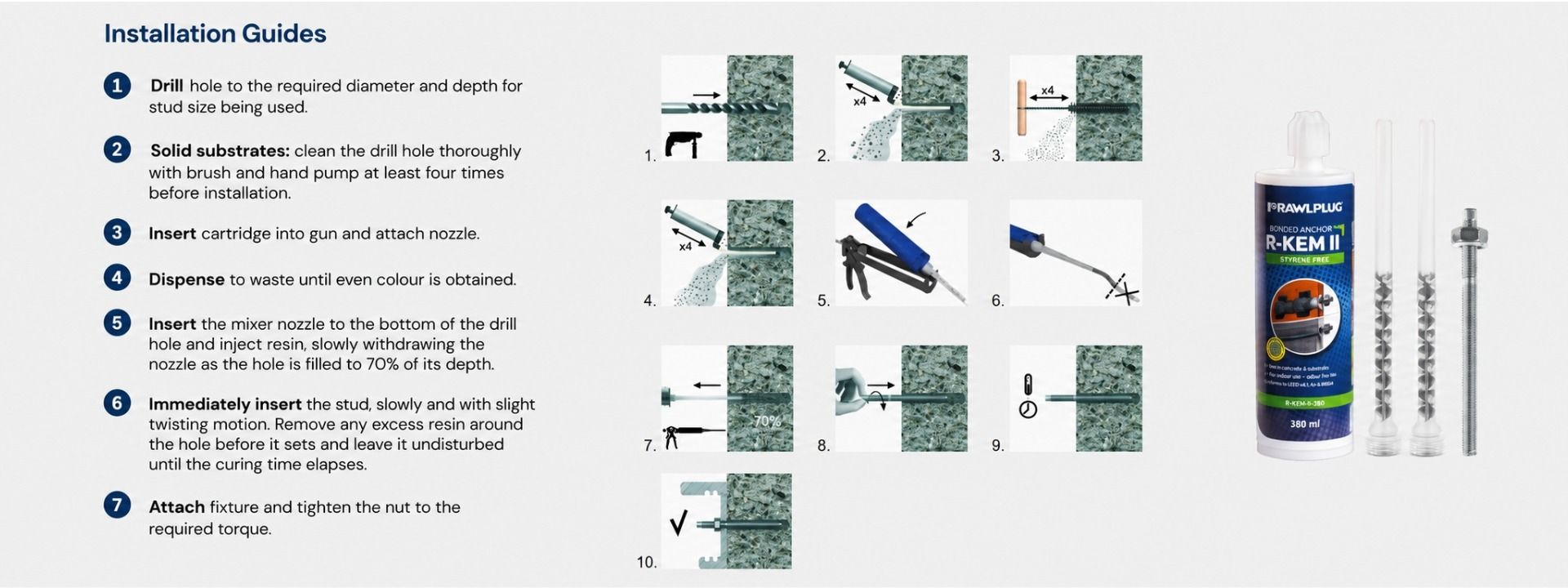
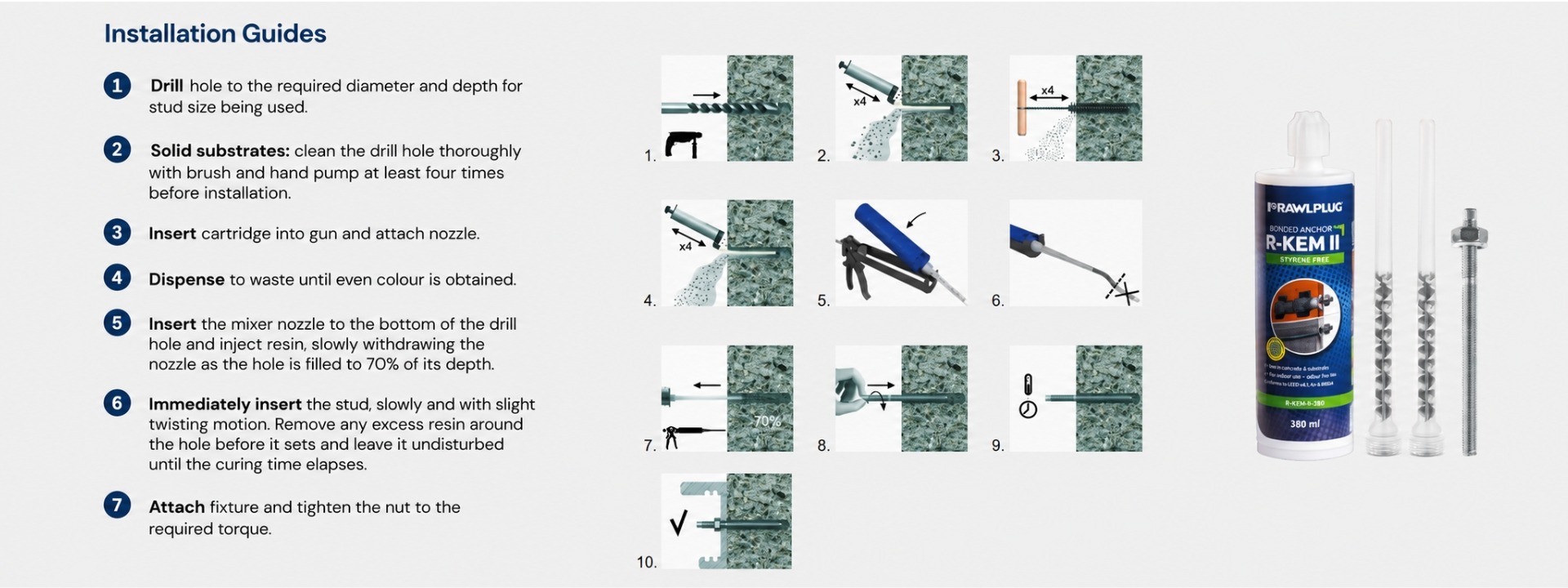
Insufficient hole cleaning: the drill hole must be cleaned with a brush and pump at least four times before injection. Concrete dust left in the hole significantly reduces bond strength and can cause anchor pull-out below the rated load.
-
Not purging the cartridge before use: the first material dispensed from a new or stored cartridge is often incompletely mixed. Always dispense to waste until the resin exits as a fully even colour before injecting into the hole.
-
Loading the anchor before curing is complete: the minimum curing time is temperature-dependent and must be observed fully. Loading an anchor before full cure reduces the achieved bond strength and may cause immediate failure.
-
Overfilling the hole: injecting resin beyond 70% of the hole depth leaves insufficient volume for the stud to displace into. This creates back-pressure during insertion and may prevent the stud seating to the correct embedment depth.
-
Using with sea water in the hole: wet hole installation is acceptable except where the hole contains sea water. Sea water contamination affects the resin chemistry and the approval does not cover this condition.
Safety
This product is a two-component chemical resin system. Read the Safety Data Sheet before use. Wear appropriate PPE during installation including chemical-resistant gloves, eye protection, and suitable respiratory protection in poorly ventilated spaces. Whilst the formula is styrene free and produces significantly lower odour than conventional polyester resins, ventilation of the work area remains good practice. Resin in an uncured state is an irritant. Avoid skin and eye contact. Dispose of empty cartridges and waste resin in accordance with local regulations. Store in a cool, dry location away from direct sunlight and heat sources. Do not exceed the stated shelf life.
Maintenance
Bonded anchor resins do not require maintenance once cured. Inspect installed fixings as part of the structure's regular inspection programme, checking for any movement, cracking of the surrounding substrate, or evidence of corrosion on exposed metalwork. If anchor integrity is in doubt following substrate movement, overloading, or damage to the surrounding concrete, carry out pull-out testing before returning the fixing to service. Partially used cartridges should be fitted with a new mixer nozzle before reuse. Do not reuse the nozzle from a previous session as it will contain cured resin. Store unused cartridges within the stated shelf life conditions.
Frequently Asked Questions
Q: Can this resin be used in cracked concrete?
A: No. The R-KEM II carries European Technical Assessment under Option 7, which covers non-cracked concrete only. Using a polyester resin in cracked concrete voids the ETA and produces a fixing without verified load performance. For cracked concrete applications, specify the Rawlplug R-KER II hybrid resin, which carries ETA Option 1 covering both cracked and non-cracked concrete.
Q: What is the difference between polyester, hybrid, and epoxy anchor resins?
A: Polyester resin covers standard-strength general purpose fixing in non-cracked concrete and masonry, it is the most economical option for medium-load applications and is not suitable for cracked concrete. Hybrid vinylester resin provides higher strength and covers both cracked and non-cracked concrete, rebar, and wet hole applications, making it suitable for more demanding structural fixings. Pure epoxy resin delivers maximum strength and covers cracked concrete, diamond drilled holes, seismic loads, rebar, and elevated temperature environments. It is the correct specification for critical, overhead, and high-load applications. Curing time for epoxy is significantly longer than polyester or hybrid.
Q: What is this resin NOT suitable for?
A: It is not approved for cracked concrete, diamond drilled holes, or seawater-contaminated holes. It is not the correct specification for critical overhead fixings or very high load applications where hybrid or epoxy resin is required. Natural stone approval requires site pull-out testing before installation commences. Do not use in natural stone without first confirming suitability.
Q: Why does the resin need to be dispensed to waste before use?
A: The two resin components are stored separately in the dual-chamber cartridge. At the start of a session, or after storage, the initial material dispensed may not be fully mixed, it exits with colour variation rather than an even compound colour. Uncured or poorly mixed resin produces significantly lower bond strength. Dispensing to waste until an even colour is obtained confirms the mixing ratio is correct before injection into the hole.
Q: How do I know when the resin has fully cured?
A: Curing time is temperature-dependent and varies significantly. At higher concrete temperatures curing is faster; at low temperatures it is substantially longer. The full curing time must be observed before any load is applied to the anchor. Refer to the technical datasheet on cmt.co.uk for confirmed cure times at specific substrate temperatures. Do not attempt to accelerate curing by applying heat to the installed anchor.
Q: Can I reuse a partially used cartridge?
A: Yes. A partly used cartridge can be resealed and stored for reuse. Before reusing, fit a new mixer nozzle.Do not reuse the nozzle from the previous session as it will contain cured resin that will block the dispense path. Purge to waste until an even colour is obtained before injecting into the next hole, as with a new cartridge.
Q: What gun does this resin require?
A: The 300ml cartridge is compatible with a standard manual silicone gun (SEAL01 or equivalent). The 410ml cartridge is compatible with both a standard silicone gun and the manual dispensing gun for 380-410ml cartridges (MET410). An electric dispensing gun can also be used with both sizes for high-volume or repetitive installation work. The patented self-opening cartridge system requires no separate piercing tool.