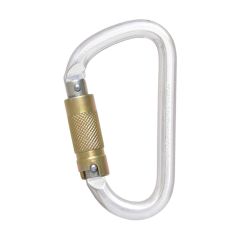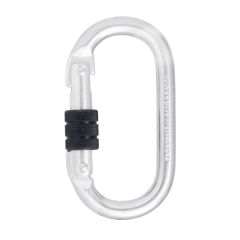


Not all fall arrest connectors are the same. CMT Group explains EN362:2004 classes, locking mechanisms, and which connector is right for your position on site.
Loading...
An aluminium alloy rebar hook with a 60mm gate opening and 23kN breaking strength, certified to EN362:2004 Class T and EN12275 Class K/T for direct connection to scaffold tubes and rebar in fall arrest systems.

An aluminium alloy rebar hook with a 60mm gate opening and 23kN breaking strength, certified to EN362:2004 Class T and EN12275 Class K/T for direct connection to scaffold tubes and rebar in fall arrest systems.
| BULK DISCOUNT | 20 | 50 |
|---|---|---|
| Price | £30.92 £37.10 | £28.41 £34.09 |
Order 1x to earn 33 FASTPoints
Order to earn 33 FASTPoints
Log in to access trade discountsThe three steel karabiners in this range have gate openings of 16 to 22mm. That is the right size for connecting lanyard loops to harness D-rings and standard anchor hardware. It is the wrong size for connecting directly to a scaffold tube, which has an outside diameter of 48.3mm. The rebar hook solves that problem with a 60mm gate opening, large enough to clip directly onto a scaffold tube, rebar, or structural steel section without requiring an intermediate connector or adaptor. Certified to EN362:2004 Class T, the specific classification for scaffold hooks, and additionally to EN12275 Class K/T with UIAA approval. Aluminium alloy construction keeps weight down at a gate size where a steel equivalent would be significantly heavier, and individual numbering on every hook provides the traceability required for compliant inspection records.
60mm gate opening for direct scaffold tube connection: A standard scaffold tube has an outside diameter of 48.3mm. The 60mm gate on this hook allows direct connection without adaptors, karabiners, or intermediate hardware, reducing connection time and the number of components in the system.
EN362:2004 Class T certification: Class T is the specific EN362 classification for scaffold hooks. It is not interchangeable with Class B, which covers general connection karabiners. Specifying a Class T connector for scaffold tube anchor connections confirms the correct product for the application.
EN12275 Class K/T and UIAA approval: Dual certification to the industrial and mountaineering standard in addition to EN362 confirms this hook meets requirements beyond the construction minimum. UIAA approval is an additional quality and performance mark recognised across professional and industrial sectors.
Individually numbered for traceability: Every hook carries a unique individual number. This allows each unit to be logged, inspected, and tracked through its service life as a discrete item, satisfying the record-keeping requirements of PUWER and site inspection regimes where individual equipment traceability is required.
Aluminium alloy construction: At a gate opening of 60mm, an aluminium hook is significantly lighter than a steel equivalent. For scaffolders carrying lanyards and connectors throughout a working day, this weight reduction matters in practice without compromising the 23kN breaking strength required by the standard.
Black colour for site identification: The black aluminium alloy finish distinguishes this hook visually from the silver steel karabiners in the range, reducing the risk of misidentification when selecting connectors from a kit or tool bag.
60mm Aluminium Rebar Hook x 1
| Specification | Details |
|---|---|
| Product Name | Kratos 60mm Aluminium Rebar Hook – 23kN Breaking Strength |
| Product Code | PP080016 |
| Material | Aluminium alloy |
| Colour | Black |
| Connector Type | Rebar hook / scaffold hook |
| Gate Opening | 60mm |
| Breaking Strength | 23kN |
| Overall Length | 236mm |
| Gate Depth | 135mm |
| Overall Width | 110mm |
| Individual Numbering | Yes, each hook individually numbered |
| Certification | CE Marked |
| Standards | EN362:2004 Class T, EN12275 Class K/T |
| Additional Approval | UIAA |
| HS Code | 76169990 |
| Equipment / Application | Compatibility |
|---|---|
| Scaffold Tubes (48.3mm OD) | ✓ Compatible |
| Rebar & Structural Steel Sections up to 60mm | ✓ Compatible |
| Energy Absorbing Webbing Lanyards (loop ends) | ✓ Compatible |
| Forked Twin-Tail Lanyards (anchor end connector) | ✓ Compatible |
| Use as General Connection Karabiner (Harness to Lanyard) | ✗ Not recommended |
| Use on Components Requiring Gate Opening <30mm | ✗ Not recommended |
| Use Along Minor Axis or Across the Gate | ✗ Not recommended |
This hook is for scaffolders, steel erectors, and site operatives who need to connect a fall arrest lanyard directly to a scaffold tube or rebar anchor point. It is the correct anchor-end connector for lanyards used in scaffolding fall arrest systems, replacing the need for intermediate karabiners or adaptors between the lanyard and the scaffold structure. Safety managers specifying connectors for scaffolding operations should include this hook alongside any lanyard that requires a direct scaffold tube connection.
Direct connection of energy absorbing lanyards to scaffold tubes as the anchor-end connector
Connecting forked twin-tail lanyards to scaffold tube anchor points on structural steel frames
Connecting fall arrest lanyards to rebar during reinforced concrete construction operations
Anchor-end connection for scaffolders working on tube and fitting scaffold structures
Replacement anchor connector for scaffolding fall arrest kits following a fall arrest event or inspection withdrawal
Inspect the hook before each use. Check the aluminium body for cracks, deformation, or corrosion. Check the gate mechanism for correct function and confirm the locking action is positive. Do not use any hook that fails inspection. Note the individual number and cross-reference with the inspection record.
Open the gate by operating the locking mechanism and position the hook over the scaffold tube, rebar, or structural section. The 60mm gate accommodates standard scaffold tube outside diameters directly.
Close the gate fully. Confirm the locking mechanism has engaged before applying any load.
Connect the lanyard loop to the hook body along the major axis. Confirm the lanyard loop is seated toward the spine of the hook, not resting against the gate.
Apply load only along the major axis. Never side-load or gate-load the hook.
On completion, release the gate lock, remove from the anchor point, and inspect before storage.
Load only along the major axis. Side-loading or gate-loading significantly reduces breaking strength and can cause failure.
Confirm the gate is fully closed and locked before every use. A visual check takes one second.
Do not use this hook as a general connection karabiner between harness and lanyard. It is designed as an anchor-end connector for scaffold tubes and rebar, not a component-to-component connection element.
Aluminium is lighter than steel but more susceptible to damage from sharp impacts. Inspect carefully for nicks, cracks, or deformation after any impact or drop.
Withdraw from service immediately after any fall arrest event regardless of visible condition.
Inspect before and after every use. Check the aluminium body for cracks, deformation, nicks, and corrosion. Check the gate mechanism for positive locking action.
Clean with a damp cloth. Remove concrete, rust, mud, and chemical contamination before storage.
Lubricate the gate hinge and locking mechanism periodically with a light oil if the action becomes stiff.
Log the individual number against each inspection in the equipment record.
Formally inspect by a competent person at intervals not exceeding 12 months with written records per PUWER.
Retire from service if the gate does not lock positively, if the body shows deformation or cracking, or if the hook has been involved in a fall arrest event.
Q: What is the difference between EN362 Class T and Class B and why does it matter for this product?
A: EN362:2004 Class B covers general connectors used as connection elements between components within a fall arrest system, such as harness to lanyard. Class T covers scaffold hooks specifically: connectors designed to connect directly to scaffold tubes and structural sections. The classification difference reflects the different loading geometry and gate size requirements for scaffold tube connection versus component connection. Using a Class B karabiner as a scaffold tube anchor connector is not the correct product for the application. This hook is Class T, which is the correct specification for scaffold tube anchor connections.
Q: What does EN12275 Class K/T mean and what is UIAA approval?
A: EN12275 is the European standard for connectors used in mountaineering and climbing equipment, covering strength, gate function, and locking requirements. Class K covers karabiners and Class T covers scaffold hooks within that standard. UIAA is the International Climbing and Mountaineering Federation, whose equipment approval marks indicate compliance with internationally recognised performance standards. Dual certification to both EN362:2004 and EN12275, with UIAA approval, confirms this hook meets requirements across both the industrial fall arrest and technical equipment sectors.
Q: Why is this hook made from aluminium rather than steel?
A: At a 60mm gate opening, an aluminium hook is significantly lighter than a steel equivalent. The 23kN breaking strength required by EN362:2004 Class T is achievable in aluminium alloy without the weight penalty of steel at this gate size. For scaffolders carrying lanyards and connectors throughout a working day, the weight reduction is a practical benefit. Steel is the correct choice for smaller gate karabiners used as component connection elements, where abrasion resistance and corrosion resistance at a smaller scale are the primary material requirements.
Q: Why does this hook have an individual number and what do I do with it?
A: Individual numbering allows each hook to be tracked as a discrete item through its service life. The number is logged against the inspection record, allowing the competent person conducting formal inspections to confirm the specific unit inspected, record the date, and note any findings. This satisfies the PUWER record-keeping requirement for individually identified PPE and is particularly important on sites where principal contractors require documented equipment inspection histories for audit purposes.
Q: Can this hook be used to connect a harness to a lanyard?
A: No. The 60mm gate opening is designed for scaffold tubes and structural sections, not for harness D-ring connections. Using a large-gate hook as a harness-to-lanyard connector would result in the hook sitting incorrectly on the D-ring and loading in a geometry it is not designed for. For harness-to-lanyard connections, use the 18mm screw-lock, 16mm quarter turn-lock, or 22mm triple-lock karabiners as appropriate for the frequency of use.
Q: What should I do if this hook has been involved in a fall arrest event?
A: Withdraw it from service immediately. Note the individual number and update the inspection record to show the hook has been withdrawn following a fall arrest event. Dynamic loading during an arrest can stress the aluminium body beyond what is visible externally. Quarantine it, label it as withdrawn, and have it assessed by a competent person. In practice, any connector involved in a fall arrest event should be scrapped and replaced.
Q: How often must this hook be formally inspected?
A: Pre-use inspection by the operative before every session, and formal inspection by a competent person at intervals not exceeding 12 months. The individual number must be logged against each inspection. Written records must be kept per PUWER.
Q: Where can I order this and how quickly can I get it to site?
A: CMT Group supplies this hook from stock with next working day delivery on orders placed by 7pm online or 5pm by phone. Same-day delivery is available: call the team to confirm stock and arrange despatch. For scaffolding contractors ordering fall arrest hardware across multiple sites, the EDGE portal provides agreed contract pricing, bulk ordering, and full delivery visibility in one place.