Which fall arrest connector do you actually need?
A plain guide to EN362 classes, locking mechanisms, and the four Kratos Safety connectors — matched to the right position on site.
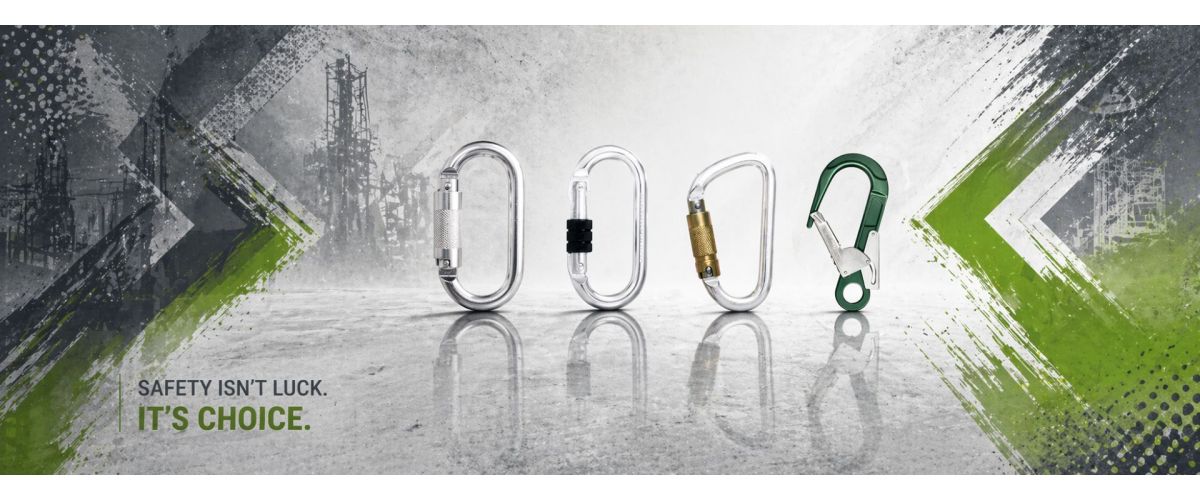
A connector is the link between every component in a fall arrest system. Get it wrong and the consequences range from a failed site audit to a failed arrest. Yet most site buyers choose connectors by habit or by price rather than by the specific requirements of each connection point in the system. This guide covers the four connectors in the Kratos Safety range, what EN362:2004 actually requires, and how to match the right connector to the right position on site.
What EN362:2004 requires from every connector
EN362:2004 is the European standard for connectors used in personal fall protection systems. Every connector used in a fall arrest system on a UK site must meet it. The standard defines four connector classes, each designed for a different role in the system.
 Class B
General connectors used as connection elements between components: harness to lanyard, lanyard to anchor hardware.
 Class T
Scaffold hooks. Designed for direct connection to scaffold tubes and structural sections. Large gate essential.
 Class A
Anchor connectors for use with anchor slings and fixed anchor points on structures.
 Class Q
Quick links for quasi-permanent connections where frequent opening is not required.
All connectors must be loaded along the major axis in one direction at a time, locked during use, and never used on an outside support area. Side-loading or gate-loading can reduce breaking strength to as little as 10% of the rated figure.
Choosing the right locking mechanism
The locking mechanism is the first decision, driven by one factor: how often the operative connects and disconnects throughout the working day. Kratos Safety connectors use colour-coded sleeves: black for screw-locking, gold/silver for double action, orange for triple action.
For occasional use
Manual sleeve must be unscrewed before opening. Reserve for fixed or occasional connections set once per session and not changed during the shift.
For moderate use
Two sequential actions to open. Automatic locking on gate close. Suited to moderate-frequency use where a screw-lock creates a re-locking risk.
For frequent use
Three sequential actions to open. Automatic locking on close. Correct for frequent connection and disconnection throughout a full shift.
For occasional or fixed connections
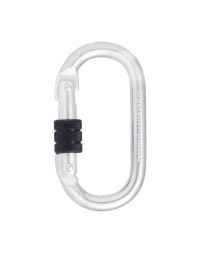
Where the connection is set once at the start of a work session and not changed during the shift, the screw-lock is the correct choice. The manual sleeve provides a positively locked gate that cannot open accidentally under load. The 18mm gate opening suits standard lanyard end loops and harness D-ring connections. Steel with zinc electroplating gives it durability in construction environments.
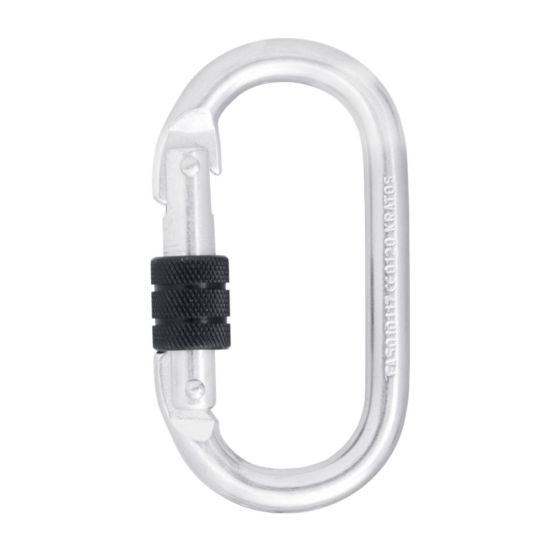
Kratos 18mm Steel Screw-Lock Karabiner
Steel, 18mm gate, 25kN breaking strength. EN362:2004 Class B. Zinc electroplated. For occasional or fixed connections.
For moderate-frequency connections
A single quarter turn opens the gate and it locks automatically every time it closes. This removes the manual re-locking step that creates misuse risk with a screw-lock in moderate-frequency applications. The oval shape distributes load across both sides, making it right for pulley systems and double lanyard configurations where two contact points sit on the connector simultaneously.
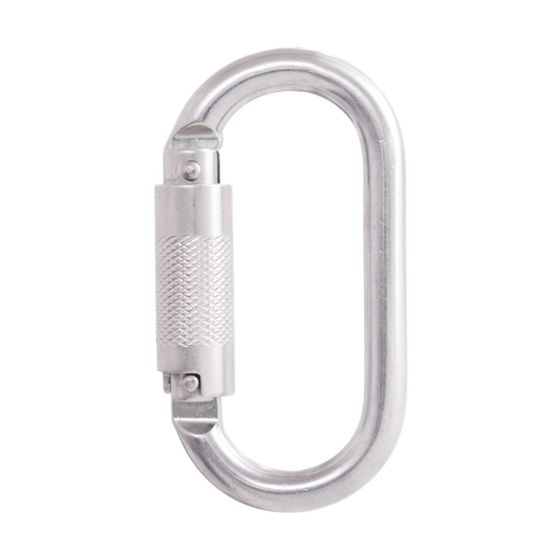
Kratos 16mm Steel Quarter Turn-Lock Karabiner
Steel oval, 16mm gate, 25kN breaking strength. EN362:2004 Class B. Automatic locking, single quarter turn to open.
For frequent connections throughout the shift
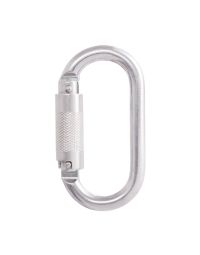
Three sequential actions are required to open the gate, and it locks automatically every time it closes. This makes accidental opening virtually impossible and eliminates re-locking oversight, which is the most common connector misuse failure on busy sites. At 40kN it exceeds the EN362:2004 Class B minimum by 60%. The asymmetric 22mm gate accommodates a wider range of hardware and keeps load toward the spine of the connector.

Kratos 22mm Steel Triple-Lock Karabiner
Steel asymmetric, 22mm gate, 40kN breaking strength. EN362:2004 Class B. Triple-action automatic locking for frequent use.
For scaffold tube and rebar anchor connections
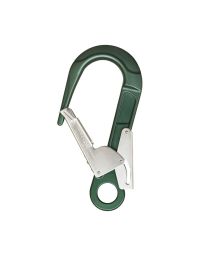
None of the three karabiners above will fit around a scaffold tube: standard outside diameter is 48.3mm. The rebar hook solves that with a 60mm gate opening for direct connection to scaffold tubes and rebar without adaptors. Certified to EN362:2004 Class T, the specific classification for scaffold hooks, and additionally EN12275 Class K/T with UIAA approval. Aluminium keeps weight down at this gate size, and individual numbering on every hook enables traceability through inspection records.
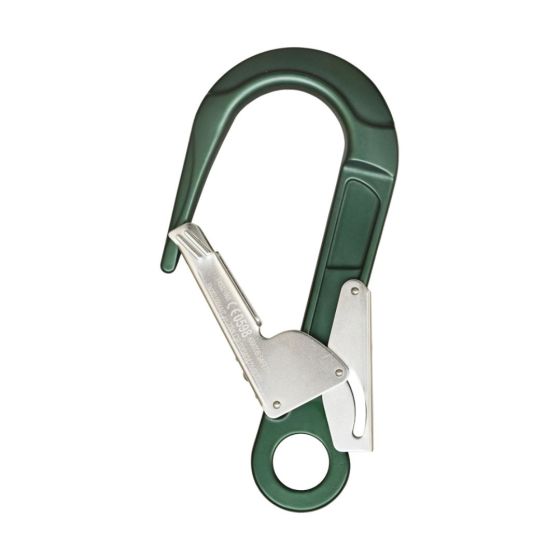
Kratos 60mm Aluminium Rebar Hook
Aluminium alloy, 60mm gate, 23kN. EN362:2004 Class T, EN12275 Class K/T, UIAA approved. Individually numbered for traceability.
At a glance: which connector for which position
| Connector | Gate | Strength | Locking | EN362 Class | Best for |
|---|---|---|---|---|---|
| 18mm Screw-Lock | 18mm | Manual screw | Class B | Fixed or occasional connections | |
| 16mm Quarter Turn | 16mm | Auto, 1 action | Class B | Moderate-frequency, pulley systems | |
| 22mm Triple-Lock | 22mm | Auto, 3 actions | Class B | Frequent connections all shift | |
| 60mm Rebar Hook | 60mm | Auto latch | Class T | Scaffold tubes and rebar |
Steel or aluminium: which material and when
Steel is the correct default for construction environments. It resists abrasion, impact, and corrosion better than aluminium at the small gate sizes used for component connections. All three steel karabiners in this range carry zinc electroplating for additional anti-corrosion protection.
Aluminium is the correct choice where weight is the primary concern and gate size is large. At 60mm, a steel rebar hook would be significantly heavier without a performance advantage for this application. The aluminium alloy in the rebar hook achieves 23kN, meeting the EN362 Class T requirement, whilst keeping the product light enough for daily use by scaffolders.
Every connector must be loaded along its major axis, in one direction at a time, and locked during use. A connector used incorrectly — side-loaded, gate-loaded, or unlocked — is not operating within its certified parameters. No breaking strength figure protects against misuse.