
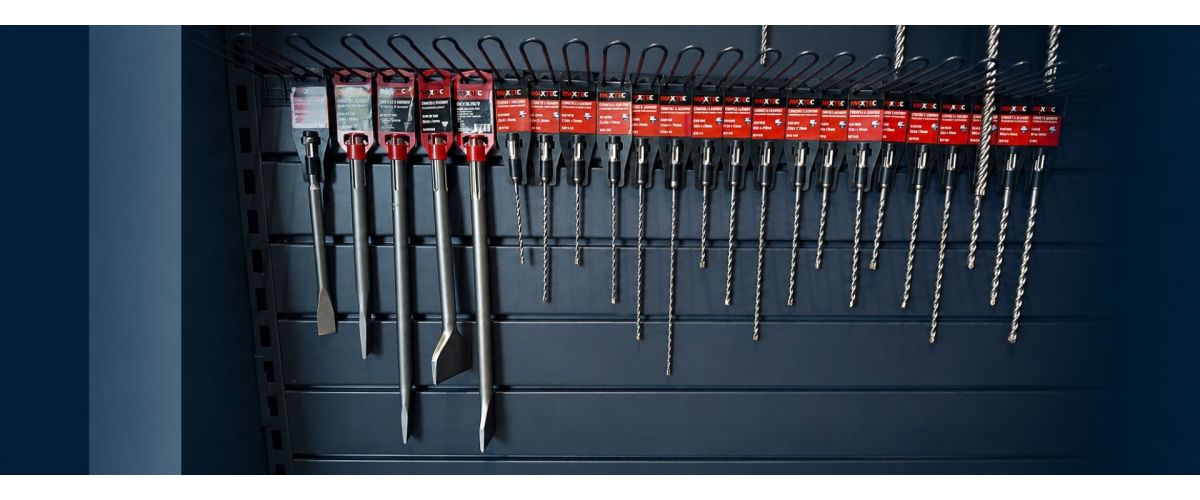
The complete guide to choosing the right drill bit for every construction material
Using the wrong drill bit costs more than just a blunt tip. It costs time, damages tools, ruins fixings, and on structural applications, it can compromise safety. This guide covers every drill bit type used on UK construction sites in 2026, matched to material, machine, and application.
Shop the full drill bit range →
The basics: what makes a drill bit work
Every drill bit has four elements that determine its performance: the material it is made from, the tip geometry, the flute design, and the shank type. Getting any one of these wrong for the material you are drilling will blunt the bit quickly, produce poor holes, and put unnecessary strain on the drill motor.
Bit materials at a glance
Carbon Steel
Lowest cost, softest. For light occasional use in wood and soft plastics only. Blunts quickly on anything harder.
High Speed Steel (HSS)
Standard for metal, wood, and plastic. Retains hardness at elevated temperatures. The professional default for steel drilling.
Cobalt HSS (M35/M42)
5% to 8% cobalt alloyed into the steel. Significantly higher heat resistance. Correct specification for stainless steel and hard alloys.
Tungsten Carbide (TCT)
Harder than HSS and cobalt. Used as a brazed tip on masonry bits. Withstands the abrasive wear of concrete, brick, and stone.
YG8C Sintered Carbide
High-cobalt impact-resistant grade. Specified for SDS Plus percussion drilling in reinforced concrete where standard carbide chips prematurely.
Diamond
Hardest cutting material. For porcelain, ceramic tile, glass, and granite. Used in wet or dry hole saws and core bits.
Shank types: why they matter
The shank is how the bit connects to the drill. Using the wrong shank type in the wrong machine is the single most common cause of bit damage and slippage on site.
- Round shank (straight): Fits standard keyed and keyless chucks. Used with corded and cordless drills, combi drills, and pillar drills. Cannot be used in SDS machines.
- 1/4" hex shank: Fits impact drivers, cordless drills with hex chuck, and quick-release bit holders. Standard for screwdriver bits, flat wood bits, and hex shank masonry bits.
- SDS Plus shank: Slotted shank that locks into SDS Plus machines and allows axial movement during percussion. Not interchangeable with standard chucks or SDS Max.
- SDS Max shank: Larger slotted shank for heavy duty SDS Max breakers and rotary hammers. Larger diameter than SDS Plus, not interchangeable.
- Hilti TE-S shank: Proprietary Hilti format for TE-S series heavy breakers. Not compatible with SDS Plus or SDS Max machines.
Key principle: The drill bit must match both the material you are drilling into and the machine you are using. A SDS Plus bit will not fit a standard cordless drill. A straight shank masonry bit will not transfer percussion energy efficiently in an SDS machine. Always confirm both before ordering.
Concrete and reinforced concrete
Concrete is the most demanding drilling substrate in construction. The combination of hard aggregate, cement matrix, and in reinforced concrete, embedded steel reinforcement bars, requires bits that can absorb impact loading, maintain carbide sharpness against abrasive aggregate, and in the case of rebar contact, deflect rather than snap. This is where SDS Plus technology and carbide grade selection make the biggest difference.
SDS Plus 2-cutter masonry drill bit
The standard professional specification for concrete drilling. The SDS Plus shank transmits full percussion energy from the machine into the carbide tip. Two cutting edges distribute the impact load and produce clean, accurate holes. YG8C carbide grade is specified for reinforced concrete applications where standard carbide chips under repeated impact. Available from 5mm to 25mm diameter and 160mm to 1000mm in length for deep anchor and service penetration work.
When to use it: Standard and reinforced concrete, dense block, natural stone. Anchor installations, service penetrations, structural fixings from 5mm to 25mm.
SDS Plus 4-cutter masonry drill bit
Four carbide cutting edges versus two. Higher penetration rate, better debris removal through twin-spiral flutes with integrated dust extraction grooves, and a symmetrical rebar-safe tip geometry that deflects off reinforcement rather than snagging. PGM certified to the German Prüfgemeinschaft Mauerbohrer standard, meaning hole diameter accuracy is independently verified. Required on safety-critical anchor installations where the engineer of record specifies certified hole dimensions.
When to use it: High-volume concrete drilling, reinforced concrete where rebar contact is likely, safety-critical chemical and mechanical anchor installations requiring PGM certification. 5mm to 24mm diameter.
SDS Plus and TE-S chisels and points
For breaking out concrete rather than drilling through it. Points concentrate percussion energy for breaking hard concrete and raking mortar. Flat chisels suit chasing for pipe and cable runs. Wide spade chisels handle tile stripping, screed removal, and broad surface demolition. Hardened steel body resists mushrooming at the shank and deformation at the working tip. Used in chisel mode only, never in rotary hammer mode.
When to use it: Demolition, chasing, tile removal, screed lifting, mortar raking. Requires hammer drill with rotary stop feature (chisel mode).
Common mistake: Using a standard percussion drill bit in reinforced concrete. Standard carbide grades chip and fracture under the impact loads generated by SDS Plus percussion in hard aggregate. For reinforced concrete, always specify SDS Plus bits with YG8C or equivalent impact-resistant carbide.
Brick, block, and natural stone
Brick, block, and natural stone sit below concrete in terms of hardness and density, which means a standard percussion drill with a straight shank masonry bit is often sufficient for light to medium fixing work. The correct choice depends on the volume of holes required, the specific substrate, and the fixing being installed.
Straight shank masonry drill bit
Tungsten carbide tipped with a straight round shank for use in standard percussion and rotary drills with a keyed or keyless chuck. The correct choice for brick, block, and soft to medium natural stone where an SDS Plus machine is not available or not required. Available individually or in sets. Two cutting edges are preferred for better penetration rate and cleaner holes over single-edge alternatives.
When to use it: Brick, block, soft natural stone. Light to medium fixing tasks: wall plugs, frame fixings, service clips. Standard corded or cordless percussion drills. 4mm to 12mm.
SDS Plus Tapcon drill bit - 5.15mm
Tapcon concrete screws are self-tapping fixings that cut their own thread directly into concrete, brick, or block as they are driven. The pilot hole must be exactly 5.15mm for a standard 1/4" Tapcon screw. Not 5mm. Not 5.5mm. Using a standard SDS Plus bit at a rounded diameter will produce a hole that is either too tight or too loose for the Tapcon thread to grip correctly. The U-flute design removes concrete dust efficiently, leaving a clean hole for the Tapcon thread to cut into.
When to use it: Pilot holes for Tapcon 1/4" concrete screws in concrete, brick, and block. Available in 210mm and 310mm lengths.
Wall plug size guide
| Plug Colour | Pilot Hole Diameter | Typical Screw Size | Typical Application |
|---|---|---|---|
| Red | 5mm or 5.5mm | No.8 (4mm) | Light fixings, picture rails, hooks |
| Brown | 5mm or 6mm | No.10 (5mm) | Shelves, brackets, light fittings |
| Yellow | 7mm | No.12 (6mm) | Medium fixings, cabinets |
| Blue | 8mm | No.14 (7mm) | Heavier fixings, TV brackets |
| Grey | 10mm | No.18 (8mm) | Heavy structural fixings |
Trade note: In older UK brickwork with softer, sandier mortar, the plug sometimes sits loose in the correct size hole. A 6mm bit where 5.5mm is specified often produces a better result in this substrate. Check pull-out resistance before applying load to any fixing in older masonry.
Timber, MDF, and board materials
Wood drilling covers the widest range of bit types of any material category. The correct choice depends on hole diameter, the finish quality required, the depth of the hole, and whether the work is rough first fix or visible joinery. Using a masonry or metal bit in wood will produce a hole, but it will be rough, oversized, and likely to splinter the face grain.
Flat wood drill bit (spade bit) - hex shank
The fastest and most cost-effective way to drill large diameter holes through softwood, hardwood, chipboard, MDF, and plasterboard. The centre point locates the bit precisely before the flat blade engages, preventing walking on entry. The 1/4" hex shank fits cordless drills, combi drills, and impact drivers directly. Available from 6mm to 40mm, covering the full range from small cable holes to large pipe and conduit penetrations. Produces a functional hole rather than a finished one: ideal for first fix cable routing, pipe penetrations, and rough carpentry work.
When to use it: Cable routing through joists (16mm to 25mm), pipe penetrations (22mm to 40mm), door lock barrels (25mm), plasterboard back boxes (25mm). Speed over finish quality.
Wood auger drill bit
The auger bit drills deeper and cleaner than a flat bit. The tight helical flute pulls the bit through the wood as it rotates, producing a clean hole with minimal tear-out. Suited to deep holes through thick timber sections, multiple joists in a single pass, and hardwood where a flat bit would wander. Available in hex shank format for cordless drill compatibility. The correct choice for joinery work where hole quality is visible or where the depth requirement exceeds the 50mm working length of a flat bit.
When to use it: Deep holes through thick timber sections, hardwood, multiple joist penetrations, any application where clean hole quality matters more than drilling speed.
Wood bit comparison
| Bit Type | Hole Quality | Drilling Speed | Best For |
|---|---|---|---|
| Flat / Spade bit | Functional, rough | Fast | First fix: cable, pipe, rough carpentry |
| Auger bit | Clean, accurate | Medium | Deep holes, hardwood, visible joinery |
| Forstner bit | Flat-bottomed, precise | Slow | Hinge pockets, cabinetry, furniture |
| Brad point (twist) | Clean entry and exit | Medium | Precision holes in softwood and MDF |
| Hole saw | Clean circular cutout | Medium | Pipe entries, cable glands, spot lights |
Tear-out prevention: On flat bits, place a scrap piece of timber behind the workpiece before drilling. The scrap supports the wood fibres on exit and eliminates the splintering that a flat bit produces when it breaks through the back face unsupported.
Steel and metal
Metal drilling requires bits that can withstand the heat generated as the cutting edge removes material. Unlike wood or masonry, metal drilling produces heat through friction rather than abrasion, and this heat is the primary cause of premature bit failure. The correct steel grade, drill speed, and use of cutting fluid determines whether a metal drilling task takes seconds or destroys the bit.
HSS twist drill bit
High Speed Steel is the standard specification for drilling mild steel, alloyed carbon steel, aluminium, copper, brass, and most non-ferrous metals. The 135° split point tip is the specification to look for: at 135°, the tip is more acute than a standard 118° point, which reduces the force needed to start the hole and prevents walking on smooth steel surfaces without a centre punch. HSS retains its hardness at the elevated temperatures generated during steel drilling, which is why it outperforms carbon steel bits on any metal application.
When to use it: Mild steel plate, structural steel sections, aluminium, copper, brass, and general metal drilling. 2mm to 12mm. Standard corded and cordless drills.
HSS cobalt drill bit (M35/M42)
Cobalt is not a coating: it is alloyed directly into the steel at 5% (M35) or 8% (M42) concentration. This means the cobalt content remains constant even as the bit is sharpened and the cutting edges wear. Cobalt HSS withstands significantly higher temperatures than standard HSS before losing hardness, which is the critical property for drilling stainless steel and work-hardening alloys that generate excessive heat at the cutting zone. Available in individual sizes and as sets.
When to use it: Stainless steel, hardened alloys, cast iron, and any application where standard HSS bits blunt rapidly or generate excessive heat. Ground cobalt bits (fully ground from solid) deliver better accuracy and longer service life than roll-forged alternatives.
HSS long shank twist drill bit
Standard jobber length HSS bits have a fixed overall length that limits how deep a hole can be drilled before the chuck contacts the surface. Long shank bits extend this reach for through-hole drilling in thick steel plate and structural sections, access to confined areas where the drill must stand further from the work, and pilot holes through multiple layers in a single pass. Suited to handheld operations with standard corded and cordless drills.
When to use it: Thick steel plate, structural sections, confined space drilling, deep through-holes in a single pass. 3mm to 8mm.
Drill speed guide for HSS in steel
| Bit Diameter | Mild Steel (rpm) | Stainless Steel (rpm) | Aluminium (rpm) |
|---|---|---|---|
| 2mm to 4mm | 2000 to 3000 | 800 to 1200 | 3000 to 5000 |
| 5mm to 8mm | 1000 to 2000 | 400 to 800 | 2000 to 3500 |
| 9mm to 12mm | 500 to 1000 | 200 to 400 | 1000 to 2000 |
Warning: If the swarf (metal chips) coming off the bit is discoloured blue or black, the drill speed is too high and the bit is overheating. Reduce speed immediately and allow the bit to cool. Overheating permanently softens HSS, after which the bit will blunt on the next hole regardless of speed.
Specialist applications
Tile, porcelain, and glass
Ceramic tile requires a diamond-tipped bit or a TCT multi-material bit run at low speed with water cooling. The material is brittle and cracks if the bit is run too fast or too much pressure is applied. Never use percussion mode when drilling tile: the hammer action shatters the glaze and the tile body. Porcelain tiles are denser and harder than standard ceramic and require diamond-core bits for clean results.
Plasterboard
Plasterboard is soft enough for any HSS twist bit, flat bit, or TCT masonry bit to drill cleanly. The practical choice depends on the diameter required. For small pilot holes (3mm to 6mm), an HSS twist bit works well. For larger holes (25mm and above for back boxes), a flat bit or hole saw is the correct choice. Never use SDS percussion mode in plasterboard: the impact action shatters the board around the hole.
Multi-material drilling
Jobs that require drilling through multiple materials in a single pass (for example, timber stud followed by masonry behind it) require a multi-material or universal bit with a TCT tip. These bits will not produce the cleanest hole in any individual material but will cut through combinations without changing bits. Useful for first fix trades drilling through partition linings and into the substrate behind.
Anchor and fixing-specific bits
Chemical anchors, throughbolts, and self-tapping concrete screws each require a specific pilot hole diameter that must be drilled to tolerance. Always check the anchor manufacturer's technical data sheet before selecting a bit. The specified diameter is not always the same as the bolt or stud diameter, and using the wrong size directly affects the load-rated performance of the fixing.
↑ Back to topMatching the bit to the machine
The machine type determines which shank format is required. This is not a preference: it is a physical compatibility constraint. The table below covers the most common drill and breaker types used on UK construction sites in 2026.
| Machine Type | Shank Required | Correct Bit Types |
|---|---|---|
| Standard cordless or corded drill | Round (straight) shank | HSS twist bits, cobalt bits, straight shank masonry bits, flat wood bits (round shank) |
| Impact driver | 1/4" hex shank | Screwdriver bits, flat wood bits (hex shank), hex shank masonry bits, auger bits (hex shank) |
| Combi drill | Round (straight) or 1/4" hex shank | All straight shank and hex shank bits depending on chuck fitted |
| SDS Plus rotary hammer | SDS Plus slotted shank | SDS Plus masonry bits (2-cutter, 4-cutter, Tapcon), SDS Plus wood auger, SDS Plus chisels and points |
| SDS Max rotary hammer or breaker | SDS Max slotted shank | SDS Max masonry bits, SDS Max chisels and points |
| Hilti TE-S breaker | Hilti TE-S shank | TE-S points, flat chisels, wide spade chisels |
| Pillar drill / bench drill | Round (straight) shank or Morse taper | HSS twist bits, cobalt bits, Forstner bits, hole saws |
SDS Plus vs standard percussion drill: An SDS Plus hammer drill will outperform a standard percussion drill in concrete every time. The SDS Plus mechanism allows the bit to slide axially during hammering, transmitting full impact energy directly into the carbide tip. A standard percussion drill transmits impact through the chuck, which absorbs some energy and wears both the chuck jaws and the bit shank over time.
Quick decision table: material to bit in 30 seconds
| Material | Machine | Correct Bit Type |
|---|---|---|
| Reinforced concrete (structural) | SDS Plus rotary hammer | SDS Plus 4-cutter PGM certified masonry bit |
| Standard concrete (anchor drilling) | SDS Plus rotary hammer | SDS Plus 2-cutter masonry bit (YG8C carbide) |
| Concrete (Tapcon concrete screws) | SDS Plus rotary hammer | SDS Plus Tapcon bit 5.15mm |
| Dense block and engineering brick | SDS Plus or percussion drill | SDS Plus 2-cutter or straight shank TCT masonry bit |
| Standard brick and block | Percussion drill | Straight shank TCT masonry bit (2 cutting edges) |
| Natural stone | SDS Plus or percussion drill | SDS Plus masonry bit (rotary mode for soft stone) |
| Concrete breaking and chasing | Hilti TE-S breaker or SDS Plus (chisel mode) | Point, narrow chisel, or wide spade chisel |
| Softwood and hardwood (large holes) | Cordless drill or impact driver | Flat wood bit (hex shank) 6mm to 40mm |
| Timber (deep holes) | Cordless drill or impact driver | Wood auger bit (hex shank) |
| MDF, chipboard, plasterboard | Cordless drill or impact driver | Flat wood bit (hex shank) or HSS twist bit |
| Mild steel and plain carbon steel | Corded or cordless drill | HSS twist bit (135° split point) |
| Stainless steel and hard alloys | Corded or cordless drill | Cobalt HSS bit (M35 or M42 ground) |
| Steel (deep holes) | Corded or cordless drill | HSS long shank twist bit |
| Aluminium and non-ferrous metals | Corded or cordless drill | HSS twist bit (standard or long shank) |
| Ceramic tile | Drill (no percussion) | Diamond-tipped tile bit or TCT multi-material bit |
| Porcelain tile and granite | Drill (no percussion) | Diamond core bit or diamond-tipped hole saw |
The CMT Group drill bit range for UK construction
CMT Group stocks a comprehensive range of drill bits across every category covered in this guide, available for next working day delivery to UK mainland sites. The range covers SDS Plus masonry bits, 4-cutter high performance bits, wood boring bits, HSS metal bits, cobalt drill sets, and specialist Tapcon and TE-S chisel accessories.
Masonry and concrete
Wood boring
HSS and cobalt for metal
CMT Group operates a fleet of over 100 vehicles covering 90% of the UK mainland. Next working day delivery on orders placed by 7pm online. VIP dedicated delivery available UK-wide for urgent site requirements, dispatched within 30 minutes. Trade accounts and EDGE portal ordering available for procurement teams requiring agreed pricing and full order visibility.
Shop the full range at cmt.co.uk →