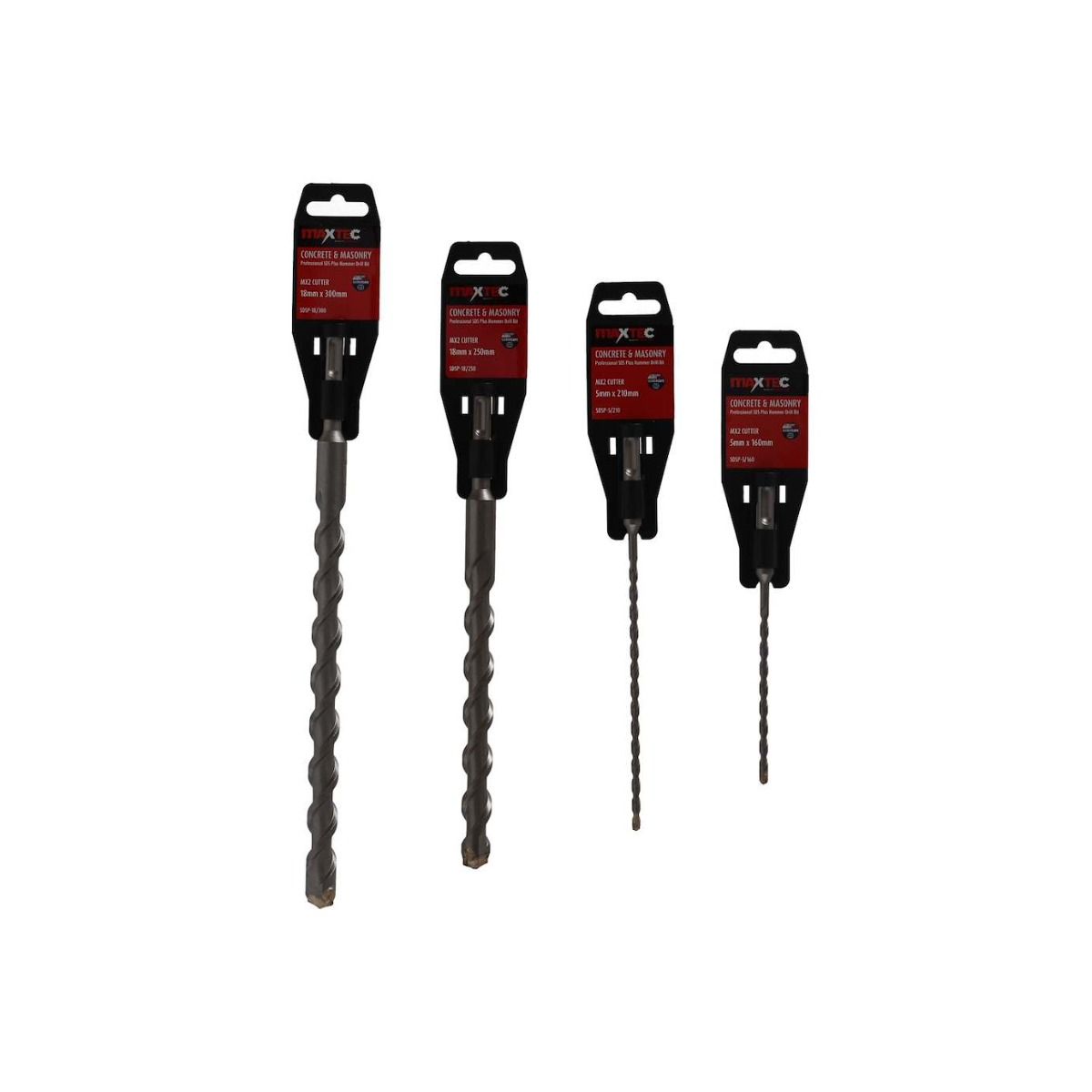

MAXTEC SDS Plus 2-cutter masonry drill bits for concrete, natural stone, and masonry. Available from 5mm to 25mm diameter and 160mm to 1000mm length for all SDS Plus rotary hammer drills.
- YG8C carbide tip: outlasts standard carbide in reinforced concrete and hard aggregate
- 2-cutter geometry: faster penetration and cleaner, more accurate holes
- U-flute design: rapid dust extraction reduces heat and extends bit life
- Reinforced core: minimises vibration and reduces breakage under SDS percussion loads
- Diameter range: 5mm to 25mm across 46 size and length variants
- Length range: 160mm to 1000mm for standard through to deep anchor drilling
- PGM certified: independently verified for dimensional accuracy and anchor compliance
MAXTEC SDS Plus 2-Cutter Masonry Drill Bit - 5mm to 25mm Range

MAXTEC SDS Plus 2-cutter masonry drill bits for concrete, natural stone, and masonry. Available from 5mm to 25mm diameter and 160mm to 1000mm length for all SDS Plus rotary hammer drills.
- YG8C carbide tip: outlasts standard carbide in reinforced concrete and hard aggregate
- 2-cutter geometry: faster penetration and cleaner, more accurate holes
- U-flute design: rapid dust extraction reduces heat and extends bit life
- Reinforced core: minimises vibration and reduces breakage under SDS percussion loads
- Diameter range: 5mm to 25mm across 46 size and length variants
- Length range: 160mm to 1000mm for standard through to deep anchor drilling
- PGM certified: independently verified for dimensional accuracy and anchor compliance
MAXTEC SDS Plus 2-cutter masonry drill bit
The MAXTEC SDS Plus 2-cutter range is built for professionals who drill into concrete, reinforced concrete, natural stone, and dense masonry at volume. Covering diameters from 5mm through to 25mm and lengths from 160mm to 1000mm, this range handles everything from standard wall plug holes through to deep anchor installations and service penetrations in structural concrete. The YG8C sintered carbide tip and dual-cutter geometry are the specifications that separate this range from standard SDS Plus bits: harder, more impact-resistant carbide and two cutting edges working simultaneously mean faster penetration, longer tip life, and cleaner holes in the substrates that wear out inferior bits quickly.
Why choose the MAXTEC SDS Plus 2-cutter masonry drill bit
-
YG8C sintered carbide tip: YG8C is a high-cobalt tungsten carbide grade selected specifically for impact resistance. In reinforced concrete and hard aggregate, it maintains its cutting edge significantly longer than the standard carbide grades used in most competing SDS Plus bits. The practical result is fewer bit changes and lower cost per hole on high-volume drilling tasks.
-
2-cutter tip geometry: Two cutting edges contact the substrate simultaneously, distributing the impact load evenly and doubling the material removal rate compared to a single-cutter design. Holes are cleaner, more accurate, and produced faster, which matters when anchor load capacity depends on hole diameter tolerance.
-
Optimised U-flute design: The flute geometry is engineered for rapid debris removal rather than drilling speed alone. Efficient dust extraction reduces friction and heat at the tip, which is the primary cause of premature carbide failure in deep hole drilling. The U-flute keeps the cutting zone clear on holes up to 1000mm deep.
-
Reinforced core: The bit body is manufactured with a reinforced cross-section to resist the bending forces generated during SDS Plus percussion drilling, particularly on longer bits and in harder substrates. This is the specification that prevents the sudden snapping failures that occur with thinner-walled competing bits.
-
PGM certified: Each bit in the range is PGM certified, meaning dimensional accuracy has been independently verified. For anchor installations where hole diameter and depth tolerance determine whether a fixing meets its load specification, this certification is the assurance that the hole drilled matches the hole specified.
-
Full diameter and length coverage: 46 size and length combinations from SDSP-5/160 through to SDSP-25/450 mean this single range covers light fixing work at 5mm through to 25mm structural anchor and service penetration drilling, including 1000mm extreme-depth variants for deep foundation and infrastructure work.
-
Compatible with all SDS Plus rotary hammers: The SDS Plus shank fits every SDS Plus hammer drill on the market, including Hilti, Bosch, Makita, DeWalt, Milwaukee, and all other mainstream brands, without adapters or modifications.
What's included
-
1 x MAXTEC SDS Plus 2-cutter masonry drill bit in your selected diameter and length combination
Specifications
| Specification | Detail |
|---|---|
| Product Name | MAXTEC SDS Plus 2-Cutter Masonry Drill Bit - 5mm to 25mm Range |
| Product Code | SDSP2 |
| Brand | MAXTEC |
| Shank Type | SDS Plus |
| Tip Type | YG8C Sintered Tungsten Carbide |
| Cutting Edges | 2-Cutter |
| Flute Design | Optimised U-Flute for Rapid Dust Extraction |
| Core | Reinforced to Minimise Vibration and Breakage Risk |
| Diameter Range | 5mm to 25mm |
| Length Range | 160mm to 1000mm |
| Available Variants | 46 size and length combinations |
| For Use With | All SDS Plus Rotary Hammer Drills |
| Material Compatibility | Concrete, Reinforced Concrete, Natural Stone, Brick, Block, Masonry |
| Certification | PGM Certified |
| Standard | SDS Plus (ISO 5468) |
Compatibility
| Compatible with | Status |
|---|---|
| All SDS Plus rotary hammer drills (all brands) | ✓ Compatible |
| Hilti, Bosch, Makita, DeWalt, Milwaukee SDS Plus machines | ✓ Compatible |
| Concrete, reinforced concrete, natural stone, brick, block | ✓ Compatible |
| SDS Max machines (direct fit) | ✗ Not recommended |
| Standard percussion drills with keyless or keyed chuck | ✗ Not recommended |
| Cordless drills without SDS Plus chuck | ✗ Not recommended |
Available sizes
| Product Code | Diameter (mm) | Working Length (mm) | Overall Length (mm) |
|---|---|---|---|
| SDSP-5/160 | 5.0 | 93 | 160 |
| SDSP-5/210 | 5.0 | 143 | 210 |
| SDSP-5.5/160 | 5.5 | 93 | 160 |
| SDSP-5.5/210 | 5.5 | 143 | 210 |
| SDSP-5.5/260 | 5.5 | 193 | 260 |
| SDSP-6/160 | 6.0 | 93 | 160 |
| SDSP-6/210 | 6.0 | 143 | 210 |
| SDSP-6/260 | 6.0 | 193 | 260 |
| SDSP-6.5/160 | 6.5 | 93 | 160 |
| SDSP-6.5/210 | 6.5 | 143 | 210 |
| SDSP-6.5/260 | 6.5 | 193 | 260 |
| SDSP-7/160 | 7.0 | 93 | 160 |
| SDSP-7/210 | 7.0 | 143 | 210 |
| SDSP-8/160 | 8.0 | 93 | 160 |
| SDSP-8/210 | 8.0 | 143 | 210 |
| SDSP-8/260 | 8.0 | 193 | 260 |
| SDSP-10/160 | 10.0 | 93 | 160 |
| SDSP-10/210 | 10.0 | 143 | 210 |
| SDSP-10/260 | 10.0 | 193 | 260 |
| SDSP-10/450 | 10.0 | 383 | 460 |
| SDSP-10/1000 | 10.0 | 875 | 1000 |
| SDSP-12/160 | 12.0 | 80 | 160 |
| SDSP-12/210 | 12.0 | 130 | 210 |
| SDSP-12/260 | 12.0 | 180 | 260 |
| SDSP-12/310 | 12.0 | 230 | 310 |
| SDSP-12/450 | 12.0 | 370 | 460 |
| SDSP-12/1000 | 12.0 | 875 | 1000 |
| SDSP-14/210 | 14.0 | 128 | 210 |
| SDSP-14/260 | 14.0 | 178 | 260 |
| SDSP-14/310 | 14.0 | 228 | 310 |
| SDSP-14/450 | 14.0 | 368 | 460 |
| SDSP-16/210 | 16.0 | 127 | 210 |
| SDSP-16/310 | 16.0 | 227 | 310 |
| SDSP-16/450 | 16.0 | 367 | 460 |
| SDSP-16/1000 | 16.0 | 875 | 1000 |
| SDSP-18/250 | 18.0 | 166 | 250 |
| SDSP-18/300 | 18.0 | 216 | 300 |
| SDSP-18/450 | 18.0 | 366 | 460 |
| SDSP-20/300 | 20.0 | 215 | 300 |
| SDSP-20/450 | 20.0 | 365 | 460 |
| SDSP-20/1000 | 20.0 | 875 | 1000 |
| SDSP-22/450 | 22.0 | 364 | 460 |
| SDSP-22/1000 | 22.0 | 875 | 1000 |
| SDSP-25/450 | 25.0 | 364 | 460 |
Who is this for?
The MAXTEC SDS Plus 2-cutter masonry drill bit range is used by structural fixings operatives, groundworkers, civil engineers, electricians, mechanical contractors, and specialist drilling teams who work regularly in concrete, reinforced concrete, and hard natural stone. The full diameter and length range means this is a single range capable of covering an entire project's SDS Plus drilling requirements, from 5mm plug holes through to 25mm structural anchor installations and 1000mm deep service penetrations.
Typical applications
-
Chemical anchor installations in concrete requiring precise hole diameters from 10mm to 25mm at specified embedment depths
-
Throughbolt and mechanical anchor installations in reinforced concrete beams, columns, and ground slabs
-
Service penetrations through concrete walls, floors, and soffits for conduit, cable trays, and pipe runs
-
Scaffold fixing and temporary works anchor points in concrete structures
-
Deep foundation drilling using 1000mm variants for post-installed fixings in ground beams and pile caps
-
Infrastructure and rail projects requiring precise, PGM-certified hole dimensions for critical anchor installations
-
General masonry and brick drilling from 5mm for light plug and frame fixings through to 18mm and above for heavy structural connections
How to use
-
Select the correct diameter and length for your anchor or fixing. Always check the anchor manufacturer's technical data sheet for the specified hole diameter and minimum embedment depth. These are not interchangeable with the bolt or stud diameter.
-
Insert the SDS Plus shank into your hammer drill chuck. Push firmly until the bit clicks and locks. The small amount of axial play in the shank is correct for SDS Plus operation and essential for efficient percussion transfer.
-
Set the drill to hammer drilling mode for concrete, dense block, and hard stone. Rotary-only mode is appropriate for softer natural stone only.
-
Mark the drilling position clearly and start at low speed to establish the hole before increasing to full hammer speed.
-
Apply steady forward pressure without forcing the bit. The SDS percussion mechanism transfers the drilling energy: excessive operator pressure increases tip wear and overloads the reinforced core.
-
On holes deeper than 50mm, withdraw the bit periodically to clear dust from the flute. On 1000mm deep holes, withdraw and clear every 100 to 150mm of depth.
-
For chemical anchor installations, use a blow-out pump and wire brush to clean the hole fully after drilling, repeating the process three times before injecting resin.
Safety
Wear safety glasses and hearing protection at all times during SDS Plus drilling. Wear an FFP2 or FFP3 dust mask for all work in concrete and masonry: respirable crystalline silica is a category 1 carcinogen and exposure must be controlled under UK COSHH regulations. SDS Plus drilling generates significantly more airborne silica dust than standard percussion drilling. Before drilling into any concrete element, use a suitable detector to locate embedded reinforcement, conduit, and services. On infrastructure and rail projects, follow site-specific permits to dig and drilling procedures.
Maintenance
Inspect the YG8C carbide tip after each drilling session. Chipping, cracking, or visible rounding of the cutting edges indicates a bit that should be replaced before the next use. A worn tip produces oversize holes, reduces penetration rate, and may cause sudden bit failure under load, which is a particular risk in structural anchor applications where hole geometry determines fixing performance. Clear concrete dust from the U-flute with a stiff brush after use. Store bits vertically or in a bit holder to prevent tip damage. Do not use MAXTEC SDS Plus bits in SDS Max machines or standard percussion drills.
Frequently Asked Questions
Q: What does YG8C carbide mean and why is it specified for this range?
A: YG8C is a sintered tungsten carbide grade with a higher cobalt content than standard carbide, giving it significantly better impact resistance and toughness. In SDS Plus percussion drilling, the bit tip is subjected to repeated impact forces that cause standard carbide grades to chip or fracture prematurely in hard aggregate concrete. YG8C tolerates these impact loads whilst maintaining a sharp cutting edge for longer, which reduces bit changes and lowers the cost per hole on high-volume drilling tasks.
Q: What is PGM certification and why does it matter?
A: PGM certification means the bit has been independently tested and verified for dimensional accuracy. Anchor manufacturers specify exact hole diameters and tolerances for their products: a hole that is even slightly oversize reduces the contact area between the anchor and the concrete, which directly reduces the load capacity of the installation. PGM certified bits give engineers and fixings specialists the assurance that the hole drilled meets the specification, which is particularly important on structural and safety-critical anchor installations.
Q: What is the difference between a 2-cutter and a 4-cutter SDS Plus bit?
A: A 2-cutter bit has two carbide cutting edges on the tip. A 4-cutter has four. Four-cutter bits penetrate faster and clear debris more efficiently, making them the preferred choice for very hard concrete and high-volume production drilling. Two-cutter bits offer a balance of penetration rate and tip life that suits a broader range of applications and substrates, and are generally lower in cost per bit. For most construction and infrastructure drilling tasks, a quality 2-cutter such as the MAXTEC range is the correct and most cost-effective specification.
Q: How do I choose the right length for my application?
A: The overall length must be sufficient for the drill chuck to clear the surface whilst the bit reaches the required embedment depth. As a rule, select an overall length that exceeds your required hole depth by at least 60 to 70mm to allow for the chuck body clearance. For deep chemical anchor installations, add the embedment depth to the chuck clearance and select the next available length up. The 1000mm variants are for deep foundation, infrastructure, and service penetration work only.
Q: Can I use these bits in any SDS Plus hammer drill?
A: Yes. The SDS Plus shank is a standardised system and is compatible with every SDS Plus rotary hammer drill on the market, including Hilti, Bosch, Makita, DeWalt, Milwaukee, and all other mainstream brands. No adapters are required. These bits are not compatible with SDS Max machines, which use a larger shank format.
Q: What hole cleaning is required before installing a chemical anchor?
A: Concrete dust left in the hole significantly reduces the bond strength of chemical anchor resins. After drilling, the hole must be blown out with a blow-out pump and brushed with a correctly sized wire brush, repeating the cycle three times minimum. Always follow the specific cleaning procedure in the anchor manufacturer's technical data sheet, as some products require additional steps. Skipping hole cleaning is the most common cause of anchor failures in chemical fixings.
Q: Are these bits suitable for use in reinforced concrete?
A: Yes. The YG8C carbide tip and reinforced core are specified to handle the impact encountered when the bit contacts embedded reinforcement bars. However, drilling through reinforcement is not recommended and should be avoided wherever possible. Always locate reinforcement before drilling using a rebar scanner and position holes to avoid contact with steel.
Q: How do I know when a MAXTEC SDS Plus bit needs replacing?
A: Signs include noticeably slower penetration rate, overheating at the tip, visible chipping or rounding of the carbide cutting edges, and holes that are slightly rough or oversize. For structural anchor installations, replace any bit showing these signs immediately: an oversize hole produced by a worn bit may render the anchor installation non-compliant with the design specification.
Q: Where can I order MAXTEC SDS Plus drill bits and what are the delivery options?
A: The full MAXTEC SDS Plus 2-cutter range is available at cmt.co.uk across all 46 size and length variants. CMT Group operates a fleet of over 100 vehicles covering 90% of the UK mainland, with next working day delivery on orders placed by 7pm online. VIP dedicated delivery is available UK-wide for urgent site requirements, dispatched within 30 minutes. Trade accounts and EDGE portal ordering are available for procurement teams requiring agreed pricing and full order visibility.