Why rebar caps keep coming off on site and how magnetic technology fixes it
Push-fit rebar mushroom caps have protected UK construction sites for decades. They also blow off in the wind, vibrate loose, and get knocked off by plant without anyone noticing. This guide covers why it happens, what the regulations require, and how magnetic snap-fit technology changes the risk profile entirely.
View MAGGIE caps at CMT Group UK →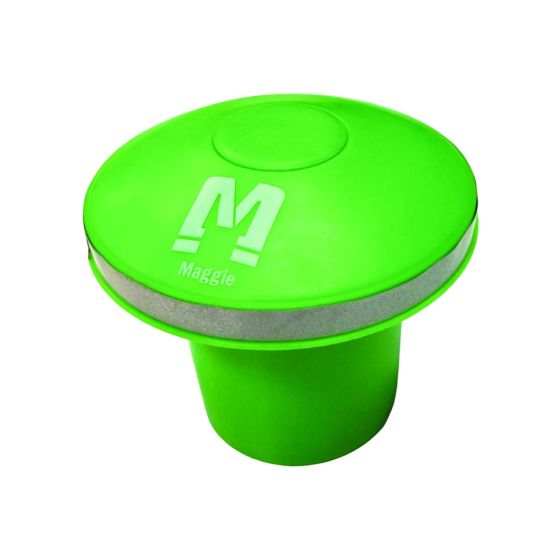
The rebar hazard: what it actually is and why it matters
Reinforcement steel bars, rebar, are left protruding from concrete elements throughout every phase of structural construction. Foundation starter bars, column bars after a slab pour, wall reinforcement during formwork, pile cap bars waiting for the pile cap concrete: on any active construction site, exposed rebar is present somewhere at almost all times.
The hazard is not subtle. An operative who falls onto an uncapped rebar projection faces an impalement risk. A worker who trips and grabs for the nearest solid object may grab a rebar end. Plant operators moving equipment across a groundworks area are routinely working within metres of exposed bars. These are not edge-case scenarios: they are the everyday reality of reinforced concrete construction.
The UK construction industry takes this seriously. Rebar capping is not optional, and HSE inspectors check for it. But the product most commonly used to mitigate the hazard, the standard push-fit mushroom cap, has a significant limitation that the industry has largely accepted as unavoidable.
Until now it was.
↑ Back to topWhat the regulations actually require
UK construction sites are regulated under a framework that makes rebar capping a legal obligation, not a best-practice recommendation. Understanding which regulations apply helps site managers and H&S officers specify the right product and document their compliance correctly.
CDM 2015 Construction (Design and Management) Regulations 2015
The principal contractor has a legal duty to plan, manage, and monitor construction phase health and safety. This includes identifying and controlling foreseeable hazards, of which exposed rebar is one of the most consistently present on concrete construction projects. The Construction Phase Plan must address how rebar hazards are managed, which cap specification is used, and how compliance is maintained throughout the project.
HSWA 1974 Health and Safety at Work Act 1974
The general duty of care requires employers and principal contractors to ensure, so far as is reasonably practicable, the health and safety of all persons on site, including visitors and sub-contractor operatives. A rebar impalement injury following the discovery that caps had been displaced and not replaced would be extremely difficult to defend under this duty.
PUWER 1998 Provision and Use of Work Equipment Regulations 1998
Rebar caps are work equipment. They must be suitable for purpose, maintained in a safe condition, and inspected regularly. A cap that is displaced or damaged and left in situ is not suitable for its protective purpose and constitutes a PUWER compliance failure in addition to the underlying CDM duty.
Key point for procurement: Specifying a magnetic cap over a push-fit cap is a demonstrably stronger compliance position. A site that can show its cap specification was selected to address the specific failure mode of wind displacement is better placed in the event of an HSE inspection or a near-miss investigation than one that cannot explain why standard caps were specified.
Why push-fit caps keep failing on site
The standard mushroom cap is a simple product: a domed polypropylene or LDPE cap with tapered internal ribs that grip the rebar by friction when pushed down. The design has not changed fundamentally in decades and it works adequately in controlled conditions. The problem is that construction sites are not controlled conditions.
The four failure modes of push-fit rebar caps
Push-fit mushroom cap Standard
- Relies entirely on friction between internal ribs and bar surface
- Wind load applies sustained upward and lateral force the friction cannot always resist
- Concrete slurry on bar surface acts as a lubricant, reducing grip significantly
- Vibration from nearby plant causes progressive loosening over time
- Incidental contact from plant, materials, or operatives knocks caps off without immediate notice
- No visibility in low-light conditions: no retroreflective feature
- Displacement is invisible from distance: uncapped bars look similar to capped ones in low light
MAGGIE magnetic cap 2026
- NdFeB magnet provides retention independent of surface condition or friction
- Magnetic force resists wind load, vibration, and lateral contact simultaneously
- Flexible hybrid grip collar stabilises cap regardless of bar surface condition
- One-handed snap-fit placement takes seconds per bar
- 360° retroreflective band visible at night and in low light
- Hi-vis green body clearly visible from plant cab and across site
- Reusable: removed cleanly and reinstalled on the next project
The invisible displacement problem: Push-fit caps that blow off overnight leave bars uncapped before the morning shift arrives. Unless someone walks every bar before work starts, which is rarely practical on a large groundworks site, those bars remain unprotected until the missing cap is noticed. Magnetic caps that resist displacement do not create this invisible window of non-compliance.
Types of rebar cap on the UK market in 2026
Not all rebar caps offer the same level of protection. The UK market in 2026 has three main categories, each with a different performance profile and compliance position.
Standard push-fit mushroom cap
The most widely used cap type in the UK. LDPE or polypropylene dome, friction-fit via internal tapered ribs. Available in hi-vis green, orange, or yellow. Suitable for most standard applications on sites without significant wind exposure or overnight working. The baseline specification: compliant, cost-effective, and adequate when displacement risk is actively managed through daily inspection.
Heavy-duty and steel-reinforced caps
A steel plate insert inside the cap dome is designed to resist penetration if a worker falls directly onto the bar. These caps are specified on sites where fall-onto-rebar risk is elevated, such as deep excavations or elevated working platforms adjacent to exposed bars. The steel insert dramatically increases impact resistance but does not address the displacement problem: a heavy-duty push-fit cap that has blown off provides no more protection than a standard cap that has blown off.
Magnetic snap-fit cap
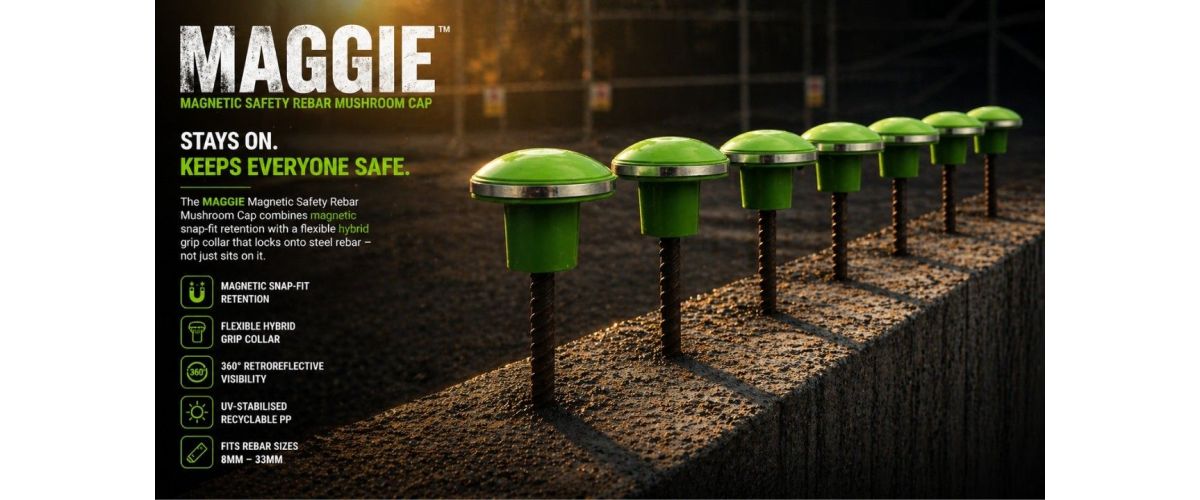
A neodymium magnet encapsulated in the cap body snaps directly onto steel rebar and holds firm against wind and vibration. The MAGGIE Magnetic Safety Rebar Mushroom Cap is the only magnetic rebar cap available in the UK market as of 2026. It combines the magnetic retention system with a 360° retroreflective band, a flexible hybrid grip collar, and a UV-stabilised PP body designed for the full service life of a typical construction project.
Which cap type is right for your site? Standard push-fit caps are the correct specification for sheltered sites with good daily inspection routines and no night-time working. Magnetic caps are the correct upgrade specification for exposed sites, sites with overnight or shift working, sites where push-fit caps have historically been found displaced, and any site where the principal contractor wants to demonstrate a proactive compliance approach to rebar hazard management.
How magnetic retention actually works
Understanding the technology behind the MAGGIE cap helps site managers and H&S officers explain the specification decision to clients, CDM coordinators, and HSE inspectors.
NdFeB: what it is and why it matters
NdFeB stands for neodymium-iron-boron, the strongest commercially available permanent magnet material. Neodymium magnets are the same grade used in electric motors, wind turbines, and MRI machines: they are not novelty magnets. An NdFeB magnet of the size encapsulated in the MAGGIE cap generates a holding force that significantly exceeds the wind and vibration loads typically encountered on UK construction sites, including exposed coastal and elevated infrastructure sites.
Encapsulated magnet
The NdFeB magnet is fully encapsulated in the PP body, protecting it from concrete slurry, water, and site chemicals.
360° retroreflective band
Returns light from any horizontal angle in low-light and night conditions. No competing UK rebar cap offers this.
One-handed placement
The magnetic snap-fit allows operatives to cap rebar one-handed with no pressing or twisting. Significantly faster on large sites.
Flexible hybrid grip collar
Stabilises the cap across varying bar diameters and surface conditions. Resists vibration-induced loosening.
UV-stabilised PP body
Impact-modified polypropylene resists the brittleness and cracking that affects standard rebar caps.
Reusable and recyclable
Remove cleanly at project end, inspect, and redeploy on the next site. Recyclable PP material.
The MAGGIE Magnetic Safety Rebar Mushroom Cap
The MAGGIE cap is the only magnetic rebar safety cap available in the UK construction market in 2026. It was designed specifically to address the displacement failure mode of push-fit caps, with an engineering specification that goes beyond any standard mushroom cap currently available.
MAGGIE Magnetic Safety Rebar Mushroom Caps - Pack of 100
The UK's first magnetic snap-fit rebar cap. NdFeB neodymium magnet, 360° retroreflective band, flexible hybrid grip collar, and UV-stabilised PP body. Two size variants covering 8mm to 33mm. Packed in boxes of 100.
- Magnetic snap-fit: one-handed placement, wind-resistant retention
- Encapsulated NdFeB magnet: corrosion-protected, high-strength
- 360° retroreflective band: visible in low-light and at night
- Covers 8mm to 33mm bar across two size variants
- UV-stabilised PP body, reusable, recyclable
- Box of 100 caps per order
Choosing the right size variant
The MAGGIE cap is available in two size variants. The correct choice depends on the bar diameter range in use on your site. The overlap between 22mm and 25mm means either variant works on T25 bar: select CF130005 if your site predominantly uses bar above T20.
| Product Code | Bar Diameter Range | Rebar Grade Coverage | Typical Applications |
|---|---|---|---|
| CF130004 | 8mm to 25mm | T8, T10, T12, T16, T20, T25 and wire/studding | General groundworks, slab reinforcement, column starter bars |
| CF130005 | 22mm to 33mm | T25, T32 and large diameter heavy structural bar | Heavy-duty structural rebar, pile cap reinforcement |
What size rebar is most common on UK construction sites?
The most common bar sizes on UK residential and commercial construction sites are T10, T12, T16, and T20, all of which fall within the CF130004 range. For most building sites, CF130004 will cover the full range of exposed bars. For infrastructure and groundworks contractors working with larger structural sections, ordering both variants ensures full coverage across all exposed bar sizes.
Ordering tip: If you are unsure which variant to order, check your reinforcement schedule or engineer's drawing for the range of bar diameters specified. Order CF130004 for bars up to T25 and CF130005 for T25 and above.
The true cost of displaced rebar caps
Rebar caps are a low-cost item. A box of 100 caps represents a very small fraction of the safety budget on any construction project. The true cost calculation is not the cap price: it is the cost of the risk that a displaced cap creates.
Direct costs of cap displacement
- Re-capping labour: An operative tasked with replacing displaced caps spends significant time on a task that would not be necessary if the original caps had stayed in place.
- Work stoppage: If an HSE inspector arrives during the period between displacement and re-capping, the site may face a prohibition notice, stopping work until compliance is restored.
- Incident investigation: A near-miss involving an uncapped bar triggers an incident report, investigation, and potentially a RIDDOR notification.
The cost comparison
A magnetic rebar cap costs more per unit than a standard push-fit cap. On a large groundworks site with 1,000 exposed bars, the premium for magnetic caps over push-fit is a defined, predictable cost. The alternative cost, being a site stoppage, an HSE improvement or prohibition notice, or a RIDDOR reportable incident, is neither defined nor predictable.
Sustainability note: The MAGGIE cap's reusable design means the cost premium reduces further across multiple projects. A cap that is removed at the end of Project A, inspected, cleaned, and redeployed on Project B has its per-use cost halved.
Order the MAGGIE Magnetic Safety Rebar Mushroom Caps
Both size variants are available at cmt.co.uk in boxes of 100. We operate a fleet of over 100 vehicles covering 90% of the UK mainland with next working day delivery on orders placed by 7pm online. VIP dedicated delivery is available UK-wide for urgent site requirements. Trade accounts and EDGE portal ordering available for procurement teams.
Shop MAGGIE caps at CMT Group UK