The definitive guide to debris netting for UK construction sites. Covers colour selection and hazard conventions, CDM compliance, step-by-step installation, scaffold wind loading, flame-retardant requirements, and maintenance. Written for site managers, scaffolding contractors, and principal contractors.
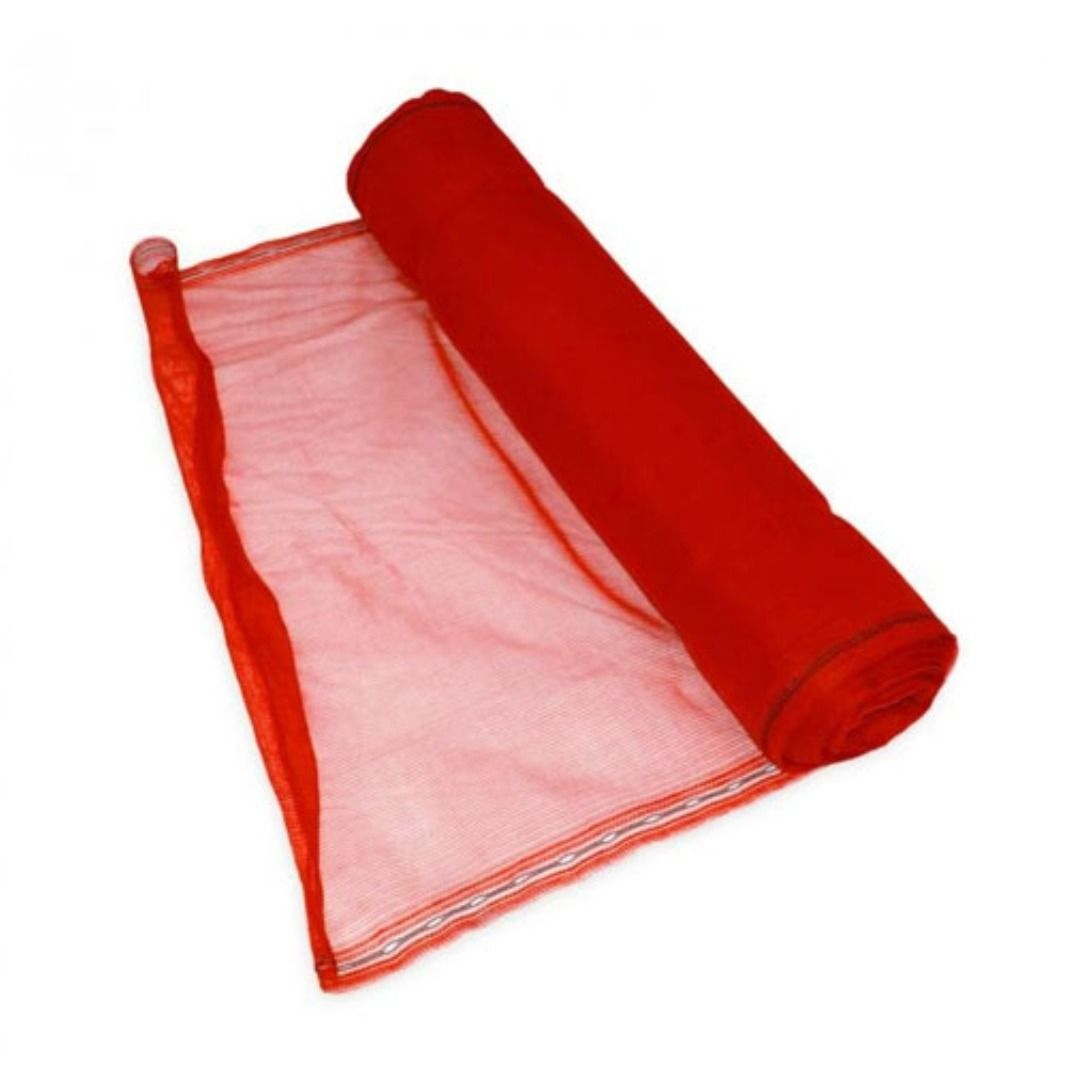
Red eyeletted debris netting supplied in a 2 metre x 50 metre roll for danger zone marking, restricted access perimeters, demolition sites, and high-hazard exclusion zones on UK construction and civil engineering sites.
- Red colour for danger zone marking, restricted access, and prohibition perimeters consistent with UK site safety colour conventions
- Eyeletted construction with buttonhole eyelets along edges and centre section for fast, secure fixing
- 50gsm knitted HDPE construction for debris containment and wind reduction
- Not flame retardant: do not use where fire-rated netting is specified
- Supplied as a single 2m x 50m roll
- Red
Red Debris Netting Roll 2m x 50m - Eyeletted 50gsm
Red eyeletted debris netting supplied in a 2 metre x 50 metre roll for danger zone marking, restricted access perimeters, demolition sites, and high-hazard exclusion zones on UK construction and civil engineering sites.
- Red colour for danger zone marking, restricted access, and prohibition perimeters consistent with UK site safety colour conventions
- Eyeletted construction with buttonhole eyelets along edges and centre section for fast, secure fixing
- 50gsm knitted HDPE construction for debris containment and wind reduction
- Not flame retardant: do not use where fire-rated netting is specified
- Supplied as a single 2m x 50m roll
- Red
- Buy 5 for £49.31 £41.09 each and save 5%
- Buy 10 for £45.58 £37.98 each and save 12%
| BULK DISCOUNT | 5 | 10 |
|---|---|---|
| Price | £41.09 £49.31 | £37.98 £45.58 |
Order 1x to earn 43 FASTPoints
Order to earn 43 FASTPoints
Log in to access trade discountsRed Debris Netting Roll 2m x 50m
Red debris netting supplied in a 2 metre x 50 metre roll for site managers, demolition contractors, and principal contractors requiring danger zone marking, restricted access perimeter screening, and prohibition boundary delineation on UK construction, demolition, and civil engineering sites. Red is the established colour for danger, prohibition, and restricted access in UK site safety conventions, consistent with the colour coding used in safety signage under the Health and Safety (Safety Signs and Signals) Regulations 1996. Specifying red debris netting on a restricted access perimeter or danger zone boundary communicates the highest level of hazard or access restriction to operatives and the public in a way that green, yellow, and orange netting does not. Manufactured to approximately 50gsm from knitted HDPE with buttonhole eyelets along both edges and through the centre section for fast and secure fixing to scaffold tube, heras fencing panels, and post systems. Supplied as a single roll. Not flame retardant: where fire-rated netting is required by a fire risk assessment or site specification, a certified flame-retardant variant must be used.
How red netting communicates danger and restricted access on construction and demolition sites
Colour coding is one of the most immediate and universally understood communication tools on a construction site. Green signals a general working area. Yellow and orange signal caution and heightened hazard. Red signals danger, prohibition, and restricted access, consistent with the red used in prohibition signs, fire safety equipment, and emergency stop controls across UK workplaces. On a demolition site, a structural collapse zone, or a restricted access area adjacent to live underground services, the distinction between orange perimeter netting and red perimeter netting is not cosmetic. It communicates a qualitatively different level of hazard to anyone approaching the boundary, reducing the cognitive load on operatives who must make fast access decisions in busy site environments.
Key Features
Red danger and prohibition colour: Consistent with UK site safety colour conventions for danger, prohibition, and restricted access under the Health and Safety (Safety Signs and Signals) Regulations 1996. Communicates the highest level of hazard or access restriction to operatives and the public at a glance, without requiring additional signage at every fixing point.
Buttonhole eyelets along edges and centre section: Reinforced fixing points distributed along both long edges and through the mid-section allow systematic installation with cable ties or scaffold clips at defined intervals. Reduces installation time and distributes fixing load across reinforced points rather than raw mesh strands.
50gsm knitted HDPE construction: Knitted construction absorbs movement and wind load without tearing at fixing points. The 50gsm weight provides debris containment and wind reduction without adding significant load to the scaffold structure or heras fencing system.
2 metre working height: Matches standard scaffold bay and heras panel heights, reducing the need for overlapping or trimming on most applications. Covers 100 square metres per roll.
Not flame retardant: This product does not carry a flame-retardant rating. Where a fire risk assessment or site fire safety specification requires FR-rated netting, a certified FR variant must be specified. On demolition sites where fire risk assessment requirements are heightened, this distinction is particularly important.
Supplied as a single roll: Each order is fulfilled as one complete 2m x 50m roll. No minimum multi-roll requirement on standard orders.
Who is this for
Trades and roles:
- Demolition contractors
- Site managers and principal contractors
- Civils and groundwork contractors
- Structural engineers and project managers
- Utilities and infrastructure operatives
Industries:
- Demolition and strip-out
- Construction and civil engineering
- Utilities and infrastructure
- Structural refurbishment
- Facilities management

Specifications
| Specification | Detail |
|---|---|
| Product Name | Red Debris Netting Roll 2m x 50m - Eyeletted 50gsm |
| SKU / Product Code | DN200RED |
| Product Type | Knitted HDPE debris containment netting |
| Primary Function | Danger zone marking, restricted access perimeter screening, debris containment |
| Material | HDPE (high-density polyethylene), knitted construction |
| Weight (gsm) | Approximately 50gsm |
| Eyelet Construction | Buttonhole eyelets along both edges and centre section |
| Roll Dimensions | 2 metres x 50 metres |
| Coverage per Roll | 100 square metres |
| Flame Retardant | No — not flame retardant |
| Colour | Red |
| Supply Format | Single roll |
Compatibility
| Application / Condition | Status |
|---|---|
| Danger zone and restricted access perimeter marking | ✓ Compatible |
| Demolition site exclusion zone perimeters | ✓ Compatible |
| Structural collapse zone boundary marking | ✓ Compatible |
| Heras fencing danger and prohibition perimeter screening | ✓ Compatible |
| Scaffold face debris containment on high-hazard sites | ✓ Compatible |
| Live services exclusion zone perimeters | ✓ Compatible |
| Colour-coded site zone systems requiring red prohibition marking | ✓ Compatible |
| Sites requiring flame-retardant netting | ✗ Not suitable — not flame retardant |
| Fall arrest or personnel safety netting | ✗ Not suitable — debris netting only |
| Full weatherproof sheeting replacement | ✗ Not suitable — open mesh construction |
Who is this for
Red debris netting at this specification is used primarily by demolition contractors, principal contractors, and site managers on UK construction and demolition sites where danger zone marking, restricted access perimeter screening, and prohibition boundary delineation are required. The red colour communicates the highest level of hazard or access restriction in the standard UK site safety colour range, making it the correct choice for structural collapse zones, live services exclusion areas, demolition perimeters, and any site location where operatives and the public must understand immediately that access is prohibited or severely restricted. Site managers operating colour-coded zone systems across large construction projects will find red netting the appropriate designation for the most restricted zones, used in combination with orange, yellow, and green netting for lower-hazard areas. Utilities contractors marking live high-voltage cable or gas main exclusion zones and structural engineers cordoning off areas of structural risk will find red the correct colour specification for those applications.
Typical applications
Marking structural collapse zones and unsafe structure perimeters on demolition and strip-out sites where access is prohibited to all operatives except those directly supervising or managing the structural risk.
Screening heras fencing perimeters around live services excavations, high-voltage cable exposure zones, and gas main working areas where red signals an absolute access restriction to unauthorised operatives.
Defining the highest-hazard restricted access zones in colour-coded site safety systems on large construction and civil engineering projects where green, yellow, orange, and red netting designate progressively more restricted areas.
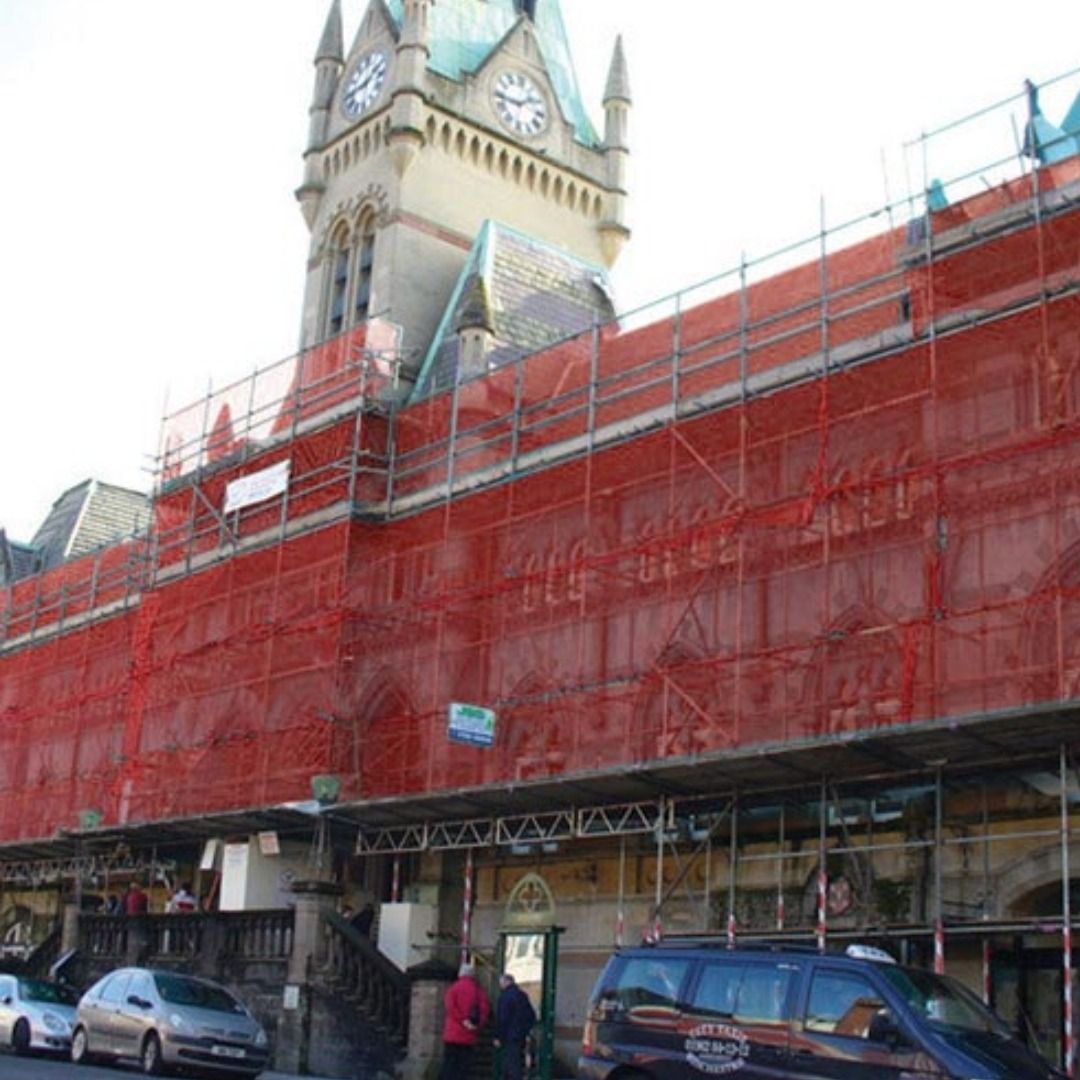
Wrapping scaffold faces on demolition and structural alteration sites where the work above presents a significantly elevated falling object risk and the red perimeter signals a higher level of hazard than standard scaffold netting colours convey.
Marking temporary exclusion zones around structural propping, shoring, and temporary works installations where access by unauthorised operatives during the works period presents a structural safety risk.
Creating clearly identifiable danger perimeters on emergency repair and emergency structural works sites where the hazard boundary must be communicated rapidly and unambiguously to site operatives and members of the public.
How to use
Step 1: Before attaching to any scaffold structure, inform the scaffold designer and erector so they can confirm the scaffold is designed to carry the additional wind load. This is mandatory regardless of netting colour or application.
Step 2: Unroll the netting along the perimeter or face to be marked, starting from one end. Keep the roll supported during unrolling to prevent the netting dragging on the ground.
Step 3: Secure the top edge first using cable ties or scaffold clips at each buttonhole eyelet along the upper edge. Work along the full length before securing the lower edge.
Step 4: Tension the netting across the face and secure the lower edge at each eyelet, maintaining even tension to prevent billowing and uneven load distribution between fixing points.
Step 5: Secure through the centre eyelets on any span where mid-section movement is visible. On demolition sites where wind conditions can be unpredictable due to the removal of surrounding structures, centre fixing is particularly important.
Step 6: Combine red netting perimeters with appropriate safety signage under the Health and Safety (Safety Signs and Signals) Regulations 1996. Netting colour alone does not replace mandatory prohibition or danger signs at access points.
Step 7: Inspect fixings regularly. Replace any degraded cable ties before the next shift begins, particularly on demolition sites where site conditions can change rapidly.
Common mistakes
Relying on colour alone without supporting signage: Red netting communicates danger and restriction by colour convention, but it does not replace mandatory prohibition and danger signs at perimeter access points under the Health and Safety (Safety Signs and Signals) Regulations 1996. Always combine red netting perimeters with appropriate signage at every entry point.
Using this netting where flame-retardant netting is specified: Demolition and structural alteration sites frequently have heightened fire risk requirements. This product is not flame retardant. Always check the site fire risk assessment before specifying debris netting on demolition and structural works sites.
Attaching to scaffold without notifying the scaffold contractor: The HSE is explicit that debris netting increases wind loading on the scaffold structure. On demolition sites where adjacent structures may have been removed, wind exposure can be significantly higher than on standard construction sites. Always confirm with the scaffold contractor before installation.
Using red netting for general site enclosure: Red netting used for routine site enclosure where no specific danger or access restriction exists undermines the colour coding system across the site. Reserve red for genuine danger zones and restricted access perimeters. Use green for general enclosure.
Under-fixing at the centre section: On exposed demolition sites where surrounding structures have been removed and wind exposure is elevated, fixing only at the top and bottom edges creates dynamic load that concentrates stress at the edge fixing points. Always use the centre eyelets.
Safety
This product is debris containment netting for use on scaffolding, heras fencing, and construction site perimeters. It is not a fall arrest system, safety net, or personnel protection net and must not be used for those purposes. It is not flame retardant: on demolition and structural alteration sites where fire risk assessment requirements are heightened, this is a critical specification check before ordering. Before attaching to any scaffold structure, inform the scaffold designer and erector in accordance with HSE guidance. Red netting perimeters must be supported by appropriate mandatory prohibition and danger signage at all access points under the Health and Safety (Safety Signs and Signals) Regulations 1996. The Working at Height Regulations 2005, CDM Regulations 2015, and the site-specific fire risk assessment are the primary references governing debris containment and perimeter marking requirements on UK demolition and construction sites.
Maintenance
Inspect fixing points regularly during use, particularly after high wind events or rapid changes in site conditions on demolition sites where surrounding structure removal can significantly alter wind exposure. Replace cable ties or scaffold clips showing degradation or loosening before the next shift. Remove carefully after use to avoid tearing at the eyelets. Shake out debris before rolling for storage. Store rolled and under cover away from direct sunlight and heat. Inspect the netting material for tears or degraded areas before redeployment. Replace if the red colour has faded significantly, as a faded perimeter undermines the danger communication purpose of the netting.

Frequently Asked Questions
Q: When should red debris netting be specified instead of orange or yellow on a construction site?
A: Red is the correct specification where the netting is marking a danger zone, restricted access area, or prohibition perimeter rather than a general hazard warning. In UK site safety colour conventions, consistent with the Health and Safety (Safety Signs and Signals) Regulations 1996, red signals danger and prohibition. Orange and yellow signal caution and heightened hazard. On a demolition site, a structural collapse zone, a live services exclusion area, or a restricted access perimeter where unauthorised entry presents a serious risk, red netting communicates a qualitatively different level of restriction from orange or yellow and should be specified accordingly.
Q: Is this debris netting flame retardant?
A: No. This product is not flame retardant. Demolition and structural alteration sites frequently have heightened fire risk requirements in their fire risk assessments, and the correct FR-rated debris netting must be used where fire performance is specified. Do not substitute this product on any site where FR netting is required. If you are unsure whether your site's fire risk assessment requires flame-retardant netting, consult the site fire safety plan or your principal contractor before ordering.
Q: Can red debris netting replace mandatory danger and prohibition signage on a restricted access perimeter?
A: No. Red netting communicates danger and restriction by colour convention, but it does not satisfy the mandatory signage requirements under the Health and Safety (Safety Signs and Signals) Regulations 1996. Prohibition and danger signs must be displayed at all access points to a restricted zone regardless of the netting colour used on the perimeter. Red netting reinforces the message of the signage and extends it visually along the full perimeter between access points. It complements mandatory signage but does not replace it.
Q: What is the difference between red debris netting and red barrier tape for marking exclusion zones?
A: Red barrier tape is a lightweight product used for temporary, short-duration hazard marking where a physical barrier is not required, typically for short-duration works or immediate hazard indication. Red debris netting at 50gsm is a structural perimeter product that provides debris containment alongside hazard marking, withstands sustained wind loading when correctly fixed to heras fencing or scaffold systems, and maintains a defined perimeter boundary over extended project durations. For exclusion zones that need to remain in place for more than a few hours or that face sustained wind conditions, red debris netting is the correct specification rather than barrier tape.
Q: Can red debris netting be used on heras fencing as well as scaffolding?
A: Yes. The 2 metre width matches standard heras panel heights and the buttonhole eyelets allow direct cable tie fixing to the fencing mesh at regular intervals. Red netting on heras fencing perimeters is commonly used on demolition sites and live services excavation areas where the heras fence defines the physical boundary and the red netting communicates the danger or prohibition status of the enclosed area to anyone approaching.
Q: How does wind exposure on demolition sites differ from standard construction sites and why does it matter for netting fixing?
A: On active construction sites, surrounding structures provide shelter that limits wind exposure on internal scaffold faces and perimeter fencing. On demolition sites, the progressive removal of surrounding structures can significantly increase wind exposure on netting installations as the project progresses. This means fixing requirements that were adequate at the start of a demolition project may become insufficient as demolition advances. Inspect all netting fixings regularly on demolition sites and reassess wind exposure as the structural context of the site changes.
Q: How much netting do I need for a typical demolition site perimeter?
A: Each roll covers 100 square metres at 2 metres high and 50 metres long. For a heras fencing perimeter, each roll covers 50 linear metres of standard panel at the correct height. Measure the total linear metres of the restricted access perimeter, divide by 50 to calculate the number of rolls required, and add a minimum 10% contingency for corners, overlaps, and waste on irregular perimeters.
Q: How quickly can I get red debris netting delivered to a demolition or construction site?
A: Order by 7pm for next-day delivery nationwide at no extra cost on stocked lines. CMT Group operates its own fleet of vehicles covering over 95% of the UK mainland, with live order tracking, real-time ETAs, and What3Words integration for precise delivery to any site entrance or compound location without needing a full postcode. VIP 2-hour delivery is available from any CMT depot for time-critical site requirements, including emergency structural works where rapid perimeter establishment is needed. Call the sales team for pricing and availability.
Q: Why order debris netting from CMT Group for demolition and structural works projects?
A: CMT Group holds large stock positions on core site consumable lines with no backorders, so procurement teams can order with confidence for immediate project requirements including emergency and time-critical structural works. The EDGE procurement portal gives contract customers agreed pricing, role-based spending controls, live stock visibility, and full delivery tracking, making it practical to manage recurring netting and site consumable orders across multiple demolition and construction projects simultaneously. CMT Group holds ISO 9001:2015 accreditation, CHAS Elite approval, and Crown Commercial Service Supplier status, and is rated Excellent on Trustpilot with over 400 verified Reviews.io reviews.