The Complete Guide to Debris Netting on UK Construction Sites
Everything site managers, scaffolding contractors, and principal contractors need to know about specifying, colour-coding, installing, and maintaining debris netting. From CDM 2015 compliance to scaffold wind loading.
Section 01
What is debris netting and what does it do?
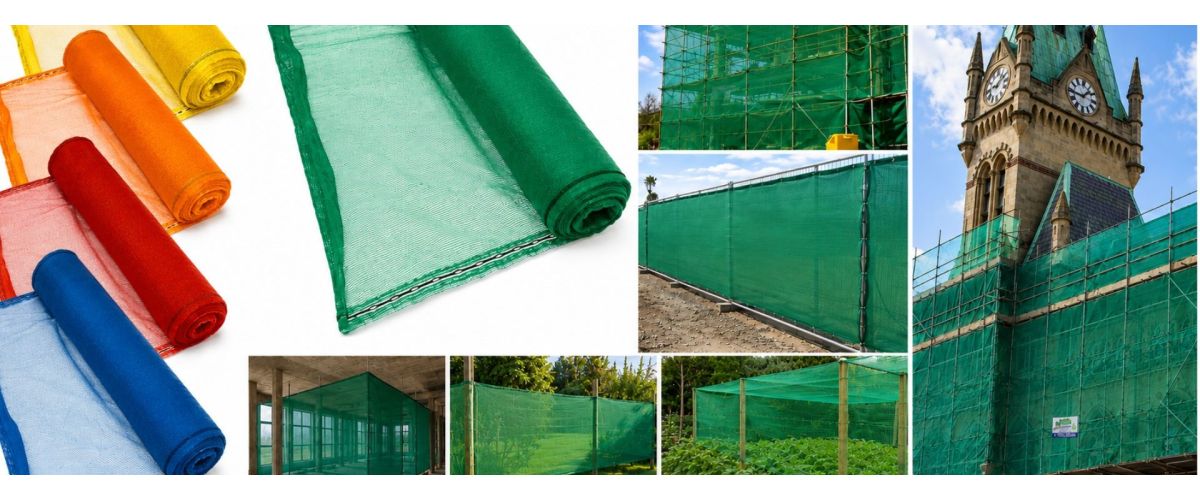
Debris netting is a knitted HDPE (high-density polyethylene) mesh product attached to scaffolding, heras fencing, and temporary site perimeters to contain falling objects, reduce dust migration, and provide wind resistance across the face of a construction site.
Unlike solid scaffold sheeting, debris netting is an open mesh construction. Air passes through it, which reduces the wind loading the scaffold structure must carry whilst still containing loose debris, mortar droppings, and airborne dust that would otherwise reach the public below.
On a scaffolded facade adjacent to a public footpath, debris netting is the primary physical barrier between falling materials and members of the public. It is a direct part of the principal contractor's CDM 2015 public protection duty.
What debris netting is designed to do
- Contain loose debris, mortar, dust, and small materials falling from scaffold structures and working platforms
- Reduce dust migration from construction activities to adjacent public areas, properties, and roads
- Provide partial wind reduction across scaffold faces and site perimeters
- Screen heras fencing perimeters to reduce visibility into the site and improve the appearance of the site boundary
- Communicate hazard level and access restriction through colour in colour-coded site safety systems
What debris netting is not designed to do
- Arrest falls of persons: debris netting is not a fall arrest or safety net system
- Replace scaffold sheeting where full weather protection of the works is required
- Act as a fire barrier: standard HDPE netting is not flame retardant
- Support structural loads or replace scaffold boarding, toe-boards, or brick guards
Standard UK specification
The most common construction site debris netting specification in the UK is knitted HDPE at approximately 50gsm, supplied in 2 metre x 50 metre rolls with buttonhole eyelets along both long edges and through the centre section. The 2 metre width matches standard scaffold bay heights and heras fencing panel heights, making it the practical default for most applications without cutting or overlapping.
Section 02
Debris netting colour guide: what each colour means
Debris netting colour is not formally standardised by a UK or EN regulation. The conventions are industry-established, but they are widely recognised across the UK construction, highways, and utilities sectors and should be treated as standard practice when specifying for any site where the public has access.
| Colour | Convention | Primary application | Avoid using for |
|---|---|---|---|
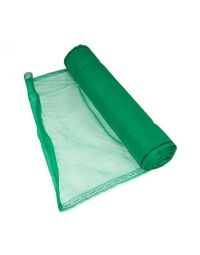
| Green | General site enclosure, neutral | Scaffolding, heras fencing, gardens, allotments, residential and heritage sites | Hazard or danger zone marking where a warning signal is needed |
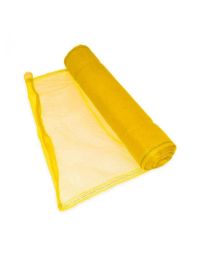
| Yellow | Caution, warning | Urban road works, utilities perimeters, general high-visibility hazard marking | Danger zones, restricted access, or sites where orange is specified |
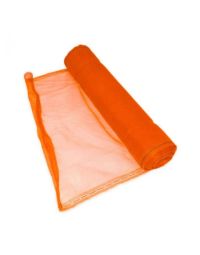
| Orange | High hazard, maximum visibility | Motorway maintenance, A-road works, traffic management, high-speed perimeters | General site enclosure where high-visibility is not required |
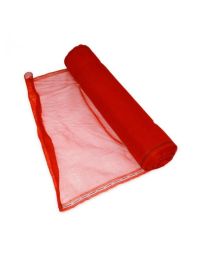
| Red | Danger, prohibition, restricted access | Demolition exclusion zones, structural collapse areas, live services perimeters | General enclosure: reserve for genuine danger and restricted access only |
| Blue | No hazard convention: branding and zone ID | Corporate-branded development sites, colour-coded industrial zone systems | Any hazard communication purpose: use red, orange, or yellow instead |
Important: Red netting communicates danger and restricted access by colour convention alone. It does not satisfy the mandatory signage requirements under the Health and Safety (Safety Signs and Signals) Regulations 1996. Prohibition and danger signs must still be displayed at all access points regardless of netting colour.
Section 03
CMT Group debris netting colour range
All five colours are manufactured to the same 50gsm knitted HDPE specification with buttonhole eyelets along both edges and the centre section. Each is supplied as a single 2m x 50m roll covering 100 square metres. All five colours are held in stock with next-day delivery available nationwide.
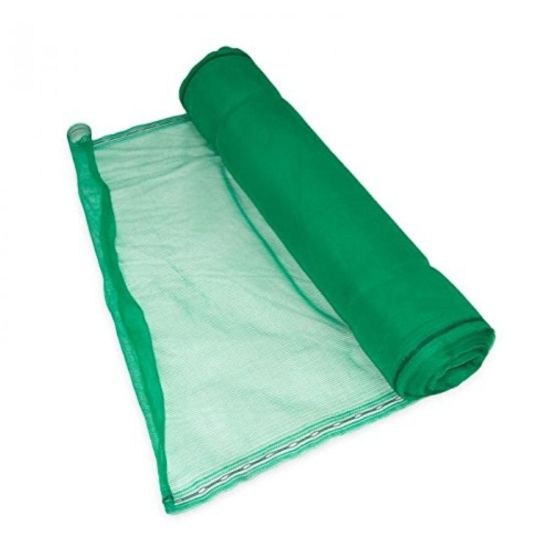
Green Debris Netting
DN200GRE
The standard UK construction site colour. Correct for general scaffold face wrapping, heras fencing, residential areas, heritage settings, gardens, and allotments.
 View product→
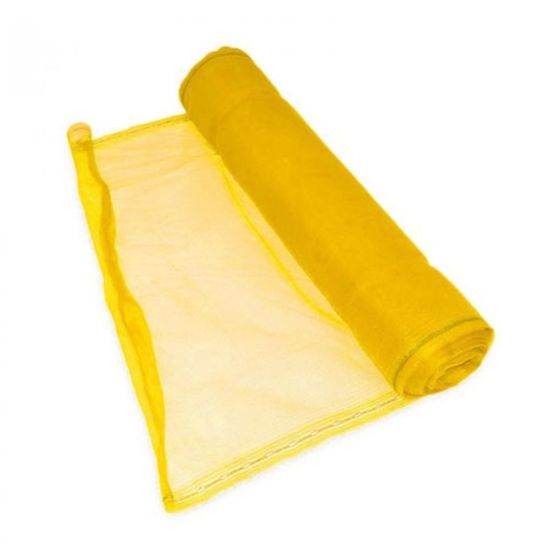
Yellow Debris Netting
DN200YEL
High-visibility warning colour for urban road works, utilities installations, and public-facing hazard perimeters where the netting must communicate caution to passing traffic.
 View product→
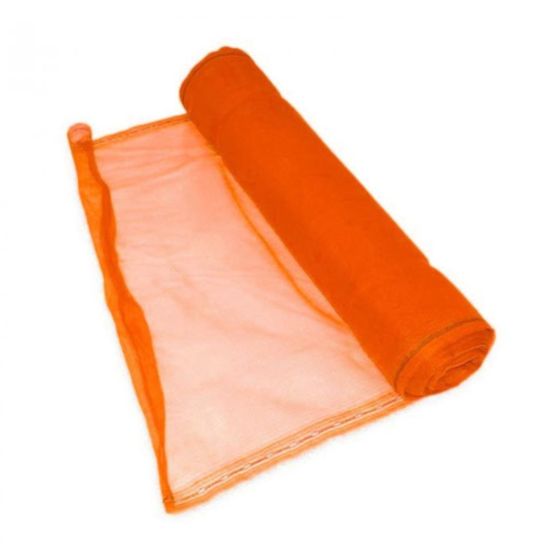
Orange Debris Netting
DN200ORA
Maximum visibility for motorway maintenance, A-road works, and traffic-adjacent sites where driver reaction distance is a direct safety variable.
 View product→
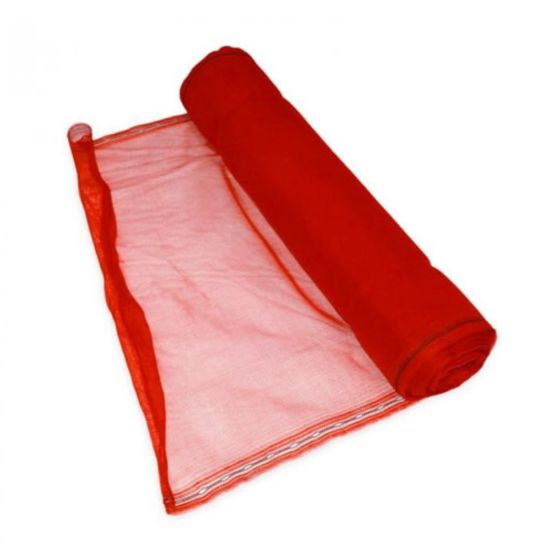
Red Debris Netting
DN200RED
Danger, prohibition, and restricted access. Demolition exclusion zones, structural collapse areas, live services perimeters, and locations where access must be clearly prohibited.
 View product→
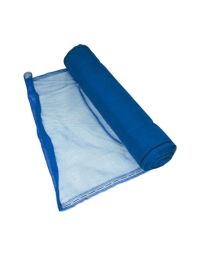
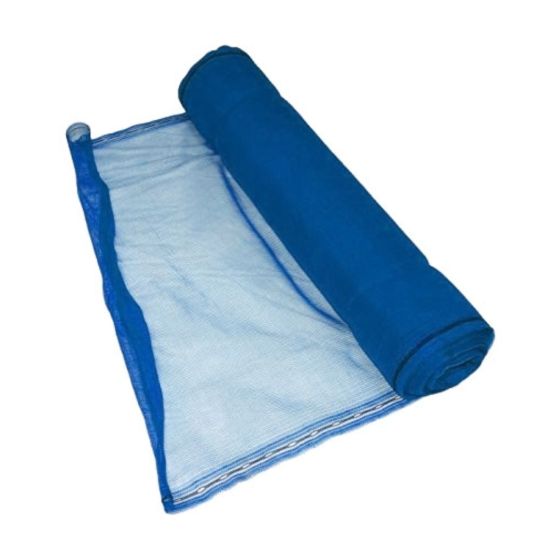
Blue Debris Netting
DN200BLU
No fixed hazard convention. Specified for corporate-branded site enclosures and colour-coded zone systems in industrial and warehousing environments.
 View product→
All five colours in stock. Order by 7pm for next-day delivery.
Own-fleet nationwide delivery covering over 95% of the UK mainland. What3Words site integration for delivery to any gate or compound.
Section 04
How to install debris netting correctly
Correct installation determines whether debris netting performs its containment and wind reduction function throughout the project, or whether it fails at fixings, billows under wind load, and compromises CDM public protection compliance. The most common failures are under-fixing, incorrect tension, and missing mid-section eyelets.
Before you begin: The HSE is explicit that debris netting must never be attached to a scaffold structure without informing the scaffold designer and erector. Netting increases the wind loading on the scaffold. Attaching it to a scaffold not designed for that additional load creates a structural risk. This step is mandatory, not optional.
Notify the scaffold contractor
Confirm with the scaffold designer and erector that the scaffold is designed to carry the wind load imposed by the netting. On traffic-adjacent sites, account for additional dynamic load from passing vehicles. Get confirmation in writing where possible.
Calculate rolls required
Each 2m x 50m roll covers 100 square metres. Measure the total face length and height. Allow a minimum 10% overlap and contingency allowance. On faces taller than 2 metres, rolls will need to be overlapped vertically.
Unroll along the face with support
Keep the roll supported as it is unrolled. Allowing the netting to drag on the ground accumulates debris in the mesh and can damage the material before installation begins. Start from one end and work to the other.
Secure the top edge first
Fix the top edge to the scaffold tube using cable ties or scaffold clips at every buttonhole eyelet along the upper edge. Work along the full top length before moving to the lower edge. This sets the hang of the netting and ensures even tension through the mid-section.
Tension and secure the lower edge
Pull the netting taut across the face and fix the lower edge at each eyelet. Even tension prevents billowing between fixing points under wind load. Uneven tension concentrates stress at individual fixings and accelerates cable tie failure.
Fix through the centre eyelets
The centre eyelets are not optional. On a 2 metre high panel, the mid-point is 1 metre from each fixing line. Under moderate wind, an unfixed mid-section billows significantly, increasing dynamic load at the edge fixings. Fix the centre section at every eyelet along the full run.
Secure all overlaps between rolls
Where two rolls meet, the overlap must be cable-tied at regular intervals along its full height. An unsecured overlap creates a gap that defeats the debris containment purpose of the netting and a flapping section under wind load.
Inspect all fixings before leaving
Walk the full installation before leaving it unattended. Check every cable tie is properly seated. Check tension is even across the full face. On motorway and traffic-adjacent sites, inspect daily as vehicle turbulence creates dynamic loading that standard site wind does not.
Installation on heras fencing
Heras panels give less structural rigidity than scaffold tube. On exposed perimeters, wind load on netting-covered heras fencing can cause panels to topple if feet are not adequately ballasted before attaching netting.
- Confirm heras fencing feet are ballasted appropriately for the additional wind load before attaching netting
- Cable-tie the netting to the mesh of the heras panel at each eyelet along both edges
- Fix through the centre eyelets as with scaffold installation
- Inspect ballasting and panel stability after any high wind event
Fixing method: Cable ties are the standard fixing method for both scaffolding and heras fencing applications. UV-resistant cable ties extend service life on long-duration outdoor installations. For exposed or long-duration sites, build periodic cable tie replacement into the site maintenance schedule.
Section 05
Wind loading: the most important thing site managers get wrong
Wind loading is the single most common reason debris netting installations fail, and the most frequent source of HSE intervention on scaffolded sites. Attaching netting to a scaffold face increases the wind pressure the structure must resist. A scaffold designed without netting may be structurally adequate for its intended load but inadequate once netting is added.
The HSE's guidance on scaffolding design and wind loading is contained in TG20, published by the NASC. TG20 provides calculations for permissible scaffold configurations and explicitly includes the additional loading imposed by debris netting in its design methodology.
Factors that increase wind load
- Higher gsm netting: more solid face, more wind resistance
- Larger netted face area without intermediate supports
- Exposed locations: coastal, elevated, open rural, or traffic-adjacent
- Demolition sites where surrounding structures have been removed
- Multiple stacked rolls on tall scaffold faces
Reducing wind load risk
- Always notify the scaffold contractor before attaching netting
- Fix at all three eyelet lines: top, centre, and bottom
- Use UV-rated cable ties on long-duration installations
- Inspect after every high wind event
- Replace degraded fixings before they fail, not after
Section 06
Regulations and compliance: what the law requires
Debris netting on UK construction sites sits at the intersection of several pieces of primary legislation and industry guidance. Understanding which regulation applies to which aspect of the installation helps site managers and principal contractors meet their duties without relying on generic advice.
Key legislation and guidance
| Construction (Design and Management) Regulations 2015 | Places a duty on principal contractors to protect the public from falling objects and hazards where construction work is adjacent to public areas, roads, and footpaths. Debris netting on external scaffold faces is one of the primary methods for discharging this duty. |
| Work at Height Regulations 2005 | Governs the prevention of falls and the control of falling objects from height on construction sites. Requires employers to take practicable measures to prevent objects falling where they could cause injury. |
| Health and Safety at Work etc. Act 1974 | The overarching duty of care on employers and principal contractors to ensure, so far as reasonably practicable, the health and safety of employees and members of the public affected by the work. |
| Health and Safety (Safety Signs and Signals) Regulations 1996 | Governs mandatory signage requirements at hazard zones and restricted access areas. Debris netting colour conventions are consistent with this framework but do not satisfy mandatory signage requirements at access points. |
| TG20: NASC Scaffolding Guide | Industry guidance on scaffold design and loading, including the additional wind load imposed by debris netting and sheeting. The scaffold contractor must be informed before netting is attached. |
| Chapter 8 of the Traffic Signs Manual | Governs signing, lighting, and guarding on highways works. Relevant for orange and yellow debris netting on motorway and A-road maintenance sites. |
What CDM 2015 requires in practice
CDM 2015 does not prescribe debris netting specifically. It requires principal contractors to plan, manage, and monitor construction work to ensure it is carried out without risks to health and safety, including risks to the public from falling objects. Where a scaffolded facade is immediately adjacent to a public footpath, road, or occupied property, the combination of toe-boards, brick guards, and debris netting represents the minimum expected standard of public protection. Relying on one element alone is unlikely to satisfy a CDM inspection.
Section 07
Debris netting vs scaffold sheeting: which do you need?
This is the most frequent specification question on UK construction sites. The practical difference is significant and the structural implications of getting it wrong are serious.
| Factor | Debris netting (50gsm) | Scaffold sheeting |
|---|---|---|
| Wind loading on scaffold | Moderate: mesh allows air to pass through | High: solid face resists wind entirely |
| Debris containment | Yes: contains loose debris and dust | Yes: complete containment |
| Weather protection | No: open mesh, rain passes through | Yes: full weather protection |
| Visual screening | Partial: semi-transparent at 50gsm | Complete: solid or near-solid opacity |
| Scaffold design requirement | Inform contractor, standard designs often adequate | Scaffold must be specifically designed for the wind load |
| Cost | Lower | Higher |
| Primary use case | CDM public protection, dust suppression, perimeter screening | Weather protection for masonry, restoration, roofing works |
The decision between netting and sheeting is not about preference. It is about the task being carried out. If the work below requires weather protection, specify sheeting and design the scaffold accordingly. If CDM public protection and dust suppression are the primary requirements, debris netting is the correct and more practical specification.
Section 08
Flame-retardant debris netting: when standard HDPE is not enough
Standard HDPE debris netting, including all five colours in the CMT range, is not flame retardant. This is a critical specification distinction that must be checked against the site fire risk assessment before ordering for any project where fire performance could be a requirement.
When is flame-retardant netting required?
- Demolition and structural alteration sites where fire risk from existing materials or services is elevated
- Refurbishment of occupied or partially occupied buildings where fire spread to adjacent areas is a risk
- Sites adjacent to or above other occupied structures, public spaces, or transport infrastructure
- Projects where the client, insurer, or planning authority requires FR materials on the site boundary
- High-rise construction and refurbishment where fire spread via the scaffold face is a specific design risk
Never substitute standard HDPE netting for FR-rated netting where the site fire risk assessment or principal contractor specification requires flame-retardant performance. Standard netting does not provide fire resistance and its use where FR is specified creates a compliance failure and a potential liability.
Section 09
Maintenance, inspection, and replacement
Debris netting is a site consumable that degrades over time through UV exposure, physical abrasion, wind loading, and contact with construction materials. Under CDM 2015, the principal contractor's duty to protect the public is continuous, not just at the point of installation.
Regular inspection checklist
- Check all cable ties at top, centre, and bottom fixing lines for cracking, UV degradation, or loosening after every high wind event
- Inspect the HDPE mesh for tears, perforations, or areas where the mesh has been caught and stretched
- Check all overlap joins are still cable-tied and have not pulled apart under wind load
- Confirm netting tension is even across the full face: visible sagging indicates a fixing has failed
- On demolition sites, reassess wind exposure after significant structural elements are removed
- Check that the netting colour has not faded to the point where its hazard communication function is compromised
When to replace debris netting
- Any section with a visible tear or perforation that could allow debris to pass through
- Any section where the HDPE mesh has degraded, thinned, or become brittle through UV exposure
- Sections where the reinforced eyelet border has torn and the netting can no longer be securely fixed
- High-visibility colours where significant fading has reduced the visual signal effectiveness
Storage between uses
Roll netting loosely after removal. Shake out construction debris before rolling. Store under cover away from direct sunlight: prolonged UV exposure degrades HDPE even in storage. Keep away from solvents, fuels, and heat sources. Inspect before redeployment on a new project.
Section 10
Frequently asked questions
There is no single regulation that mandates debris netting on every scaffold. The duty arises from CDM 2015 and the Work at Height Regulations 2005, which require principal contractors to prevent objects falling where they could cause injury to the public. Where a scaffolded facade is adjacent to a public area, road, or occupied property, the combination of toe-boards, brick guards, and debris netting represents the expected minimum standard of public protection, and a CDM inspector would expect to see it in place.
GSM is grams per square metre: the weight of the netting material. A higher gsm means a denser mesh that provides greater opacity, stronger wind reduction, and improved debris containment. The trade-off is increased wind loading on the scaffold structure. At 50gsm, knitted HDPE netting is the standard construction site specification, sufficient for general debris containment and public protection without requiring special scaffold design in most standard configurations. 70gsm products are used where greater opacity or wind resistance is required on long-duration or exposed sites.
Yes, provided the netting passes inspection before redeployment. Check the HDPE mesh for tears and degradation, inspect the eyelet borders for damage, and confirm the netting material is still structurally sound. Netting that has been on an exposed site for a full year will have experienced significant UV loading and should be inspected carefully. Replace any section that shows degradation before redeploying it on a site where CDM public protection duties apply.
Yes. The 2 metre width and eyeletted construction are the same for both applications. Cut the roll to the required length for each application or use the full 50-metre run across a continuous scaffold face or heras perimeter. There is no technical difference in the product between scaffold and heras fencing use.
Each roll covers 100 square metres at 2 metres high and 50 metres long. For a scaffold face, multiply the total face length by the number of lift heights covered and divide by 100. For a heras perimeter, divide the total linear metres of perimeter by 50. Add a minimum 10% contingency for corners, overlaps, and waste. For irregular perimeters with many corners, allow 15%.
No. All five colours in the CMT range are manufactured to the same 50gsm knitted HDPE specification with the same eyelet construction. Colour is a property of the yarn used in the knitting process and does not affect tensile strength, tear resistance, wind resistance, or debris containment performance. The choice of colour is determined entirely by application context and site specification requirements.
Fix at every eyelet along all three lines: top edge, centre section, and bottom edge. Eyelet spacing on standard 50gsm debris netting is typically every 300mm to 500mm along the edge and centre section. On exposed or traffic-adjacent sites, do not skip eyelets: every fixing point matters for wind load distribution and the security of the installation under dynamic loading.
Order debris netting for your site today
All five colours in stock. Order by 7pm for next-day delivery nationwide. Own-fleet vehicles covering over 95% of the UK mainland with live tracking and What3Words site delivery.