Fixings, Fasteners & Resins

Fixings, fasteners, and resins are the components that hold construction together. CMT Group supplies a comprehensive range of contractor-grade fixings for construction, civil engineering, and groundwork applications, including screws, bolts, anchors, nails, MAX chemical resins, and fixings accessories. Whether specifying for structural connections in concrete and masonry or general fastening across site trades, our range covers the fixings needs of site teams, engineers, and procurement professionals across the UK.
Read more Read less
Selecting the correct fixing for the material, load, and environment is one of the most critical decisions on a construction project. An incorrectly specified fixing in a structural or safety-critical connection can result in failure, with consequences for both the structure and the people working on and around it. CMT Group has been supplying fixings to UK construction sites for over 20 years, with an extensive range curated to cover every specification and application from general trade screws to load-rated structural anchors and chemical resin systems.
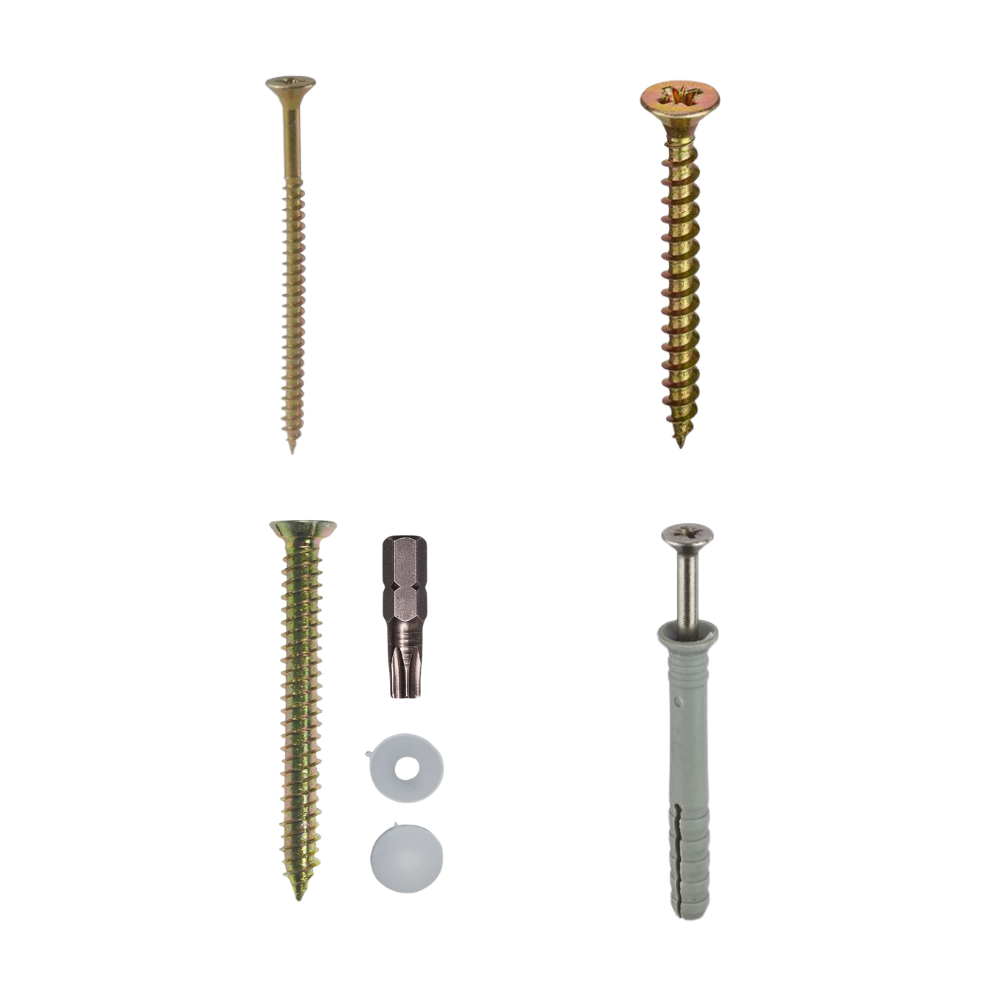
- ✓ Screws for timber, drywall, concrete, and general construction applications
- ✓ Bolts including coach bolts, hex bolts, and hook bolts in multiple grades
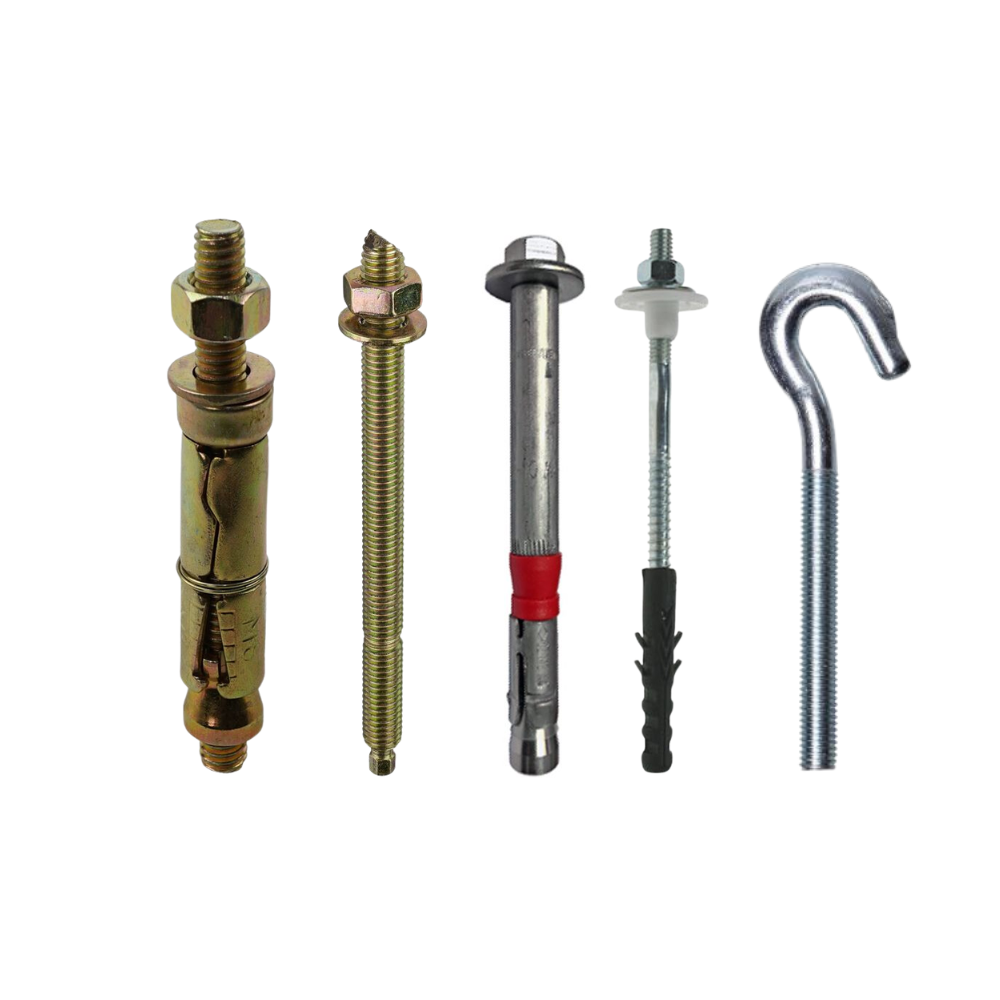
- ✓ Anchors including expansion anchors, through-bolts, and sleeve anchors for concrete and masonry
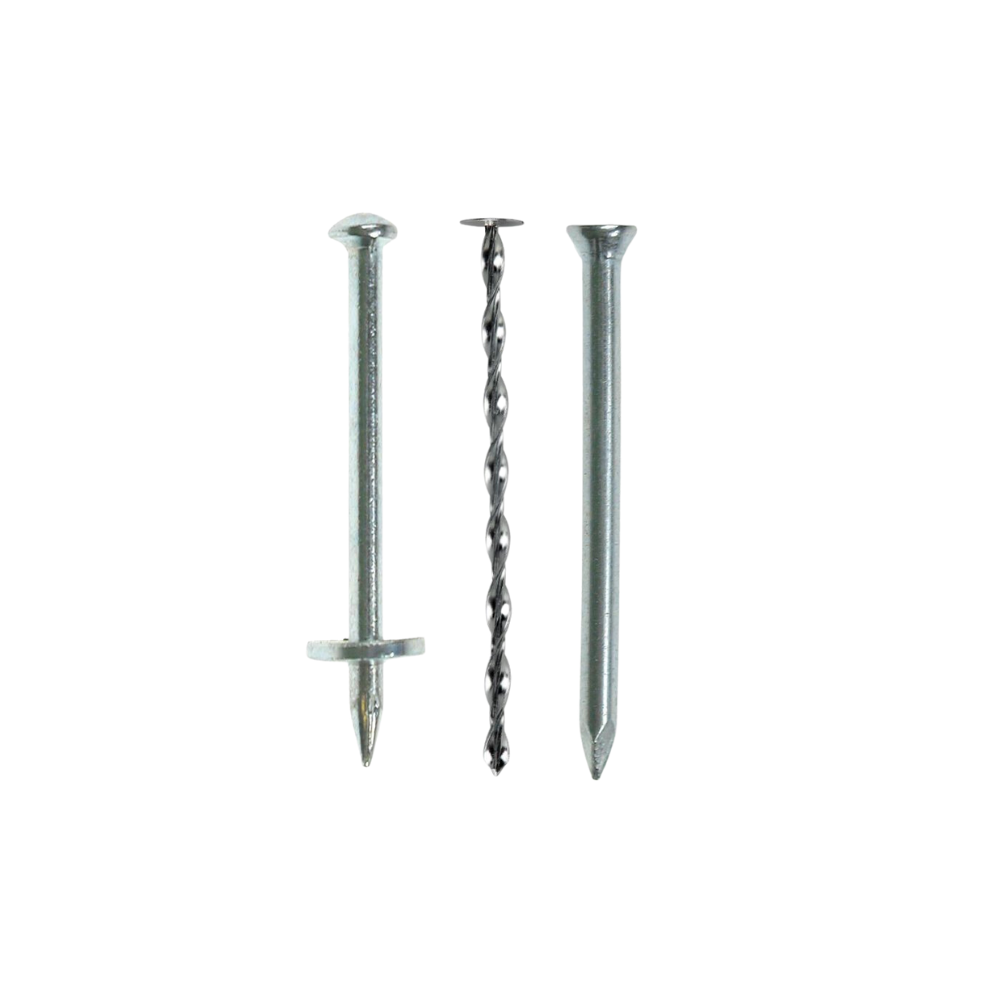
- ✓ Nails for framing, flooring, roofing, and general construction carpentry
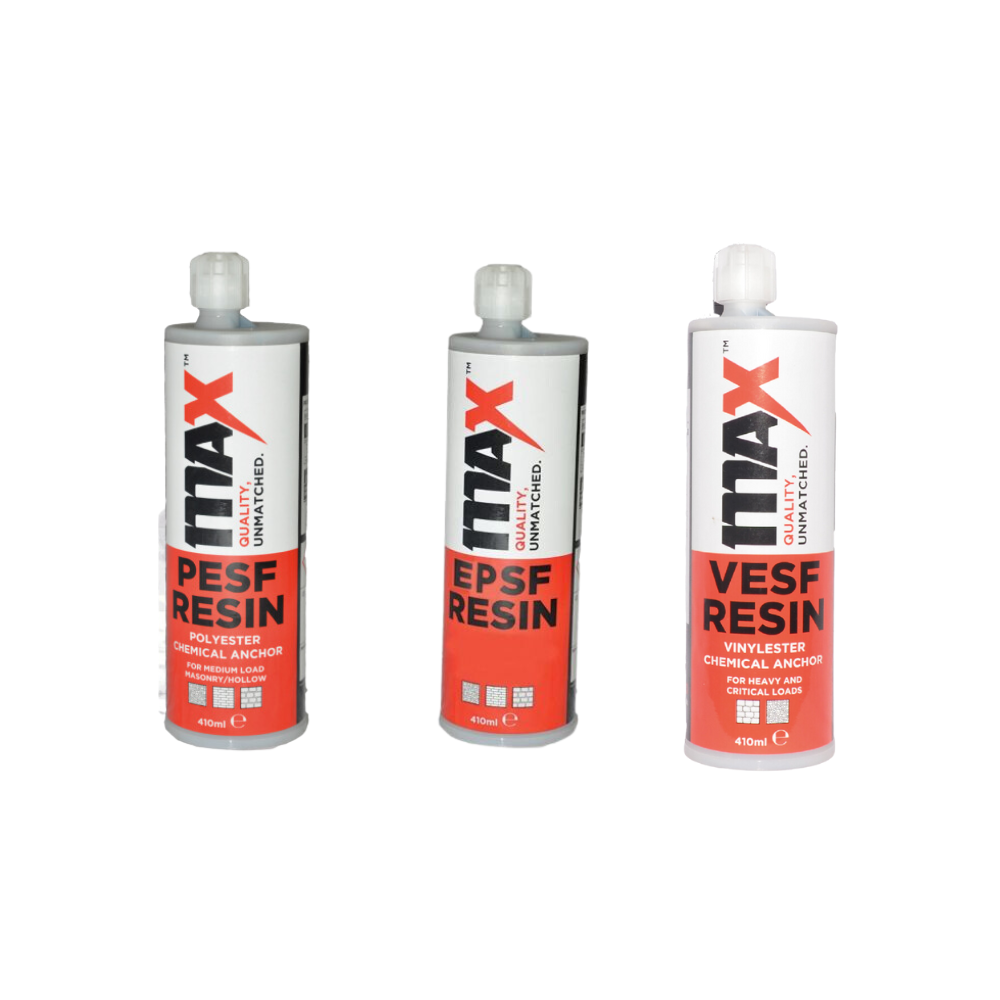
- ✓ MAX chemical resins including polyester, epoxy, and vinylester systems for post-installed anchors
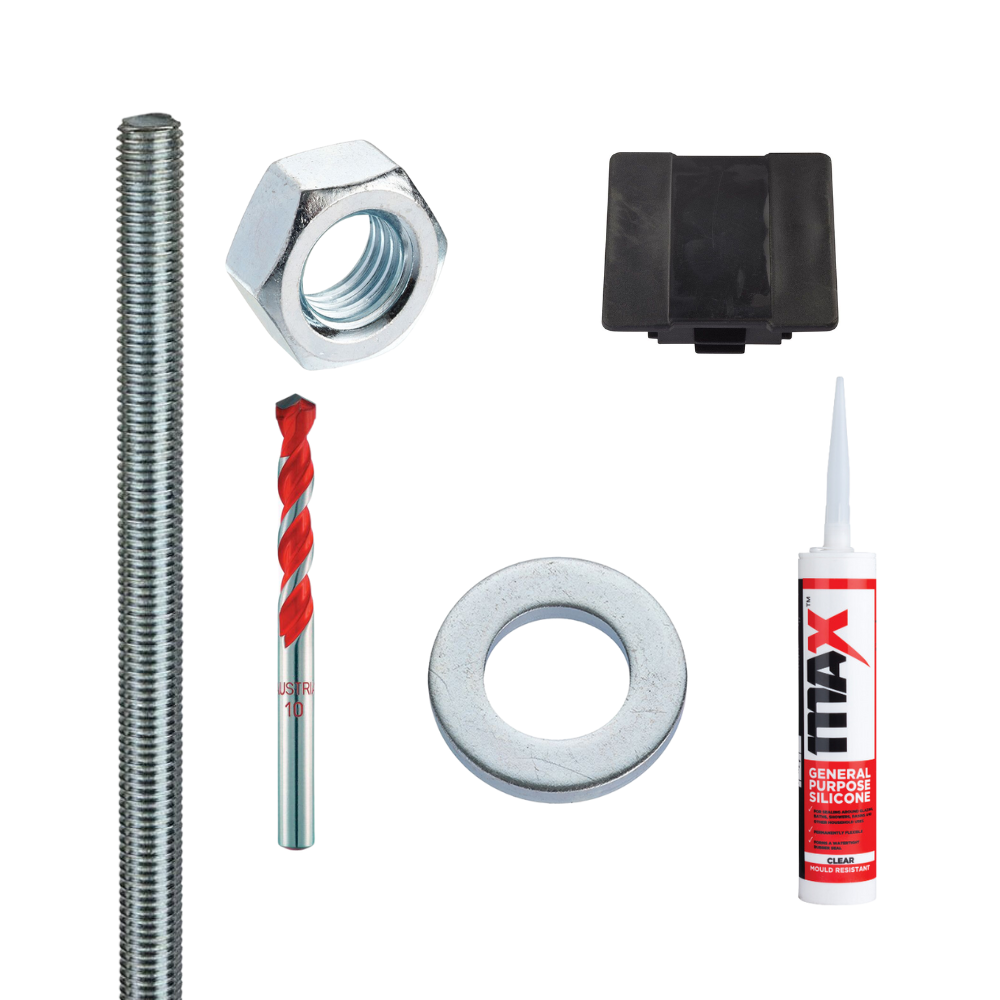
- ✓ Fixings accessories including threaded rod, nuts, washers, drill bits, and sealant
- ✓ Bulk supply available for site procurement and trade accounts
- ✓ Next day delivery standard. VIP 2-3 hour delivery on a dedicated vehicle also available
What Are Construction Fixings?
Construction fixings are the components used to join, secure, and connect materials in building, civil engineering, and infrastructure projects. They include screws and nails for timber and general trade fixing, bolts for steel-to-steel and timber-to-steel connections, mechanical anchors for fixing into concrete and masonry, and chemical resin systems for post-installed anchors in structural and high-load applications.
The correct fixing for a given application depends on the base material being fixed into, the load the fixing must transfer, the direction of that load, and the environment the fixing will be exposed to. Fixings in external or exposed environments require a higher level of corrosion resistance than those used internally, and structural fixings must be specified against the design loads of the connection rather than selected by size alone. Using the wrong fixing in a structural connection is a safety-critical error. CMT Group stocks fixings across the full specification range to support engineers, contractors, and site teams in selecting the right component for every application.
Fixings and Fasteners by Type
Our range covers the fixings and fasteners required across the full scope of construction and groundwork site operations.
Choosing the Right Fixing
The correct fixing for any application depends on four factors: the base material being fixed into, the load the fixing must transfer, the direction of that load, and the environment the fixing will be exposed to. Selecting on size alone without reference to the design load and base material is the most common cause of fixing failure on construction sites.
For timber-to-timber connections, screws and nails provide sufficient fastening for most applications. For connections to concrete and masonry, mechanical anchors are the standard solution for the majority of applications, with chemical resin anchors specified where edge distances are close, spacings are reduced, or the loads exceed what a mechanical anchor can reliably transfer. Corrosion resistance requirements must also be considered: internal environments can use zinc-plated fixings, while external and exposed environments require hot-dip galvanised or stainless steel grades.
| Application | Fixing type | Key consideration |
|---|---|---|
| Timber-to-timber framing and joinery | Woodscrews or wire nails | Length and gauge to suit timber thickness |
| Fixing into concrete and masonry (standard loads) | Mechanical expansion anchor or sleeve anchor | Anchor diameter and embedment depth for load |
| Structural fixing into concrete (high loads, close edges) | Chemical resin anchor (EPSF or VESF) | ETA-approved system and correct cure time |
| Steel-to-steel or steel-to-timber connections | Hex bolts or throughbolts with nuts and washers | Grade to match design load and environment |
| External or exposed environments | Hot-dip galvanised or stainless steel fixings | Corrosion resistance class to BS EN ISO 2081 |
| Roofing, cladding, and weathered applications | Galvanised or stainless roofing screws and nails | Sealing washer where weather resistance required |
Construction Fixings Supplied Across the UK
Fixings play a critical role in construction, civil engineering, and infrastructure projects, where the performance of a connection directly affects the safety, durability, and longevity of the structure. From the nails and screws used in everyday site carpentry to the load-rated chemical anchor systems used for structural post-installed fixings in reinforced concrete, the correct specification of fixing is a fundamental part of sound construction practice.
CMT Group has been supplying fixings and fasteners to UK construction sites for over 20 years. Our range covers the full scope of fixing requirements across construction trades, from bulk nails and screws for general site use to MAX chemical anchor resins for structural applications. We operate our own fleet of 100+ FORS Gold accredited vehicles covering 90% of the UK, with next day delivery standard on orders placed by 5pm by phone or 7pm online, and VIP 2-3 hour delivery on a dedicated vehicle dispatched within 30 minutes for urgent site requirements.
Frequently asked questions
What is the difference between a mechanical anchor and a chemical anchor?
A mechanical anchor holds by expansion within the drilled hole, using a sleeve or wedge that expands against the sides of the hole as the bolt is tightened. Mechanical anchors are suitable for the majority of concrete and masonry fixing applications and can be installed and loaded quickly. A chemical anchor uses a two-component resin injected into the hole before the threaded bar or bolt is inserted. The resin bonds the bar to the base material as it cures, providing a high-strength connection that is particularly effective in cracked concrete, close to edges, and where reduced anchor spacings are required. Chemical anchors require a cure time before loading and are more involved to install, but offer higher load capacity and greater design flexibility in structural applications.
What are the MAX resin types and when do I use each?
CMT Group supplies three MAX chemical resin systems. PESF is a polyester resin suitable for use in uncracked concrete and masonry for non-structural and general fixing applications. EPSF is an epoxy resin providing higher strength and chemical resistance, suitable for structural applications in both cracked and uncracked concrete. VESF is a vinylester resin offering a performance level between polyester and epoxy, suitable for structural use in cracked and uncracked concrete with good chemical resistance properties. For structural applications in reinforced concrete, the system used should be ETA-approved and the selection made against the design load requirements and the base material condition.
What fixings do I need for external and exposed applications?
External and exposed fixing applications require a higher level of corrosion resistance than internal applications. For most external applications in the UK climate, hot-dip galvanised fixings provide sufficient protection and are cost-effective for structural and heavy-duty applications. Stainless steel fixings are required for coastal environments, applications involving direct contact with treated timber, and any application where the fixing will be in contact with dissimilar metals. Zinc-plated fixings are suitable for internal use only and are not appropriate for external or corrosive environments.
Can I buy fixings in bulk for site procurement?
Yes. CMT Group supplies fixings in bulk quantities for site procurement, trade accounts, and ongoing project supply. Screws and nails are available in large trade boxes and bulk pack sizes. Bolts and anchors are available in box quantities suited to site purchasing. Bulk ordering reduces cost per unit and ensures sufficient stock availability for project programmes. Contact our team to discuss volume pricing and account options for ongoing site supply requirements.
Why buy fixings and fasteners from CMT Group?
CMT Group has been supplying fixings to UK construction sites for over 20 years. Our range covers every specification from general trade fasteners to structural chemical anchor systems, and our team can advise on the correct fixing for your application and base material. We hold CHAS Elite accreditation, ConstructionOnline Gold membership, and BSI ISO 9001:2015 certification. We operate our own fleet of 100+ FORS Gold accredited vehicles covering 90% of the UK, with next day delivery standard on orders placed by 5pm by phone or 7pm online, and VIP 2-3 hour delivery on a dedicated vehicle dispatched within 30 minutes for urgent site requirements.
Mechanical Anchors vs Chemical Resins: Which Do You Need?
Mechanical anchors and chemical resin anchors both fix into concrete and masonry, but they work differently and are suited to different applications. Mechanical anchors expand within the hole to grip the base material and can be installed and loaded without a waiting period. They are cost-effective, fast to install, and suitable for the majority of everyday fixing applications in concrete and masonry including fixing brackets, equipment, and non-structural elements.
Chemical resin anchors bond the fixing to the base material as the resin cures, requiring a waiting period before the anchor can be loaded. The cure time varies with the resin type and ambient temperature. The advantage of chemical anchors is that they achieve higher load capacities, perform better in cracked concrete, tolerate reduced edge distances and anchor spacings, and are suitable for applications where mechanical anchors would not meet the structural requirements of the connection. For general non-structural fixing in sound concrete, a mechanical anchor is the practical and cost-effective choice. For structural post-installed anchors, particularly where the engineer has specified a chemical system, use the correct approved resin for the base material and load condition.
Accreditations and memberships


Shop Fixings and Fasteners by Type
Fixings, Fasteners & Resins
Fixings, fasteners, and resins are the components that hold construction together. CMT Group supplies a comprehensive range of contractor-grade fixings for construction, civil engineering, and groundwork applications, including screws, bolts, anchors, nails, MAX chemical resins, and fixings accessories. Whether specifying for structural connections in concrete and masonry or general fastening across site trades, our range covers the fixings needs of site teams, engineers, and procurement professionals across the UK.
Read more Read less
Selecting the correct fixing for the material, load, and environment is one of the most critical decisions on a construction project. An incorrectly specified fixing in a structural or safety-critical connection can result in failure, with consequences for both the structure and the people working on and around it. CMT Group has been supplying fixings to UK construction sites for over 20 years, with an extensive range curated to cover every specification and application from general trade screws to load-rated structural anchors and chemical resin systems.
- ✓ Screws for timber, drywall, concrete, and general construction applications
- ✓ Bolts including coach bolts, hex bolts, and hook bolts in multiple grades
- ✓ Anchors including expansion anchors, through-bolts, and sleeve anchors for concrete and masonry
- ✓ Nails for framing, flooring, roofing, and general construction carpentry
- ✓ MAX chemical resins including polyester, epoxy, and vinylester systems for post-installed anchors
- ✓ Fixings accessories including threaded rod, nuts, washers, drill bits, and sealant
- ✓ Bulk supply available for site procurement and trade accounts
- ✓ Next day delivery standard. VIP 2-3 hour delivery on a dedicated vehicle also available
What Are Construction Fixings?
Construction fixings are the components used to join, secure, and connect materials in building, civil engineering, and infrastructure projects. They include screws and nails for timber and general trade fixing, bolts for steel-to-steel and timber-to-steel connections, mechanical anchors for fixing into concrete and masonry, and chemical resin systems for post-installed anchors in structural and high-load applications.
The correct fixing for a given application depends on the base material being fixed into, the load the fixing must transfer, the direction of that load, and the environment the fixing will be exposed to. Fixings in external or exposed environments require a higher level of corrosion resistance than those used internally, and structural fixings must be specified against the design loads of the connection rather than selected by size alone. Using the wrong fixing in a structural connection is a safety-critical error. CMT Group stocks fixings across the full specification range to support engineers, contractors, and site teams in selecting the right component for every application.
Fixings and Fasteners by Type
Our range covers the fixings and fasteners required across the full scope of construction and groundwork site operations.
Choosing the Right Fixing
The correct fixing for any application depends on four factors: the base material being fixed into, the load the fixing must transfer, the direction of that load, and the environment the fixing will be exposed to. Selecting on size alone without reference to the design load and base material is the most common cause of fixing failure on construction sites.
For timber-to-timber connections, screws and nails provide sufficient fastening for most applications. For connections to concrete and masonry, mechanical anchors are the standard solution for the majority of applications, with chemical resin anchors specified where edge distances are close, spacings are reduced, or the loads exceed what a mechanical anchor can reliably transfer. Corrosion resistance requirements must also be considered: internal environments can use zinc-plated fixings, while external and exposed environments require hot-dip galvanised or stainless steel grades.
| Application | Fixing type | Key consideration |
|---|---|---|
| Timber-to-timber framing and joinery | Woodscrews or wire nails | Length and gauge to suit timber thickness |
| Fixing into concrete and masonry (standard loads) | Mechanical expansion anchor or sleeve anchor | Anchor diameter and embedment depth for load |
| Structural fixing into concrete (high loads, close edges) | Chemical resin anchor (EPSF or VESF) | ETA-approved system and correct cure time |
| Steel-to-steel or steel-to-timber connections | Hex bolts or throughbolts with nuts and washers | Grade to match design load and environment |
| External or exposed environments | Hot-dip galvanised or stainless steel fixings | Corrosion resistance class to BS EN ISO 2081 |
| Roofing, cladding, and weathered applications | Galvanised or stainless roofing screws and nails | Sealing washer where weather resistance required |
Construction Fixings Supplied Across the UK
Fixings play a critical role in construction, civil engineering, and infrastructure projects, where the performance of a connection directly affects the safety, durability, and longevity of the structure. From the nails and screws used in everyday site carpentry to the load-rated chemical anchor systems used for structural post-installed fixings in reinforced concrete, the correct specification of fixing is a fundamental part of sound construction practice.
CMT Group has been supplying fixings and fasteners to UK construction sites for over 20 years. Our range covers the full scope of fixing requirements across construction trades, from bulk nails and screws for general site use to MAX chemical anchor resins for structural applications. We operate our own fleet of 100+ FORS Gold accredited vehicles covering 90% of the UK, with next day delivery standard on orders placed by 5pm by phone or 7pm online, and VIP 2-3 hour delivery on a dedicated vehicle dispatched within 30 minutes for urgent site requirements.
Frequently asked questions
What is the difference between a mechanical anchor and a chemical anchor?
A mechanical anchor holds by expansion within the drilled hole, using a sleeve or wedge that expands against the sides of the hole as the bolt is tightened. Mechanical anchors are suitable for the majority of concrete and masonry fixing applications and can be installed and loaded quickly. A chemical anchor uses a two-component resin injected into the hole before the threaded bar or bolt is inserted. The resin bonds the bar to the base material as it cures, providing a high-strength connection that is particularly effective in cracked concrete, close to edges, and where reduced anchor spacings are required. Chemical anchors require a cure time before loading and are more involved to install, but offer higher load capacity and greater design flexibility in structural applications.
What are the MAX resin types and when do I use each?
CMT Group supplies three MAX chemical resin systems. PESF is a polyester resin suitable for use in uncracked concrete and masonry for non-structural and general fixing applications. EPSF is an epoxy resin providing higher strength and chemical resistance, suitable for structural applications in both cracked and uncracked concrete. VESF is a vinylester resin offering a performance level between polyester and epoxy, suitable for structural use in cracked and uncracked concrete with good chemical resistance properties. For structural applications in reinforced concrete, the system used should be ETA-approved and the selection made against the design load requirements and the base material condition.
What fixings do I need for external and exposed applications?
External and exposed fixing applications require a higher level of corrosion resistance than internal applications. For most external applications in the UK climate, hot-dip galvanised fixings provide sufficient protection and are cost-effective for structural and heavy-duty applications. Stainless steel fixings are required for coastal environments, applications involving direct contact with treated timber, and any application where the fixing will be in contact with dissimilar metals. Zinc-plated fixings are suitable for internal use only and are not appropriate for external or corrosive environments.
Can I buy fixings in bulk for site procurement?
Yes. CMT Group supplies fixings in bulk quantities for site procurement, trade accounts, and ongoing project supply. Screws and nails are available in large trade boxes and bulk pack sizes. Bolts and anchors are available in box quantities suited to site purchasing. Bulk ordering reduces cost per unit and ensures sufficient stock availability for project programmes. Contact our team to discuss volume pricing and account options for ongoing site supply requirements.
Why buy fixings and fasteners from CMT Group?
CMT Group has been supplying fixings to UK construction sites for over 20 years. Our range covers every specification from general trade fasteners to structural chemical anchor systems, and our team can advise on the correct fixing for your application and base material. We hold CHAS Elite accreditation, ConstructionOnline Gold membership, and BSI ISO 9001:2015 certification. We operate our own fleet of 100+ FORS Gold accredited vehicles covering 90% of the UK, with next day delivery standard on orders placed by 5pm by phone or 7pm online, and VIP 2-3 hour delivery on a dedicated vehicle dispatched within 30 minutes for urgent site requirements.
Mechanical Anchors vs Chemical Resins: Which Do You Need?
Mechanical anchors and chemical resin anchors both fix into concrete and masonry, but they work differently and are suited to different applications. Mechanical anchors expand within the hole to grip the base material and can be installed and loaded without a waiting period. They are cost-effective, fast to install, and suitable for the majority of everyday fixing applications in concrete and masonry including fixing brackets, equipment, and non-structural elements.
Chemical resin anchors bond the fixing to the base material as the resin cures, requiring a waiting period before the anchor can be loaded. The cure time varies with the resin type and ambient temperature. The advantage of chemical anchors is that they achieve higher load capacities, perform better in cracked concrete, tolerate reduced edge distances and anchor spacings, and are suitable for applications where mechanical anchors would not meet the structural requirements of the connection. For general non-structural fixing in sound concrete, a mechanical anchor is the practical and cost-effective choice. For structural post-installed anchors, particularly where the engineer has specified a chemical system, use the correct approved resin for the base material and load condition.
Accreditations and memberships