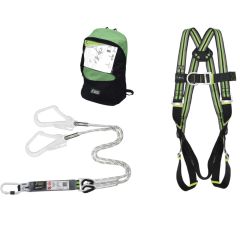


A 1.8m forked energy absorbing webbing lanyard from Kratos Safety for 100% tie-off, EN 355:2002 certified and VG11 three-point tested, with twin steel scaffold hooks and screw-lock karabiner.
-
100% tie-off: twin legs allow continuous connection during anchor transfer
-
Fall indicator: visual pre-use check, confirms fall arrest status
-
Twin steel scaffold hooks: double-action auto-locking, FA 50 207 55 x2
-
Energy absorber: 35mm webbing, limits fall force to under 6kN
-
Loop protection: abrasion-resistant tubular webbing throughout
-
Max user weight: 100kg including tools and equipment
-
Certification: EN 355:2002, VG11 three-point tested, UKCA marked
Kratos HOPE - Forked Energy Absorbing Webbing Lanyard 1.8m - Fall Indicator and Twin Steel Scaffold Hooks

A 1.8m forked energy absorbing webbing lanyard from Kratos Safety for 100% tie-off, EN 355:2002 certified and VG11 three-point tested, with twin steel scaffold hooks and screw-lock karabiner.
-
100% tie-off: twin legs allow continuous connection during anchor transfer
-
Fall indicator: visual pre-use check, confirms fall arrest status
-
Twin steel scaffold hooks: double-action auto-locking, FA 50 207 55 x2
-
Energy absorber: 35mm webbing, limits fall force to under 6kN
-
Loop protection: abrasion-resistant tubular webbing throughout
-
Max user weight: 100kg including tools and equipment
-
Certification: EN 355:2002, VG11 three-point tested, UKCA marked
- Buy 20 for £65.84 £54.87 each and save 8%
- Buy 50 for £60.50 £50.42 each and save 15%
| BULK DISCOUNT | 20 | 50 |
|---|---|---|
| Price | £54.87 £65.84 | £50.42 £60.50 |
Order 1x to earn 59 FASTPoints
Order to earn 59 FASTPoints
Log in to access trade discountsKratos HOPE Forked Energy Absorbing Webbing Lanyard 1.8m
The Kratos HOPE Forked Energy Absorbing Webbing Lanyard is the twin-leg version of the HOPE range, designed for operatives who need to remain connected to a fall arrest anchor at all times, including during anchor point transfers. The Y-shaped configuration provides one steel screw-locking karabiner at the harness end and two steel scaffold hooks at the anchor ends, allowing one leg to be connected to the new anchor before the first is released. No moment of unprotected exposure during the transfer.
The 35mm energy absorber limits fall arrest force to under 6kN, the fall indicator label gives a clear visual pre-use status check, and the VG11 three-point test confirms a minimum breaking strength above 9kN at all three ends simultaneously. For scaffolders, structural steel workers, and construction operatives working across multiple anchor points, this is the correct specification.
Why Choose the Kratos HOPE Forked Energy Absorbing Webbing Lanyard
-
100% tie-off at all times: the twin-leg design ensures the operative is always connected to at least one anchor during transfer. This is the critical safety requirement for scaffolding erection, mast climbing, and any task requiring regular anchor point changes.
-
VG11 three-point tested: the complete assembly is tested at all three ends simultaneously to above 9kN, not just individual components. This is the test that matters for a forked lanyard under real-world loading.
-
Fall indicator label: the visual NOT OK indicator gives an immediate pre-use status check. If it has activated, the lanyard is condemned and must be replaced before use.
-
Twin steel scaffold hooks: both FA 50 207 55 hooks use double-action automatic locking gates. Steel construction provides higher load resistance and better gate durability than aluminium alternatives on high-use scaffolding applications.
-
Abrasion-resistant loop protection: tubular webbing wraps all loops, extending service life on sites where the lanyard contacts scaffold tubes and steel edges repeatedly during normal use.
What's Included
One Kratos HOPE Forked 1.8m energy absorbing webbing lanyard with steel screw-locking karabiner FA 50 101 17, two steel double-action scaffold hooks FA 50 207 55, and 35mm energy absorber.
Specifications
| Specification | Detail |
| Product Name | Kratos HOPE Forked Energy Absorbing Webbing Lanyard 1.8m |
| Product Code | PP080021 |
| Brand | Kratos Safety |
| Range | Essential |
| Configuration | Forked, twin-leg |
| Length | 1.8m |
| Webbing Width | 30mm polyester |
| Energy Absorber Width | 35mm webbing |
| Max Fall Arrest Force | Under 6kN |
| Max User Weight | 100kg including tools and equipment |
| Harness Connector | Steel screw-locking karabiner FA 50 101 17 x1 |
| Anchorage Connectors | Steel double-action scaffold hook FA 50 207 55 x2 |
| Loop Protection | Abrasion-resistant tubular webbing |
| Fall Indicator | Yes, visual NOT OK label |
| Weight | 1.52kg |
| Certification | EN 355:2002 |
| Additional Testing | VG11 three-point, PPE Directive 89/686/EEC |
| Min Breaking Strength | 9kN at all three ends |
| HS Code | 63079098 |
Compatibility
| Scaffolding erection and dismantling | ✓ Compatible |
| Structural steelwork at height | ✓ Compatible |
| 100% tie-off anchor transfer | ✓ Compatible |
| Construction and building work | ✓ Compatible |
| Fixed ladder and mast climbing | ✓ Compatible |
| Use with full body harness dorsal attachment | ✓ Required |
| Users over 100kg including equipment | ✗ Not suitable |
| Use as work positioning device | ✗ Not suitable |
| Reuse after fall arrest event | ✗ Not suitable |
Who Is This For?
Scaffolders, structural steel erectors, construction operatives, and maintenance engineers who need to remain connected at all times while moving between anchor points. Specified by safety officers and procurement teams where site rules or risk assessments require 100% tie-off throughout the working task.
Typical Applications
- Scaffolding erection and dismantling requiring continuous connection during bay transfers
- Structural steelwork installation across multiple anchor points
- Mast, pylon, and tower climbing where anchor transfers are frequent
- Construction work on facades and elevated structures
- Lattice metallic structure inspection and maintenance
- Any application where a single-leg lanyard would create an unprotected moment during anchor transfer
How to choose?
Whatever type of lanyard or energy absorber, the performances are identical, so it is above all a personal choice, but it must be based on the intensity of use.
When choosing the product it is necessary to take into account the importance of connectors.
VG11 Tested: Why It Matters
EN 355 certification tests lanyard components individually. VG11 goes further by testing the complete assembly, webbing, energy absorber, and connectors together, exactly as the lanyard is used in practice. This confirms that no single element will fail under load before the energy absorber deploys.
For forked lanyards, VG11 includes a specific three-point test requiring a minimum breaking strength above 9kN at all three ends simultaneously. That is the test that matters when both legs are loaded during an anchor transfer.
How to Use
- Check the fall indicator label before every use. NOT OK visible means condemned. Do not use.
- Inspect the full webbing, both scaffold hooks, karabiner, and energy absorber pouch.
- Connect the karabiner to the dorsal D-ring of a certified full body harness and lock the sleeve.
- Connect one scaffold hook leg to the first anchor. Confirm the gate is locked before moving.
- Before releasing the first leg, connect the second leg to the new anchor and confirm it is locked.
- Release the first leg only once the second is confirmed connected. Never have both legs unconnected simultaneously.
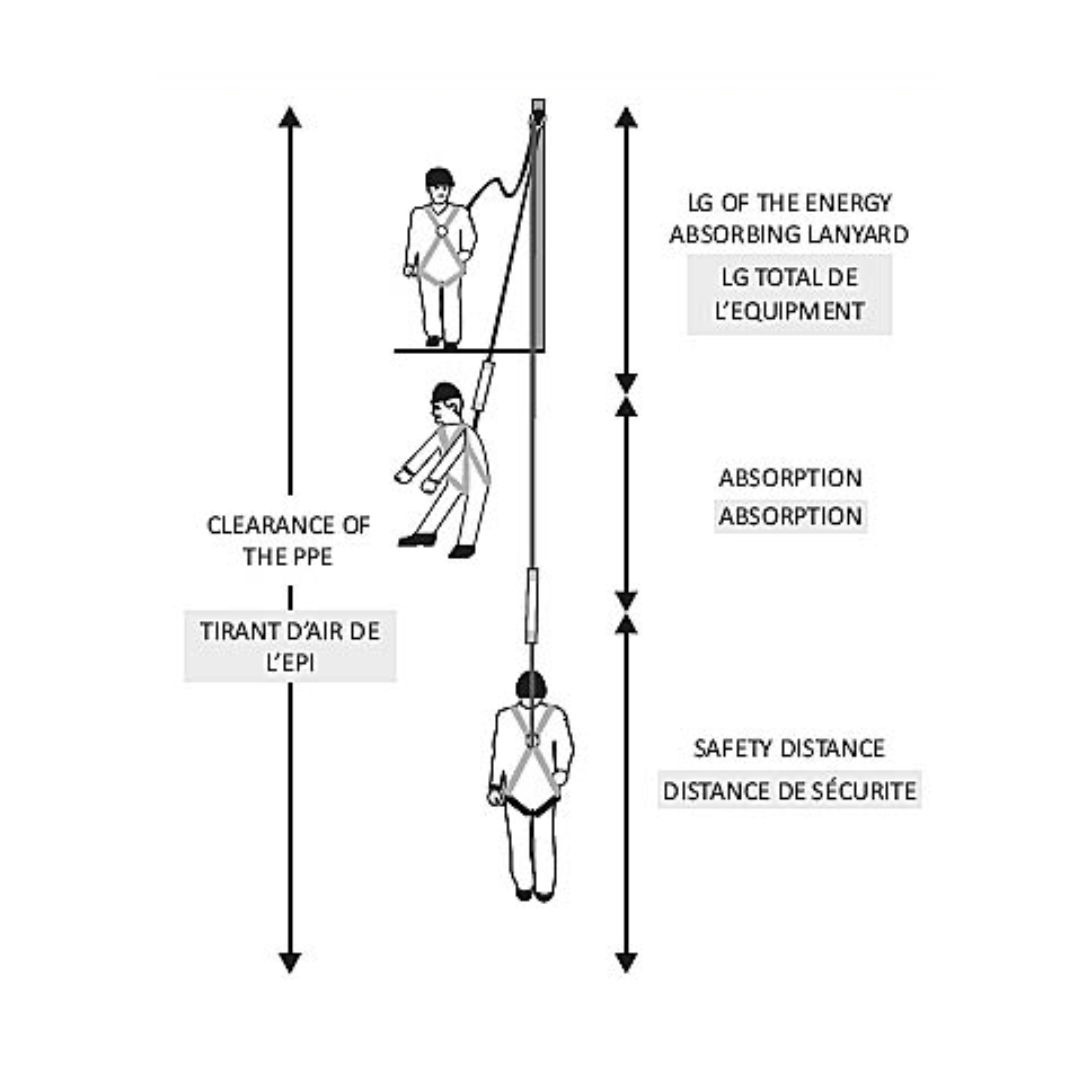
- Confirm adequate clearance below your feet at every new anchor position before transferring.

Safety and Maintenance
Before every use:
- Fall indicator label: NOT OK means immediate withdrawal and replacement
- Check webbing, both legs, and all three connectors for damage, abrasion, and deformation
- Confirm energy absorber pouch is intact and not partially deployed
During use:
- Always maintain at least one leg connected during anchor transfers
- Never connect both legs to the same anchor point simultaneously
- Never exceed 100kg total user weight including tools and equipment
- Confirm clearance below feet before every anchor position change
After use:
- Clean with mild soap and warm water if contaminated, dry naturally
- Store dry, away from UV, chemicals, and sharp objects
- Annual formal inspection by a competent person required under PUWER
- Withdraw immediately after any fall arrest event, no exceptions
Frequently Asked Questions
Q: What is the difference between this forked lanyard and the single-leg HOPE lanyard?
A: The single-leg HOPE connects the operative to one anchor point at a time. When that anchor needs to change, there is a brief moment of disconnection during the transfer. The forked HOPE has two legs, so one can be connected to the new anchor before the first is released. The operative is connected at all times. This is the key distinction and the reason forked lanyards are specified wherever site rules or risk assessments require 100% tie-off.
Q: What does VG11 three-point testing mean for a forked lanyard?
A: Standard EN 355 testing can assess components individually. VG11 requires the complete assembly to be tested together. For a forked lanyard specifically, the three-point test applies a load above 9kN simultaneously to all three ends: the karabiner and both scaffold hooks. This confirms the entire assembly holds under worst-case loading, not just individual components in isolation.
Q: Why does this lanyard use steel scaffold hooks rather than aluminium?
A: Steel scaffold hooks have a higher load rating and resist deformation better than aluminium on high-use scaffolding applications where the hook contacts tubes repeatedly throughout the working day. The FA 50 207 55 double-action gate requires deliberate sequential movement to open, preventing accidental release from contact with scaffold tubes during normal movement.
Q: Can both legs be connected to the same anchor at the same time?
A: No. Connecting both legs to the same anchor defeats the purpose of the twin-leg design and concentrates the full fall arrest load at a single point not rated for that configuration. Always use each leg on a separate, independently certified anchor point.
Q: What is the maximum user weight and does it include tools?
A: 100kg total. This must include the operative's full bodyweight plus all clothing, tools, and equipment carried during the task. It is not a bodyweight-only figure.
Q: What should I do if the fall indicator reads NOT OK?
A: Withdraw the lanyard from service immediately. Tag it as condemned and do not return it to service under any circumstances. The energy absorber is a single-use component. Replace with a new HOPE forked lanyard before the task continues.
Q: Why order from CMT Group?
A: CMT Group has supplied height safety PPE to UK construction sites since 2010. Next working day delivery on orders placed by 7pm, same-day despatch on confirmed stock, and VIP dedicated delivery for urgent site requirements. CMT is a BSIF Registered Safety Supplier. Trade accounts and EDGE portal pricing available for procurement teams managing PPE across multiple projects.