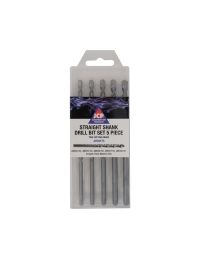

Straight shank vs SDS Plus masonry bits: which drill bit set do you need on site?
Not all masonry drill bits are the same, and using the wrong type for your machine costs time, damages bits, and produces poor quality holes. This guide covers the three JCP masonry drill bit sets available from CMT Group, explains the practical difference between straight shank and SDS Plus in plain terms, and helps you choose the right set for your drill and your job.
The three sets at a glance
What is the difference between straight shank and SDS Plus?
This is the question that causes the most confusion on site, and it comes down to how the bit is held in the drill and how percussion energy is transferred.
A straight shank bit is gripped directly by a keyed or keyless chuck. The chuck squeezes the shank and holds it in place by friction. When the drill's percussion mechanism fires, the impact travels through the chuck into the bit. The problem is that chuck friction absorbs some of that energy and, under repeated percussion loads, straight shanks can slip inside the chuck, wearing both the shank and the jaws.
An SDS Plus bit has two open slots machined into the shank. These slots engage with locking pins inside the SDS chuck, which means the bit cannot rotate independently of the chuck. The slots also allow the bit to move axially, freely back and forth by a few millimetres. This is by design: the axial movement lets the drill's percussion hammer strike directly through the shank into the bit, transmitting full impact energy into the carbide tip without any of it being lost to chuck friction.
The practical result is that an SDS Plus drill drilling concrete will outperform a standard percussion drill with a straight shank bit in the same material, often significantly, particularly in reinforced or dense aggregate concrete.
Rule of thumb: If your drill has a standard keyless or keyed chuck, use the straight shank set. If your drill has an SDS Plus chuck with the slotted locking mechanism, use one of the SDS Plus sets.
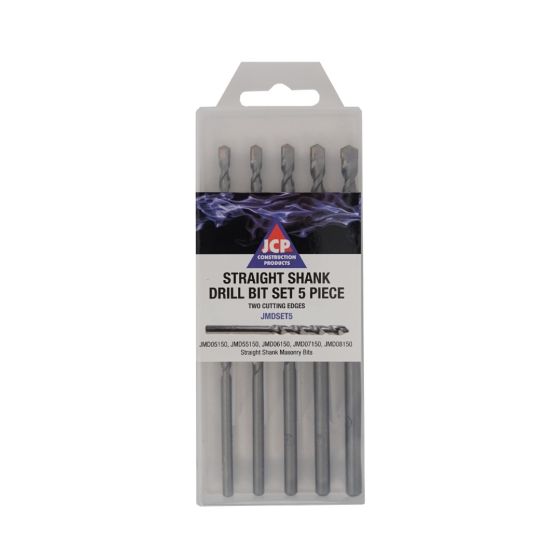
The JCP straight shank set: JMDSET5
The JCP straight shank masonry bit set covers 5, 5.5, 6, 7, and 8mm in a fitted plastic case. All five bits are tungsten carbide tipped with two cutting edges and are designed for percussion and rotary drilling in brick, block, and natural stone.
This is the set to buy when:
- Your drill is a standard corded or cordless percussion drill with a keyless chuck
- The substrate is brick, block, or soft to medium natural stone rather than structural concrete
- The work involves light to medium fixing tasks: wall plugs, frame fixings, and service clips
- You need a complete set of the most common fixing diameters in a protected case for site use
The five sizes cover the most common UK plug and anchor specifications: 5mm for brown plugs, 5.5mm for red, 6mm for the transition between red and brown depending on the manufacturer, 7mm for yellow, and 8mm for blue.
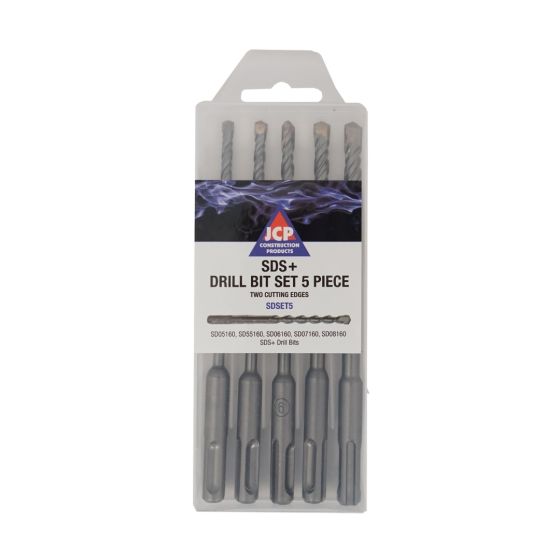
↑ Back to topThe JCP SDS Plus 5 piece set: SDSET5
The JCP SDS Plus 5 piece set covers the same five diameters as the straight shank set: 5, 5.5, 6, 7, and 8mm. The difference is entirely in the shank type and the drilling performance that follows from it.
Each bit has a 160mm overall length with a 93mm working length, and is made from high-strength steel specifically to resist the bending and snapping forces generated by SDS Plus percussion action.
This is the set to buy when:
- Your drill is an SDS Plus hammer drill from any brand
- The substrate includes concrete, dense aggregate block, or hard natural stone
- You need to drill the same common fixing diameters as the straight shank set but with more impact energy
- Drilling speed and bit longevity matter more than the cost saving of the straight shank set
Key difference from the 8 piece set: The SDSET5 covers 5 to 8mm only. If your work includes 10mm or 12mm holes for structural anchors or throughbolts, you need the SDSET8.
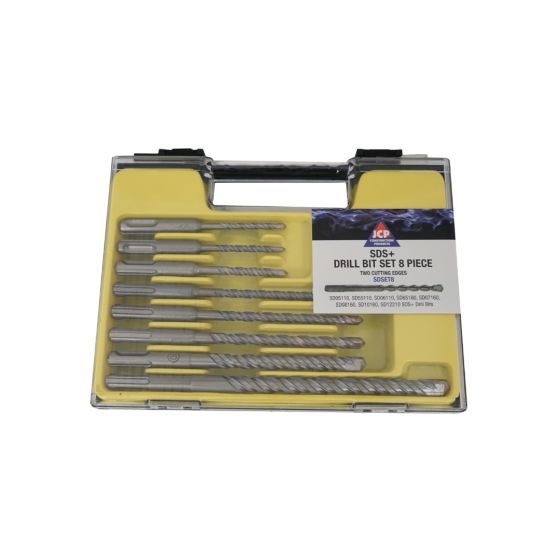
The JCP SDS Plus 8 piece set: SDSET8
The JCP SDS Plus 8 piece set extends the SDS Plus range to include 6.5mm, 10mm, and 12mm alongside the five smaller sizes. It comes in a hard carry case with formed bit slots, making it the practical choice for operatives who move between locations and need the full spread of masonry drilling sizes in one place.
The additional sizes matter for specific applications:
- 6.5mm appears in several electrical and mechanical fixing specifications that fall between the standard 6mm and 7mm diameters
- 10mm is the standard hole diameter for M8 chemical anchors and many throughbolt installations in concrete
- 12mm is required for M10 and M12 structural anchor installations, heavy duty throughbolts, and larger service penetrations
This is the set to buy when:
- Your work includes structural anchor installations requiring 10mm and 12mm holes
- You need a single complete set covering all common masonry drilling diameters
- You work across multiple trade disciplines or site types and need the full range available without sourcing individual bits
- Portability between locations matters: the hard carry case is built for site transport
Side by side: which set for which job?
| Situation | Recommended set |
|---|---|
| Standard cordless drill, brick and block, plug and frame fixings | JMDSET5 Straight Shank |
| SDS Plus drill, concrete and dense block, plug and light anchor fixings | SDSET5 SDS Plus 5 piece |
| SDS Plus drill, concrete, structural anchors and throughbolts required | SDSET8 SDS Plus 8 piece |
| Mixed site with both percussion and SDS Plus drills in use | JMDSET5 and SDSET5 together |
| Single operative covering all masonry work from plugs to structural fixings | SDSET8 SDS Plus 8 piece |
| Chemical anchor installations in concrete requiring 10mm and 12mm holes | SDSET8 SDS Plus 8 piece |
A note on dust and safety
All three sets are used in masonry materials that produce respirable crystalline silica dust. Under UK COSHH regulations, silica dust exposure must be controlled on site. SDS Plus drilling generates significantly more airborne dust per metre drilled than standard percussion drilling due to the higher energy input. At minimum, an FFP2 dust mask should be worn for any masonry drilling task. For enclosed spaces, overhead drilling, or sustained SDS Plus work, FFP3 masks and localised extraction are the appropriate controls.
Safety glasses are non-negotiable for all masonry drilling. Carbide tip fragments and aggregate particles are ejected at speed and cause serious eye injuries.
↑ Back to topAll three JCP drill bit sets are available at cmt.co.uk with next working day delivery on orders placed by 7pm. For urgent site requirements, VIP dedicated delivery is available UK-wide, dispatched within 30 minutes. Trade accounts and EDGE portal ordering available for procurement teams.