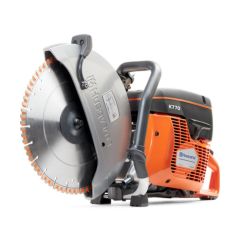
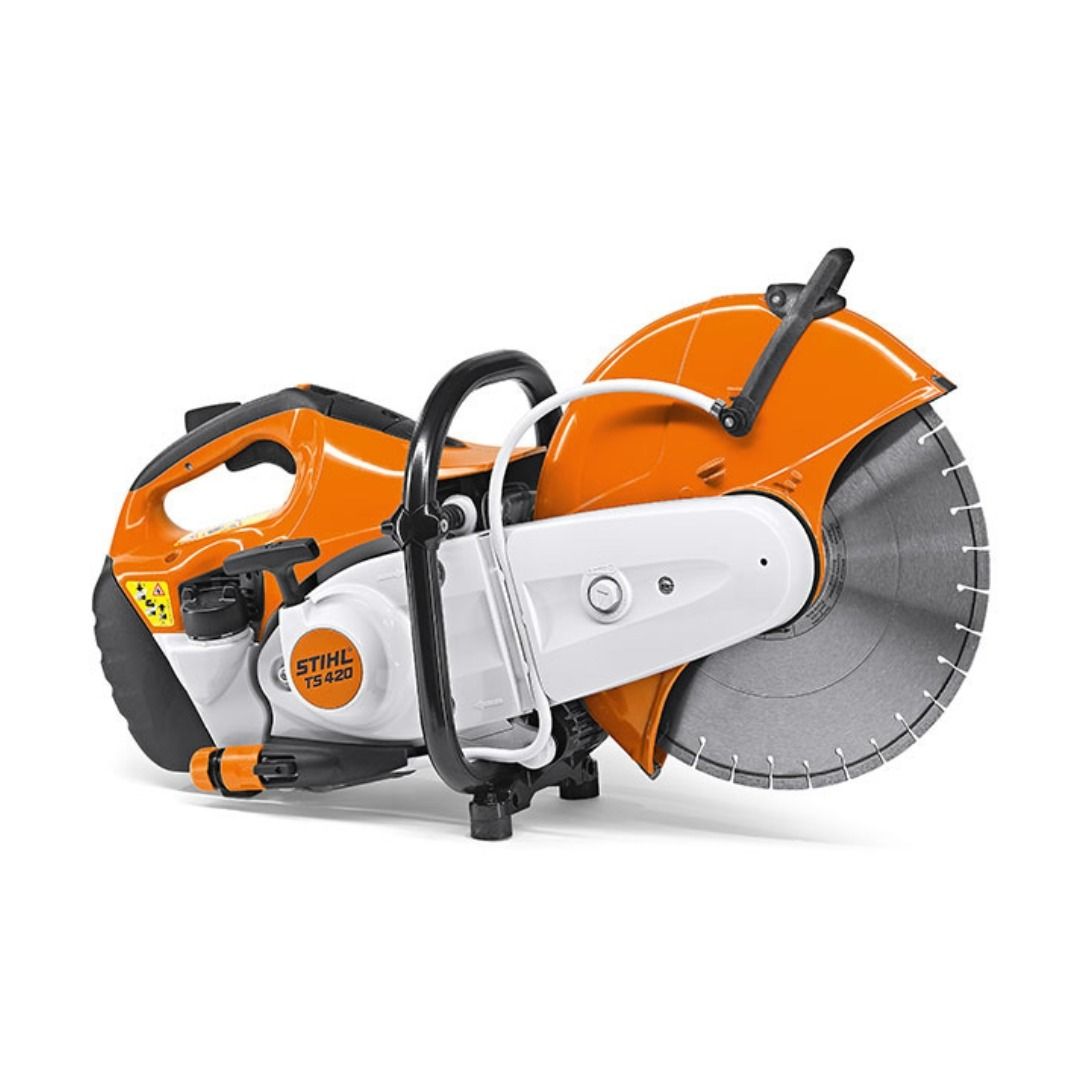
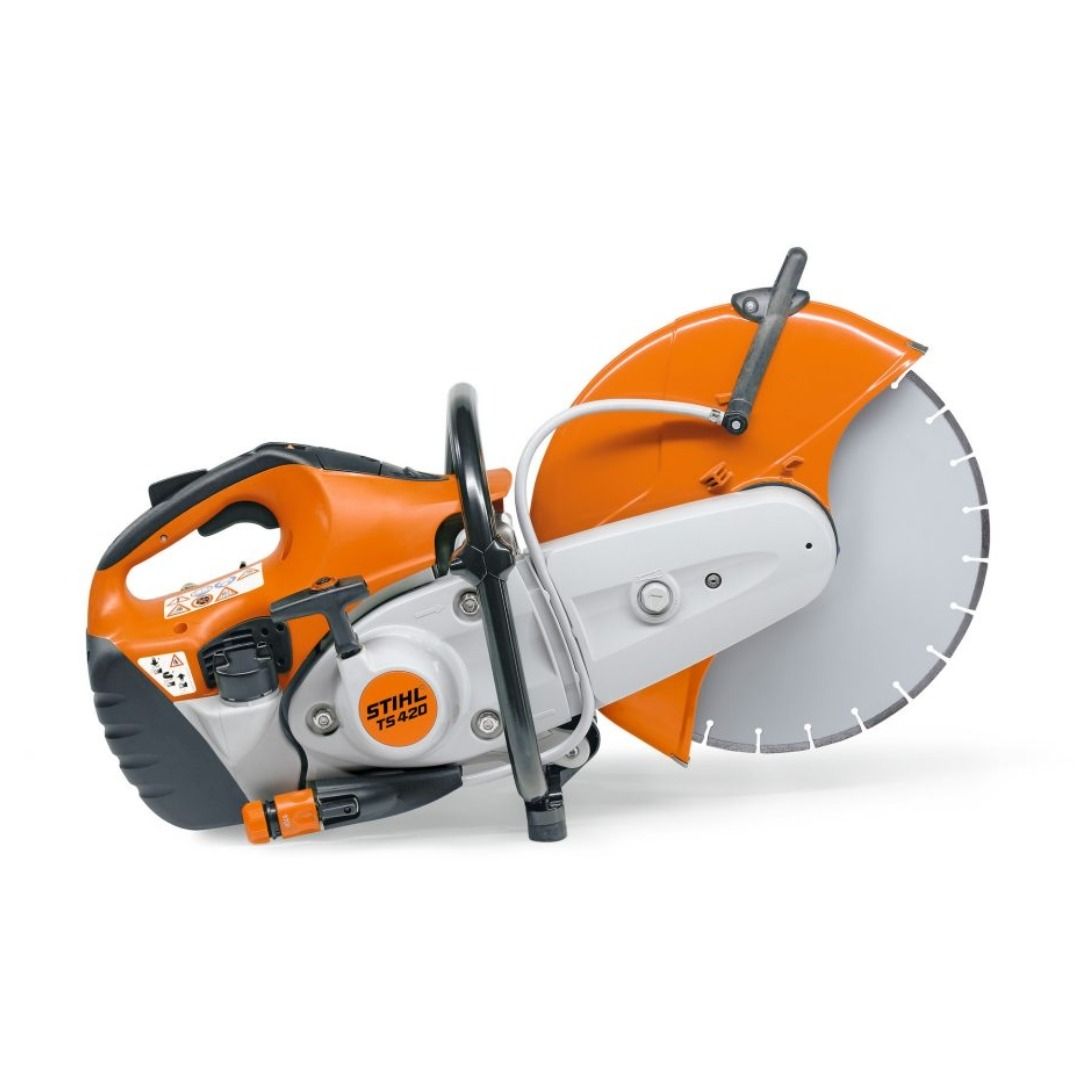
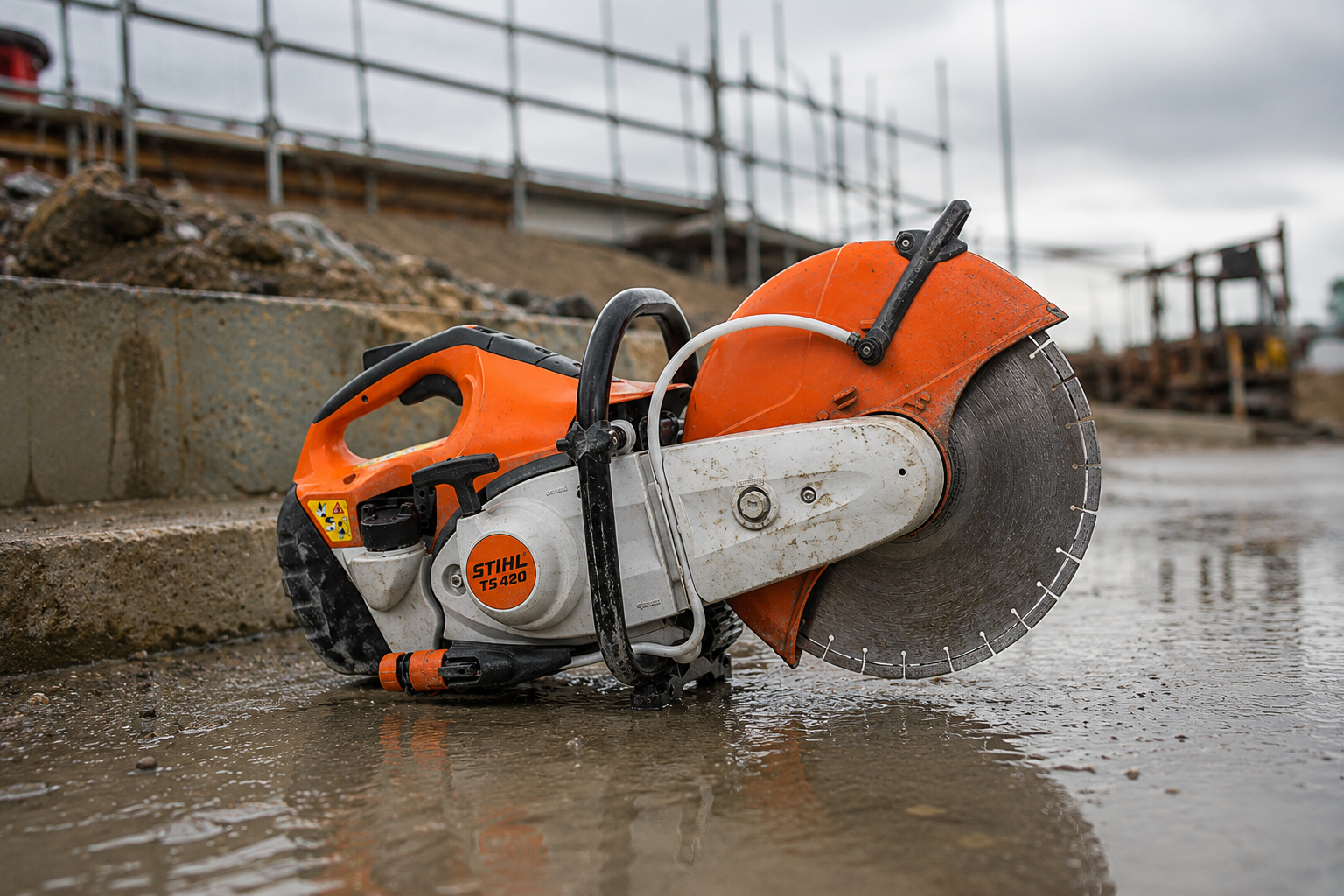
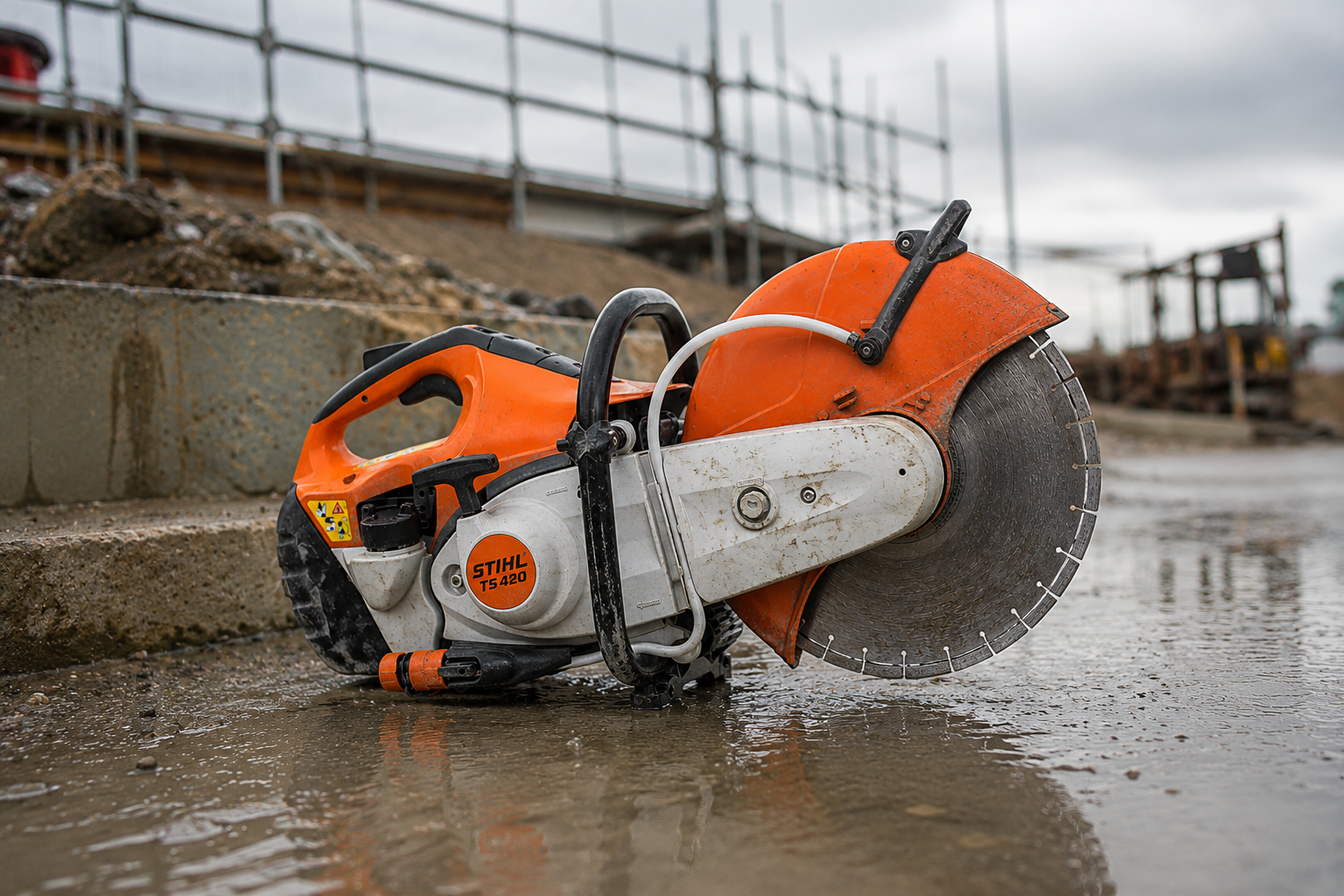
Stihl TS420 350mm (14") petrol cut-off saw for road construction, concrete cutting, kerb and slab work, and civils operations requiring a compact, robust handheld disc cutter.
- 3.2kW 66.7cc two-stroke engine with 2-MIX stratified charge technology
- All-purpose, user-friendly cut-off machine
- Cyclone pre-separation air filter, low-maintenance filter system
- Anti-vibration system rated 3.9m/s² on both handles
- 350mm (14") cutting wheel, 125mm maximum cutting depth
- Integrated dosable water connection for wet cutting and dust suppression
- ElastoStart, manual fuel primer pump, and decompression valve
- EU Stage V emissions compliant, CE marked
- Requires a signature on delivery
Stihl TS420 350mm (14") Petrol Cut-Off Saw - 3.2kW 66.7cc Two-Stroke

Stihl TS420 350mm (14") petrol cut-off saw for road construction, concrete cutting, kerb and slab work, and civils operations requiring a compact, robust handheld disc cutter.
- 3.2kW 66.7cc two-stroke engine with 2-MIX stratified charge technology
- All-purpose, user-friendly cut-off machine
- Cyclone pre-separation air filter, low-maintenance filter system
- Anti-vibration system rated 3.9m/s² on both handles
- 350mm (14") cutting wheel, 125mm maximum cutting depth
- Integrated dosable water connection for wet cutting and dust suppression
- ElastoStart, manual fuel primer pump, and decompression valve
- EU Stage V emissions compliant, CE marked
- Requires a signature on delivery
Order 1x to earn 700 FASTPoints
Order to earn 700 FASTPoints
Log in to access trade discountsStihl TS420 350mm (14") Petrol Cut-Off Saw
Stihl TS420 petrol cut-off saw built for groundworkers, civils contractors, road construction teams, and kerb and slab operatives who require a compact, robust 350mm disc cutter capable of sustained cutting through concrete, stone, asphalt, and masonry on active construction sites. Powered by the STIHL 2-MIX stratified charge two-stroke engine delivering 3.2kW from 66.7cc displacement, the TS420 combines high cutting performance with up to 20% lower fuel consumption than standard two-stroke engines of equivalent displacement. The cyclone pre-separation air filter system, integrated water connection, and semi-automatic belt tensioning reduce on-site maintenance requirements, keeping the machine cutting through demanding shift work without extended downtime. Weighing 9.6kg without fuel or cutting wheel, the TS420 is compact enough for handheld use in confined trench and kerb-line positions and robust enough for full-day road construction programmes.
How the 2-MIX engine and cyclone filter system reduce running costs on site
A standard two-stroke engine loses a proportion of the fresh fuel charge through the exhaust port during the scavenging cycle, wasting fuel and increasing emissions with every cut. The STIHL 2-MIX stratified charge engine places a fuel-free layer of air between the burned charge and the fresh fuel charge in the combustion chamber, reducing the fuel lost during scavenging and delivering more power from less fuel. On a site where a cut-off saw runs for several hours each day, the cumulative fuel saving across a project is significant. The cyclone pre-separation filter extends this economy further by removing approximately 80% of dust particles from intake air before they reach the air filter, increasing the service interval between filter replacements and reducing the on-site maintenance time that takes the machine out of productive use.
Key Features
-
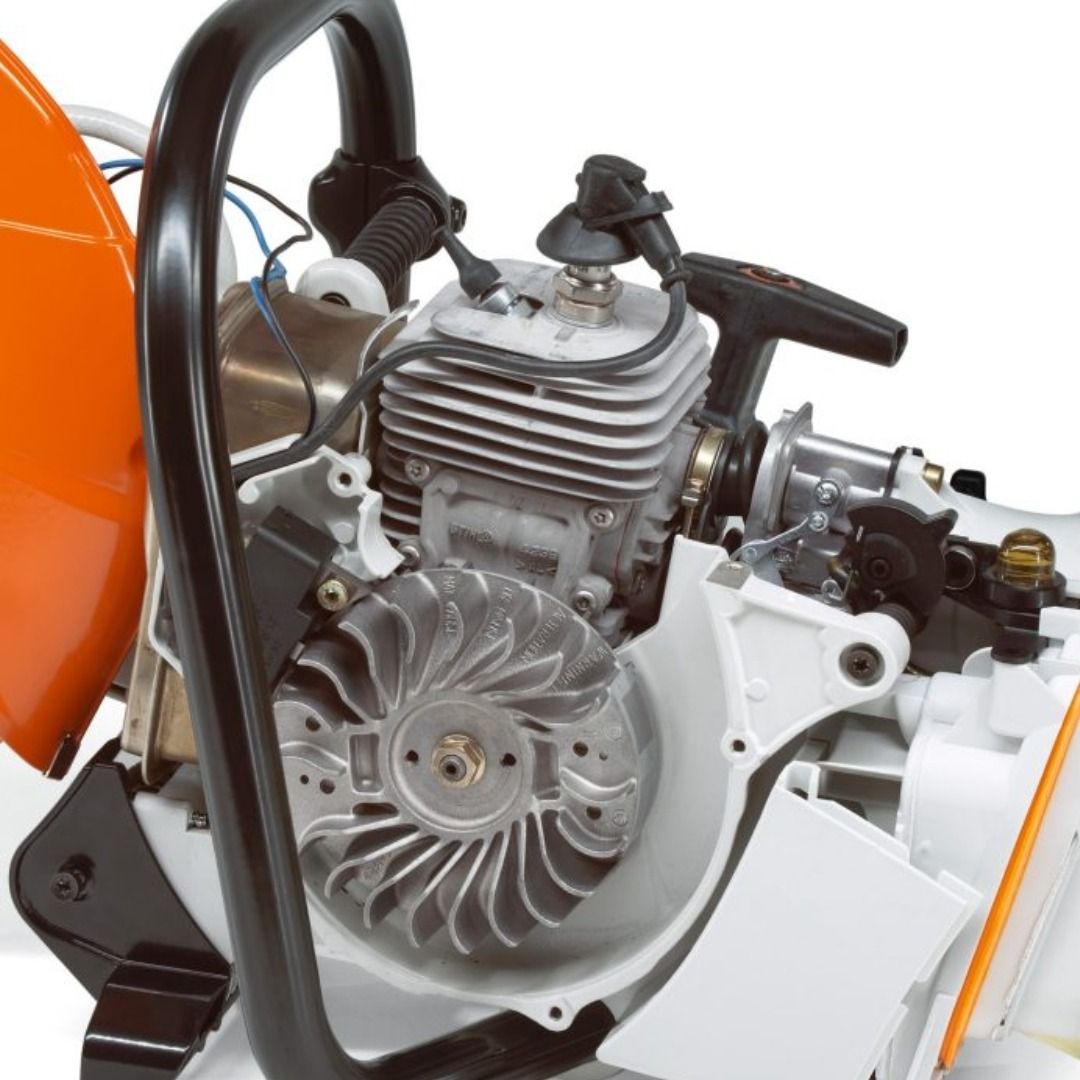
STIHL 2-MIX stratified charge engine: 66.7cc single-cylinder two-stroke delivering 3.2kW at 9,000rpm with up to 20% lower fuel consumption than conventional two-stroke engines. EU Stage V emissions compliant. Reduces fuel costs and exhaust fume concentration in trench and confined-space cutting conditions.
-
Cyclone pre-separation air filter system: Swirls incoming air to eject larger dust particles before they reach the paper air filter element, removing approximately 80% of particulate contamination at the first stage. The result is significantly longer filter life and reduced maintenance intervention on site without compromising engine protection.
-
Integrated dosable water connection: A permanent water supply feeds directly to the cutting wheel during operation, simultaneously suppressing silica dust in compliance with HSE COSHH guidance for construction dust, cooling the blade to extend service life, and improving cut quality in concrete and masonry. The dosable connection allows the operator to control water flow from the machine without interrupting the cut.
-
Anti-vibration system — 3.9m/s² on both handles: Buffer and spring elements between the engine and handle assembly reduce vibration transmission to the operator's hands and arms. At 3.9m/s² on both handles, the TS420 sits well within the action value threshold under the Control of Vibration at Work Regulations 2005 for extended shift work, subject to exposure time calculations specific to each site programme.
-
Maximum cutting depth 125mm: Accepts 350mm composite resin or diamond cutting wheels with 20mm spindle bore. Maximum cutting depth of 125mm covers the majority of kerb, slab, pipe, and road construction cutting applications encountered in UK groundwork and civils operations.
-
ElastoStart and decompression valve: The ElastoStart system absorbs the recoil shock from the starter cord through a spring element in the starter mechanism, reducing the force required to start the engine and protecting the starter system during repeated cold starts on site. The decompression valve releases compression from the cylinder before starting, further reducing the pull force required.
-
Semi-automatic V-belt tensioning: The spring-loaded semi-automatic tensioning system allows the drive belt to be retensioned on site in minutes using the combination wrench supplied. Consistent belt tension extends belt and spindle bearing service life compared with machines requiring manual tensioning judgement.
Who is this for
Trades and roles:
-
Groundworkers and civils contractors
-
Road construction and reinstatement operatives
-
Kerb and slab layers
-
Drainage and utilities contractors
-
Plant and equipment operators
Industries:
-
Road construction and maintenance
-
Civil engineering and groundworks
-
Utilities and infrastructure
-
Landscaping and hard landscaping
-
Demolition and building contractors
Specifications
| Specification | Detail |
| Product name | Stihl TS420 350mm (14") Petrol Cut-Off Saw - 3.2kW 66.7cc Two-Stroke |
| SKU | TS420 |
| Brand | STIHL |
| Model | TS420 |
| Engine type | STIHL single-cylinder two-stroke, 2-MIX stratified charge |
| Displacement | 66.7cc (66.7cm³) |
| Engine power | 3.2kW (4.4hp) at 9,000rpm |
| Idle speed | 2,500rpm |
| Max. spindle speed (ISO 19432) | 4,880rpm |
| Cutting wheel diameter | 350mm (14") |
| Spindle bore diameter | 20mm |
| Max. cutting wheel thickness | 4.5mm |
| Max. cutting depth | 125mm |
| Tightening torque | 30Nm |
| Air filter system | Cyclone pre-separation with paper main filter and flocked wire mesh auxiliary filter |
| Fuel system | All-position diaphragm carburettor with integral fuel pump |
| Fuel tank capacity | 710cm³ (0.71 litre) |
| Fuel mix ratio | 50:1 petrol to STIHL two-stroke engine oil |
| Ignition system | Electronic magneto ignition |
| Spark plug | Bosch WSR 6 F or STIHL ZK C 14, electrode gap 0.5mm |
| Water connection | Integrated dosable water connection, direct on machine |
| Anti-vibration system | Buffer and spring elements, 3.9m/s² both handles (ISO 19432) |
| Sound pressure level | 98dB(A) (ISO 19432, K: 2dB(A)) |
| Sound power level | 109dB(A) (ISO 19432, K: 2dB(A)) |
| Guaranteed sound power level | 116dB(A) (2000/14/EC) |
| Weight (without fuel, without cutting wheel) | 9.6kg |
| Starting system | ElastoStart recoil starter with decompression valve and manual fuel primer pump |
| Belt tensioning | Semi-automatic spring-action V-belt tensioning |
| Fuel cap | Bayonet-type, tool-free opening |
| Cart compatibility | STIHL FW 20 cut-off machine cart (sold separately) |
| Emissions compliance | EU Stage V, 2-MIX stratified charge engine |
| Conformity | CE marked |
| Supplied with | Composite resin abrasive cutting wheel, combination wrench |
Compatibility
| Application or condition | Status |
| 350mm composite resin abrasive cutting wheels (wet or dry depending on wheel type) | ✓ Compatible |
| 350mm diamond cutting wheels — wet cutting, 20mm bore | ✓ Compatible |
| Concrete, limestone, reinforced concrete, hard unabrasive concrete products | ✓ Compatible |
| Asphalt, render, cement screed, lignacite blocks | ✓ Compatible |
| Stone, kerbs, slabs, medium hard bricks, yorkstone, concrete paviors | ✓ Compatible |
| Ductile cast iron pipes — with appropriate composite resin wheel | ✓ Compatible |
| Water-carrying plastic pipes PP, PE, PVC — D-G80 cutting wheel only | ✓ Compatible with D-G80 wheel |
| Granite, engineering bricks, hard clay, very hard concrete — segmented diamond blade recommended | ✓ Compatible with appropriate diamond blade |
| Wood or wooden objects | ✗ Not suitable |
| Asbestos-containing materials | ✗ Never use — legally prohibited |
| Railway tracks | ✗ Not suitable with composite resin wheels |
| Circular saw blades, carbide tips, or wood-cutting attachments | ✗ Never use — fatal injury risk |
Who is this for
The Stihl TS420 is used by groundworkers, civils contractors, road construction operatives, drainage teams, and kerb and slab layers who require a handheld petrol cut-off saw capable of sustained cutting through concrete, asphalt, stone, and masonry on UK construction and civil engineering sites. The 3.2kW 66.7cc engine and 125mm maximum cutting depth cover the full range of kerb cutting, slab trimming, road reinstatement, expansion joint cutting, and pipe preparation tasks encountered in daily groundwork and civils operations. The compact design and 9.6kg weight make it practical for handheld use in trench bottoms, alongside kerb lines, and in confined working areas where larger floor saws cannot be manoeuvred. Health and safety officers and site managers responsible for COSHH compliance will note the integrated dosable water connection provides the on-tool dust suppression required by HSE guidance on respirable crystalline silica (RCS) when cutting concrete, stone, and masonry materials.
Typical applications
-
Cutting kerbs, concrete edging, and paving slabs to length during road construction, reinstatement, and hard landscaping works where a precise straight cut is required on site.
-
Road reinstatement cutting to define clean saw-cut edges around carriageway repairs, utility reinstatements, and pothole patching operations in compliance with the Specification for the Reinstatement of Openings in Highways (SROH).
-
Cutting expansion joints in concrete slabs, hardstanding, and floor construction where a controlled straight cut to a specified depth is required.
-
Cutting concrete and clay drainage pipes to length during drainage installation, connection, and repair works on groundwork and civils projects.
-
Cutting ductile iron pipes, valve chambers, and utility apparatus during utility diversion and connection works on infrastructure projects.
-
Concrete and masonry cutting during demolition and structural alteration works where a controlled cut to a specified line is required alongside or beneath existing structure.
-
Cutting stone, yorkstone, and natural stone paving to shape and length during hard landscaping and public realm works where precision cut quality is a specification requirement.
-
Asphalt cutting for road marking preparation, gully and drainage channel installation, and utility trench reinstatement on highways maintenance contracts.
How to use
Step 1: Before starting, inspect the cutting wheel for cracks, chips, buckling, or damage to the spindle hole. Never use a damaged cutting wheel. Confirm the cutting wheel is rated for the material to be cut and that its maximum permissible speed equals or exceeds 4,880rpm.
Step 2: For diamond cutting wheels, confirm the direction of rotation arrow on the wheel matches the direction of blade travel. Position the front thrust washer and tighten the hexagon bolt to 30Nm using the combination wrench supplied. Block the shaft with the locking pin through the V-belt guard bore whilst tightening.
Step 3: Check the fuel level. The TS420 runs on a 50:1 petrol to two-stroke oil mix. Fill using an approved fuel canister in a well-ventilated area at least 3 metres from the cutting location. Never refuel a hot engine.
Step 4: For wet cutting operations, connect a water supply to the dosable water connection on the machine before starting. Diamond cutting wheels must always be used with water. Ensure a minimum supply of 0.6 litres per minute for dust binding and blade cooling.
Step 5: To start a cold engine, press the decompression valve button, actuate the manual fuel primer pump 7 to 10 times, set the choke to the cold position, and pull the starter cord briskly. Once the engine fires, return the choke to the warm position and allow the engine to warm up before beginning cutting.
Step 6: Hold the machine firmly with both hands throughout the cut. Keep the right hand on the rear handle at all times. Guide the cutting wheel into the workpiece using the weight of the machine rather than pressing down. Never exert lateral pressure on the cutting wheel.
Step 7: At the end of each shift, drain the fuel tank if the machine will be stored for more than 30 days. Run the engine at idle until it stops to clear fuel from the carburettor. Remove the cutting wheel before storing. Clean the machine and store in a dry, secure location.
Common mistakes
Using the wrong cutting wheel for the material: A composite resin abrasive wheel rated for general purpose cutting will wear rapidly and cut poorly in reinforced concrete or granite. A diamond wheel rated for hard materials will glaze and lose cutting performance in soft abrasive materials. Always match the wheel specification to the material being cut using the application chart in the STIHL documentation.
Dry cutting with diamond wheels: Diamond cutting wheels must always be used with water on the TS420. Dry use with a diamond wheel overheats the segments, causes glazing, leads to stress cracks in the parent wheel, and creates a serious breakage risk at operating speed. If the water supply fails during cutting, stop immediately.
Failing to use water when cutting concrete or masonry: Beyond the blade damage risk, cutting dry into concrete, stone, or masonry generates respirable crystalline silica (RCS) dust at concentrations that can cause silicosis with repeated exposure. HSE guidance and COSHH Regulations 2002 require that dust suppression measures, including wet cutting where practicable, are used when cutting silica-containing materials on UK construction sites.
Operating without PPE: The TS420 produces airborne particles, high noise levels of 98dB(A) sound pressure, and vibration at 3.9m/s² on both handles. Every operator must wear safety glasses to EN166, ear defenders to EN352, a dust mask rated FFP3 for silica dust, safety boots, protective gloves, and a hard hat where overhead hazards exist. This is a legal requirement under the Personal Protective Equipment at Work Regulations 1992.
Applying lateral pressure to the cutting wheel: The cutting wheel must be guided straight through the material without tilting. Lateral pressure causes the wheel to bind in the cut, creates a kickback risk, and accelerates segment wear on diamond wheels. If the cut begins to close and bind the wheel, stop the engine and support the workpiece to open the kerf before resuming.
Storing fuel mixture beyond 30 days: Two-stroke fuel mixture deteriorates within 30 days, causing carburettor deposits, starting difficulties, and performance loss. Mix only the quantity required for the immediate working period. If storing the machine for longer than 30 days, drain the fuel tank completely.
Safety
The TS420 is a professional petrol cut-off machine governed by the Provision and Use of Work Equipment Regulations 1998 (PUWER). Under PUWER, employers must ensure that anyone operating this machine is trained, competent, and aware of the risks. The machine generates high noise levels requiring hearing protection. Vibration levels of 3.9m/s² on both handles require exposure time management under the Control of Vibration at Work Regulations 2005. Cutting concrete, stone, and masonry generates respirable crystalline silica dust requiring control measures under COSHH Regulations 2002, including wet cutting wherever practicable. This machine must never be used to cut asbestos-containing materials under any circumstances. Never use circular saw blades, carbide-tipped attachments, or wood-cutting accessories on this machine. The machine must be operated by one person only and must never be started indoors or in enclosed spaces due to toxic exhaust emissions. Read the STIHL instruction manual in full before first use.
Maintenance
Before each use, inspect the cutting wheel for damage, check the fuel system for leaks, check the idle speed adjustment, and confirm the cutting wheel guard is secure. At the end of each working day, clean the machine, check and retension the V-belt if required, and inspect the anti-vibration elements. Weekly, clean the cooling air intake slots and check all accessible nuts and bolts for tightness. Replace the spark plug after every 100 operating hours. Replace the air filter only when a noticeable loss of engine power occurs. Change the fuel pickup body annually. All maintenance beyond that described in the STIHL instruction manual must be carried out by an authorised STIHL servicing dealer.
Frequently Asked Questions
Q: What materials can the Stihl TS420 cut and what cutting wheel does each material require?
A: The TS420 accepts 350mm cutting wheels with a 20mm spindle bore. Composite resin abrasive wheels are suitable for concrete, asphalt, stone, ductile cast iron pipes, and steel depending on the wheel specification. Diamond cutting wheels are required for reinforced concrete, granite, engineering bricks, hard clay, and other hard materials, and must always be used with water. For cutting water-carrying plastic pipes in PP, PE, or PVC, the specific D-G80 cutting wheel is required. The material application chart in the STIHL documentation confirms the correct wheel type for each material. Never use a cutting wheel that is not rated for the material being cut.
Q: Does the TS420 have to be used with water and what happens if it is not?
A: Diamond cutting wheels must always be used with water on the TS420. The integrated dosable water connection feeds water directly to the cutting wheel during operation. Dry use with a diamond wheel causes the segments to overheat, glaze, and develop stress cracks that can lead to wheel breakage at operating speed. Beyond the blade damage risk, cutting dry into concrete, stone, or masonry generates respirable crystalline silica dust at concentrations that require control under COSHH Regulations 2002. Composite resin wheels may be used dry or wet depending on the specific wheel type and its markings.
Q: What is the 2-MIX engine and why does it matter for site running costs?
A: The STIHL 2-MIX stratified charge engine places a fuel-free layer of air between the burned charge and the fresh fuel charge in the combustion chamber during the scavenging cycle. This reduces the amount of unburned fuel expelled through the exhaust port during each cycle, delivering up to 20% lower fuel consumption than a conventional two-stroke engine of equivalent displacement. On a site where the TS420 runs for several hours daily across a project programme, the cumulative fuel saving reduces operating costs whilst the reduced exhaust emissions lower fume concentration in trench and confined-space cutting environments.
Q: What are the HAV exposure limits for the TS420 and how should site managers manage them?
A: The TS420 produces vibration of 3.9m/s² on both handles as measured to ISO 19432. Under the Control of Vibration at Work Regulations 2005, the daily exposure action value is 2.5m/s² and the daily exposure limit value is 5m/s². At 3.9m/s², the TS420 reaches the action value after approximately 60 minutes of continuous trigger-on cutting time. Site managers should calculate daily vibration exposure using HSE's HAV ready reckoner, rotate operators to limit individual exposure, encourage regular breaks, and provide warm gloves in cold conditions. Operatives showing symptoms of hand-arm vibration syndrome including tingling or numbness in the fingers should be referred to occupational health immediately.
Q: What PPE is required when operating the TS420?
A: Every operator must wear safety glasses rated to EN166 for impact and particle protection, ear defenders rated to EN352 providing adequate attenuation for the 98dB(A) sound pressure level generated, an FFP3 disposable respirator for silica dust protection when cutting concrete or masonry, steel-toed safety boots with non-slip soles, sturdy protective gloves, and a hard hat where overhead hazards exist. When cutting steel, clothing must be made from flame-resistant material due to the risk of sparks igniting synthetic fibres. These requirements are a legal obligation under the Personal Protective Equipment at Work Regulations 1992 and must be stated in the site RAMS documentation for any task using this machine.
Q: Which diamond blade should I use with the TS420 for concrete and road construction work?
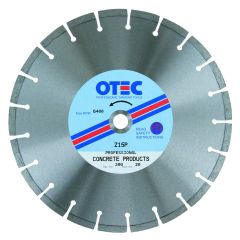
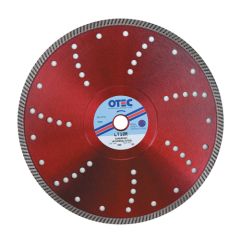
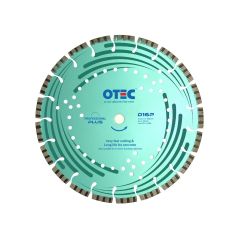
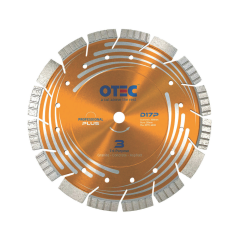
A: STIHL recommends fitting a diamond cutting wheel rather than the supplied composite resin wheel for longer and more intensive cutting tasks. CMT Group supplies a comprehensive range of OTEC diamond blades in 350mm diameter with 20mm bore specifically suited to the TS420. For general concrete and kerb cutting, the OTEC Z15P 350mm professional concrete blade is highly recommended. For reinforced concrete and hard aggregate, the OTEC D17P 350mm professional blade provides the segment specification required. For mixed-material road construction including asphalt and concrete, the OTEC LT10R multi-purpose blade covers both applications. Speak to the CMT Group sales team for blade selection advice specific to the material and cutting conditions on your site.
Q: What fuel does the TS420 use and how should it be mixed?
A: The TS420 runs on a 50:1 mixture of unleaded petrol with a minimum octane rating of 90 RON and STIHL two-stroke engine oil or an equivalent classified to JASO FB, JASO FC, JASO FD, ISO-L-EGB, ISO-L-EGC, or ISO-L-EGD. Mix by adding the oil to the fuel canister first, then adding petrol, and shaking thoroughly. For 5 litres of petrol, add 100ml of two-stroke oil. Never use fuel with more than 10% ethanol content in this engine. Fuel mixture deteriorates within 30 days and must not be stored beyond this period. If the machine will be stored for longer than 30 days, drain the fuel tank and run the engine until it stops to clear the carburettor.
Q: Why buy the Stihl TS420 from CMT Group?
A: CMT Group operates its own delivery fleet covering over 95% of the UK mainland. Order by 7pm for next-day delivery nationwide, with live tracking, real-time ETAs, and What3Words integration for precise delivery to any site entrance or compound. For contractors managing ongoing equipment and consumable requirements, the EDGE portal provides contract pricing, bulk ordering, and full delivery visibility from a single account. CMT Group also supplies the full range of OTEC diamond blades in 350mm diameter for the TS420, with over 30 years of diamond blade expertise to support blade selection for any cutting application.