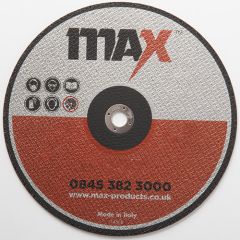

A Type F27 depressed centre silicon carbide grinding wheel with C24/30SBF dual-grade abrasive and 2A/11 reinforcement, designed for heavy duty surface grinding of concrete, natural stone, and masonry on angle grinders.
- C24/30SBF dual-grade silicon carbide: aggressive material removal on concrete, stone, and brick
- 6mm to 6.8mm thickness, 2A/11 reinforcement: no flex or breakage under heavy grinding load
- Sizes: 100mm to 230mm, four variants for all standard angle grinders
- Max speed: 80 m/s, up to 15,300rpm on the 100mm disc
- Depressed centre profile: flush grinding on flat surfaces and into corner joints
- Compatibility: angle grinders with standard arbor fitments
- Standard: EN 12413, ISO 6103 and ISO 13942
MAX Depressed Centre Stone Grinding Disc - Type 27 Masonry Wheel

A Type F27 depressed centre silicon carbide grinding wheel with C24/30SBF dual-grade abrasive and 2A/11 reinforcement, designed for heavy duty surface grinding of concrete, natural stone, and masonry on angle grinders.
- C24/30SBF dual-grade silicon carbide: aggressive material removal on concrete, stone, and brick
- 6mm to 6.8mm thickness, 2A/11 reinforcement: no flex or breakage under heavy grinding load
- Sizes: 100mm to 230mm, four variants for all standard angle grinders
- Max speed: 80 m/s, up to 15,300rpm on the 100mm disc
- Depressed centre profile: flush grinding on flat surfaces and into corner joints
- Compatibility: angle grinders with standard arbor fitments
- Standard: EN 12413, ISO 6103 and ISO 13942
MAX Depressed Centre Stone Grinding Disc - Type 27 Masonry Wheel
The MAX Depressed Centre Stone Grinding Disc is a Type F27 reinforced grinding wheel designed for heavy duty surface grinding and preparation of concrete, natural stone, brick, and masonry. Fitted with a C24/30SBF dual-grade silicon carbide abrasive and 2A/11 reinforcement, it combines aggressive material removal with the structural rigidity needed to resist flex and breakage at high operating speeds. For groundworkers, civils contractors, stonemasons, and flooring trades who need reliable masonry grinding performance across a range of stone and concrete surfaces, this disc covers demanding surface preparation work from 100mm detail grinding to 230mm large-section work.
Why Choose the MAX Depressed Centre Stone Grinding Disc
-
C24/30SBF dual-grade silicon carbide abrasive: the combination of C24 coarse and C30 medium silicon carbide grains delivers both aggressive initial material removal and a controlled finish, reducing the need for a secondary dressing pass on most masonry surfaces.
-
6mm to 6.8mm grinding thickness: the substantial disc body provides significantly more abrasive material than thinner masonry grinding discs, extending disc life on hard concrete and dense natural stone where thinner discs wear rapidly.
-
2A/11 reinforced construction: the 2A/11 designation indicates a heavier reinforcement specification than standard grinding discs, giving the wheel greater resistance to lateral stress and preventing the bending and breakage that can occur with lighter discs at high grinding speeds on hard masonry.
-
Depressed centre Type F27 profile: the recessed centre allows the grinding face to contact flat surfaces and corner joints directly without the mounting hardware fouling the workpiece, which is essential for flush surface preparation on concrete floors, masonry piers, and stone sections.
-
Ergonomic balance at operating speed: the disc is manufactured to tight unbalance tolerances, with maximum unbalance values controlled per variant, which reduces vibration transfer to the operator during sustained grinding work.
-
Four size variants from 100mm to 230mm: covers hand-held angle grinder work on detail joints and localised repairs up to larger surface preparation tasks on structural masonry and concrete sections.
-
EN 12413 manufacture with ISO-controlled quality: deconstruction speed verified to EN 12413, unbalance tested to ISO 6103, and run-out controlled to ISO 13942 across all variants.
What's Included
- One MAX Depressed Centre Stone Grinding Disc in the selected size variant (100mm, 115mm, 125mm, or 230mm)
Specifications
| Specification | Detail |
|---|---|
| Product Name | MAX Depressed Centre Stone Grinding Disc - Type 27 Masonry Wheel |
| Product Code | S-GRD |
| Type | F27 (Depressed Centre / Type 27 Grinding Wheel) |
| Grade | C24/30SBF |
| Abrasive | Silicon Carbide, Dual Grade |
| Reinforcement | 2A/11 |
| Form | Reinforced Grinding Disc |
| Max Peripheral Speed | 80 m/s |
| Standard | EN 12413 |
| Unbalance Control | ISO 6103 |
| Run-Out Tolerance | ISO 13942 |
Size & Performance
| Code | Size (Dia x Thick x Bore) | Max RPM | Weight | Min Deconstruction Speed | Max Unbalance | Run-Out Tolerance |
|---|---|---|---|---|---|---|
| S-GRD-100/16 | 100 x 6.5 x 16.0 mm | 15,300 rpm | 107g (+/-10g) | 26,500 rpm | 2.4g | 0.5 mm |
| S-GRD-115/22 | 115 x 6.0 x 22.0 mm | 13,300 rpm | 140g (+/-5g) | 23,000 rpm | 3.0g | 0.6 mm |
| S-GRD-125/22 | 125 x 6.0 x 22.0 mm | 12,200 rpm | 155g (+/-5g) | 21,200 rpm | 3.0g | 0.6 mm |
| S-GRD-230/22 | 230 x 6.8 x 22.23 mm | 6,600 rpm | 530g (+/-20g) | 12,500 rpm | 4.6g | 1.0 mm |
Compatibility
| Material | Status |
|---|---|
| Concrete | ✓ Compatible |
| Natural Stone | ✓ Compatible |
| Brick & Block | ✓ Compatible |
| Sandstone & Limestone | ✓ Compatible |
| Render & Screed | ✓ Compatible |
| Structural Steel | ✗ Not Recommended |
| Stainless Steel | ✗ Not Recommended |
| Aluminium | ✗ Not Recommended |
| Wood | ✗ Not Recommended |
Who Is This For?
The MAX Depressed Centre Stone Grinding Disc is aimed at groundworkers, civils contractors, stonemasons, flooring trades, and general construction operatives who carry out surface preparation, material removal, and dressing work on concrete, natural stone, and masonry. It suits the operative grinding localised high spots and surface defects on concrete floors with a 115mm or 125mm angle grinder, and the contractor carrying out larger surface preparation tasks on masonry structures with a 230mm grinder. This is a professional specification disc for sustained, high-load masonry grinding, not for occasional light dressing.
Typical Applications
-
Grinding high spots, laitance, and surface defects from concrete floors before screeding or tiling
-
Removing mortar residue and cement splatter from brick and block surfaces during construction and refurbishment
-
Dressing and smoothing natural stone and sandstone surfaces for landscaping, walling, and architectural stonework
-
Grinding back proud mortar joints and protruding aggregate from masonry and concrete block work
-
Surface preparation of concrete substrates before adhesive bonding, waterproofing, or coating application
-
Removing render and plaster patches from masonry walls during refurbishment and alteration work
-
Grinding concrete kickers and construction joints before continuing structural concrete pours
How to Use
-
Select the correct disc variant for your angle grinder, confirming the bore size matches your tool's arbor and the tool's maximum RPM does not exceed the disc's rated operating speed for the selected variant.
-
Fit the disc with the depressed centre facing away from the tool body, with the correct Type 27 guard in place. Ensure the flanges seat correctly against the disc face and the locking nut is tightened to the tool manufacturer's specification.
-
Inspect the disc visually before use for chips, cracks, or delamination. Do not use a disc showing any sign of damage.
-
Run the disc at full operating speed for at least 30 seconds before making contact with the workpiece, observing from the side.
-
Apply the disc to the masonry surface at a grinding angle of 15 to 25 degrees. This angle maximises material removal on concrete and stone whilst maintaining operator control and disc stability.
-
Use consistent, overlapping strokes across the surface. Avoid dwelling in one spot, which concentrates heat and can glaze the abrasive surface on hard concrete.
-
On concrete floors and large flat surfaces, work in a systematic pattern to maintain an even surface level across the grinding area.
-
Allow the disc to cool periodically on extended grinding operations. Do not quench a hot disc with water.
-
After use, remove the disc from the tool and store flat in a dry environment away from impact risk.
Safety and Maintenance
Safety during use:
-
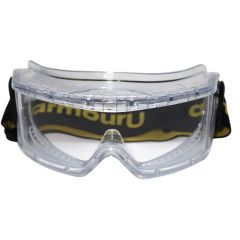
Eye protection is mandatory: use approved safety goggles or a full face shield to EN 166. Masonry grinding generates high-velocity stone and abrasive fragments across a wide arc.
-
Respiratory protection is critical: grinding concrete, brick, and natural stone generates respirable crystalline silica dust, which is a serious long-term lung hazard under COSHH. Wear a minimum FFP3 mask to EN 149 for all masonry grinding operations. For sustained or enclosed grinding work, powered air-purifying respirator protection should be considered.
-
Wear cut-resistant gloves to EN 388 for disc handling, fitting, and all grinding operations where hand proximity to the masonry surface is unavoidable.
-
Hearing protection to EN 352 is required. Angle grinders operating under grinding load on masonry consistently exceed 85dB(A).
-
Never exceed the maximum operating RPM for the selected disc variant.
-
Do not use this disc for cutting operations. It is a Type F27 grinding wheel designed for surface grinding only.
-
The Abrasive Wheels Regulations 1970, as incorporated into PUWER 1998, require that abrasive wheels are only mounted and operated by trained and appointed persons.
After use and storage:
-
Inspect the disc after each use for chips, edge damage, glazing of the abrasive surface, or delamination of the reinforcement layers.
-
A glazed grinding surface indicates the bond is not releasing worn grains efficiently on the material being ground. Dress the disc briefly on a piece of scrap concrete or abrasive dressing block to restore cutting aggression.
-
Store discs flat in a dry, stable-temperature environment away from impact, vibration, and damp. Silicon carbide bonds are susceptible to moisture degradation over time.
-
Do not stack heavy objects on top of stored discs.
-
Dispose of worn or damaged discs as general factory waste in line with site waste management procedures.
Frequently Asked Questions
Q: What does the C24/30SBF dual-grade specification mean for grinding performance?
A: C24/30SBF combines two silicon carbide grain sizes in a single bond. The coarser C24 grain provides aggressive initial material removal on hard concrete and dense stone, whilst the C30 grain delivers a more controlled surface finish. The result is a disc that removes material efficiently without leaving an excessively rough surface that requires significant secondary dressing.
Q: What is the difference between a Type F27 depressed centre grinding disc and a Type F41 flat cutting disc?
A: A Type F27 disc has a recessed centre that raises the grinding face above the mounting hardware, allowing flush contact with flat surfaces and into corner joints. A Type F41 is a flat cut-off wheel designed for straight cutting only. Using a cutting disc for grinding or a grinding disc for cutting are both serious safety risks under the Abrasive Wheels Regulations.
Q: What does EN 12413 mean and why does it matter on a UK site?
A: EN 12413 is the harmonised standard for bonded abrasive products covering dimensional accuracy, maximum operating speed, and structural integrity. Specifying EN 12413 certified discs supports compliance with the Abrasive Wheels Regulations under PUWER 1998 and strengthens your risk assessment and method statement documentation.
Q: Is silica dust a risk when using this disc on concrete and stone?
A: Yes. Grinding concrete, brick, sandstone, and natural stone generates respirable crystalline silica dust, which is a serious long-term respiratory hazard regulated under COSHH. FFP3 respiratory protection is the minimum requirement for sustained masonry grinding, and on-tool dust extraction or wet suppression should be considered for high-exposure tasks in enclosed spaces.
Q: Can this disc be used on structural steel or metal surfaces?
A: No. Silicon carbide abrasive is not formulated for metal grinding and will wear rapidly and unpredictably on steel surfaces. For metal grinding, use a dedicated aluminium oxide grinding disc such as the MAX Depressed Centre Metal Grinding Disc, which uses an A24RBF grade specifically formulated for steel.
Q: What grinding angle gives the best results on concrete and masonry?
A: Apply the disc at 15 to 25 degrees from the surface. Below 15 degrees reduces material removal rate and increases the risk of the disc skipping on uneven masonry. Above 25 degrees concentrates wear on a narrow band of the disc face and reduces the effective grinding area per stroke.
Q: Why does the 2A/11 reinforcement matter for masonry grinding specifically?
A: Masonry grinding applies higher lateral and impact forces to the disc than metal grinding, because concrete and stone surfaces are harder and less forgiving than steel. The 2A/11 reinforcement provides greater structural resistance to these forces, preventing the disc bending and potential breakage at speed that can occur with lighter reinforcement specifications on hard masonry.
Q: How do I prevent the disc from glazing on hard concrete?
A: Glazing on hard concrete usually means the bond is too hard for the surface being ground, preventing worn grains from releasing and exposing fresh abrasive. Dress the disc briefly on an abrasive dressing block or rough scrap concrete to restore the cutting surface. Maintaining consistent forward movement during grinding and avoiding dwelling in one spot also reduces glazing risk.
Q: Why should I order from CMT Group rather than a general builders merchant?
A: CMT Group has supplied construction and industrial sites across the UK since 2010, operating a fleet of over 100 FORS Silver accredited vehicles covering 90% of the UK mainland. Orders placed online by 7pm qualify for next working day delivery, and a VIP dedicated delivery service dispatched within 30 minutes is available UK-wide for urgent requirements. CMT's EDGE procurement portal provides agreed contract pricing, role-based spending controls, and live delivery tracking with What3Words integration for construction buyers managing multiple projects.