


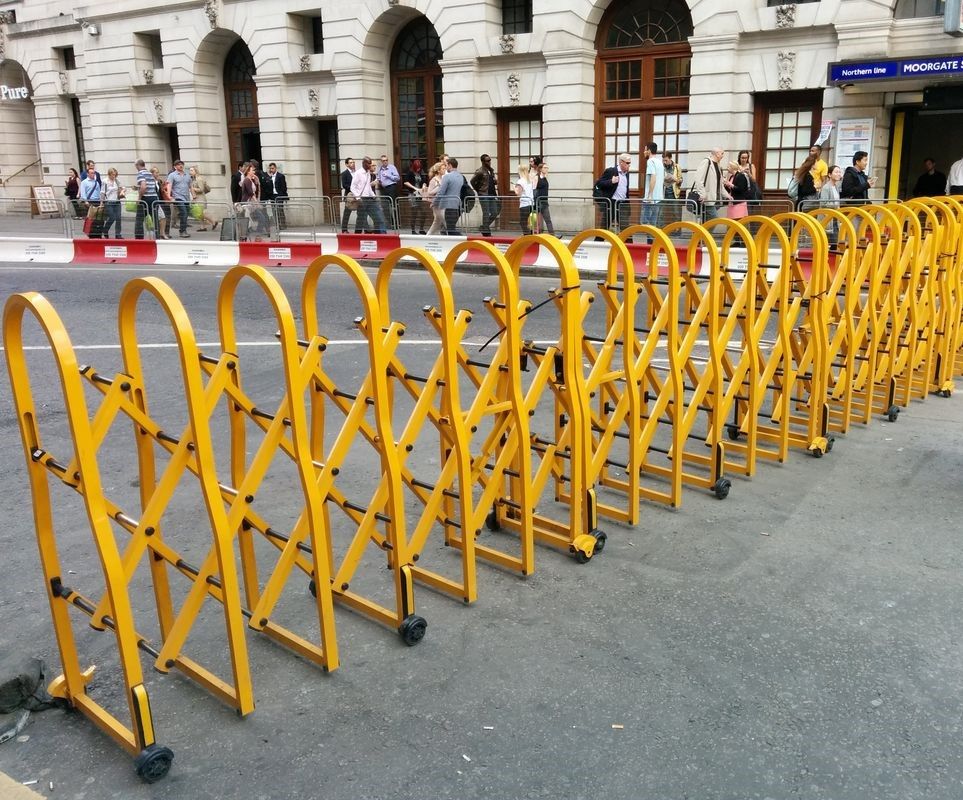


Expandable powder-coated aluminium crowd control barrier designed for UK construction sites, highways, utilities and facilities management, controlling pedestrian traffic, restricting unauthorised access and securing work zones.
- Rapid-deploy concertina barrier for temporary access control and pedestrian management
- Available in 1.3m or 1.8m height options with 2.1m or 4.0m expanded length variants
- Powder-coated aluminium construction for corrosion resistance and outdoor use
- Wheeled, retractable frame enables one-person positioning and relocation
- Locking ends and wheel brakes support unattended or fixed-position use
- Hi-vis yellow finish with reflectors for improved visibility in low light
- Lead time: 1-2 days
- CE certified
- Products with the “To Order” icon may not always be available from stock for same-day or next-day delivery. Please contact our team, who will be happy to confirm exact delivery dates.
Securasite Spanguard Concertina Barrier
Expandable powder-coated aluminium crowd control barrier designed for UK construction sites, highways, utilities and facilities management, controlling pedestrian traffic, restricting unauthorised access and securing work zones.
- Rapid-deploy concertina barrier for temporary access control and pedestrian management
- Available in 1.3m or 1.8m height options with 2.1m or 4.0m expanded length variants
- Powder-coated aluminium construction for corrosion resistance and outdoor use
- Wheeled, retractable frame enables one-person positioning and relocation
- Locking ends and wheel brakes support unattended or fixed-position use
- Hi-vis yellow finish with reflectors for improved visibility in low light
- Lead time: 1-2 days
- CE certified
- Products with the “To Order” icon may not always be available from stock for same-day or next-day delivery. Please contact our team, who will be happy to confirm exact delivery dates.
The Securasite Spanguard Concertina Barrier is a professional-grade folding barrier system designed for UK construction contractors, highways maintenance teams, utilities operatives and facilities managers requiring rapid pedestrian traffic management and access restriction. Manufactured from lightweight powder-coated 6063-T5 aluminium alloy, the barrier extends to either 2.1 metres or 4.0 metres, depending on model selection, and collapses compactly for storage and transportation between sites.
Each unit features a seven-section concertina frame with integrated wheel brakes and lockable end mechanisms, allowing single-operative deployment and the ability to link multiple barriers together for extended coverage across large work zones. The one-piece-bended tubular construction eliminates vulnerable connection points while providing high wind resistance suitable for outdoor applications. Hi-visibility yellow powder coating with UV protection and reflective elements ensures conspicuity during both daytime and nighttime work. The barrier is CE certified and proven in high-demand environments, including the London Underground and national infrastructure projects where rapid deployment, strong physical deterrence and operational efficiency are critical.
This barrier is suitable for temporary traffic management schemes, construction site perimeters, maintenance work zones, event crowd control and facilities access restriction. It is not suitable as a permanent boundary solution, as a load-bearing structure for vertical or horizontal forces, or for securing heavy plant and equipment against theft.
✓ Concertina scissor-frame design creates a physical and visual deterrent without fixed-frame bulk
✓ Retracts for storage and transport, supporting depots, vans and facilities teams with limited space
✓ Wheeled base helps deployment across typical hardstanding and internal floors
✓ Linkable units allow extended coverage across wider entrances, platforms and access corridors
✓ Powder coating supports use in wet and outdoor conditions, where steel barriers can corrode
✓ Curved tubular frame reduces exposed connectors to support durability in repeated use cycles
✓ Suitable for indoor and outdoor crowd control where fast repositioning is required
Specifications Table – JL180002
| Specification | Details |
|---|---|
| Product Name | Securasite Expandable Crowd Control Safety Barrier 2M & 4M |
| Product Code | SCCCG |
| Product Type | Expandable/retractable crowd control barrier |
| Primary Application | Pedestrian Traffic Control & Access Restriction |
| Frame Material | 6063-T5 Industrial Grade Aluminium Alloy |
| Frame Construction | One-Piece-Bended Tubular Design |
| Surface Finish | Hi-Visibility Yellow Powder Coating with UV Protection |
| Colour | Hi-vis yellow |
| Visibility Features | Integrated Reflective Elements for Night Works |
| Frame Sections | Seven Interconnected Concertina Sections |
| Mobility System | Wheeled Castors with Integrated Brakes |
| Security Features | Lockable End Mechanisms on Both Sides |
| Connection System | Clip System for Multi-Unit Linking |
| Typical Weight | Approximately 33kg (varies by model) |
| Deployment Method | Single Operative, No Tools Required |
| Use Environment | Indoor & Outdoor, All-Weather |
| Wind Resistance | High (Tubular Frame Design) |
| Corrosion Resistance | Powder-Coated Aluminium, Suitable for Outdoor Prolonged Use |
| Safety Certification | CE Certified |
| Manufacturer & Country of Origin | Securasite - United Kingdom |
Variations Table:
| Variation Code | Height | Expanded Length | Closed Width |
|---|---|---|---|
| SCCCG-13 | 1.3m | 2.1m | 47.5cm |
| SCCCG-18 | 1.8m | 2.1m | 48.5cm |
| SCCCG-134 | 1.3m | 4.0m | 83.0cm |
| SCCCG-184 | 1.8m | 4.0m | 83.0cm |
Selection Guide:
The Securasite Expandable Crowd Control Barrier is suitable for:
- Pedestrian diversion around temporary roadworks, utility excavations and street maintenance operations
- Securing construction site access points to prevent unauthorised entry during unmanned periods
- Controlling foot traffic at events, public gatherings and temporary installations
- Creating temporary barrier runs in retail environments, transport hubs and commercial facilities during maintenance
- Protecting work zones in underground stations, railway platforms and confined public spaces
- Restricting access to hazardous areas, including open excavations, floor openings and scaffold bases
- Channelling pedestrian flow through designated routes during building refurbishment or infrastructure upgrades
- Emergency site security followingan incidents or structural failures requiring rapid cordon establishment
| Variant | Typical Site Use | Why Choose It |
|---|---|---|
| 1.3m high / 2.1m length | Doorways, small corridor control, internal maintenance areas | Compact footprint with rapid deployment |
| 1.8m high / 2.1m length | Higher visual barrier where climbing deterrence is needed | Increased height for public-facing environments |
| 1.3m high / 4.0m length | Wider openings, station concourses, work zone segregation | Longer run reduces number of units needed |
| 1.8m high / 4.0m length | High public interface, larger restricted zones | Maximum coverage with increased deterrence |
Suitability Guide:
SCCCG
| Environment / Requirement | Suitability |
|---|---|
| Pedestrian Traffic Control | ✓ |
| Construction Site Perimeter Security | ✓ |
| Temporary Roadworks & Highways | ✓ |
| Indoor Facilities & Retail | ✓ |
| Underground Stations & Rail Platforms | ✓ |
| Event Crowd Management | ✓ |
| Outdoor All-Weather Use | ✓ |
| High Wind Exposure Locations | ✓ |
| Night Works (Low-Light Visibility) | ✓ |
| Single Operative Deployment | ✓ |
Deployment Guide:
Before Deployment
Inspect barrier frame for damage, including bent sections, cracked welds or missing reflective elements. Check wheel brakes operate correctly and castors rotate freely. Confirm the deployment area surface is suitable for wheeled movement, and the barrier will not obstruct emergency vehicle access. Ensure sufficient units are available to cover the required barrier length, accounting for terrain and connection points.
During Deployment
Position folded barrier at deployment start point with wheels unlocked. Extend concertina frame smoothly while guiding sections to prevent uncontrolled expansion. Deploy to required length and engage wheel brakes to stabilise barrier on ground. Activate locking mechanisms on both end frames to secure barrier in position. Where multiple units are required, connect using integrated clip system ensuring firm engagement between adjacent barriers. Check barrier alignment is straight and provides clear visual deterrent to pedestrian approach.
During Use
Monitor barrier position regularly, particularly in high-wind conditions or high-traffic areas where physical contact may displace sections. Check wheel brakes remain engaged and end locks are secure. Reposition or adjust barrier length as work zone requirements change throughout shift. Clean powder-coated surfaces periodically to maintain visibility and remove site contamination that may obscure reflective elements.
After Use / Storage
Unlock end mechanisms and release wheel brakes. Collapse concertina frame carefully, ensuring clip system engages to hold folded position. Wheel barrier to storage location or transport vehicle. Store in dry, secure environment to prevent theft and weather damage. Stack folded units vertically if space permits, ensuring weight distribution does not deform lower frames. Conduct routine inspection for damage or wear requiring repair before next deployment.
Can one person deploy and move these barriers without assistance?
Yes. The wheeled frame design with castors enables single-operative deployment, extension, retraction and repositioning without requiring lifting. The approximate 33kg weight is manageable for one person when using the wheels. However, for transport up/down stairs or over significant obstacles, a second operative is recommended to prevent strain injury or barrier damage. The concertina mechanism extends and collapses smoothly without requiring tools or complex assembly procedures.
Are these barriers suitable for use in high-wind locations such as exposed roadworks or elevated sites?
Yes. The tubular frame construction provides inherent wind resistance superior to mesh or panel-type barriers. The one-piece-bended aluminium design eliminates multiple connection points that can act as wind load concentration zones. When deployed with wheel brakes engaged and end locks activated, the barrier maintains stability in typical UK wind conditions. For extreme wind exposure sites (coastal areas, elevated motorway works), additional securing methods such as weighted bases or ground anchoring may be required, though this is not standard practice for temporary applications.
How many barriers are needed to secure a typical construction site access point or work zone?
This depends on perimeter length and barrier model selected. For a single access point (approximately 4–6 metres wide), 2–3 units of the 2.1m model or 1–2 units of the 4.0m model would be sufficient. For larger work zones, calculate total perimeter length and divide by extended barrier length (2.1m or 4.0m), adding 10% for overlap and configuration flexibility. Multiple units connect via the integrated clip system to form continuous barrier runs. Consult site-specific risk assessments and temporary traffic management plans for minimum barrier coverage requirements.
What is the expected lifespan and do these barriers require maintenance?
When used and stored correctly, these barriers provide multi-year service life typical of professional-grade aluminium traffic management equipment. The powder-coated finish with UV protection resists fading and corrosion during outdoor exposure. Routine inspection should check for frame damage, wheel operation, brake function and reflective element condition. Cleaning with water removes site contamination that may reduce visibility. The absence of complex mechanical components minimises maintenance requirements. Damaged sections may require professional repair or replacement rather than field fixes to maintain CE certification and structural integrity.
Are these barriers compliant with UK highways and construction site safety regulations?
Yes. The barriers are CE certified and meet requirements for temporary traffic management equipment used on UK highways and construction sites. The hi-visibility yellow colour and integrated reflective elements comply with conspicuity standards for temporary works. However, compliance with specific regulations (Traffic Signs Manual Chapter 8, CDM 2015, site-specific method statements) depends on correct deployment, appropriate barrier selection for the application, and integration within wider traffic management or site security measures. Contractors remain responsible for ensuring barrier use aligns with risk assessments and temporary works designs.
Can these barriers be used to secure areas overnight or during unmanned periods?
Yes, when used correctly. The lockable end mechanisms prevent unauthorised displacement, and the physical presence provides a visual deterrent. However, these are not anti-theft barriers for securing valuable plant or materials – they are designed to restrict pedestrian access and manage foot traffic. For high-security applications or overnight protection of equipment, additional measures such as hoarding, fencing or monitored security may be required. The barriers are suitable for cordoning work zones, restricting access to hazards, and maintaining site perimeters during short unmanned periods where physical security is not the primary concern.

