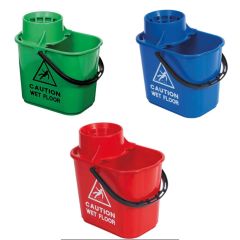


Kentucky mop bucket and wringer for site cleaning teams, welfare units, and commercial premises requiring colour-coded professional mopping.
- 24 litre capacity, suits continuous commercial mopping tasks
- Divided compartments, clean and dirty water kept separate
- Removable handle-operated wringer
- Heavy-duty castor wheels for easy site movement
- Caution Wet Floor warning printed on two sides
- Red colour, designated for high-risk area cleaning
- Microfibre mop compatible, designed for damp mopping
Kentucky Mop Bucket and Wringer 24L - Red Wheeled with Divider
Kentucky mop bucket and wringer for site cleaning teams, welfare units, and commercial premises requiring colour-coded professional mopping.
- 24 litre capacity, suits continuous commercial mopping tasks
- Divided compartments, clean and dirty water kept separate
- Removable handle-operated wringer
- Heavy-duty castor wheels for easy site movement
- Caution Wet Floor warning printed on two sides
- Red colour, designated for high-risk area cleaning
- Microfibre mop compatible, designed for damp mopping
- Buy 3 for £65.40 £54.50 each and save 8%
- Buy 6 for £58.80 £49.00 each and save 17%
| BULK DISCOUNT | 3 | 6 |
|---|---|---|
| Price | £54.50 £65.40 | £49.00 £58.80 |
Order 1x to earn 59 FASTPoints
Order to earn 59 FASTPoints
Log in to access trade discountsKentucky Mop Bucket and Wringer 24L - Red
Kentucky mop bucket and wringer systems are the professional standard for commercial floor cleaning in welfare units, site canteens, washrooms, and large hard floor areas. This 24-litre red model features divided clean and dirty water compartments, a removable handle-operated wringer, and heavy-duty castor wheels. The red colour designates it for high-risk cleaning zones under the British colour-coded cleaning system.
How the divided compartments keep your floors cleaner with every pass
A single-compartment mop bucket means dirty water from the wrung mop immediately mixes back into the clean solution. Each subsequent pass across the floor deposits a thinner film of diluted dirt rather than cleaning it. On a welfare unit floor or site cabin, this is the main reason floors look clean moments after mopping but feel grimy within the hour. The divided compartment on this bucket keeps the clean solution on one side and dirty wrung water on the other. The mop re-enters clean water each time, so the cleaning effect holds across the full session without needing to change the water as often.
Key Features
-
Divided compartments: Clean solution and dirty wrung water are kept separate throughout the mopping session. The floor gets clean water on every pass rather than progressively contaminated solution.
-
Removable handle-operated wringer: Positioned for maximum leverage with minimum effort. Removes sufficient moisture for damp mopping without needing to manually squeeze the mop head.
-
Heavy-duty castor wheels: The bucket moves freely across hard site floors without tipping. Reduces manual lifting and the associated strain during long cleaning sessions.
-
Caution Wet Floor warning on two sides: The safety warning is visible regardless of which way the bucket faces in a corridor or room. Most competitor buckets carry it on one side only.
-
Red colour coding: Red is the designated colour for high-risk cleaning areas, washrooms, toilet facilities, and urinals, under UK commercial and NHS cleaning guidelines. Using the correct colour prevents cross-contamination between cleaning zones.
-
24-litre capacity: Enough water to cover a large floor area without repeated refilling during a single session.
-
Microfibre compatible: Designed for damp mopping with microfibre mop heads, which lift and trap debris rather than spreading it.
Who is this for
Trades and roles:
-
Site welfare attendants
-
Cleaning operatives and contractors
-
Facilities managers
-
Site managers
-
Caretakers
Industries:
-
Construction
-
Civil engineering
-
Facilities management
-
Hospitality and catering (site welfare)
-
Healthcare (site medical rooms)
Specifications
| Specification | Detail |
| Product Name | Kentucky Mop Bucket and Wringer 24L - Red Wheeled with Divider |
| SKU | BBM03 |
| Type | Kentucky mop bucket and wringer |
| Capacity | 24 litres |
| Compartments | 2, divided — clean water and dirty water separated |
| Wringer | Removable, handle-operated |
| Castors | Heavy-duty plastic castors |
| Safety Warning | "Caution Wet Floor" printed on two sides |
| Compatible Mops | Microfibre and Kentucky mop heads |
| Mopping Method | Damp mopping |
| Material | Polypropylene |
| Dimensions | 27cm (W) x 73cm (D) x 61cm (H) |
| Colour | Red |
Compatibility
| Application or condition | Status |
| Welfare unit washrooms and toilet facilities | ✓ Suitable |
| Site cabin and canteen hard floors | ✓ Suitable |
| Commercial hard floor areas | ✓ Suitable |
| Microfibre mop heads | ✓ Suitable |
| Kentucky mop heads (300g to 450g) | ✓ Suitable |
| Damp mopping technique | ✓ Suitable |
| Diluted cleaning solutions | ✓ Suitable |
| Carpet or soft floor surfaces | ✗ Not suitable |
| Outdoor or uneven ground use | ✗ Not suitable |
| Undiluted or concentrated chemical immersion | ✗ Not suitable |
| High-risk area cleaning (colour code: red) | ✓ Suitable |
| Low-risk or food preparation areas | ✗ Use correct colour-coded bucket |
Who is this for
This bucket is used by cleaning operatives, welfare unit attendants, and facilities managers responsible for maintaining welfare unit toilets, site cabin floors, and washroom areas on construction and civil engineering projects. It suits any environment where a colour-coded cleaning system is in use and where hard floor areas need to be mopped regularly without interruption for water changes. It is equally suited to contract cleaners working on commercial premises at project completion.
Typical applications
-
Cleaning welfare unit toilet and washroom facilities at the start and end of each shift, using red equipment as designated for high-risk zones.
-
Mopping site cabin and canteen floors after meals and during daily cleaning routines.
-
Fast-response floor cleaning after spillages in welfare units, canteens, or site offices.
-
Maintaining hygiene in site medical rooms and first aid facilities.
-
Regular floor maintenance in large welfare cabin common areas and reception zones.
-
End-of-project commercial cleaning of hard floor areas in completed buildings.
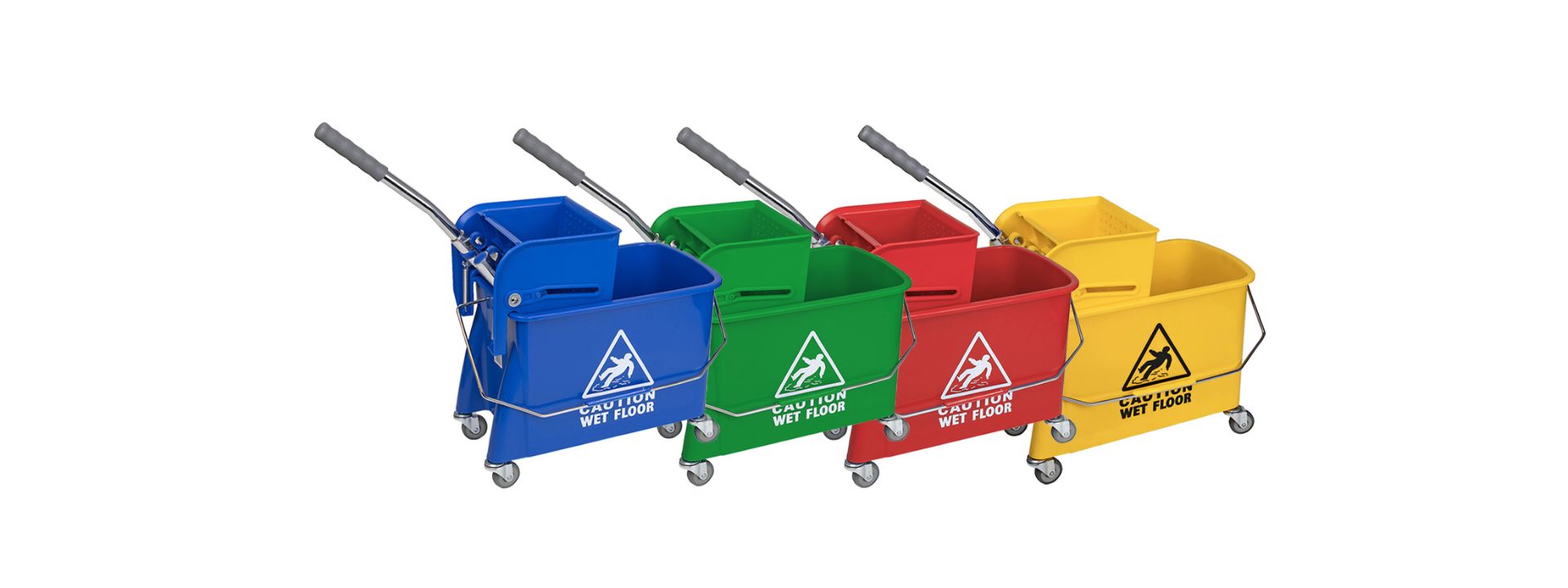
| Colour | Designated Area |
|---|---|
| Red | Toilets, urinals, and washrooms — highest contamination risk |
| Blue | General low-risk areas — offices, common rooms, public spaces |
| Green | Food preparation and catering areas — canteens and kitchens |
| Yellow | Clinical or isolation areas — medical rooms and first aid points |
How to use
Step 1: Fill the clean water compartment with fresh water and the appropriate diluted floor cleaning solution for the surface type. Do not fill above the indicated level.
Step 2: Position the bucket near the area to be mopped. Allow the castors to roll freely on the hard floor.
Step 3: Place the mop head into the clean water compartment to saturate it, then use the handle-operated wringer to remove excess moisture. For damp mopping, wring firmly until the mop head is damp rather than wet.
Step 4: Mop the floor using overlapping figure-of-eight passes, working backwards from the far end of the area so you do not tread on freshly mopped surfaces.
Step 5: After each pass, return the mop head to the bucket and wring into the dirty water side before re-wetting in the clean water compartment.
Step 6: Change the water when it turns visibly grey or brown. Continuing with dirty water spreads contamination rather than removing it.
Step 7: After the session, empty both compartments, rinse the bucket and wringer with clean water, and store with the mop head kept separately to allow both to dry.
Common mistakes
-
Not using the divider correctly: The divided compartment only works if the wringer directs water into the dirty side. Check the wringer position before use.
-
Over-wetting the mop for damp mopping: A dripping mop leaves standing water on the floor, extends drying time, and increases slip risk. Wring thoroughly before each pass.
-
Continuing to mop with dirty water: When the water turns grey or brown, empty and refill. Dirty water deposits a residue that makes floors look clean immediately but feel grimy within minutes.
-
Cross-using colour-coded equipment: A red bucket stays in the high-risk area it is assigned to. Using it to mop a food preparation area or general office is a hygiene compliance failure.
-
Leaving the bucket full after use: Standing water in a mop bucket promotes bacterial growth. Empty and rinse after every session without exception.
Safety
The Caution Wet Floor warning is printed on two sides of this bucket, providing a visible alert regardless of bucket orientation. In high-traffic corridors or public areas, use this alongside a dedicated wet floor sign for full compliance with health and safety requirements. Ensure cleaning solutions are diluted to the correct ratio. Use appropriate PPE, disposable nitrile or vinyl gloves, when handling chemical cleaning solutions.
Maintenance
Empty and rinse the bucket after every use. Check the wringer mechanism moves freely. If it becomes stiff, check for mop fibre build-up around the wringer bars and clear before the next use. Inspect the castor wheels periodically for debris and confirm they swivel and roll without resistance. Replace the bucket if the body cracks or the wringer mechanism becomes damaged and cannot be cleaned clear.
Frequently Asked Questions
Q: What is the difference between a Kentucky mop bucket and a standard round mop bucket?
A: A Kentucky mop bucket is a rectangular system designed for use with Kentucky and microfibre flat mop heads. It typically includes a built-in wringer, castors for mobility, and, on this model, a divided compartment to separate clean and dirty water. A standard round bucket has none of these features and is used with a conventional string or looped mop. For professional site and commercial cleaning, the Kentucky system is more efficient and better suited to large floor areas.
Q: What does the red colour signify in professional cleaning?
A: In the British colour-coded cleaning system, red equipment is designated for high-risk areas, specifically toilets, urinals, and washroom facilities. The system prevents cross-contamination by ensuring that mops, buckets, and cloths used in these areas are never used elsewhere. Red equipment stays in the high-risk zone. For general office areas, blue is used. For food preparation, green. For clinical or isolation areas, yellow.
Q: What is this NOT suitable for?
A: This bucket is not suitable for outdoor use on uneven or muddy ground, where the castors would be obstructed and the bucket could tip. It is not designed for carpet cleaning. It should not be used with undiluted or concentrated cleaning chemicals, which can degrade the polypropylene over time. It must not be used in cleaning zones other than those designated red in a colour-coded system.
Q: How does the divided compartment actually work during mopping?
A: The bucket has two sections separated by a central divider. The clean water and solution sit in one section. When you wring the mop, the dirty water is directed into the other section. Each time you re-wet the mop, it contacts the clean side, not the dirty water. This keeps the cleaning solution effective for longer and means each pass of the mop delivers clean solution to the floor rather than redistributing contamination.
Q: What mop heads work with this bucket?
A: This bucket is compatible with microfibre mop heads and Kentucky mop heads in the 300g to 450g range. It is designed for damp mopping rather than heavy wet mopping. Check that the mop handle and head you are using are compatible with the wringer bar spacing before use.
Q: How do I know when to change the water?
A: The water in the clean compartment should remain visibly clear and have a consistent cleaning solution colour. When the water in either compartment turns grey or brown, empty both sections and refill with fresh solution. There is no fixed interval, it depends on the level of soiling and how much floor area has been covered.
Q: How do I maintain the bucket and wringer between uses?
A: Empty and rinse both compartments after every use. Clear any mop fibre from the wringer bars. Check the castor wheels are free of debris. Store in a clean dry area with the mop head removed and stored separately. Inspect the wringer mechanism and castor condition monthly during heavy use.