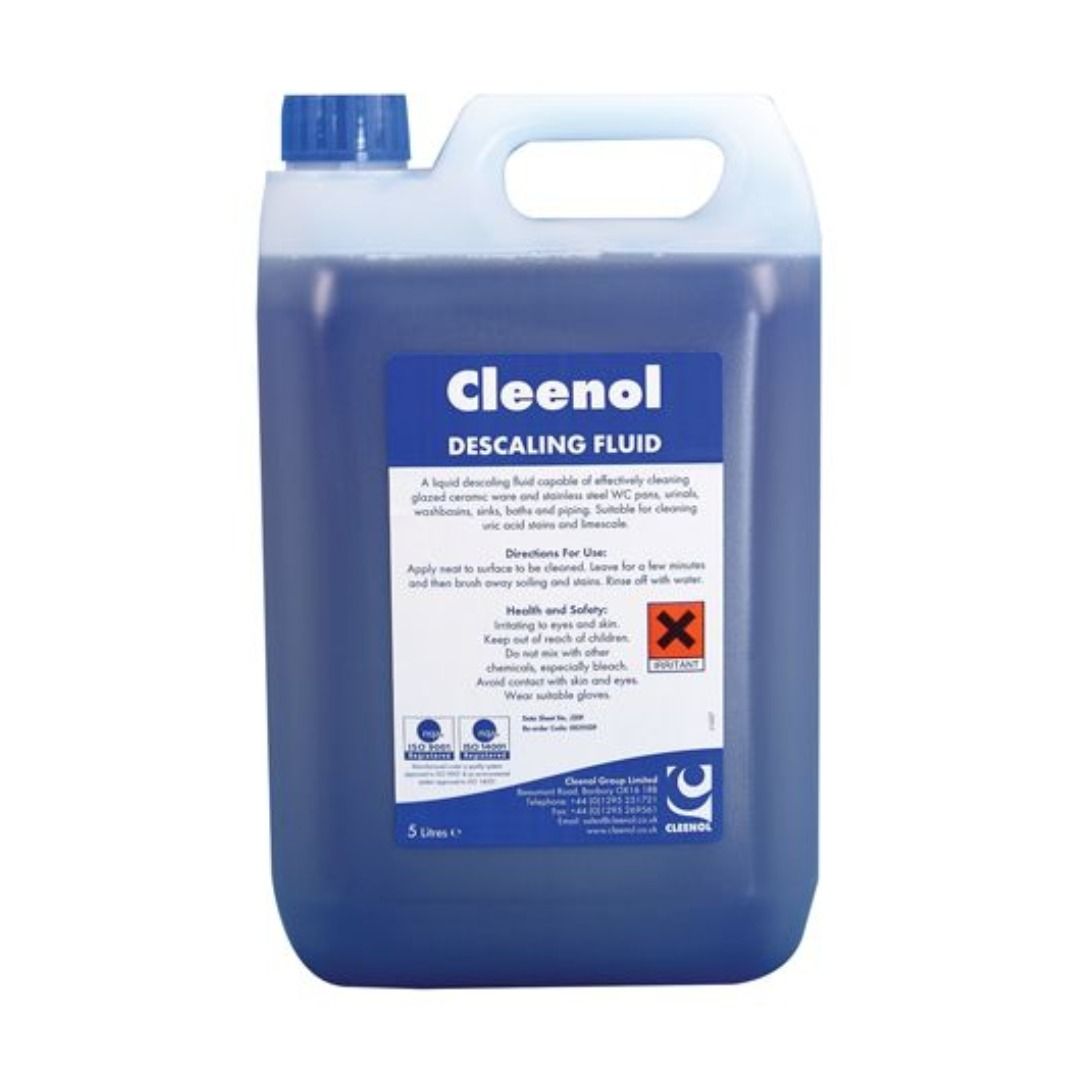
Professional-grade liquid descaler for removing limescale and uric acid deposits from welfare unit urinals, WC pans, sinks, and sanitary pipework on construction and industrial sites.
- Hydrochloric acid formula, 15 to 30% concentration, fast-acting
- Applied neat, no dilution required, leave for a few minutes then brush and rinse
- Suitable for glazed ceramic ware, stainless steel sanitary ware, and sanitary pipework
- For professional use only: EN 374 nitrile gloves and EN 166 eye protection required throughout
Liquid Descaler 5 Litre - Hydrochloric Acid Formula
Professional-grade liquid descaler for removing limescale and uric acid deposits from welfare unit urinals, WC pans, sinks, and sanitary pipework on construction and industrial sites.
- Hydrochloric acid formula, 15 to 30% concentration, fast-acting
- Applied neat, no dilution required, leave for a few minutes then brush and rinse
- Suitable for glazed ceramic ware, stainless steel sanitary ware, and sanitary pipework
- For professional use only: EN 374 nitrile gloves and EN 166 eye protection required throughout
- Buy 6 for £17.59 £14.66 each and save 13%
- Buy 12 for £15.20 £12.67 each and save 24%
| BULK DISCOUNT | 6 | 12 |
|---|---|---|
| Price | £14.66 £17.59 | £12.67 £15.20 |
Order 1x to earn 16 FASTPoints
Order to earn 16 FASTPoints
Log in to access trade discountsLiquid Descaler 5 Litre
Liquid descaler formulated with hydrochloric acid at 15 to 30% concentration for the professional removal of limescale, uric acid deposits, and mineral scale from welfare unit urinals, stainless steel WC pans, washbasins, sinks, baths, and sanitary pipework on construction sites and commercial facilities. Applied neat with no dilution required, the formula works directly on calcified and encrusted surfaces where diluted food-safe alternatives do not deliver adequate results. For professional use only: requires chemical-resistant nitrile gloves (EN 374), safety glasses (EN 166), and use in a well-ventilated area throughout application.
How hydrochloric acid cuts through scale that weaker descalers leave behind
Citric acid and diluted food-safe descalers are formulated for light limescale in commercial kitchen equipment, not for the heavy calcification and uric acid scale that builds up in welfare unit urinals, WC pans, and sanitary pipework over extended site operations. Attempting to treat heavy-duty welfare facility scale with an underpowered product means repeated application, extended contact times, and residual deposits that harbour odour and create ongoing hygiene problems throughout the project. Hydrochloric acid reacts directly with calcium carbonate and uric acid deposits, dissolving scale rapidly at the chemical level and restoring sanitary ware surfaces and pipework to a serviceable condition in a single treatment.
Key Features
-
Hydrochloric acid formulation: Contains hydrogen chloride at 15 to 30%, the established professional-grade acid for rapid dissolution of calcium carbonate limescale and uric acid deposits on sanitary ware and welfare unit pipework.
-
Applied neat, no dilution: Product is applied directly to the surface without mixing or measuring, reducing handling steps and minimising unnecessary contact with the concentrated formula.
-
Multi-surface effectiveness: Suitable for glazed ceramic ware, stainless steel WC pans, urinals, washbasins, sinks, baths, and sanitary pipework across site welfare and commercial washroom facilities.
-
Uric acid and limescale removal: Addresses both mineral limescale from hard water deposits and uric acid scale from urinal use, two distinct deposit types that require acid chemistry to break down effectively.
-
5 Litre professional format: Provides sufficient volume for multiple treatment sessions across a welfare compound, reducing restocking frequency on longer-duration projects.
-
DANGER classified, professional use only: GHS05 and GHS07. H314 and H332. Requires chemical-resistant nitrile gloves (EN 374), safety glasses (EN 166), and ventilated working conditions. Not for consumer or domestic use.
Who is this for
Trades and roles:
-
Site managers
-
Welfare unit operatives
-
Maintenance contractors
-
Facilities managers
-
Compound managers
Industries:
-
Construction
-
Civil engineering
-
Utilities and groundworks
-
Industrial facilities management
-
Property maintenance
Specifications
| Specification | Detail |
|---|---|
| Product Name | Liquid Descaler 5 Litre - Hydrochloric Acid Formula |
| SKU / Product Code | JLDS05 |
| Fixed Specifications | |
| Product Type | Professional acidic descaling agent |
| Application | Removal of limescale and uric acid deposits from sanitary ware and pipework |
| Active Ingredient | Hydrogen chloride (hydrochloric acid) 15-30% |
| Surfactant Content | Alcohol Alkoxylate 1-5% |
| pH | 1 (strongly acidic) |
| Application Method | Applied neat, no dilution required |
| Signal Word | DANGER |
| Hazard Classification | GHS05, GHS07 — H314 severe skin burns and eye damage, H332 harmful if inhaled, H318 serious eye damage |
| UN Number | UN 1789 (Hydrochloric Acid) |
| Transport Hazard Class | Class 8 (Corrosive), Packing Group II |
| Required PPE | EN 374 chemical-resistant nitrile gloves, EN 166 safety glasses, protective clothing |
| Ventilation | Required — use in well-ventilated area only |
| Incompatible With | Bleach, chlorine-based products, strong alkalis, strong bases, reactive metals (aluminium, zinc, copper) |
| Storage | Keep container closed and locked when not in use. Away from heat, bleach, and incompatible materials. |
| Use Category | For professional use only |
| Variable Specifications | |
| Volume | 5 Litre |
| Relative Density | 1.09 |
| Colour | Blue |
Compatibility
| Surface or Application | Status |
|---|---|
| Glazed ceramic ware (WC pans, washbasins) | ✓ Compatible |
| Stainless steel sanitary ware (brief contact, rinse thoroughly) | ✓ Compatible |
| Urinals and urinal pipework | ✓ Compatible |
| Washbasins and sinks | ✓ Compatible |
| Baths | ✓ Compatible |
| Sanitary drainage pipework | ✓ Compatible |
| Aluminium, copper, zinc, or other reactive metals | ✗ Not recommended |
| Bleach or chlorine-based cleaning products | ✗ Never mix — toxic gas risk |
| Strong alkalis or caustic cleaners | ✗ Not recommended |
| Food preparation or food contact surfaces | ✗ Not recommended |
| Consumer or domestic use | ✗ Not recommended — professional use only |
Who is this for
Site managers, welfare operatives, and maintenance contractors responsible for the upkeep of sanitary facilities in construction site welfare units will find this product suited to situations where heavy limescale and uric acid scale has accumulated in urinals, WC pans, and washbasins over weeks or months of continuous use on long-running projects. Facilities managers overseeing industrial compounds, temporary accommodation blocks, and commercial washroom facilities with persistent scale build-up will find the hydrochloric acid formula effective where repeated application of weaker products has not delivered results. For professional use only: a COSHH assessment under the Control of Substances Hazardous to Health Regulations 2002 is required before use on site.
Typical applications
-
Descaling urinals in construction site welfare units where uric acid deposits and limescale have built up over several weeks of continuous use by site operatives.
-
Removing mineral scale from stainless steel WC pans in welfare facilities where hard water supply has caused persistent calcification around the pan and pipework connections.
-
Treating washbasins and sinks in site compound ablution facilities where limescale accumulation around taps and drain openings has reduced drainage performance.
-
Descaling baths in welfare units serving operatives on overnight or extended-stay site operations where hard water scale has built up on the bath surface and around fittings.
-
Clearing scale deposits from sanitary drainage pipework and urinal connections where limescale build-up has reduced flow rate and created persistent odour.
-
Removing uric acid staining and encrusted deposits from glazed ceramic sanitary ware that has become resistant to standard surface cleaners and biological treatments.
How to use
Step 1: Put on all required personal protective equipment before handling the product. Wear chemical-resistant nitrile gloves (EN 374), safety glasses (EN 166), and protective clothing. Ensure the working area is well ventilated before opening the container.
Step 2: Apply the liquid descaler neat and undiluted directly to the surface to be treated. Do not mix with water, bleach, or any other cleaning product before or during application.
Step 3: Leave the product on the surface for a few minutes. Allow the acid to react with and dissolve scale deposits before attempting to remove them.
Step 4: Brush away loosened scale and soiling using a suitable brush or cloth appropriate to the surface being treated.
Step 5: Rinse the treated surface thoroughly with clean water to remove all product residue. Rinsing must be thorough before any other cleaning product is applied to the surface.
Step 6: Remove PPE carefully after use. Wash hands thoroughly with soap and water.
Step 7: Replace the container lid securely after use. Store in a locked location away from bleach, strong alkalis, and incompatible materials.
Common mistakes
-
Mixing with bleach or chlorine-based products: this is the most serious handling error. Hydrochloric acid reacts violently with bleach to produce toxic chlorine gas. Never use these products together, and always rinse surfaces thoroughly before switching between them.
-
Handling without PPE: this product causes severe skin burns and serious eye damage (H314, H318) at full concentration. Full PPE compliance is required before any contact with the product, including during dispensing and container handling.
-
Applying to reactive metals: do not apply to aluminium, zinc, copper, or other reactive metals. Hydrochloric acid corrodes these materials. The product is suitable for stainless steel only with brief contact followed by thorough rinsing.
-
Leaving product on surfaces beyond the recommended contact time: apply, wait a few minutes as directed, then brush and rinse. Monitor contact and do not leave unattended on surfaces for extended periods.
-
Inadequate rinsing after treatment: all acid residue must be removed by thorough rinsing with clean water. Residual acid left on surfaces after treatment continues to react and can cause damage to the substrate over time.
Safety
DANGER classification (Signal Word: Danger). H314: causes severe skin burns and eye damage. H332: harmful if inhaled. H318: causes serious eye damage. Use only in well-ventilated areas. Do not breathe vapour. Wear chemical-resistant nitrile gloves (EN 374), safety glasses (EN 166), and protective clothing at all times during handling and application. If inhaled, remove to fresh air. If skin contact occurs, remove contaminated clothing immediately and rinse with water. If eye contact occurs, rinse cautiously with water for several minutes, remove contact lenses if present, and seek immediate medical attention. Do not induce vomiting if swallowed. Never mix with bleach, strong alkalis, or other cleaning chemicals. Store locked when not in use. Keep out of reach of children. A COSHH assessment is required under the Control of Substances Hazardous to Health Regulations 2002 before use on site.
Maintenance
Replace the container lid securely after each use. Store in a locked location away from direct sunlight, heat sources, bleach, strong alkalis, and metals. Inspect the container for damage or leakage before each use and do not use a damaged container. Do not transfer product to unlabelled or unsuitable containers. Dispose of product and packaging in accordance with local waste disposal regulations and COSHH requirements.
Frequently Asked Questions
Q: What surfaces is this liquid descaler suitable for?
A: This liquid descaler is suitable for glazed ceramic sanitary ware including WC pans, urinals, and washbasins, stainless steel WC pans and sinks with brief contact followed by thorough rinsing, baths, and sanitary pipework. It is not suitable for aluminium, copper, zinc, or other reactive metals, which react with hydrochloric acid. It must not be used on food preparation or food contact surfaces, and is not suitable for consumer or domestic use.
Q: How does a hydrochloric acid descaler work?
A: Hydrochloric acid reacts chemically with calcium carbonate, the mineral compound that makes up limescale, breaking it down into water-soluble products that can be rinsed away. The same acid chemistry also dissolves uric acid deposits, the hard crystalline scale that accumulates in urinals through repeated use. This chemical reaction is significantly faster and more complete than the weaker organic acid reactions produced by citric or lactic acid descalers, making HCl-based products the standard choice for heavy-duty professional applications where diluted alternatives have failed. The formula is applied neat with no dilution required, allowing the full acid concentration to act directly on the deposit.
Q: What is this product NOT suitable for?
A: This product must not be mixed with bleach or any chlorine-based cleaning product under any circumstances. The combination of hydrochloric acid and bleach produces toxic chlorine gas. It is not suitable for aluminium, zinc, copper, or other reactive metals. It is not suitable for food preparation or food contact surfaces, and must not be used for domestic or consumer applications. A COSHH assessment is required before use on site.
Q: What PPE is required when using this liquid descaler?
A: Chemical-resistant nitrile rubber gloves meeting EN 374 are required throughout handling and application. Safety glasses meeting EN 166 must be worn. Protective clothing and safety boots are also required. Use in a well-ventilated area is essential as the product is harmful if inhaled (H332). Respiratory protection is not required under normal conditions of use, but avoid breathing vapour or spray at all times.
Q: Is a COSHH assessment required before using this product on site?
A: Yes. This product is classified as DANGER (Signal Word: Danger) and contains hydrogen chloride at 15 to 30%. Under the Control of Substances Hazardous to Health Regulations 2002, a COSHH assessment is required before use. The full Safety Data Sheet for this product is available for download at cmt.co.uk and must be available to all personnel handling the product. The SDS references UK workplace exposure limits for hydrogen chloride as set out in HSE EH40.
Q: Can this product be used alongside other cleaning products in the welfare unit?
A: This product must never be mixed with bleach or chlorine-based products. Always ensure surfaces are thoroughly rinsed with clean water before applying any other cleaning product after descaling, or before descaling a surface that has previously been treated with bleach. Used correctly in sequence with other welfare facility cleaning products such as disinfectant and surface cleaner, this descaler is part of a complete washroom maintenance routine.
Q: How long should I leave the product on the surface before rinsing?
A: Apply neat to the surface and leave for a few minutes to allow the acid to react with and loosen scale deposits, then brush away soiling and rinse thoroughly with water. Do not leave unmonitored for extended periods. The exact contact time will depend on the severity of the scale build-up, but the application is intended to be a short-contact treatment followed by brushing and rinsing rather than an extended soak.