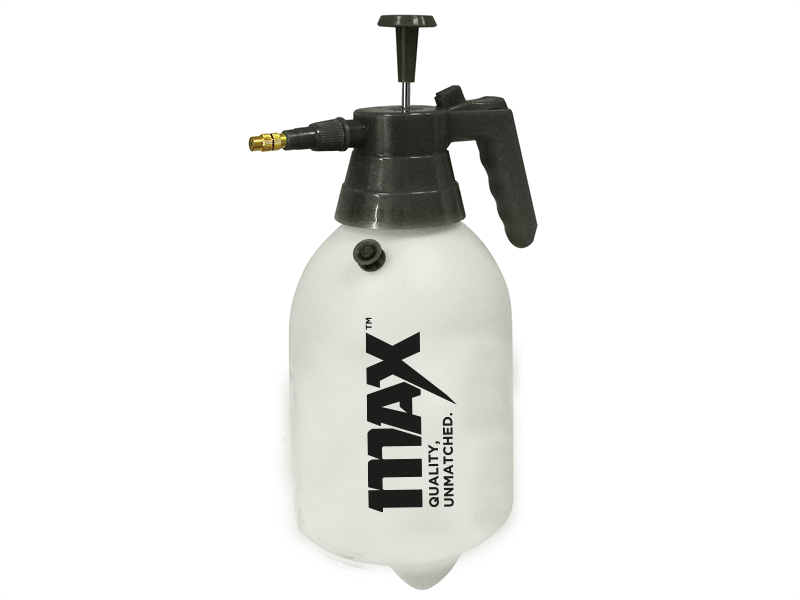
A 2 litre manual pressure sprayer built for contractor use, with a Viton seal for chemical compatibility and a solid brass nozzle for consistent spray control on site.
- Viton seal: Compatible with oils, solvents, lubricants, and petrol without seal deterioration
- Solid brass nozzle: Adjustable, corrosion-resistant, delivers consistent spray pattern
- Tank capacity: 2 litres (4.5 pints)
- Pressure management: Integrated pressure gauge and safety valve
- Pump mechanism: Manual pump action, approximately 30 strokes to operating pressure
- Trigger lock: Continuous spray without sustained hand pressure
- Compliance: Safety valve integrated to prevent over-pressurisation
A 2 litre manual pressure sprayer built for contractor use, with a Viton seal for chemical compatibility and a solid brass nozzle for consistent spray control on site.
- Viton seal: Compatible with oils, solvents, lubricants, and petrol without seal deterioration
- Solid brass nozzle: Adjustable, corrosion-resistant, delivers consistent spray pattern
- Tank capacity: 2 litres (4.5 pints)
- Pressure management: Integrated pressure gauge and safety valve
- Pump mechanism: Manual pump action, approximately 30 strokes to operating pressure
- Trigger lock: Continuous spray without sustained hand pressure
- Compliance: Safety valve integrated to prevent over-pressurisation
- Buy 6 for £19.42 £16.18 each and save 11%
- Buy 12 for £16.99 £14.16 each and save 22%
| BULK DISCOUNT | 6 | 12 |
|---|---|---|
| Price | £16.18 £19.42 | £14.16 £16.99 |
Order 1x to earn 18 FASTPoints
Order to earn 18 FASTPoints
Log in to access trade discountsMAX 2L handheld pressure sprayer
The MAX 2L handheld pressure sprayer is a 2 litre manual pump pressure sprayer designed for contractor and site use, where chemical compatibility, controlled pressure, and reliable spray delivery are non-negotiable. Unlike the consumer-grade sprayers that dominate this category, the pressure sprayer is built around a Viton seal and a solid brass nozzle: two components that determine whether a sprayer holds up in genuine site conditions or fails within a few uses.
The Viton seal is the specification that matters most when the sprayer is being used with anything beyond plain water. Standard NBR or EPDM seals degrade rapidly on contact with solvents, release agents, lubricants, and petroleum-based products. Viton is chemically inert across a far wider range of substances, which means the MAXSPRAY2 can be used for solvent application, mould release agents, light oils, and fuel-based products without the seal softening, swelling, or failing. For site teams who need one sprayer to cover multiple applications, that matters.
Why choose the MAX 2L handheld pressure sprayer?
-
Viton seal construction: Resists degradation from solvents, oils, lubricants, and petrol-based products, where standard rubber seals fail within weeks of chemical use
-
Solid brass spray nozzle: Corrosion-resistant and fully adjustable, delivering a consistent cone or stream pattern without the nozzle clogging or cracking under repeated use
-
Integrated pressure gauge: Allows the operator to monitor working pressure in real time, preventing under-pressurisation that causes uneven spray and over-pressurisation that risks seal or tank failure
-
Built-in safety valve: Automatically relieves excess pressure, removing the risk of tank rupture when the unit is used in warm conditions or with volatile liquids
-
Trigger lock mechanism: Engages for continuous spray, reducing operator fatigue on longer applications without the need to maintain constant trigger pressure
-
2 litre capacity: Sufficient for most site tasks without being heavy in the hand, and sized to fill quickly between applications
-
Manual pump action: No power source required, no charging, no batteries. Operational anywhere on site from first use
What's in the box?
-
MAX 2 litre pressure sprayer (fully assembled)
-
Integrated pump handle and pressure gauge assembly
-
Solid brass adjustable spray nozzle
-
Trigger with continuous-spray lock
-
Safety pressure relief valve (pre-fitted)
Specifications
| Specification | Detail |
|---|---|
| Product Name | MAX 2L handheld pressure sprayer - Viton seal & brass nozzle |
| Product Code | MAXSPRAY2 |
| Capacity | 2 litres |
| Pump Type | Manual pump action |
| Pressure Control | Integrated pressure gauge |
| Safety Features | Pressure relief safety valve |
| Nozzle Material | Solid brass |
| Seal Type | Viton |
| Application Type | Liquids oils solvents compatible |
| Construction | Plastic body with metal components |
| Colour | White and black |
Compatibility
| Liquid Type | Compatible |
|---|---|
| Water | ✓ Compatible |
| Oils and lubricants | ✓ Compatible |
| Petrol and fuels | ✓ Compatible |
| Mild chemicals | ✓ Compatible |
| Strong acids | ✗ Not recommended |
| Chlorinated solvents | ✗ Not recommended |
Who is this for?
The MAX 2L handheld pressure sprayer is aimed at contractors, groundworkers, civils teams, and site managers who need a reliable handheld sprayer for day-to-day site tasks involving water, light chemicals, or petroleum-based substances. It is suited to anyone working across construction, civil engineering, concrete placement, formwork, or general site maintenance where a basic garden sprayer would degrade too quickly to be cost-effective. It is also well suited to facilities management teams requiring a compact sprayer for cleaning agents, lubricants, or surface treatments.
Typical applications
-
Wetting down concrete shuttering and formwork prior to pour
-
Applying mould release agents to formwork panels and falsework
-
Site dust suppression on active working areas and access routes
-
Applying curing compounds to freshly placed concrete slabs
-
Lubricating site equipment, hinges, bolts, and moving components with light oil
-
Cleaning small surface areas with solvent or degreaser before adhesive or coating application
-
Dampening masonry, blockwork, or substrates prior to rendering or plastering
-
Applying line-marking pre-treatments or surface primers in small quantities
How to use
-
Unscrew the cap fully and fill the tank to the 2 litre maximum fill line marked on the body. Do not exceed this level: overfilling reduces the air volume available for pressurisation and results in weak or inconsistent spray.
-
Replace and firmly tighten the screw cap to create an airtight seal before pumping.
-
Pump the handle approximately 30 times until resistance is felt on the pump stroke. Check the pressure gauge to confirm the unit is at operating pressure.
-
Point the nozzle at the target surface and press the trigger lever to spray. Adjust the brass nozzle head to switch between a fine cone spray and a directed stream.
-
To spray continuously without holding the trigger, engage the trigger lock (position 4 on the unit diagram).
-
When the task is complete or before storing the unit, turn the top of the pump assembly to release residual pressure. Do not store the sprayer under pressure.
-
Ensure the trigger lock is disengaged before storing.
Safety and maintenance
During use:
-
Wear appropriate PPE for the substance being applied. When using with solvents, oils, or chemical agents, nitrile gloves (EN 374) and eye protection (EN 166) are the minimum requirement.
-
Do not fill beyond the 2 litre maximum fill line. Overfilling prevents adequate pressurisation and may cause cap seal failure under pump pressure.
-
Do not use with concentrated acids, bleach, or hypochlorite-based solutions. These substances are outside the Viton seal's compatibility range and will cause deterioration.
-
Do not leave the sprayer pressurised and unattended, particularly in direct sunlight or warm conditions where pressure can build further due to temperature.
-
The built-in safety valve is a backup device, not a substitute for correct filling and pressure management.
After use and maintenance:
-
After each use with chemicals, oils, or solvents, flush the tank, pump, and nozzle with clean water by filling partially, pressurising, and spraying through until the discharge runs clear.
-
Release all residual pressure by turning the pump top before removing the cap or storing.
-
Inspect the nozzle regularly for blockages. The brass nozzle can be removed and soaked in clean water or appropriate solvent to clear deposits.
-
Inspect the Viton seal at the cap thread periodically. If the seal shows any visible cracking, flattening, or distortion, replace it before further use.
-
Store the unit with the cap loose and the pressure fully released to extend seal life.
Frequently Asked Questions
Q: What makes a Viton seal better than a standard rubber seal in a pressure sprayer?
A: Standard sprayer seals are typically made from NBR (nitrile) or EPDM rubber. Both degrade when exposed to petroleum-based products, solvents, and many chemical agents. Viton is a fluoroelastomer that maintains its integrity across a far wider range of chemical exposures, including oils, fuels, lubricants, and solvent-based release agents. On site, this means the seal does not soften, swell, or lose its seating when the sprayer is used for anything beyond plain water, which is where most cheaper sprayers fail within weeks.
Q: Can this sprayer be used with petrol or petroleum-based products?
A: Yes. The Viton seal is compatible with petrol and petroleum-based substances, which is one of the primary reasons this sprayer is specified for site use rather than a standard garden unit. Always ensure adequate ventilation when applying petroleum-based products, and wear appropriate PPE including solvent-resistant gloves and eye protection.
Q: What is the purpose of the integrated pressure gauge on a 2 litre sprayer?
A: The gauge allows the operator to confirm the unit is at working pressure before starting and to monitor pressure throughout use. Without a gauge, there is no reliable way to know whether the sprayer is under-pressurised, which causes weak or uneven spray, or over-pressurised, which stresses the tank and seals. On site, where consistent coverage matters for applications such as curing compounds or release agents, the gauge removes the guesswork.
Q: How is this different from a garden pressure sprayer of the same capacity?
A: The key differences are the seal material and the nozzle. Consumer and garden sprayers almost universally use NBR or EPDM seals and plastic nozzles. The MAXSPRAY2 uses a Viton seal and a solid brass nozzle. Brass does not crack under repeated use or when the sprayer is pressurised with solvents, where plastic nozzles often become brittle. The Viton seal extends chemical compatibility significantly beyond what any standard garden sprayer can handle safely.
Q: What is the maximum fill level and why does it matter?
A: The tank should be filled to the 2 litre line marked on the body and no further. The space above the fill line is the air chamber that the pump pressurises. If the tank is overfilled, there is insufficient air volume to build adequate pressure, which results in weak spray and may also cause the cap to seat poorly under pressure. Two litres is both the rated capacity and the functional maximum for correct operation.
Q: Can this sprayer be used for concrete curing compounds?
A: Yes, provided the curing compound is water-based or solvent-based within the Viton compatibility range. The MAXSPRAY2 is regularly used on site for applying curing membranes to freshly placed concrete slabs, where even coverage and controlled spray rate are important to ensure the compound performs correctly. Always check the curing compound manufacturer's data sheet for any specific equipment recommendations.
Q: How do I maintain the brass nozzle to keep the spray pattern consistent?
A: After use with any chemical or particulate substance, flush the nozzle by spraying clean water through until the discharge is clear. If the spray pattern becomes uneven or blocked, remove the brass nozzle head and soak it in clean water or an appropriate solvent. The brass construction means it can be cleaned repeatedly without the risk of cracking or dissolving, which is a common problem with plastic nozzles used with solvent-based products.
Q: What should I do if the sprayer loses pressure quickly during use?
A: Rapid pressure loss usually indicates one of two things: the cap is not fully tightened, or the cap seal requires inspection. Check the cap is firmly seated first. If pressure loss continues, remove the cap and inspect the Viton seal. If it shows any visible wear, flattening, or damage, the seal should be replaced before further use. Also confirm the tank is not overfilled, as an overfilled tank reduces the air chamber and results in low pressure that dissipates quickly.
Q: Is this sprayer suitable for use indoors or in confined spaces?
A: The sprayer itself is compatible with indoor use. However, the suitability of any application in a confined space depends entirely on the substance being applied. Water and water-based products present no significant concern. Solvent-based or petroleum-based products used in enclosed areas require adequate forced ventilation and appropriate respiratory protection in line with COSHH assessment requirements. Always complete a COSHH assessment before using chemical agents in any confined or poorly ventilated space.
Q: Can I order this through a CMT trade account and what are the delivery options?
A: Yes. The MAXSPRAY2 is available through CMT Group's trade account facility, which gives registered trade buyers access to volume pricing, consolidated invoicing, and account management support. CMT Group holds stock for fast despatch, with next working day delivery available across mainland UK. Contact the CMT trade team directly or order through the Edge Portal if your business uses CMT's digital procurement tools.