
How to choose arc flash clothing in the UK: what ELIM, ATPV and APC ratings mean, which standards to check on the label, and how to layer FR clothing safely, with the MAXFR range compared.
Loading...
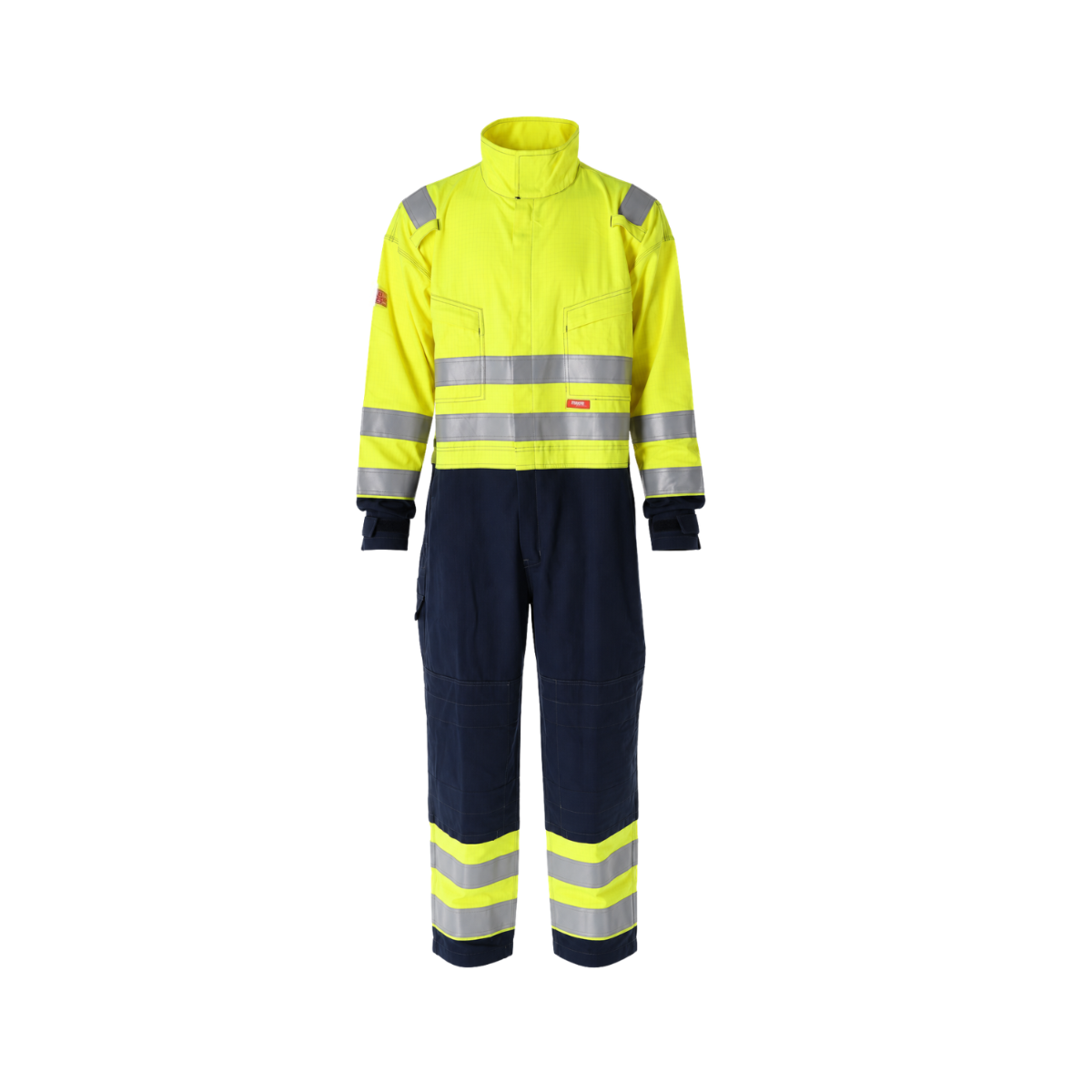
Hi-vis yellow and navy flame retardant arc flash coverall for electrical, utility and plant workers who need inherent FR, anti-static, welding and arc protection.

Hi-vis yellow and navy flame retardant arc flash coverall for electrical, utility and plant workers who need inherent FR, anti-static, welding and arc protection.
Hi-vis yellow and navy flame retardant arc flash coveralls give electrical, utility and plant workers full-body protection against flame, heat, welding spatter, static and electric arc. This two-tone coverall is made from 270 g/m2 inherent flame retardant fabric, with hi-vis yellow upper panels, reflective tape and a mainly navy lower half. Internal kneepad pockets suit work at floor-level panels and pipework.
An all-yellow coverall soon shows oil and dirt on the legs, while an all-navy one is hard to pick out in a busy plant or yard. On site, that can lead crews to wear a non-FR vest over the top for visibility, which undermines the FR protection. This coverall puts hi-vis yellow and reflective tape on the upper body and navy below, all in inherent FR fabric rated for arc and welding.
Arc rated: ELIM 8.8 cal/cm2 and ATPV 9.2 cal/cm2, for assessed arc risks.
Inherent flame retardant fabric: 270 g/m2, with flame resistance built into the fibre and tested to EN ISO 11612.
Welding protection to EN ISO 11611: for welding, cutting and allied processes.
Hi-vis yellow panels and reflective tape: tape on the body, sleeves and lower legs helps the wearer stand out on site.
Internal kneepad pockets: hold inserts inside the leg, behind the FR fabric.
Anti-static to EN 1149-5: dissipates static charge when the wearer is earthed, reducing spark risk.
Mainly navy lower half: shows less dirt from kneeling and plant work.
Trades and roles
Electricians
Electrical engineers
Substation engineers
Welders and fabricators
Maintenance engineers
Plant operators
Industries
Electricity transmission and distribution
Power generation
Utilities
Petrochemical and process
Manufacturing
Industrial maintenance
| Specification | Detail |
|---|---|
| Product name | MAXFR Hi-Vis Yellow and Navy Flame Retardant Arc Flash Coverall |
| Product code | CL010004 |
| Garment type | One-piece two-tone coverall |
| Fabric | Inherent flame retardant |
| Fabric weight | 270 g/m2 |
| Protection | Flame retardant, anti-static, electric arc, welding |
| Electric arc standard | EN 61482-2:2020 |
| Arc rating | ELIM 8.8 cal/cm2, ATPV 9.2 cal/cm2 |
| Heat and flame | EN ISO 11612:2015 |
| Welding | EN ISO 11611:2015 |
| Electrostatic | EN 1149-5:2018 |
| General requirements | EN ISO 13688:2013 + A1:2021 |
| Reflective tape | Hi-vis reflective tape on body, sleeves and lower legs |
| Pockets | Chest pocket, internal kneepad pockets |
| Leg access | No leg zips |
| Brand | MAXFR |
| Colour | Hi-vis yellow upper, navy lower |
| Product code | Size | Size label |
|---|---|---|
| CL010004-S-R | S Regular | Small |
| CL010004-M-R | M Regular | Medium |
| CL010004-L-R | L Regular | Large |
| CL010004-XL-R | XL Regular | Extra Large |
| CL010004-2XL-R | 2XL Regular | 2 Extra Large |
| CL010004-3XL-R | 3XL Regular | 3 Extra Large |
| Base material, tool or condition | Suitability |
|---|---|
| Assessed arc risk up to 8.8 cal/cm2 | Suitable as part of a full arc-rated outfit |
| Arc risk above 8.8 cal/cm2 | Not recommended, use clothing rated for the assessed incident energy |
| Welding, cutting and allied processes | Suitable, EN ISO 11611 |
| Kneeling work with kneepad inserts | Suitable, inserts fit the internal kneepad pockets |
| Areas where static build-up must be controlled | Suitable when fully fastened, with anti-static footwear |
| Work on or near the railway | Not recommended, rail work needs orange rail spec clothing |
| Putting on over safety boots | Not recommended, there are no leg zips, put the coverall on first |
| Polyester or nylon base layers | Not recommended, they can melt, use FR or natural-fibre layers |
| Chemical splash | Not recommended, use clothing rated to EN 13034 |
| Firefighting | Not recommended, this is industrial heat and flame clothing |
Electrical, utility and plant maintenance teams wear this coverall in substations, power stations, process plants and workshops. It suits work where hot work, flame and arc risks overlap and crews need to be seen around moving plant. Wearers are usually trained staff working under an arc flash risk assessment or hot work permit.
Switching and isolation in substations where an arc risk has been assessed.
Planned maintenance on industrial plant and switchgear.
Welding and cutting during plant shutdowns.
Pipework and valve work at floor level in process plants.
Cable jointing in substations and plant rooms.
Yard and plant room work around forklifts and moving plant.
Step 1: Check that the incident energy in your arc flash risk assessment is within the garment’s ELIM of 8.8 cal/cm2.
Step 2: Choose the size using the Size Selection table.
Step 3: Put the coverall on before your safety boots, because there are no leg zips.
Step 4: Slide kneepad inserts into the internal kneepad pockets and fasten the coverall fully.
Step 5: Add arc-rated gloves, face protection and anti-static footwear, with the legs worn over the boots.
Step 6: Check the coverall before each shift for holes, burns, contamination or damaged tape.
Forcing the coverall on over boots, which strains the leg seams.
Wearing a non-FR hi-vis vest over the top.
Leaving the coverall unfastened in hazardous areas.
Wearing synthetic layers underneath.
Using it for rail work that needs orange rail spec clothing.
Under the Electricity at Work Regulations 1989, isolation comes first and arc-rated clothing is the last line of defence. Plan hot work under a permit with screening and fire watch where site rules require them. Check your site’s hi-vis rules, and choose the full outfit from your risk assessments.
Wash at up to 40 degrees C, inside out and separately from ordinary clothing, using detergent rather than soap-based products. Fasten closures before washing and rinse thoroughly. Tumble dry on low or dry away from direct sunlight. Iron at up to 110 degrees C, avoiding the reflective tape and printed areas. Do not bleach, boil or dry clean, and always follow the care label on the garment.
Q: What arc rating does this coverall have?
A: It has an ELIM of 8.8 cal/cm2 and an ATPV of 9.2 cal/cm2. ELIM is the incident energy with no predicted second-degree burn, while ATPV is the point with a 50% chance of one. Plan with the ELIM figure when checking it against your arc risk assessment.
Q: What does 2XL Regular mean on a coverall size?
A: 2XL stands for 2 Extra Large, two sizes above L. Regular is the leg length. This coverall comes in S to 3XL, all with a Regular leg.
Q: What does EN ISO 11611 mean on a coverall?
A: EN ISO 11611 is the European standard for protective clothing worn for welding and allied processes. It tests resistance to small spatter of molten metal, short contact with flame and radiant heat. Clothing is rated Class 1 or Class 2 depending on the welding hazard, so check the class your task needs.
Q: What is this coverall not suitable for?
A: It is not rail spec, so it is not for work on or near the line. It is not designed for chemical splash or firefighting. It is not suitable where the assessed arc incident energy is above 8.8 cal/cm2. Check your site rules if a specific hi-vis class is required.
Q: Why choose a two-tone yellow and navy coverall?
A: The yellow upper body and reflective tape help the wearer stand out, while the navy lower half shows less dirt from kneeling and plant work. All of it is inherent FR fabric, so there is no need for a separate vest over the top. That keeps the outfit simple and the FR protection intact.
Q: Can I put the coverall on over my boots?
A: The coverall has no leg zips, so it will not open wide enough to pull over safety boots. Put the coverall on first, then your boots, and wear the legs over the boot tops. That also stops spatter falling into the boot during welding.
Q: What kneepads fit the coverall?
A: The internal kneepad pockets take kneepad inserts made for trouser pockets, usually sold as EN 14404 Type 2. Slide the inserts in so they sit over the knee. Check the insert material suits your FR and arc requirements.