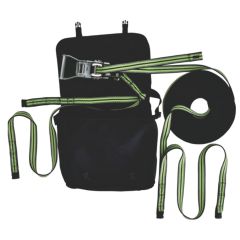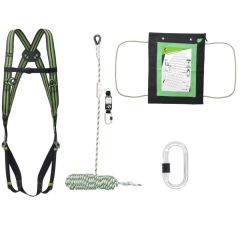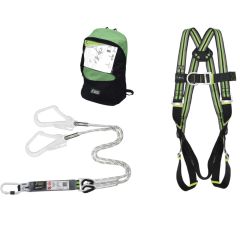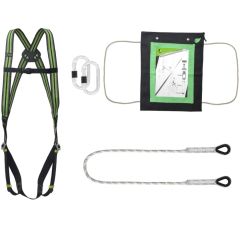


A complete, ready-to-use fall arrest kit for scaffolders, supplied with a full body harness, 1.8m energy absorbing webbing lanyard, and jute carry bag.
- Scaffold-specific connection: Steel scaffold hooks clip directly onto scaffold tubes
- Integrated energy absorber: Reduces peak arrest force during a fall to safe levels
- Dual attachment points: Rear dorsal D-ring and front sternal D-ring
- Lanyard length: 1.8m energy absorbing webbing lanyard
- Storage: Jute carry bag included for compliant on-site storage
- Adjustability: Shoulder, chest, and thigh straps fully adjustable
- Certification: CE marked to EN361:2002, EN354:2002, and EN355:2002
Kratos Scaffolder Fall Arrest Kit - Harness and Energy Absorber with Jute Carry Bag

A complete, ready-to-use fall arrest kit for scaffolders, supplied with a full body harness, 1.8m energy absorbing webbing lanyard, and jute carry bag.
- Scaffold-specific connection: Steel scaffold hooks clip directly onto scaffold tubes
- Integrated energy absorber: Reduces peak arrest force during a fall to safe levels
- Dual attachment points: Rear dorsal D-ring and front sternal D-ring
- Lanyard length: 1.8m energy absorbing webbing lanyard
- Storage: Jute carry bag included for compliant on-site storage
- Adjustability: Shoulder, chest, and thigh straps fully adjustable
- Certification: CE marked to EN361:2002, EN354:2002, and EN355:2002
- Buy 5 for £186.49 £155.41 each and save 6%
- Buy 10 for £169.00 £140.83 each and save 15%
| BULK DISCOUNT | 5 | 10 |
|---|---|---|
| Price | £155.41 £186.49 | £140.83 £169.00 |
Order 1x to earn 166 FASTPoints
Order to earn 166 FASTPoints
Log in to access trade discountsKratos Scaffolder Fall Arrest Kit
Scaffolding operations sit at the higher-risk end of work at height, and a generic harness kit bought off a shelf rarely accounts for how scaffolders actually move, connect, and anchor on a structure. This kit is built specifically for scaffolding work: the lanyard terminates in steel scaffold hooks designed to clip directly onto scaffold tubes, the harness carries both a rear dorsal D-ring and a front sternal attachment point, and the whole system is certified as a matched set to EN361:2002, EN354:2002, and EN355:2002. Everything needed to deploy a compliant fall arrest system on a scaffolding project arrives in a single jute carry bag, ready to use.
Why choose the Scaffolder Fall Arrest Kit
-
Steel scaffold hooks on the lanyard: Designed to connect directly to scaffold tubes, these hooks eliminate the need for separate karabiners or adaptors that can add unnecessary time and potential for misconnection on a busy structure.
-
Integrated energy absorber: The webbing lanyard incorporates an energy-absorbing element that deploys during a fall arrest, reducing the peak force transmitted to the harness wearer. This is a legal requirement under EN355:2002 and a critical factor in reducing injury severity.
-
Dual attachment points on the harness: The rear dorsal D-ring is the primary fall arrest point for vertical work. The front sternal D-ring provides an additional option for guided type fall arresters or work positioning lanyards on inclined structures.
-
Adjustable across all strap points: Shoulder, chest, and thigh straps are all independently adjustable, allowing the harness to be correctly fitted to the wearer before every use. A poorly fitted harness increases suspension trauma risk following an arrest.
-
Matched and certified as a system: All three components carry CE marking and meet the relevant EN standards individually and as a compatible set, satisfying the requirement under EN365 that all elements of a fall protection system must be certified and compatible with one another.
-
Jute carry bag: Durable, breathable jute storage keeps the harness and lanyard clean, dry, and protected between uses, and prevents the webbing degradation that results from storing PPE loosely in a tool bag or van.
-
Ready to use immediately: No additional purchases are required to deploy this kit on site, other than a suitable anchor point. The system is complete as supplied.
A fall protection system must include at least three components:
1: The gripping system of the body: harness, belt.
2: The fall arrest system: fall arrest on anchor line, retractable fall arrest, energy absorbing lanyard.
3: The anchoring system: anchor lanyard lifeline, tripod...
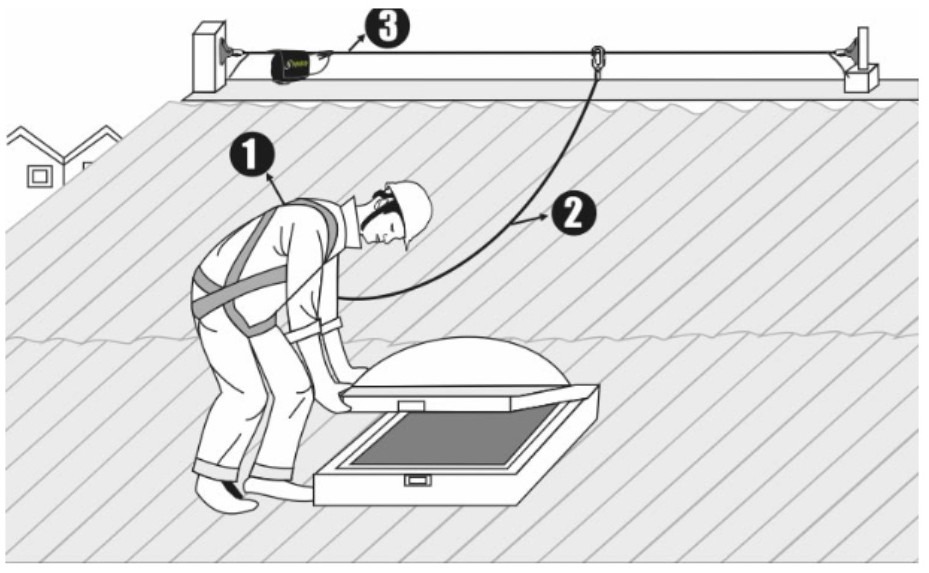
The user security can be guaranteed only if:
- These three components have the CE marking ;
- These three components are compatible together ;
- The user has been trained in the usage of these three components.
! A fall arrest system can be complete only if a rescue plan has been established in advance in order to cope with any emergency that may arise during work.
What's in the box?
-
Full body harness with rear dorsal D-ring and front sternal D-ring
-
1.8m energy absorbing webbing lanyard with steel scaffold hooks
-
Jute carry bag
Specifications
| Specification | Detail |
|---|---|
| Product Name | Scaffolder Fall Arrest Kit - Harness and Energy Absorber with Jute Carry Bag |
| Product Code | PP080055 |
| Lanyard Length | 1.8m |
| Lanyard Type | Energy Absorbing Webbing Lanyard |
| Lanyard Termination | Steel Scaffold Hooks |
| Harness Type | Full Body Harness |
| Harness Attachment Points | Rear Dorsal D-Ring, Front Sternal D-Ring |
| Harness Adjustment | Shoulder, Chest, and Thigh Straps (Fully Adjustable) |
| Energy Absorber | Integrated within Lanyard Webbing |
| Storage Bag | Jute Carry Bag |
| CE Marked | Yes |
| Standards | EN361:2002, EN354:2002, EN355:2002 |
| HS Code | 63079098 |
Compatibility
| Compatible With | Status |
|---|---|
| Scaffold Tube Anchor Points | ✓ Compatible |
| Fixed Anchor Eyebolts & Anchor Plates | ✓ Compatible |
| Horizontal Lifeline Systems (as Part of a Complete System) | ✓ Compatible |
| Retractable Fall Arresters (as Replacement for Lanyard) | ✓ Compatible |
| Use without Rated Anchor Point | ✗ Not Recommended |
| Use as Work Restraint (Instead of Dedicated System) | ✗ Not Recommended |
| Confined Space Entry or Rescue Applications | ✗ Not Recommended |
Who is this for?
This kit is intended for trained scaffolders, scaffolding supervisors, and site operatives working at height on scaffold structures where a fall arrest system is required. It is suited to contractors working on commercial, residential, civil, and infrastructure projects where NASC guidance and Working at Height Regulations 2005 compliance is required. It is not an entry-level or familiarisation product: the user must have completed suitable and sufficient training in the use of fall arrest equipment before using this kit on site.
Typical applications
-
Erecting and dismantling tube and fitting scaffolding on commercial or residential structures
-
Working on putlog and independent tied scaffolds where fall arrest is specified in the method statement
-
Scaffolding operations on civil infrastructure including bridges, viaducts, and retaining structures
-
Maintenance scaffolding on industrial plant, tanks, and process equipment
-
Birdcage and hanging scaffold configurations where the operative works above an unguarded fall
-
Mobile scaffold tower erection where a harness is specified as a secondary fall protection measure
-
Any scaffolding task where a RAMS document specifies a fall arrest system as a control measure
How to use
-
Remove the harness and lanyard from the jute bag and inspect both items visually before each use. Check webbing for cuts, abrasion, discolouration, or contamination. Check the energy absorber cover for signs of deployment. Check the scaffold hooks for damage, corrosion, or gate defects. Do not use any component that fails inspection.
-
Don the harness by stepping into the leg loops and pulling the shoulder straps up over both shoulders. The dorsal D-ring should sit centrally between the shoulder blades. The sternal D-ring should sit on the chest.
-
Fasten and adjust all buckles: chest strap first, then thigh straps, then shoulder straps. The harness should be snug but allow free movement. There should be no more than two finger widths of slack in any strap.
-
Connect the scaffold hook at one end of the lanyard to a rated, installed anchor point, such as a scaffold tube forming part of a tied structure. Confirm the gate is fully closed and locked before applying any load.
-
Connect the second end of the lanyard to the rear dorsal D-ring on the harness, or the sternal D-ring if the task requires it. Confirm connection at both ends before beginning work.
-
Position yourself so that the free-fall distance is minimised. A 1.8m lanyard will arrest a fall but total arrest distance including lanyard extension, energy absorber deployment, and harness stretch can exceed 4m. Ensure there is sufficient clearance below the work position.
-
On completion of work, disconnect the lanyard from the anchor point first, then remove the harness. Stow both items in the jute bag for storage.
Safety and maintenance
Safety during use:
-
A full body harness used with an energy absorbing lanyard is a fall arrest system, not a fall restraint system. It will arrest a fall after it has occurred. It does not prevent a fall. Where possible, collective protection measures such as guardrails should be the primary control, with this kit as a secondary measure.
-
The user must wear a hard hat (EN397), safety footwear (EN ISO 20345), and gloves appropriate to the task alongside this kit.
-
Do not connect the lanyard to an anchor point that has not been assessed, installed, and rated for fall arrest loading. A scaffold tube used as an anchor must form part of a properly tied structure; a loose or unbraced tube is not a safe anchor.
-
Never use a damaged or deployed energy absorber. If the absorber cover has torn or the internal webbing is visible and extended, the lanyard must be withdrawn from service immediately, regardless of whether a fall has been recorded.
-
Suspension trauma can occur rapidly if a worker is left suspended in a harness after an arrest. A rescue plan must be in place before work begins, as required by EN365. Do not use this kit on a site where no rescue plan exists.
-
Do not exceed the maximum user weight specified by the harness manufacturer, including clothing, tools, and equipment.
After use and maintenance:
-
After each use, wipe down the harness webbing and hardware with a clean damp cloth. Remove mud, concrete, chemical contamination, or other deposits before storage. Do not use solvents.
-
Allow the harness and lanyard to dry naturally away from direct heat sources before returning to the jute bag. Storing damp webbing accelerates degradation.
-
Inspect the jute bag for damage and ensure the bag is clean and dry before storing the kit.
-
Full body harnesses must be inspected by a competent person at intervals not exceeding 12 months, in accordance with PUWER and the Working at Height Regulations 2005. Record each inspection in the equipment log.
-
Remove the harness and lanyard from service immediately if they have been involved in a fall arrest, regardless of visible condition. The energy absorber is single-use. Both items must be withdrawn, labelled, and quarantined until assessed by a competent person.
-
Check the manufacturer's stated service life and retire the equipment accordingly, even if no fall has occurred and no visible damage is present.
Frequently Asked Questions
Q: What is the difference between a scaffolder fall arrest kit and a standard harness and lanyard set?
A: A scaffolder kit is configured for the specific anchor points and working positions found on scaffold structures. The lanyard in this kit terminates in steel scaffold hooks, which connect directly to scaffold tubes without requiring separate karabiners or adaptors. The harness carries both a rear dorsal D-ring and a front sternal attachment, giving the operative connection options appropriate to the range of positions encountered on a scaffold. A generic harness and lanyard set will typically have karabiner-terminated lanyards and may carry only a dorsal D-ring, neither of which is optimally suited to scaffolding operations.
Q: What do the EN361, EN354, and EN355 standards actually mean, and why do they matter on a UK site?
A: EN361:2002 is the European standard for full body harnesses used in fall arrest. It specifies how the harness must distribute arrest forces across the body to reduce injury risk. EN354:2002 covers lanyards, setting requirements for strength, length, and connector compatibility. EN355:2002 covers energy absorbers, specifying the maximum arrest force they may transmit to the wearer and the minimum extension at which they must deploy. Under the Working at Height Regulations 2005 and the Personal Protective Equipment at Work Regulations 1992, all fall protection PPE used on UK sites must meet a relevant harmonised standard. CE marking to these three standards is the declaration that this kit meets those requirements. A product without CE marking to these standards cannot be used legally as fall arrest PPE on a UK site.
Q: Does this kit include an anchor point?
A: No. This kit provides the body-gripping element (the harness) and the fall arrest element (the energy absorbing lanyard). A complete fall protection system under EN365 requires a third component: the anchoring system. On scaffolding, this is typically a scaffold tube forming part of a properly tied structure, an installed anchor plate, or a horizontal lifeline. The anchor must be separately assessed, rated for fall arrest loading, and installed by a competent person before this kit is connected to it.
Q: Can the energy absorbing lanyard be used more than once?
A: The energy absorber is a single-use component. If it has been deployed during a fall arrest, the internal webbing will have extended and the absorber cover will have torn. The lanyard must be withdrawn from service immediately, regardless of whether the deployment looks minor. Even a partial deployment means the absorber will not perform correctly in a subsequent fall. The same rule applies if the lanyard has been subjected to a shock load without a visible fall occurring. Any doubt means withdrawal.
Q: What clearance height do I need below my work position to use this kit safely?
A: This is a critical pre-use calculation. A 1.8m lanyard will extend during arrest, the energy absorber will deploy and add further distance, and the harness itself will stretch slightly under load. Total arrest distance from anchor to lowest point of the suspended worker can exceed 4m in a worst-case scenario, depending on the worker's height and build. Before connecting this kit, calculate the available clearance below the work position and confirm it exceeds the maximum arrest distance. If it does not, a shorter lanyard, a retractable fall arrester, or an alternative work method should be used.
Q: Is this kit suitable for confined space entry?
A: No. Fall arrest harnesses and energy absorbing lanyards are not designed or certified for confined space entry or rescue. Confined space work requires a dedicated rescue harness, typically with front and rear lifting eyes, used with a winch or tripod rescue system rated for that application. Using a fall arrest kit for confined space rescue could result in failure to extract a casualty safely.
Q: How often does the harness need to be formally inspected?
A: The harness must be pre-use inspected by the wearer before every session, and formally inspected by a competent person at intervals not exceeding 12 months. Both requirements come from PUWER and the Working at Height Regulations 2005. The formal inspection must be recorded. Most harness manufacturers also specify a maximum service life of five to ten years from the date of first use, regardless of condition. Check the manufacturer's label inside the harness for the specific service life applicable to this product.
Q: What happens if the kit is involved in a fall arrest, even if the worker says they are fine?
A: Both the harness and the lanyard must be withdrawn from service immediately. The energy absorber is single-use and cannot be reset. The harness webbing and stitching may have been stressed beyond visible damage. The worker should be assessed by a first aider or medical professional: suspension trauma symptoms can be delayed, and post-fall shock means self-assessment is unreliable. Label both items clearly as withdrawn from service and do not return them to the kit storage until a competent person has formally assessed and signed off on their condition. In practice, a fall arrest almost always means both items are scrapped.
Q: Where can I order this kit, and how quickly can I get it to site?
A: CMT Group supplies this kit directly from stock, with next working day delivery available on orders placed by 7pm online or 5pm by phone or email, Monday to Friday. Same-day delivery is available on this product: if you need it on site today, call the team to confirm stock and arrange despatch. CMT operates its own fleet of over 100 vehicles covering 90% of the UK, holds FORS Silver Accreditation across the entire fleet, and provides live tracking with SMS notifications 15 minutes before arrival. For contractors managing multiple sites or projects, CMT's EDGE procurement portal gives you agreed contract pricing, role-based spending controls, and full delivery visibility from one co-branded platform.