

Petrol generators are lighter, cheaper to buy and easy to move, so they suit short jobs and small works. Diesel generators suit full shifts, standby power and three phase machinery, and diesel is safer to store on site.
This guide compares petrol and diesel generators on fuel, storage rules, running costs, noise, weight and maintenance, so you can choose the right one for your site. It finishes with the SIP Medusa petrol and diesel generators we supply.
Quick answer
- Choose petrol for short jobs, small works and maintenance, where a lighter, cheaper generator you can lift into a van matters most.
- Choose diesel for full shifts, standby power and heavier loads, especially where diesel is already on site for plant.
- Three phase 400V machinery needs a three phase generator, and in our range that means diesel.
- Diesel is less flammable than petrol, so it is safer to store and handle on site.
- Construction sites generally cannot use red diesel in generators, so budget for standard diesel.
Key differences at a glance
- Lighter and easier to move, smaller models can be lifted by two people
- Usually cheaper to buy
- Recoil or electric start, quick to get going
- Petrol is highly flammable, so storage needs more care
- Best for short jobs, small works and maintenance
- Heavier, usually on wheels or castors, in a silenced cabinet
- Usually cost more to buy
- Diesel engines generally use less fuel for the same work
- Diesel is less flammable and easier to store safely
- Best for full shifts, standby power and three phase
Fuel safety and storage
Petrol gives off flammable vapour at normal temperatures, so it catches fire far more easily than diesel. That makes diesel the safer fuel to store and handle on a busy site.
Storing petrol on site
Storing and using petrol at work is covered by the Dangerous Substances and Explosive Atmospheres Regulations 2002 (DSEAR). You must assess the risks and keep them as low as possible. HSE guidance says work containers must be UN approved for petrol. Read the HSE guidance on petrol in the workplace.
Storing diesel on site
In England, above-ground oil containers of more than 200 litres at business premises fall under the Control of Pollution (Oil Storage) (England) Regulations 2001. The secondary containment, such as a bund, must hold at least 110% of the container's capacity. Read the Oil Storage Regulations.
Refuelling safely
Switch the generator off and let it cool before refuelling, whichever fuel it uses. Never overfill the tank, wipe up any spills, and keep naked flames and other ignition sources away.
Red diesel rules for generators
Construction lost its entitlement to red diesel from 1 April 2022, so diesel generators on construction sites generally need to run on standard (white) diesel. Some sectors, such as agriculture, kept their entitlement. Check the current HMRC guidance if you are unsure whether your use qualifies.
Running costs and fuel use
Diesel engines generally use less fuel than petrol engines to do the same amount of work, which matters most on long shifts. Petrol generators usually cost less to buy, so they often work out cheaper for short or occasional jobs.
Whichever you choose, size the generator correctly. A generator that is far too big burns fuel for capacity you never use, and one that is too small runs flat out and works harder. Our guide, What Size Generator Do I Need?, shows how to work out your load.
Noise
A silenced cabinet encloses the engine, but that does not always make a diesel generator quieter than a petrol one. Compare the published guaranteed sound power level (LwA) for each model.
| Generator | Fuel | Sound power (LwA) |
|---|---|---|
| SIP Medusa T2500W | Petrol | 95dB(A) |
| SIP Medusa T3000W | Petrol | 96dB(A) |
| SIP Medusa T5500W | Petrol | 96dB(A) |
| SIP Medusa T5500 diesel | Diesel | 97dB(A) |
| SIP Medusa T15000 three phase | Diesel | 112dB(A) |
If noise is your main concern, near homes, schools or events, look at a silent inverter generator. Read our guide, What Is an Inverter Generator?
Weight and moving it
Small petrol generators sit in a tubular frame and can be lifted by two people. The SIP Medusa T2500W, for example, weighs 37kg. Larger petrol models add wheels and handles.
Diesel generators are much heavier. The SIP Medusa T5500 diesel weighs 156.6kg on four wheels, and the T15000 three phase weighs 291kg on castors, with a lifting eye for a crane or hoist. Plan lifts under the Manual Handling Operations Regulations, and use lifting equipment for heavy units.
Maintenance
Choose a fuel type to see the service intervals from the SIP user manuals.
- Before every useCheck the oil
Check the oil level each time, with the generator on level ground.
- First 25 hoursRun it in
Keep loads under 75% of the rated output while the engine beds in.
- After 8 hoursFirst oil change
Change the oil after the first 8 hours of use.
- Every 50 hoursRegular oil change
Then change the oil every 50 hours, or sooner under heavy loads.
Intervals from the SIP Medusa T2500W, T3000W and T5500W manuals (petrol), and the T5500 and T15000 manuals (diesel). On the T15000, keep loads under 50% for the first 20 hours. Always follow the manual for your model.
Which suits your job?
Pick what matters most on your job.
Our SIP Medusa petrol and diesel generators
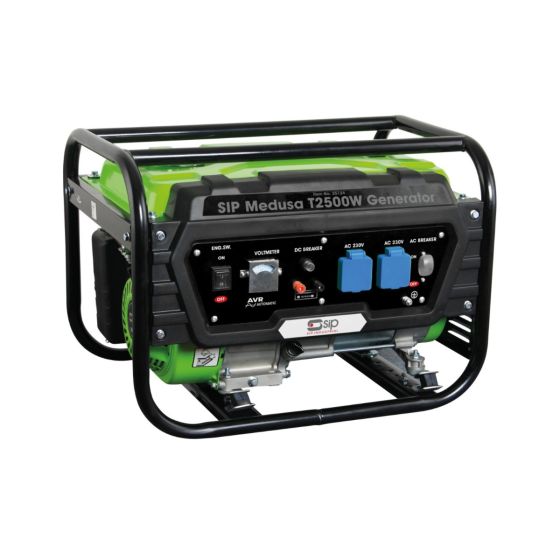
SIP Medusa T2500W Petrol Generator
2200W 230V, with AVR
- Peak / rated
- 2200W / 2000W
- Sockets
- 2x UK 3-pin 230V
- Tank
- 15L
- Start
- Recoil
Best for: lighting, chargers and small 230V tools on short jobs.
View generator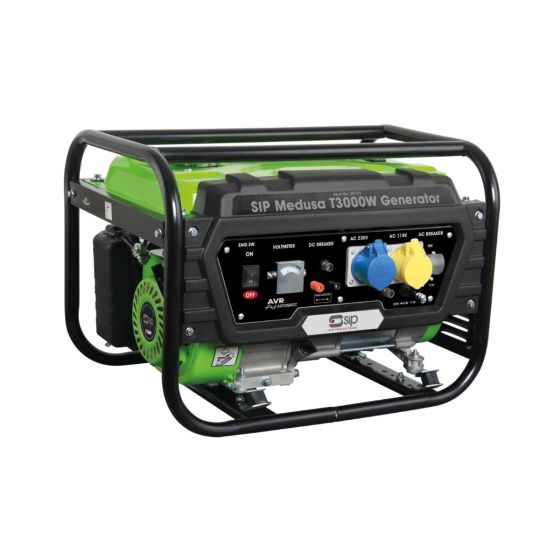
SIP Medusa T3000W Petrol Generator
3000W 110V 230V, with AVR
- Peak / rated
- 3000W / 2700W (230V)
- 110V output
- 1750W, 16A socket
- Tank
- 15L
- Start
- Recoil
Best for: a few 110V tools and lights on small works.
View generator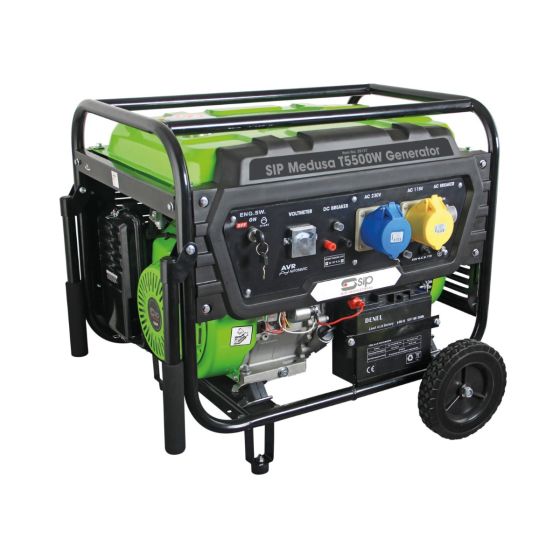
SIP Medusa T5500W Petrol Generator
5500W 110V 230V, electric start
- Peak / rated
- 5500W / 5000W (230V)
- 110V output
- 3000W, 32A socket
- Tank
- 25L
- Start
- Electric key, recoil backup
Best for: several 110V tools and lights on plots and compounds.
View generator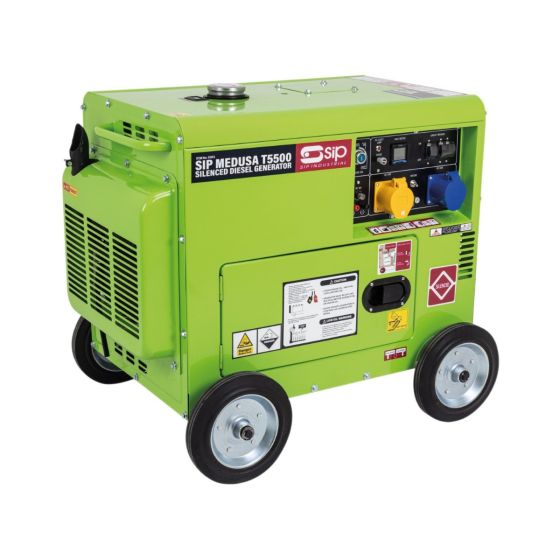
SIP Medusa T5500 Silenced Diesel Generator
5.5kVA 110V 230V
- Peak / rated
- 5.5kVA / 5kVA (230V)
- 110V output
- 3.5kW, 32A socket
- Weight
- 156.6kg, four wheels
- Start
- Electric key
Best for: full shifts and standby where diesel is on site.
View generator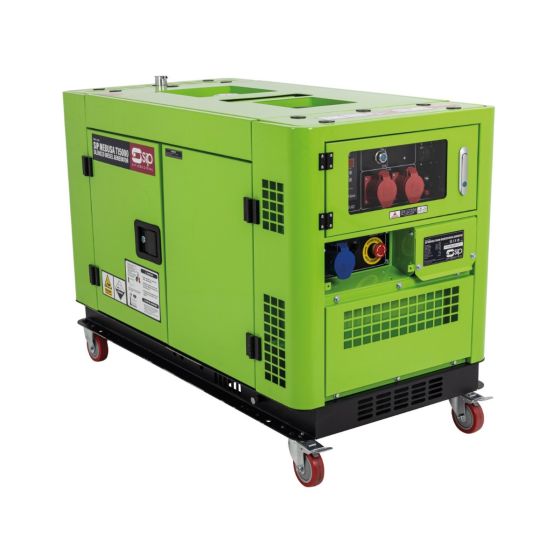
SIP Medusa T15000 Three Phase Silenced Diesel Generator
15kVA 400V 230V
- Peak / rated
- 15kVA / 13.75kVA (11kW)
- 230V output
- 3.6kW rated
- Tank
- 32L
- Start
- Electric key
Best for: three phase machinery and distribution.
View generatorPetrol and diesel range compared
Filter by fuel, or click a column heading to sort.
| Generator | Fuel | Rated output | 110V output | Three phase | Sound power (LwA) | Start |
|---|---|---|---|---|---|---|
| SIP Medusa T2500W | Petrol | 2000W (230V) | None | No | 95dB(A) | Recoil |
| SIP Medusa T3000W | Petrol | 2700W (230V) | 1750W | No | 96dB(A) | Recoil |
| SIP Medusa T5500W | Petrol | 5000W (230V) | 3000W | No | 96dB(A) | Electric key, recoil backup |
| SIP Medusa T5500 diesel | Diesel | 5kVA / 5kW (230V) | 3.5kW | No | 97dB(A) | Electric key |
| SIP Medusa T15000 | Diesel | 11kW (13.75kVA) at 400V | None | Yes, 400V | 112dB(A) | Electric key |
Figures from SIP product data, user manuals and Declarations of Conformity. Check each product page for full specifications.
Frequently asked questions
Which is better, a petrol or diesel generator?
It depends on the job. Petrol generators are lighter, cheaper to buy and suit short jobs and small works. Diesel generators suit full shifts, standby power and three phase machinery, and diesel is safer to store.
Are diesel generators more fuel efficient than petrol?
Diesel engines generally use less fuel than petrol engines for the same amount of work. The saving matters most on long shifts and heavy loads. For short or occasional jobs, a petrol generator's lower purchase price often outweighs it.
Can you use red diesel in a generator on a construction site?
Construction lost its entitlement to red diesel from 1 April 2022, so site generators generally need standard diesel. Some sectors, such as agriculture, kept their entitlement. Check HMRC's guidance if you are unsure.
Are diesel generators quieter than petrol generators?
Not always. A silenced cabinet encloses the engine, but the published sound power level is what to compare. For example, the SIP Medusa T5500 diesel is 97dB(A) and the T5500W petrol is 96dB(A). For the quietest running, look at a silent inverter generator.
Is it safer to store diesel or petrol on site?
Diesel, because it is much less flammable than petrol. Petrol storage at work falls under DSEAR and needs UN approved containers. In England, diesel containers over 200 litres at business premises need secondary containment holding at least 110% of the container's capacity.
Do I need a diesel generator for three phase power?
In our range, yes. The SIP Medusa T15000 is a three phase silenced diesel generator with 400V and 230V outlets and an 11kW rated output. Our petrol generators are single phase.
How often does a diesel generator need servicing?
For the SIP Medusa T5500 diesel, change the oil and oil filter after the first month or 20 hours, then the oil every 3 months or 100 hours. Change the oil filter and air filter every 6 months or 300 hours. Always follow the manual for your model.
Which petrol generator runs 110V site tools?
The SIP Medusa T3000W gives 1750W at 110V from a 16A socket, and the T5500W gives 3000W at 110V from a 32A socket. Both use a selector switch, so 110V and 230V are not live at the same time. The T2500W is 230V only.
Still deciding between petrol and diesel?
Tell us how long you run each day and what you need to power, and our team will help you choose. Call 020 8311 1144 or email sales@cmt.co.uk.
