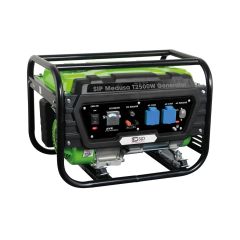
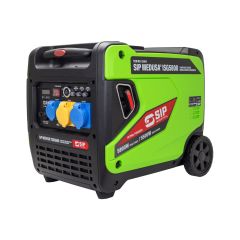
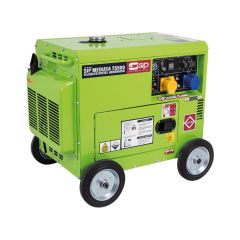
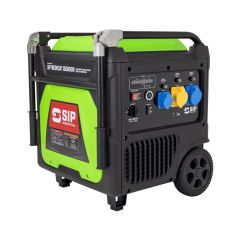
Find out what an inverter generator is, how it makes clean, stable power, and whether you need one. Pure sine wave, noise, eco mode and runtime explained, with our SIP Medusa silent inverter generators compared.
Petrol generator with electric key start, wheels and 110V and 230V outlets, giving 5000W continuous power for site tools, lighting and equipment.
- Electric key start, no pull-start needed
- 110V and 230V 32A outlets with a voltage selector switch
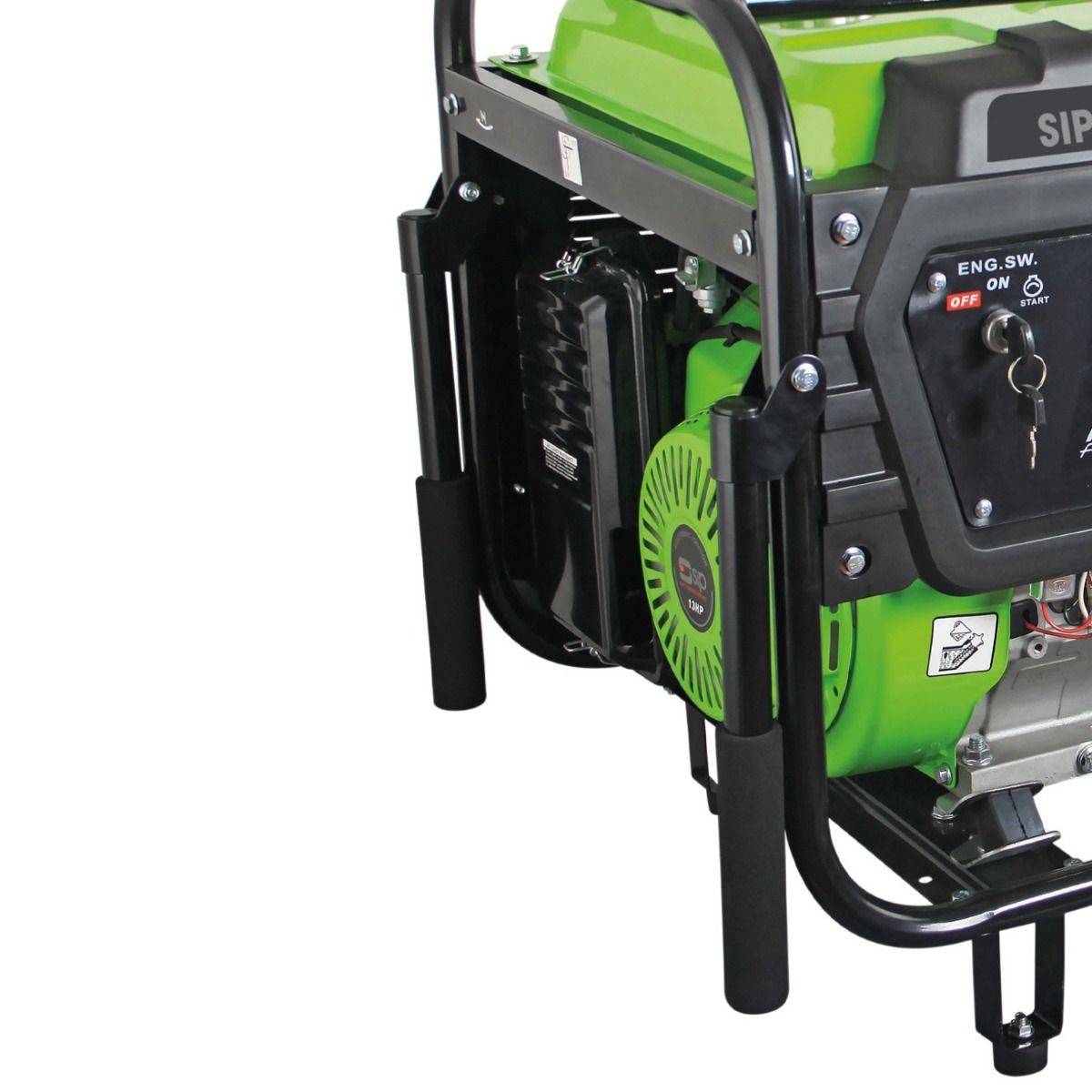
- Two wheels and lifting handles for moving on site
- Automatic voltage regulator (AVR) and 12V battery charging output
- 25L fuel tank, about 8 hours runtime
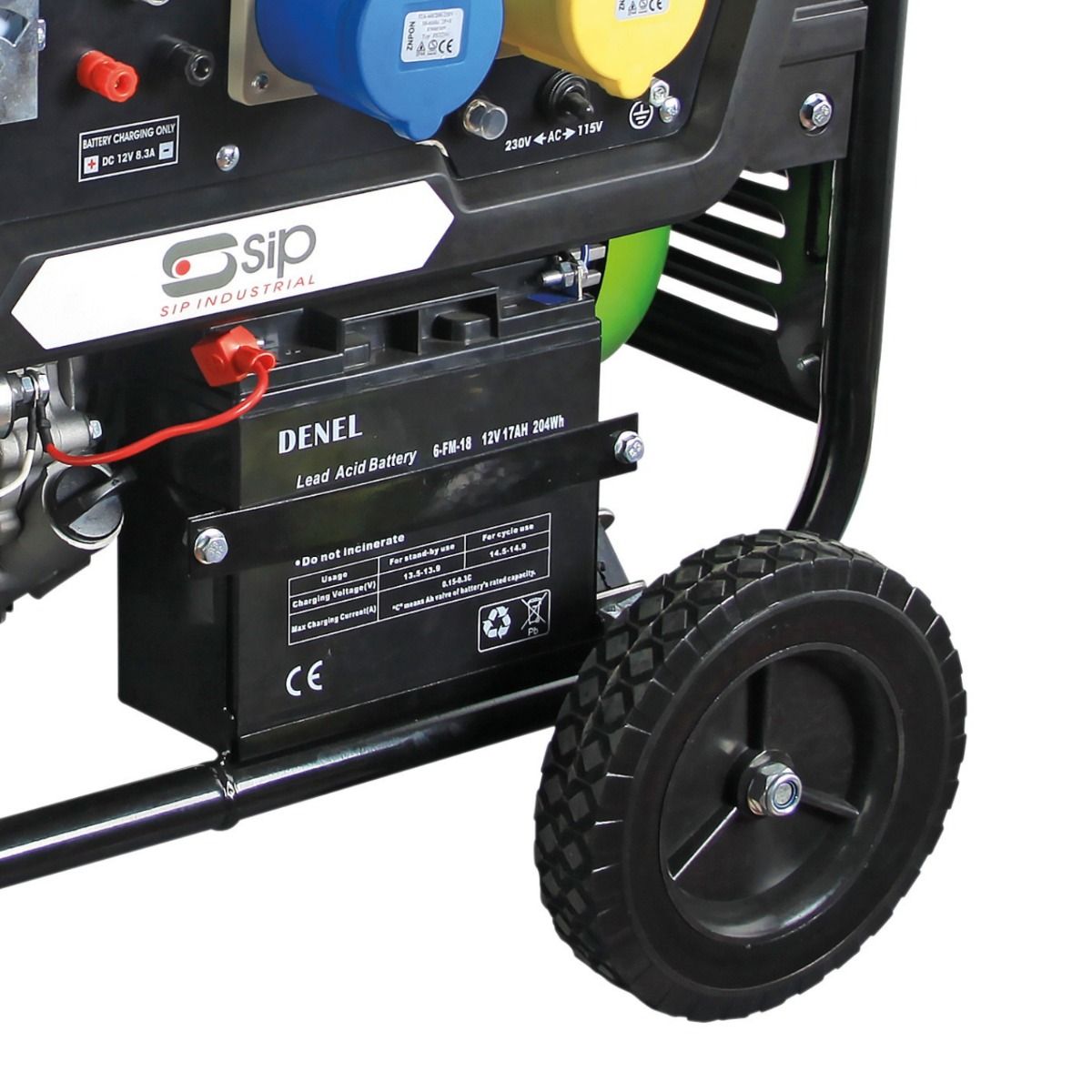
- Supplied with a fitted 12V 17Ah starter battery and ignition keys
- 5500W maximum output, 5000W continuous (maximum covers short start-up peaks, continuous is what it supplies for hours)
- Supplied with a 12V DC output lead and spark plug box spanner
SIP Medusa T5500W Petrol Generator with Electric Start - 5.5kW 110V 230V
Petrol generator with electric key start, wheels and 110V and 230V outlets, giving 5000W continuous power for site tools, lighting and equipment.
- Electric key start, no pull-start needed
- 110V and 230V 32A outlets with a voltage selector switch
- Two wheels and lifting handles for moving on site
- Automatic voltage regulator (AVR) and 12V battery charging output
- 25L fuel tank, about 8 hours runtime
- Supplied with a fitted 12V 17Ah starter battery and ignition keys
- 5500W maximum output, 5000W continuous (maximum covers short start-up peaks, continuous is what it supplies for hours)
- Supplied with a 12V DC output lead and spark plug box spanner
- Buy 3 for £904.13 £753.44 each and save 5%
- Buy 5 for £858.92 £715.77 each and save 10%
| BULK DISCOUNT | 3 | 5 |
|---|---|---|
| Price | £753.44 £904.13 | £715.77 £858.92 |
Order 1x to earn 793 FASTPoints
Order to earn 793 FASTPoints
Log in to access trade discountsSIP Medusa T5500W Petrol Generator with Electric Start 5500W 110V 230V
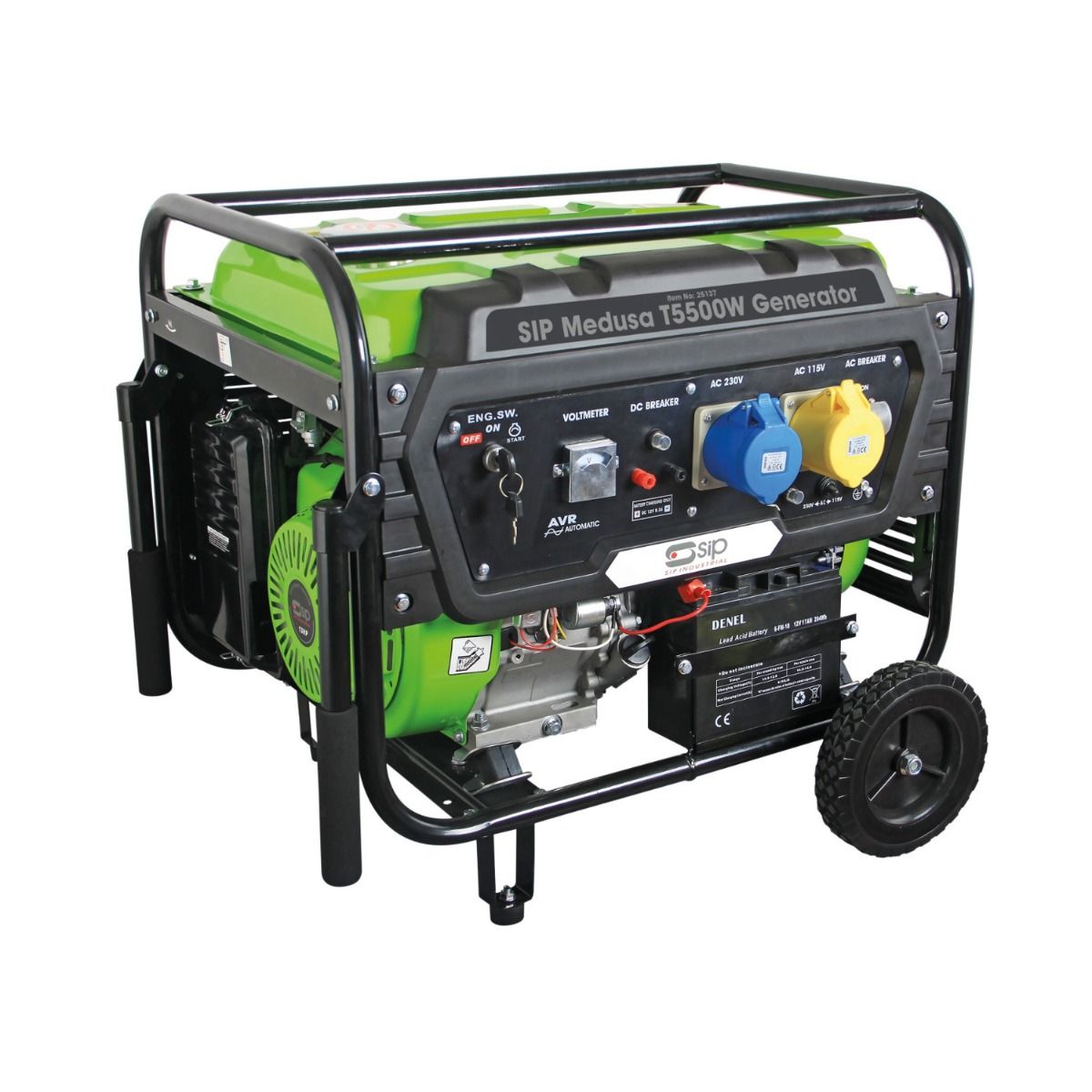
This petrol generator starts with a turn of the key, using a 390cc four-stroke engine and a fitted starter battery. It sits in a tubular steel frame with two wheels and lifting handles, so it can be moved around site rather than carried. Yellow 110V and blue 230V 32A sockets supply site tools, lighting and equipment, with a 12V output for battery charging.
How Key Start and Wheels Make a 5kW Generator Practical on Site
Larger petrol generators need a hard pull to start, and an 85kg frame is not something one person can carry. On site, that means tired operators, false starts on cold mornings and two people tied up every time the generator moves. This model starts on the key and rolls on its own wheels, so one operator can start it and reposition it across firm ground.
Key Features
-
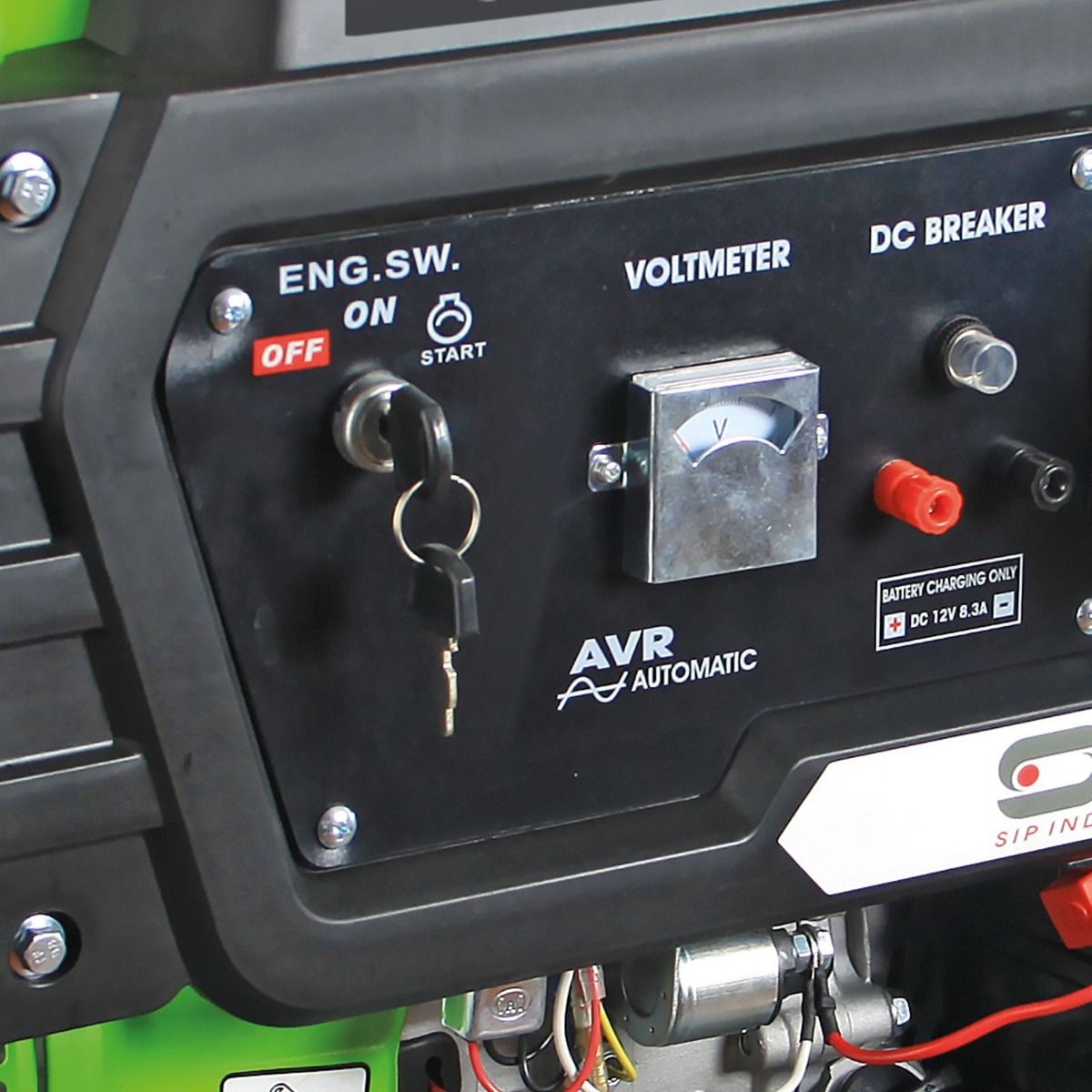
Electric key start: the fitted 12V battery turns the engine over, so there is no hard pull on a 390cc engine.
-
Wheels and lifting handles: roll the generator across firm ground instead of carrying 85kg.
-
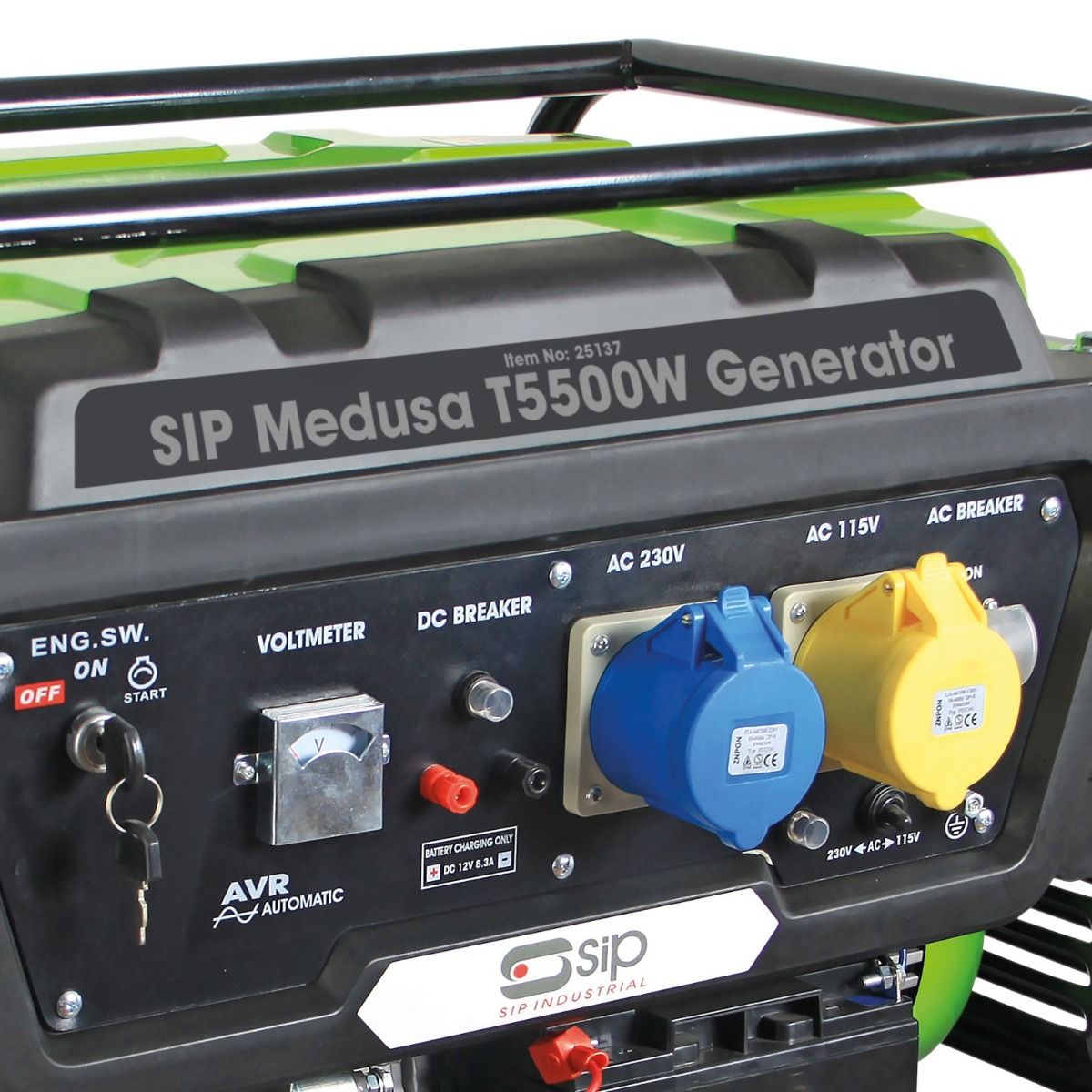
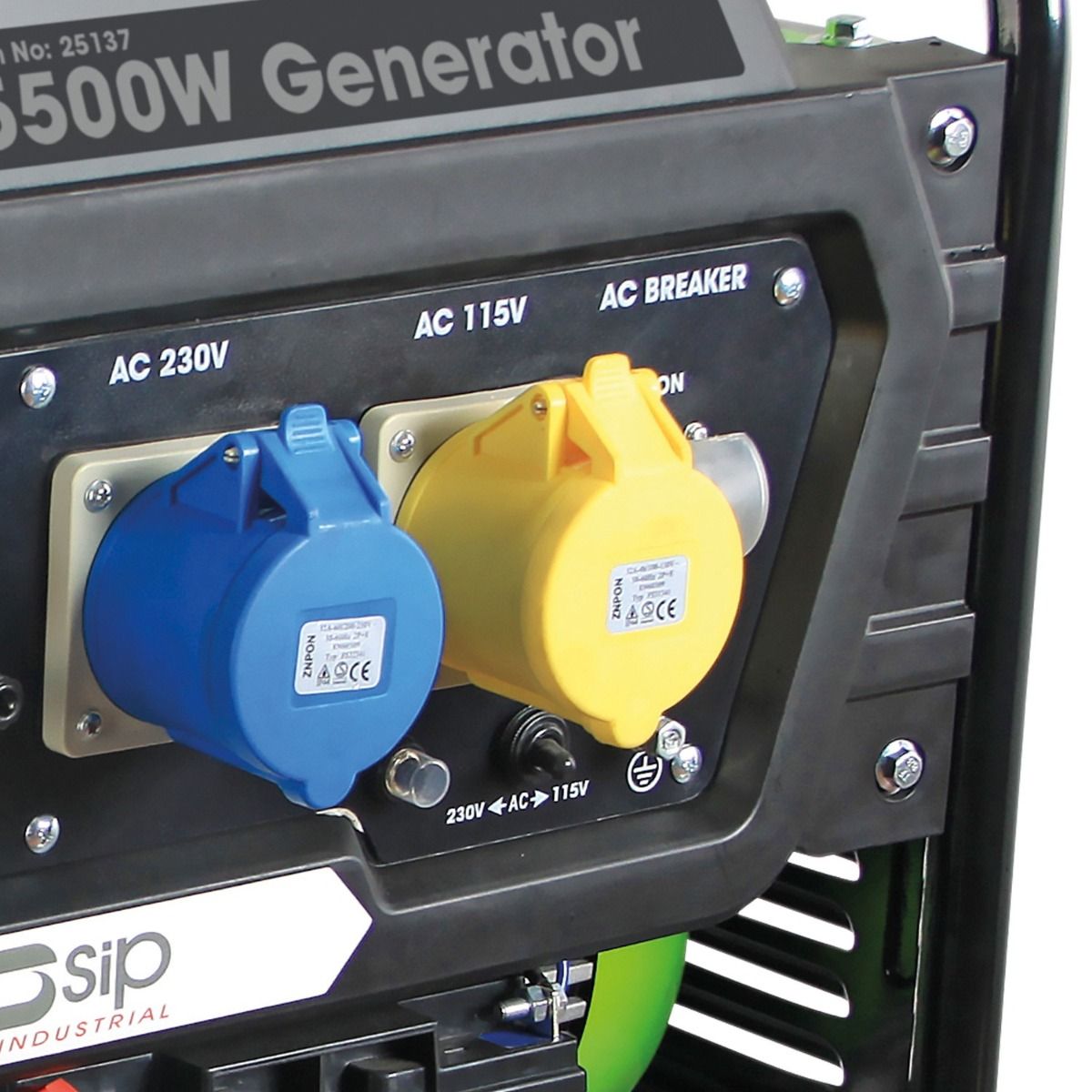
32A 110V and 230V sockets: take 32A site leads and distribution, or 16A tools through a fly lead.
-
Voltage selector switch: sets the AC output to 230V or 110V to match the job.
-
5000W continuous output: runs several tools and lights for hours, with 5500W available for short start-up peaks.
-
25L fuel tank: gives about 8 hours of running between refills.
-
Automatic voltage regulator: holds the output voltage steady as loads switch on and off.
Who is this for
Trades and roles
-
Groundworkers
-
Builders and site managers
-
Utility and civils crews
-
Plant hire and maintenance teams
-
Event and temporary works contractors
-
Farm and estate staff
Industries
-
Construction
-
Civil engineering
-
Utilities
-
Agriculture
-
Events
Specifications
| Specification | Detail |
|---|---|
| Product name | SIP Medusa T5500W Petrol Generator with Electric Start - 5.5kW 110V 230V |
| Product code | PL050003 |
| Product type | Open frame petrol generator with AVR, electric start and wheels |
| Maximum output | 5500W |
| Continuous (rated) output | 5000W at 230V, 3000W at 110V |
| Rated current | 21.7A at 230V, 27.3A at 110V |
| Power factor | 1.0 |
| AC output | 230V or 110V, 50Hz, set by selector switch |
| 230V socket | 1x 32A blue industrial socket, hinged cover |
| 110V socket | 1x 32A yellow industrial socket, hinged cover (panel marked 115V) |
| Voltage selection | Selector switch (panel marked 230V / AC / 115V), one voltage at a time |
| DC output | 12V, 8.3A, unregulated, battery charging only, batteries up to 40Ah |
| Voltage regulation | Automatic voltage regulator (AVR) |
| Alternator | Brushed |
| Engine | 390cc (13hp) 4-stroke, single cylinder, OHV, air-cooled |
| Emissions | EURO V |
| Start | Electric key start, recoil (pull-cord) backup |
| Starter battery | 12V 17Ah (204Wh) lead-acid, fitted |
| Fuel | Petrol |
| Fuel tank capacity | 25L |
| Runtime | About 8 hours (approximate) |
| Fuel gauge | Yes |
| Fuel filter | Strainer in the filler neck |
| Engine protection | Low oil pressure alert with automatic shutdown |
| Engine oil | SAE 10W-30 or 10W-40, supplied without oil |
| Earthing | Earth terminal, connect to an approved earth with wire over 0.75mm2 |
| Controls | Key switch, engine switch, fuel tap, choke lever, analogue voltmeter, voltage selector, AC breaker, DC breaker, earth terminal |
| Sound power level | 96dB(A) LwA |
| Performance class | G1 |
| Quality class | B |
| IP rating | IP23M |
| Markings | UKCA (UK Declaration of Conformity), CE (EU Declaration of Conformity) |
| Standards | BS EN ISO 8528-13:2016, BS EN 55012:2007+A1:2009, BS EN 61000-6-1:2007, BS EN ISO 3744:2010 |
| Operating limits | Up to 40C ambient, up to 1000m altitude |
| Mobility | Two wheels, two lifting handles, front support feet |
| Frame | Tubular steel |
| Dimensions (H x W x D) | 610mm x 630mm x 680mm |
| Weight | 85kg |
| Warranty | SIP 2-year |
| Brand | SIP (Medusa range) |
Compatibility
| Equipment, tool or condition | Suitability |
|---|---|
| 110V site tools with yellow 32A plugs | Suitable, through the 110V outlet with the selector set to 110V |
| 110V site tools with yellow 16A plugs | Suitable with a 32A to 16A fly lead |
| 230V equipment with blue 32A or 16A plugs | Suitable, direct or through a 32A to 16A adaptor |
| 230V equipment with UK 3-pin 13A plugs | Suitable with a 32A to 13A adaptor lead, within the load limit |
| 12V lead-acid batteries up to 40Ah | Suitable, through the 12V DC charging output |
| Batteries left on charge unattended | Not recommended, the DC output is unregulated and does not cut out when the battery is full |
| Moving across firm, level ground | Suitable, using the wheels and lifting handles |
| 110V and 230V loads at the same time | Not recommended, the panel has a voltage selector switch, check the manual |
| Motor loads with high start-up current, such as compressors | Not recommended unless the start-up load stays within the 5500W maximum |
| Lifting into a van by one person | Not recommended, it weighs 85kg, use two people or a lifting aid |
| Indoor, enclosed or poorly ventilated spaces | Not recommended, exhaust gases contain carbon monoxide, run outdoors only |
| Connecting into building wiring | Not recommended, unless installed by a qualified electrician with a changeover switch |
Typical Users and Projects
Site managers, groundworkers and utility crews use this generator on plots, compounds and roadworks that need more power than a small frame generator can give. It suits jobs running several 110V tools and lights from one unit, or heavier 230V equipment. Operators should understand load limits, the voltage selector, battery care and safe refuelling.
Typical applications
-
Running several 110V tools and task lights through a splitter box on plots without a temporary supply.
-
Powering 110V festoon and flood lighting across a compound for winter shifts.
-
Supplying 230V equipment in a welfare or site setup when mains is not yet connected.
-
Providing temporary power for utility excavations, reinstatement and civils work.
-
Running pumps, fencing and workshop equipment on farms and estates away from mains.
-
Charging 12V lead-acid batteries on plant and vehicles through the DC output.
How to use
Step 1: Wheel the generator outdoors onto firm, level ground, well away from doors, windows and air vents.
Step 2: The generator is supplied without oil, so fill the engine with SAE 10W-30 or 10W-40 to the upper mark on the dipstick, then fill the tank with unleaded petrol.
Step 3: Connect the earth terminal to an approved earth using wire over 0.75mm2 before connecting any equipment.
Step 4: With nothing plugged in, set the engine switch to ON, turn the fuel tap on and close the choke. Turn and hold the key until the engine starts, then move the choke to run once it is warm. Use the recoil starter if the battery is low.
Step 5: With nothing plugged in, set the voltage selector to 230V or 110V to match your equipment.
Step 6: Check the voltmeter, make sure the AC breaker is on, then plug in the largest load first.
Step 7: Unplug all equipment, switch the engine off, then turn the fuel tap off.
Common mistakes
-
Plugging in before setting the voltage selector to match the equipment.
-
Expecting full 5000W from the 110V socket, when the 110V output is 3000W continuous.
-
Leaving the generator unused for months, so the starter battery runs flat.
-
Lifting the generator into a van without enough people or a lifting aid.
-
Refuelling while the engine is running or still hot.
Safety
Exhaust gases contain carbon monoxide, so run the generator outdoors only, at least 1m from walls and buildings and away from openings into them. Switch off and let the engine cool before refuelling, and store petrol in approved fuel cans. HSE guidance favours 110V centre-tapped earth supplies for portable tools on construction sites, so check the manual and your site rules before relying on the 110V output. At 85kg, plan lifting under the Manual Handling Operations Regulations, using two people or a lifting aid. The sound power level is 96dB(A), so wear hearing protection when working close to it for long periods.
Maintenance
Check the oil level before every use. Change the oil after the first 8 hours, then every 50 hours, and keep loads under 75% for the first 25 hours. Clean the air filter element in a mild solvent, then lightly oil it before refitting, more often on dusty sites. Keep the starter battery charged and its terminals clean, and remove the key when the generator is not in use. Before long storage, drain the fuel or add a fuel stabiliser.

Frequently Asked Questions
Q: Which plugs and leads fit the 32A sockets?
A: Both outlets are 32A industrial sockets, yellow for 110V and blue for 230V. Most 110V hand tools have 16A plugs, so use a 32A to 16A fly lead or a splitter box with a 32A input. UK 3-pin plugs need a 32A to 13A adaptor lead on the 230V side. The selector switch sets which voltage the outlets supply.
Q: What do 5500W and 5000W mean on a generator?
A: 5500W is the maximum output, which the generator can only hold for short periods, such as while a motor starts. 5000W is the continuous output it can supply for hours at a time. Size your loads against the 5000W figure. The “T5500W” in the model name matches the maximum output.
Q: How long will it run on a full tank?
A: The supplier gives a runtime of about 8 hours from the 25L tank. Actual runtime depends on the load, and lighter loads use less fuel. Keep a filled fuel can on site for double shifts.
Q: What is this generator not suitable for?
A: It is not suitable for indoor or enclosed use, or for loads above 5000W continuous. Do not plan on running 110V and 230V loads together until the manual confirms it, because the panel has a voltage selector. It should not be connected into building wiring unless a qualified electrician fits a changeover switch. The 12V output is for charging batteries only.
Q: Why choose this over the 3000W petrol generator?
A: It gives 5000W continuous, against 2700W, so it can run more tools and lights at once. It adds key start, wheels and a 25L tank, and its 32A sockets suit site distribution. The 3000W model is lighter at 39kg, against 85kg, so it suits smaller jobs where one person carries it.
Q: Can one person move it on site?
A: One person can roll it across firm, level ground on its two wheels using the handles. Lifting it into a van or over obstacles needs two people or a lifting aid, because it weighs 85kg. Plan routes across soft ground before the job starts.
Q: What routine checks does it need?
A: Check the oil level before every use, because the low oil shutdown will stop the engine if it runs low. Keep the starter battery charged and the terminals clean, especially through winter. Keep the air filter clean and follow the service intervals in the manual.