The right generator is the one whose rated (continuous) output covers everything you run at the same time, with enough peak output for the start-up surge of your largest motor.
On UK construction sites you also need the right voltage, usually 110V for portable tools, and sockets that match your leads. This guide shows you how to work it out, and compares the SIP Medusa generators we supply.
Quick answer
- Add up the running watts of everything you will use at once. This is the rated output you need.
- Add the extra start-up watts of your largest motor tool. This must stay within the peak output.
- Check the output at the voltage you need. Many generators give less at 110V than at 230V.
- Leave headroom. A generator running flat out all day gives you nothing spare for the next tool.
- Choose the type by the job: petrol for light portable work, inverter for electronics and quieter running, diesel for long shifts and three phase.
What size generator do I need?
You need a generator whose rated output is higher than the combined running load of everything you switch on together. Its peak output must also cover the short surge when a motor starts.
| Typical use | Rated output to look for | Generator type |
|---|---|---|
| Lighting, chargers and a few small 230V tools | 2kW to 3kW | Petrol |
| A few 110V hand tools and task lights | 2kW to 3kW at 110V | Petrol or inverter |
| Several 110V tools and lights, plus 230V chargers | 5kW to 8kW | Inverter, petrol or diesel |
| Three phase mixers, pumps, saws and distribution | Around 11kW (15kVA) | Three phase diesel |
Use this as a starting point, then check your own load with the steps below.
Peak vs rated output, kVA vs kW
Peak output (also called maximum or starting output) is the most power a generator can give for a short time, such as the few seconds a motor takes to start. Rated output (also called continuous or running output) is what it can supply for hours.
Always size your running load against the rated figure. A model sold as a 3000W generator may only give 2700W continuously. The model name often matches the peak figure, not the rated one.
kVA vs kW
kVA is apparent power, the total electrical load. kW is real power, the useful work your equipment draws. They are linked by the power factor: kW = kVA x power factor.
Larger diesel generators are often rated at a power factor of 0.8. The three phase diesel generator in our range is rated at 13.75kVA, which gives 11kW (13.75 x 0.8). Many smaller generators are rated at a power factor of 1.0, so their kVA and kW figures are the same.
How to work out your site load
- Step 1List your equipment
Write down every tool, light and charger you will run at the same time.
- Step 2Find the running watts
Check each rating plate or manual for its running watts.
- Step 3Add them up
The total is the rated output your generator needs.
- Step 4Find the biggest surge
Pick the motor tool with the largest start-up surge.
- Step 5Check the peak
Running total plus that surge must stay within the peak output.
Motors in grinders, saws and compressors can draw several times their running power for a moment as they start. Do it once for each voltage you will use.
Worked example: a small 110V site
Example figures for illustration only. Always use the figures on your own tools.
| 110V equipment (example) | Running watts | Extra start-up watts |
|---|---|---|
| 4 LED task lights at 50W | 200W | None |
| SDS drill | 800W | Small |
| 115mm angle grinder | 900W | About 900W (largest motor) |
| Total | 1,900W running | About 2,800W at start-up |
This site needs at least 1,900W continuous at 110V, plus headroom, and about 2,800W for a few seconds when the grinder starts.
- A 3000W petrol generator giving 1,750W continuous at 110V is too small, even though its name says 3000W.
- A 5500W petrol generator giving 3,000W continuous at 110V covers it with room to spare.
- A 5800W or 8800W inverter generator also covers it, and can run 230V chargers from its other sockets at the same time.
Generator size checker
Enter your totals to see which SIP Medusa generators fit. This is a guide only, so ask our team to check larger or mixed loads.
Petrol, inverter or diesel: which type suits the job?
Open frame petrol
The simplest and most portable choice for short jobs, small works and maintenance crews. An automatic voltage regulator (AVR) holds the voltage steady as loads switch on and off.
- Best for light, portable work
- Often one voltage live at a time
- Louder than enclosed models
Silent inverter
Electronics give a pure sine wave output with low distortion, which suits laptops, chargers, controls and AV kit. An enclosed case and low idle mode cut noise and fuel use at light loads.
- Best for electronics, events and housing
- 110V and 230V at the same time
- Check each socket's circuit protector
Silenced diesel
Suits long shifts, standby power and heavier loads. Diesel is less flammable than petrol to store, and larger sets supply three phase 400V for machinery.
- Best for full shifts and three phase
- Silenced steel cabinets
- Heavier, so plan how to move it
Do I need a 110V generator for site tools?
On UK construction sites, portable tools usually run at 110V, using yellow 16A or 32A industrial plugs and sockets. HSE guidance favours 110V centre-tapped to earth (CTE) supplies for portable tools, because they reduce the shock risk if a lead or tool is damaged.
If you need 110V, choose a generator with a 110V outlet and check its 110V output, not just the headline figure. If your site rules require a CTE supply, confirm the generator provides it, or run your tools through a 110V site transformer from the 230V output.
Match your leads to the sockets too. A 32A socket needs a 32A to 16A fly lead or a splitter box for most 110V hand tools.
Silent generators for housing, events and night work
Noise matters near homes, schools, hospitals, offices and events. Generators publish two noise figures. Sound power (LwA) is the total noise the machine produces. Sound pressure (LpA) is what you hear at a set distance, often 7m.
The SIP Medusa ISG5800 and ISG8800 are silent inverter generators, with published sound pressure levels of 64dB(A) and 63dB(A) at 7m on a 25% load. Our diesel generators sit in silenced steel cabinets. Check any local noise limits for your site before work starts, and wear hearing protection when working close to any generator.
Single phase or three phase?
Most hand tools, lighting and welfare equipment run on single phase 110V or 230V. Larger machines, such as bigger mixers, pumps, saws and compressors, may need three phase 400V. A single phase generator cannot run them.
A three phase generator supplies 400V from red 5-pin sockets and usually has a 230V outlet as well. Keep the load balanced across the three phases, and have three phase connections and distribution made by a competent electrician.
Running a generator safely on site
- Run generators outdoors only. Exhaust gases contain carbon monoxide.
- Keep clear space around the generator, away from doors, windows and air vents.
- Earth the generator as its manual directs before connecting any equipment.
- Start the engine with nothing plugged in, then connect the largest load first.
- Never refuel while the engine is running or hot.
- Never connect a generator into building wiring unless a qualified electrician fits a changeover switch.
Can you use red diesel in a site generator?
Construction lost its entitlement to red diesel from 1 April 2022, so diesel generators on construction sites generally need to run on standard (white) diesel. Some sectors, such as agriculture, kept their entitlement. Check the current HMRC guidance if you are unsure whether your use qualifies.
Our SIP Medusa generators
Filter by type or voltage, then open any generator for full specifications.
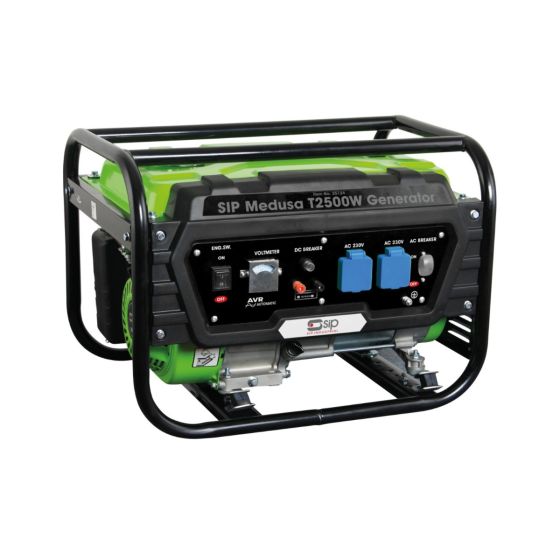
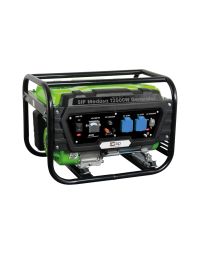
SIP Medusa T2500W Petrol Generator
2200W 230V, with AVR
- Peak / rated
- 2200W / 2000W
- Sockets
- 2x UK 3-pin 230V
- 110V
- No
- Start
- Recoil
Best for: lighting, chargers and small 230V tools away from site.
View generator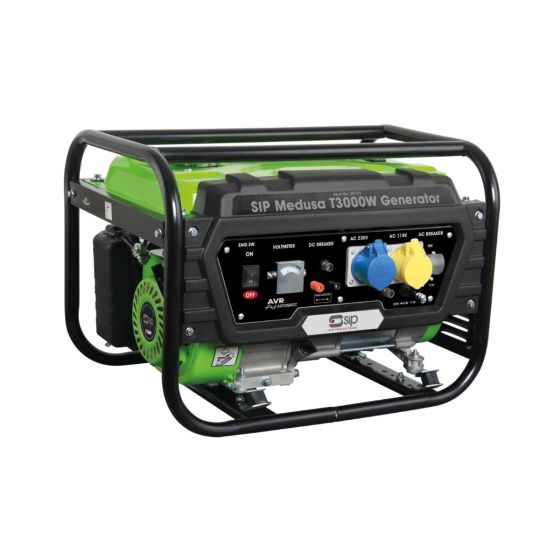
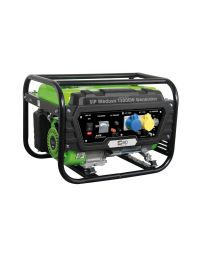
SIP Medusa T3000W Petrol Generator
3000W 110V 230V, with AVR
- Peak / rated
- 3000W / 2700W (230V)
- 110V output
- 1750W, 16A socket
- Voltage
- One at a time, selector
- Start
- Recoil
Best for: a few 110V tools and lights on small works.
View generator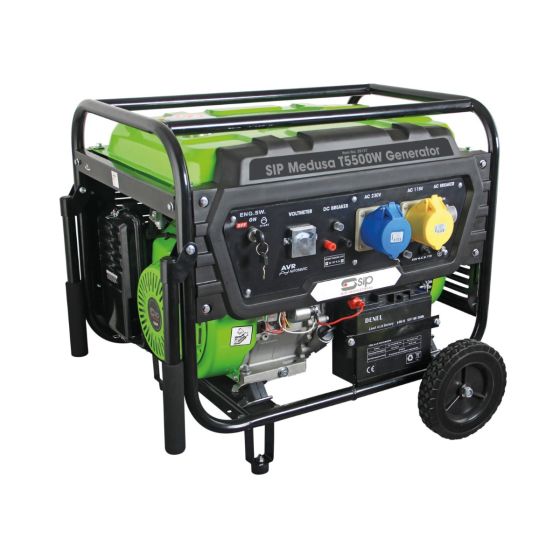
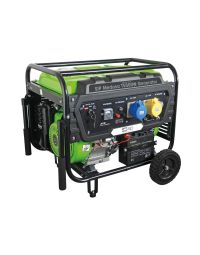
SIP Medusa T5500W Petrol Generator
5500W 110V 230V, electric start
- Peak / rated
- 5500W / 5000W (230V)
- 110V output
- 3000W, 32A socket
- Voltage
- One at a time, selector
- Start
- Electric key, recoil backup
Best for: several 110V tools and lights on plots and compounds.
View generator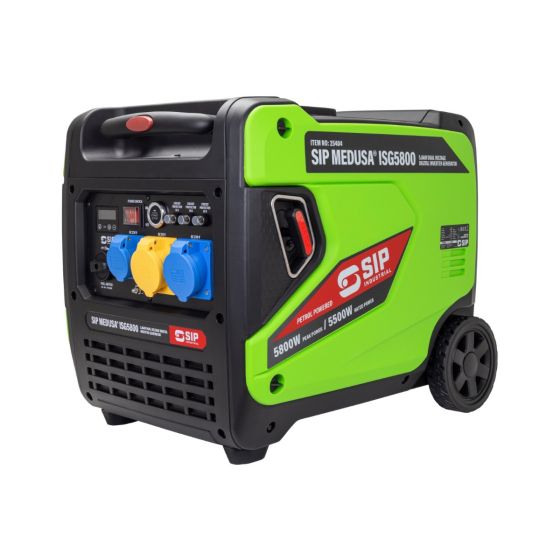
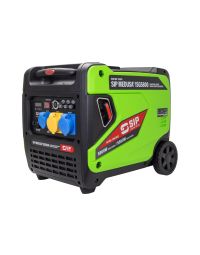
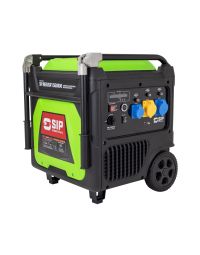
SIP Medusa ISG5800 Digital Inverter Generator
5800W 110V 230V, silent
- Peak / rated
- 5800W / 5500W
- Sockets
- 16A and 32A 230V, 32A 110V
- Voltage
- 110V and 230V together
- Noise
- 64dB(A) at 7m, 25% load
Best for: mixed tools and electronics, events and housing.
View generator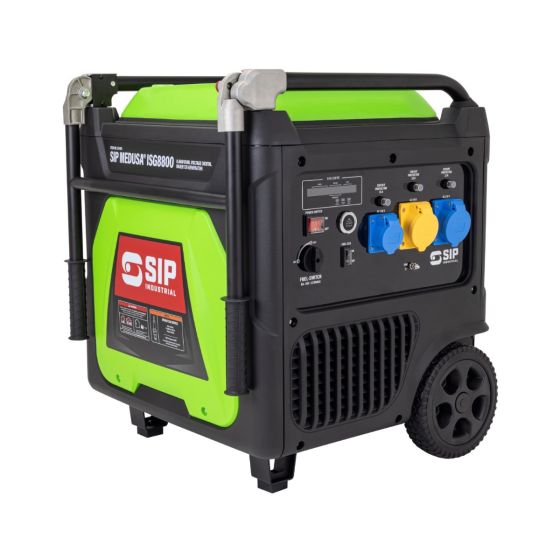
SIP Medusa ISG8800 Digital Inverter Generator
8800W 110V 230V, silent
- Peak / rated
- 8800W / 8200W
- Sockets
- 16A and 32A 230V, 32A 110V
- Voltage
- 110V and 230V together
- Noise
- 63dB(A) at 7m, 25% load
Best for: busy sites, events and several heavy loads at once.
View generator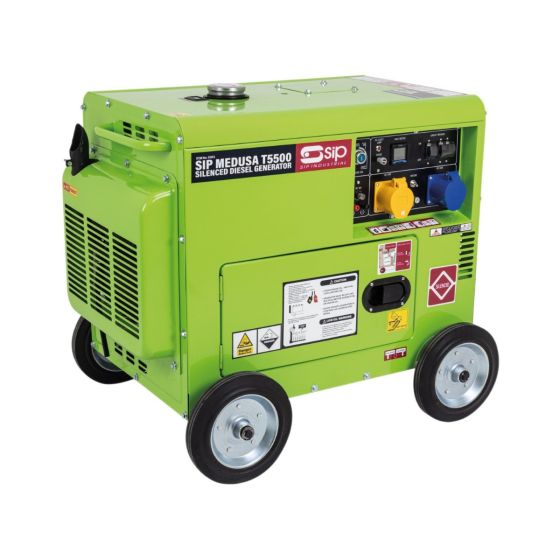
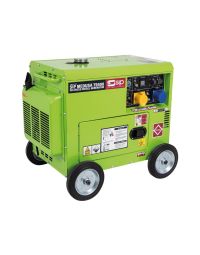
SIP Medusa T5500 Silenced Diesel Generator
5.5kVA 110V 230V
- Peak / rated
- 5.5kVA / 5kVA (230V)
- 110V output
- 3.5kW, 32A socket
- Voltage
- One at a time, selector
- Start
- Electric key
Best for: full shifts and standby where diesel is on site.
View generator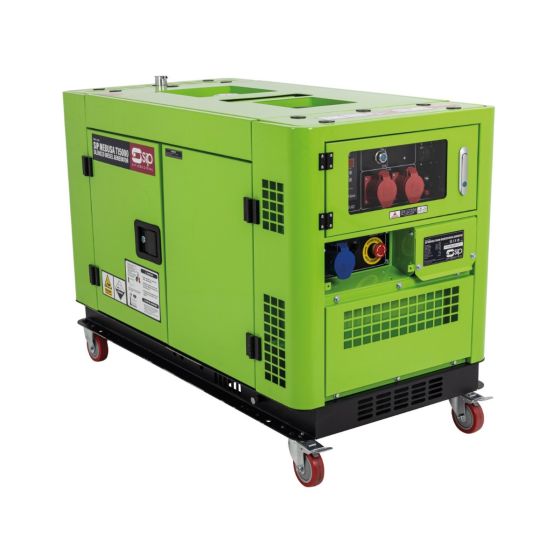
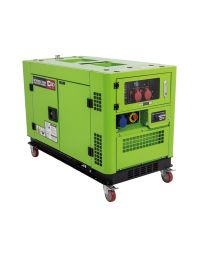
SIP Medusa T15000 Three Phase Silenced Diesel Generator
15kVA 400V 230V
- Peak / rated
- 15kVA / 13.75kVA (11kW)
- 230V output
- 3.6kW rated
- 110V
- No, use a site transformer
- Start
- Electric key
Best for: three phase machinery and distribution.
View generatorSIP Medusa generators compared
Click a column heading to sort. Rated output is the figure to size against.
| Generator | Type | Rated output | Peak output | 110V output | 110V and 230V together | Start |
|---|---|---|---|---|---|---|
| SIP Medusa T2500W | Petrol | 2000W (230V) | 2200W | None | 230V only | Recoil |
| SIP Medusa T3000W | Petrol | 2700W (230V) | 3000W | 1750W | No, selector | Recoil |
| SIP Medusa T5500W | Petrol | 5000W (230V) | 5500W | 3000W | No, selector | Electric key, recoil backup |
| SIP Medusa ISG5800 | Silent inverter | 5500W | 5800W | About 2.6kW (32A socket, 24A protector) | Yes | Push-button, recoil backup |
| SIP Medusa ISG8800 | Silent inverter | 8200W | 8800W | About 3.5kW (32A socket, 32A protector) | Yes | Push-button, recoil backup |
| SIP Medusa T5500 diesel | Silenced diesel | 5kVA / 5kW (230V) | 5.5kVA | 3.5kW | No, selector | Electric key |
| SIP Medusa T15000 | Silenced diesel, three phase | 11kW (13.75kVA) at 400V | 12kW (15kVA) | None | 400V and 230V, see manual | Electric key |
Figures from SIP product data and user manuals. Check each product page for full specifications.
Frequently asked questions
What size generator do I need for a construction site?
Add up the running watts of every tool and light you will use at the same time, at each voltage. Choose a generator whose rated output at that voltage is higher than your total, with a peak output that covers your largest motor starting. Small sites often need 3kW to 5kW at 110V, while busy sites need more.
What is the difference between peak and rated output?
Peak output is the most a generator can supply for a few seconds, such as when a motor starts. Rated output is what it can supply continuously for hours. Always size your running load against the rated figure.
How do I convert kVA to kW?
Multiply the kVA figure by the power factor. At a power factor of 0.8, 13.75kVA gives 11kW. At a power factor of 1.0, kVA and kW are the same.
Can I run 110V site tools from a generator?
Yes, if the generator has a 110V outlet with enough output for your tools. Check the 110V figure, because it is often lower than the 230V output. If your site requires a centre-tapped earth supply, confirm the generator provides it or use a 110V site transformer.
Is an inverter generator better than a standard generator?
An inverter generator gives a pure sine wave output with low distortion, which suits laptops, chargers and electronic controls. Enclosed inverter models are also quieter and use less fuel at light loads. A standard open frame generator is simpler and suits rough site work where noise and waveform matter less.
Which generator is quiet enough for housing or events?
Choose a silent inverter generator or a silenced diesel generator, and compare the sound pressure figure at 7m. The SIP Medusa ISG5800 and ISG8800 publish 64dB(A) and 63dB(A) at 7m on a 25% load. Always check local noise limits for the site.
Can you use red diesel in a generator on a construction site?
Construction lost its entitlement to red diesel from 1 April 2022, so site generators generally need standard diesel. Some sectors, such as agriculture, kept their entitlement. Check HMRC's guidance if you are unsure.
Do generators need to be earthed?
Follow the earthing instructions in the generator's manual before connecting any equipment. Manuals usually specify the earth terminal, the minimum wire size and how to connect to an approved earth. If you are unsure, ask a competent electrician.
Can a generator power a building?
Only through a changeover switch fitted by a qualified electrician. Connecting a generator straight into building wiring can feed power back into the supply and is dangerous.
Need help choosing a generator?
Send us a list of the equipment you need to run and our team will match it to the right generator. Call 020 8311 1144 or email sales@cmt.co.uk.