Every construction site in the UK that uses power tools needs a safe way to distribute electricity. 110V CTE is the standard. But setting it up correctly, from the transformer to the tool, involves selecting the right components and understanding how they work together. This guide covers everything.
A 110V site splitter box that takes one transformer output and provides four 16A sockets for running multiple tools simultaneously. Available in 16A and 32A input variants.
- output sockets match input: 16A (EL14W16) or 32A (EL14W32)
- EL14W16: 16A input, 1.5mm cable, max 16A total
- EL14W32: 32A input, 4.0mm cable, max 32A total
- 5m yellow cable, steel yellow powder coated housing
- IP44 rated, BS EN 60309
- CE and RoHS certified
- 110V CTE only
110V 4 Way Splitter Box
A 110V site splitter box that takes one transformer output and provides four 16A sockets for running multiple tools simultaneously. Available in 16A and 32A input variants.
- output sockets match input: 16A (EL14W16) or 32A (EL14W32)
- EL14W16: 16A input, 1.5mm cable, max 16A total
- EL14W32: 32A input, 4.0mm cable, max 32A total
- 5m yellow cable, steel yellow powder coated housing
- IP44 rated, BS EN 60309
- CE and RoHS certified
- 110V CTE only
110V 4 Way Splitter Box - 16A and 32A Input
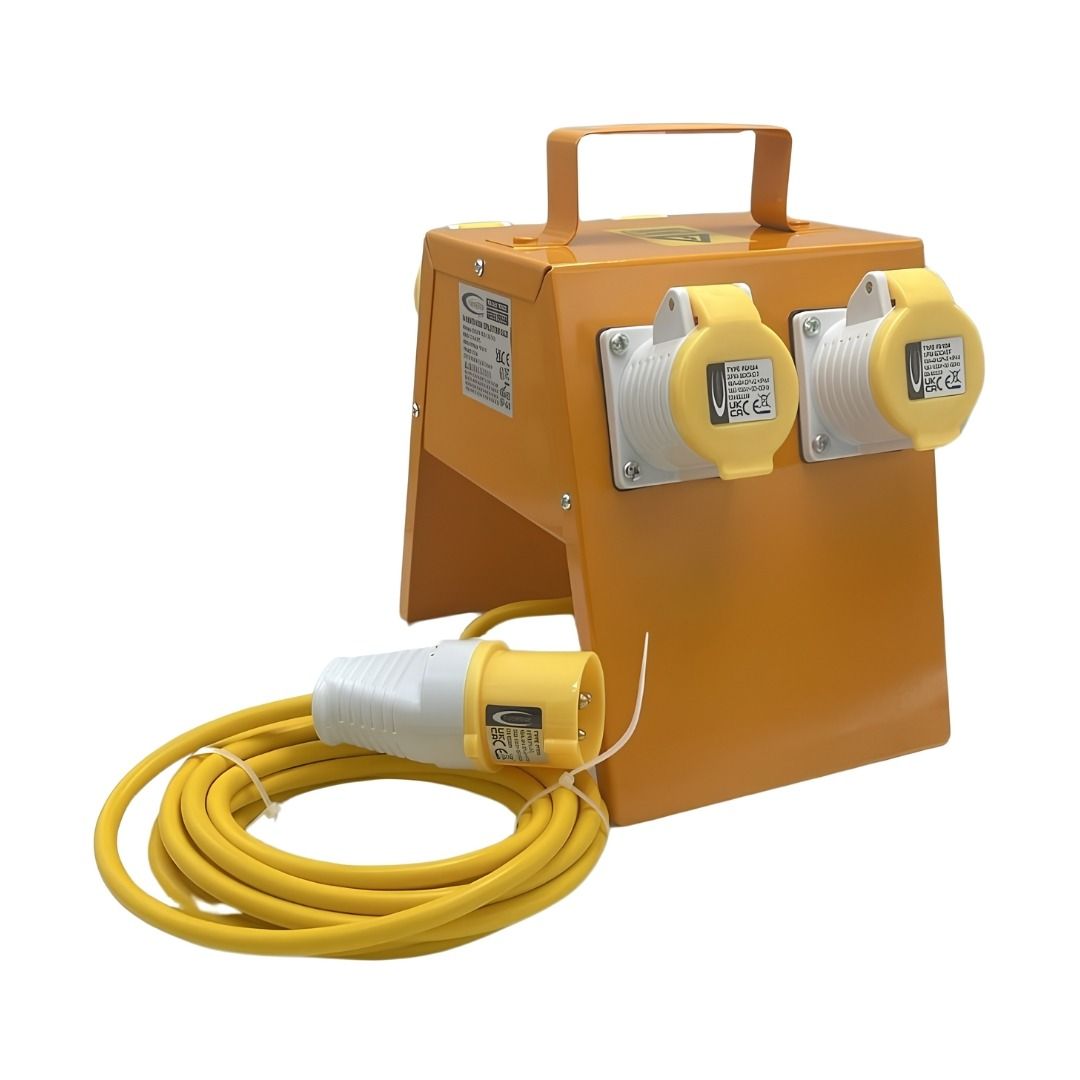
A 110V site splitter box for construction sites running 110V CTE tools. It plugs into one transformer output socket and provides four 16A sockets so multiple tools can run at the same time. No daisy-chaining. No cable overloading. One clean connection from the transformer, four working tool positions from the box. Available in two variants: 16A input (EL14W16) and 32A input (EL14W32). See the variant comparison table to choose the right one.
How one transformer output becomes four tool connections
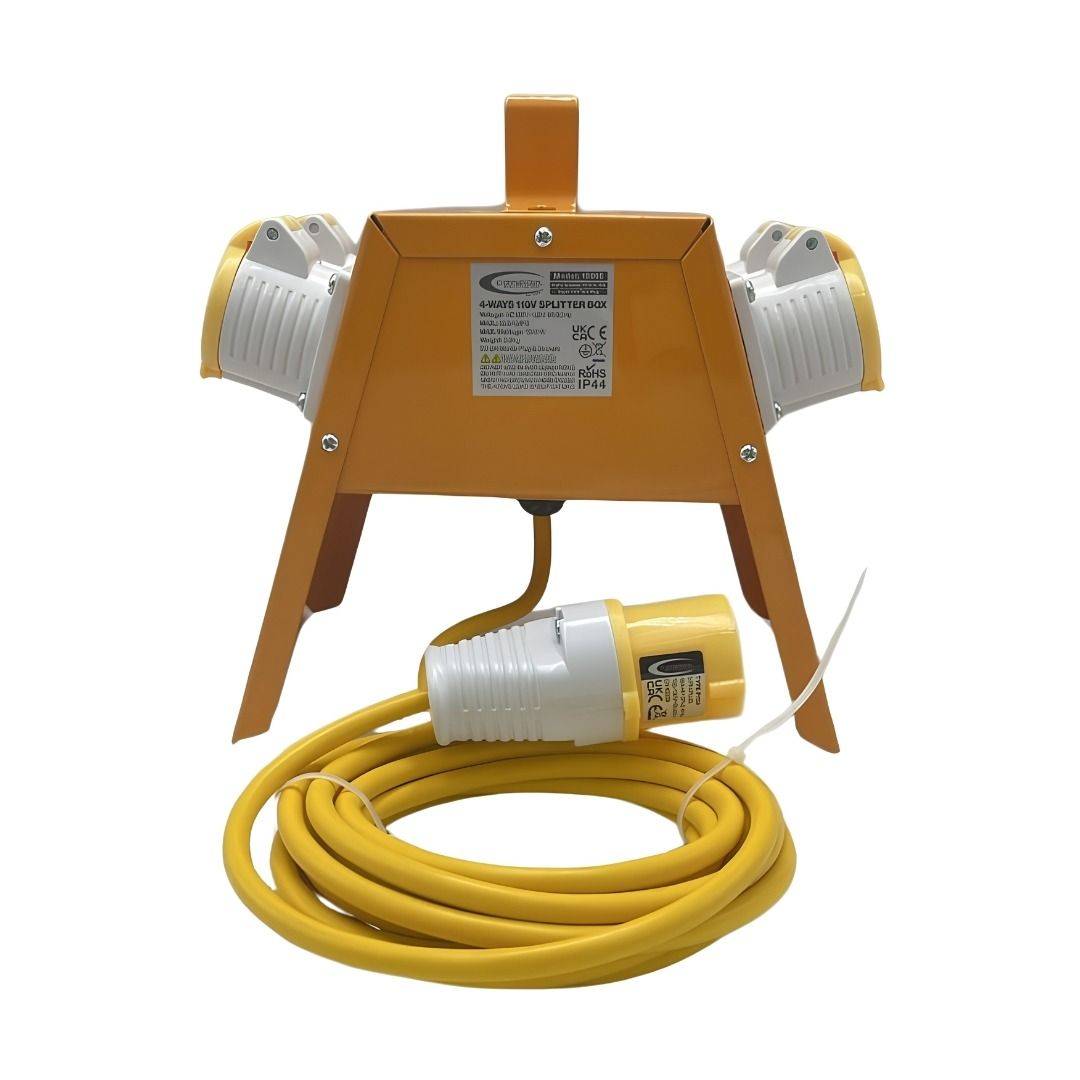
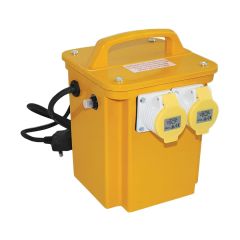
Most site transformers have one or two output sockets. More tools than sockets means operatives start connecting extension leads into each other, which is not permitted and creates overloading risks. A splitter box solves this cleanly. The 32A input takes the full transformer output and the internal wiring distributes it across four 16A output sockets. All four can run simultaneously as long as the combined load stays within the input rating. The steel housing sits stable on the A-frame legs and the carry handle makes it easy to reposition as work moves across the site.
Key Features
-
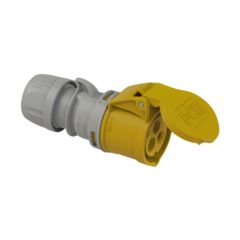
Four 16A IEC 60309 output sockets: Four independent 16A connection points for site tools and extension leads. All sockets are the standard yellow 110V IEC 60309 type. Any 110V site tool with a 16A plug connects directly without adaptors.
-
16A or 32A input variant: EL14W16 takes a 16A transformer output with a 1.5mm cable. EL14W32 takes a 32A output with a 4.0mm cable. Maximum total load across all four sockets equals the input rating: 16A or 32A respectively.
-
Steel yellow powder coated housing: Durable steel construction for site conditions. Yellow powder coat is resistant to site abrasion and identifies the unit as 110V equipment at a glance.
-
A-frame stand with carry handle: The A-frame legs keep the unit stable on uneven ground. The carry handle at the top makes it quick to pick up and move as work progresses. At around 10kg, it is substantial enough to stay in position during use.
-
IP44 rated: Protected against solid objects larger than 1mm and water splashes from all directions. Suitable for outdoor construction sites.
-
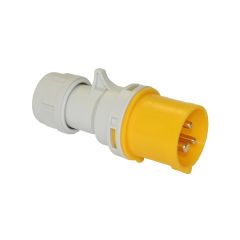
BS EN 60309 plug and sockets: Input plug and all four output sockets conform to the IEC 60309 standard. Compatible with the full range of 110V CTE site equipment.
-
5m cable: Five metres from the transformer to the splitter box gives useful positioning flexibility without creating excess trailing cable between the transformer and distribution point.
Who is this for
Trades and roles:
-
Site managers setting up 110V power distribution
-
Electricians specifying site power layouts
-
General site operatives running multiple 110V tools
Industries:
-
Construction and new build
-
Civil engineering and groundworks
-
Refurbishment sites
Specifications
| Specification | Detail |
| Product Name | 110V 4 Way Splitter Box |
| Parent SKU | EL14W |
| Voltage | 110V AC (CTE) |
| Frequency | 50/60Hz |
| Cable Length | 5m |
| Cable Colour | Yellow |
| Housing | Steel, yellow powder coated |
| Carry Handle | Yes |
| Standard | BS EN 60309 |
| Safety Class | Class I |
| IP Rating | IP44 |
| Certifications | CE, RoHS compliant |
| Net Weight | Approx. 10kg |
| Use | 110V CTE systems only. Do not connect to 240V. |
Variant Comparison
| SKU | Input | Output Sockets | Cable | Max Load |
|---|---|---|---|---|
| EL14W16 | 16A plug | 4 x 16A sockets | 1.5mm, 5m | 16A (1,760W) |
| EL14W32 | 32A plug | 4 x 32A sockets | 4.0mm, 5m | 32A (3,520W) |
Compatibility
| Application or condition | Status |
| Splitting one 110V transformer output into four 16A connections | ✓ Suitable |
| Running multiple 16A site tools from one transformer output | ✓ Suitable |
| Outdoor construction site use (IP44) | ✓ Suitable |
| 16A input transformer (EL14W16), total load up to 16A | ✓ Suitable |
| 32A input transformer (EL14W32), total load up to 32A | ✓ Suitable |
| 32A tools plugged into the 16A output sockets | ✗ Not permitted |
| Connection to a 240V supply | ✗ Not suitable |
| Daisy-chaining into another splitter box or extension lead | ✗ Not permitted |
| Sustained rainfall or standing water | ✗ Not suitable (IP44) |
Who is this for
Site managers and electricians who need to power multiple 110V tools from a single transformer output. This is the correct alternative to daisy-chaining extension leads. It is also the right solution when a transformer has one output socket but a work team needs four tool connections simultaneously.
Typical applications
-
Running four 110V tools simultaneously from a single 32A transformer output on a large construction site floor.
-
Providing four 16A connection points in a groundworks area where the transformer is positioned at the trench edge.
-
Setting up a distribution point for first and second fix electrical trades working in the same floor area.
-
Powering multiple 110V site lights from a single transformer output in areas without established lighting.
-
Distributing 110V supply across a concreting pour setup where multiple tools need to operate simultaneously.
How to use
Step 1: Select the correct variant before connecting. If your transformer has a 16A output socket, use EL14W16. If it has a 32A output socket, use EL14W32.
Step 2: Connect the input plug to the matching socket on the transformer. Lock the collar.
Step 3: Place the splitter box on a firm, stable surface using the A-frame legs. Position it where operatives can reach all four output sockets without creating trip hazards.
Step 4: Connect site tools or extension leads to the four output sockets. Keep the total combined load within the input rating: 16A maximum for EL14W16, 32A maximum for EL14W32.
Step 5: Do not connect 32A tools to the 16A output sockets. Each output socket is rated 16A regardless of which input variant is used.
Step 6: Do not plug this splitter box into another splitter box or extension lead. It must connect directly to the transformer output.
Common mistakes
-
Connecting 32A tools to the 16A output sockets: the output sockets are 16A on both variants. A 32A tool draws too much current for a 16A socket. Use a 32A extension lead directly from the transformer for 32A equipment.
-
Exceeding the total input load: all four sockets share the input rating. On the 16A variant, four tools at 400W each reach the 16A limit quickly. Calculate combined wattage before connecting.
-
Plugging the splitter into an extension lead rather than the transformer: the input plug must connect directly to the transformer output socket. Using an extension lead between the transformer and the splitter is daisy-chaining.
-
Leaving it in standing water: IP44 covers splashes, not sustained water exposure. Keep the unit elevated on its A-frame legs and out of direct water accumulation.
Safety
This splitter box is for 110V CTE systems only. Do not connect to a 240V supply. Each output socket is rated 16A. Do not connect 32A tools to the output sockets. Total combined load must not exceed the input rating (16A for EL14W16, 32A for EL14W32). Do not daisy-chain into another splitter box or extension lead. IP44, suitable for outdoor site use but not sustained rainfall or standing water. Class I construction.
EL14W16 has 16A output sockets and EL14W32 has 32A output sockets.
Maintenance
Inspect the input plug, output socket faces, and cable before each use. Check all four socket flap hinges close cleanly after tools are disconnected. Clean socket faces of site debris after use. Check the A-frame legs and carry handle for damage. Store in a dry location. Do not use if the cable, plug, or housing is damaged.

Frequently Asked Questions
Q: What is the maximum load I can run across all four sockets?
A: The maximum depends on which variant you are using. On EL14W16 with the 16A input, the combined load across all four sockets must not exceed 16A (1,760W at 110V). On EL14W32 with the 32A input, the combined maximum is 32A (3,520W at 110V). Each individual output socket is rated 16A on both variants, regardless of the input rating.
Q: What is the difference between EL14W16 and EL14W32?
A: The difference is in the input. EL14W16 has a 16A plug that connects to a 16A transformer output and uses a 1.5mm cable. Maximum total load is 16A. EL14W32 has a 32A plug for a 32A transformer output and uses a thicker 4.0mm cable. Maximum total load is 32A. Both variants have four 16A output sockets. Choose based on the current rating of your transformer output socket.
Q: Can I plug this splitter box into an extension lead instead of the transformer directly?
A: No. The input plug must connect directly to the transformer output socket. Placing an extension lead between the transformer and the splitter box constitutes daisy-chaining, which is not permitted under IET Wiring Regulations and creates an overloading risk.
Q: What does IP44 mean for site use?
A: IP44 means the unit is protected against solid objects larger than 1mm and water splashes from all directions. It is suitable for outdoor site conditions including light rain and site water splash. It is not suitable for standing water or sustained heavy rain. The A-frame legs keep the unit elevated from ground-level water.