
How to Set Up 110V CTE Power Distribution on a Construction Site
Every construction site in the UK that uses power tools needs a safe way to distribute electricity. 110V CTE is the standard. But setting it up correctly, from the transformer to the tool, involves selecting the right components and understanding how they work together. This guide covers everything.
What Is 110V CTE and Why Does It Matter?
CTE stands for Centre Tapped Earth. It is the method used by site transformers to step down the 240V mains supply to a safer voltage for portable tools on construction sites.
Here is how it works. The transformer takes 240V AC from the mains. The secondary winding outputs 110V AC. The centre point of that secondary winding is connected to earth. This means neither conductor is more than 55V above earth potential at any time. Not 110V. Always 55V or below.
That 55V limit is the reason 110V CTE exists. A shock from 55V is far less likely to cause cardiac arrest than one from 240V. It does not make electricity safe. But it reduces the severity of a shock significantly, and on a busy construction site where cables get cut, wet, and damaged, that reduction matters enormously.
HSE guidance recommends 110V CTE for most portable tools on UK construction sites. Under the Electricity at Work Regulations 1989, employers must ensure that electrical equipment is suitable for the environment it is used in and that the risk of injury from electricity is reduced so far as reasonably practicable. 110V CTE is the standard approach to meeting this requirement for portable site tools.
The yellow colour code
All 110V CTE equipment uses yellow as its standard colour. Plugs, sockets, cable reels, extension leads, splitter boxes, and transformers are all yellow. Blue indicates 240V single phase. Red indicates 415V three phase. On a site running multiple voltage systems, colour is the first line of defence against misconnection. Yellow means 110V CTE. Always.
The Complete 110V Power Chain
Every 110V site setup follows the same chain. Power flows from the 240V mains supply through each component in sequence until it reaches the tool. Understand each component and you understand the system.
Not every site needs every component. A simple setup might run directly from the transformer through a single cable reel to one tool. A complex multi-trade site might use a transformer, a 50m cable reel, a 4 way splitter box, and four separate extension leads running to different work positions. The chain adapts to the site. The principles stay the same.
Every component in the chain must be rated for 110V CTE. Never connect 110V site equipment to a 240V supply. The IEC 60309 connector geometry prevents this in most cases, but never attempt to force or adapt any connection.
Part 1The Site Transformer
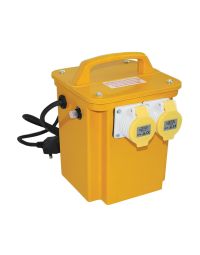
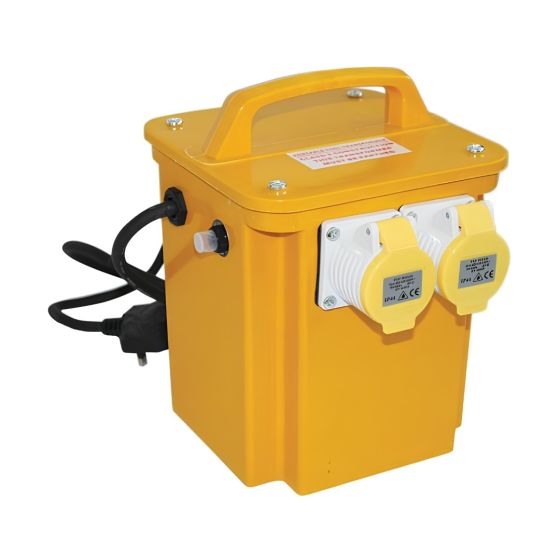
The transformer is where the 110V CTE chain begins. It takes the 240V mains supply and converts it to 110V CTE output. Without a transformer, there is no 110V CTE supply. Nothing else in the chain works without one.
The 240V input plug goes into a standard mains socket or distribution board. The 110V output sockets, in either 16A or 32A configurations, are where the cable reel, extension lead, or splitter box connects.
Choosing the right transformer
Two things determine which transformer you need. First, the total power your tools will draw simultaneously. Second, the current rating of the output sockets. Most standard site transformers provide 16A output sockets. Higher-capacity transformers provide 32A output sockets, which are needed when tools draw more than 16A at 110V, or when a 4 way splitter box is distributing supply to multiple high-draw tools at once.
The transformer sets the maximum current for everything downstream. A 16A transformer output cannot supply more than 16A total to whatever is connected to it, regardless of how many tools or sockets are attached.
Part 2110V Cable Reels
Once the transformer is in position, you need to get the 110V supply to the work area. That is what the cable reel does. It carries the supply from the transformer output socket across the site floor to wherever the tools and splitter boxes need to be.
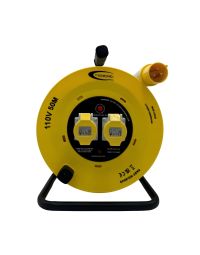
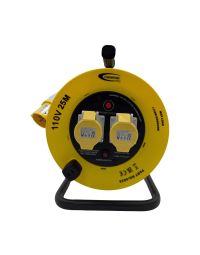
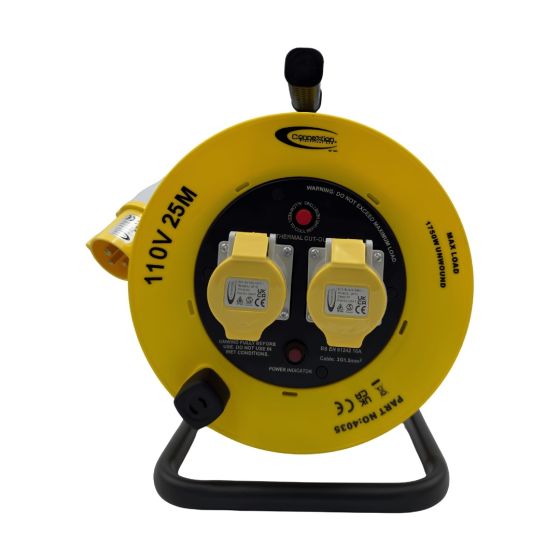
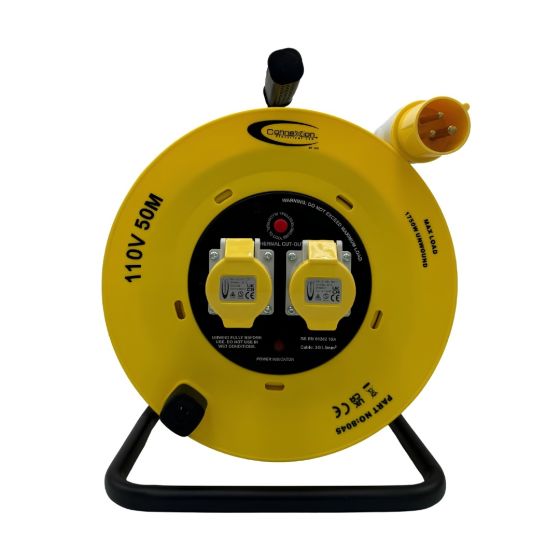
CMT stocks 110V cable reels in two lengths: 25m and 50m. Both use 1.5mm 3 core PVC yellow cable, carry IP44 protection for outdoor site use, and are certified to BS EN 61242.
25m or 50m: choosing the right length
25m is right for most standard site bays, single-floor work areas, and indoor construction zones where the transformer sits within the same building section as the work. 50m is needed when the transformer is positioned at a site entrance or perimeter and the work progresses far into the building or along a long trench or groundworks run.
Using a single reel of the correct length is always the right approach. Connecting two reels together is daisy-chaining, which is prohibited under IET Wiring Regulations and creates a fire risk at the connection point.
The wound and unwound current limit: the most important safety rule for cable reels
A wound cable reel is not just a tidy way to store cable. It is an electrical hazard if used incorrectly under load.
When cable is wound on a drum, adjacent turns cannot dissipate heat the way flat cable can. Current flowing through a wound conductor generates heat between the turns. At significant load, that heat builds faster than it can escape. The result is overheating, insulation damage, and in the worst case, fire.
CMT 110V cable reels are rated:
- Unwound: 16A maximum (1,760W at 110V). This is the full rated capacity and applies only when the entire cable is extended.
- Wound: do not use under significant load. Unwind fully before connecting any tools. The thermal cutout will protect the reel if overheating occurs, but the correct approach is always to unwind first.
Always unwind the full cable from the drum before connecting any tools or extension leads. This rule applies even if you only need 5 metres of the 25m cable. The remaining 20m must be unwound and laid on the floor, not left on the drum.
The thermal cutout
Both CMT 110V cable reels include a thermal cutout with a neon indicator and manual reset button. If the reel overheats, the cutout disconnects the circuit automatically. The neon indicator goes off when this happens.
When the cutout trips: disconnect from the transformer immediately. Remove all tools. Allow the reel to cool fully before pressing the reset button. Do not rush the reset. If the cutout trips repeatedly at normal loads, take the reel out of service.
Part 3The 4 Way Splitter Box
A transformer typically provides one or two output sockets. Most sites need more than one tool running at the same time. The 4 way splitter box bridges this gap.
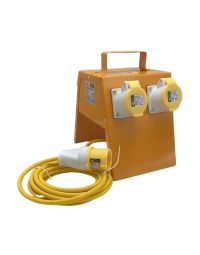
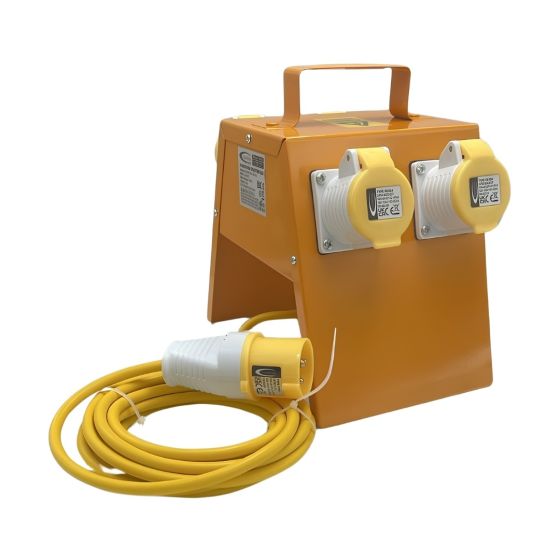
It connects to one transformer output socket or cable reel output socket and provides four independent output sockets from that single connection. Four tools can run simultaneously. One clean connection. No daisy-chaining.
Connecting one extension lead into another (daisy-chaining) is prohibited under IET Wiring Regulations (BS 7671). It overloads the socket at the first connection point, creates unprotected junctions, and is a documented cause of site electrical fires. A splitter box connected directly to the transformer or cable reel is the correct and compliant solution.
Two variants: matching the splitter to the supply
| Variant | Input | Output | Cable | Max Total Load |
|---|---|---|---|---|
| EL14W16 | 16A IEC 60309 plug | 4 x 16A sockets | 1.5mm, 5m | 16A (1,760W) |
| EL14W32 | 32A IEC 60309 plug | 4 x 32A sockets | 4.0mm, 5m | 32A (3,520W) |
Choose the variant that matches your transformer output socket. A 16A transformer output takes the EL14W16. A 32A output takes the EL14W32. The input rating sets the maximum total load. Even on the 32A variant, you must calculate total connected load and stay within 32A across all four sockets.
Part 4110V Extension Leads
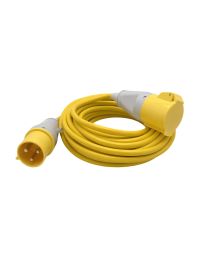
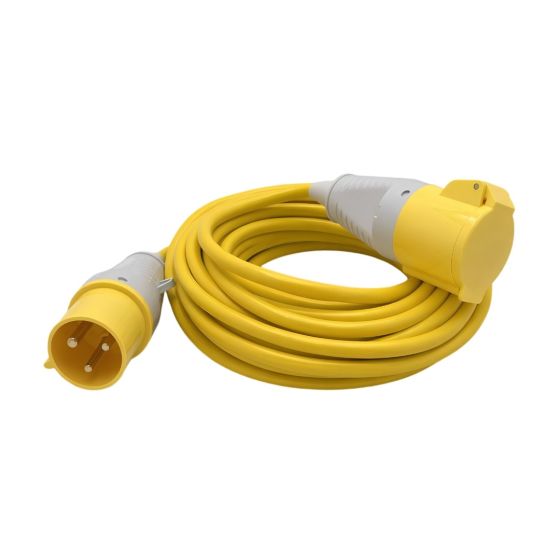
From the cable reel or splitter box, the 110V extension lead carries the supply to the individual tool position. Most site tool operations need 14m of reach from the reel or splitter output to the work area.
The CMT 110V extension lead range comes in four variants, all 14m long:
| SKU | Input Plug | Output Socket | Cable | Max Load |
|---|---|---|---|---|
| EL114116 | 16A | 16A | 1.5mm | 1,760W |
| EL114216 | 16A | 16A | 2.5mm | 1,760W |
| EL114232 | 32A | 32A | 2.5mm | 3,520W |
| EL114132 | 32A | 32A | 4.0mm | 3,520W |
The 1.5mm 16A lead is adequate for most standard site tools. The 2.5mm 16A lead is a heavier alternative for tools running close to the full 16A rating. The 32A leads are for high-draw equipment or for connecting to 32A splitter outputs.
Part 5Plugs, Sockets, and Fly Leads
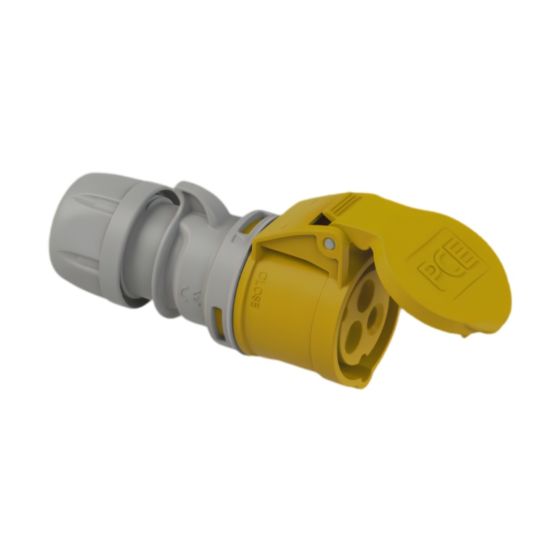
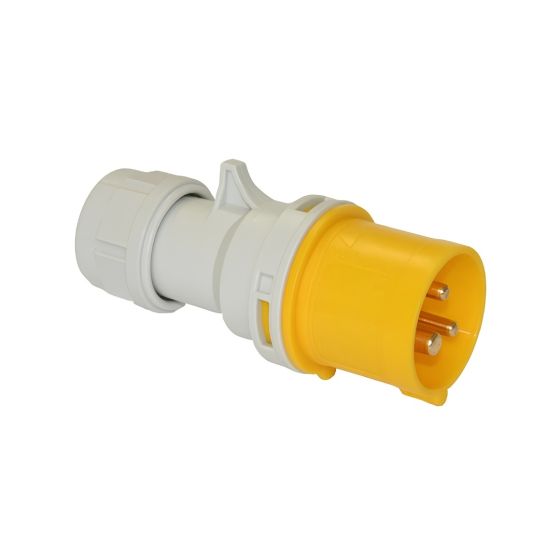
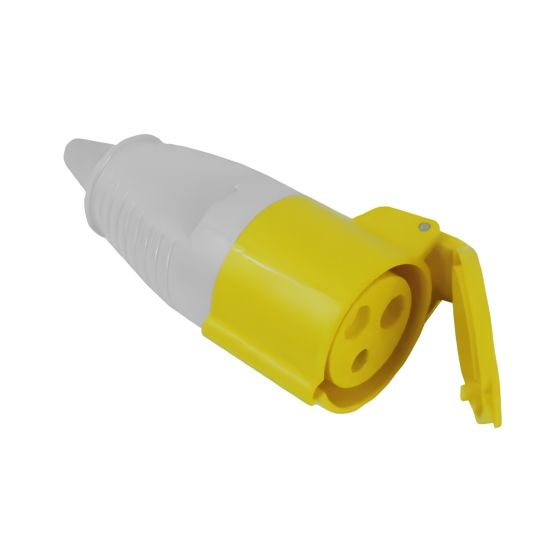
IEC 60309 is the international standard for industrial plugs and sockets. Every 110V CTE site connector follows this standard. Understanding the connector types helps you maintain, repair, and specify correctly.
The IEC 60309 standard
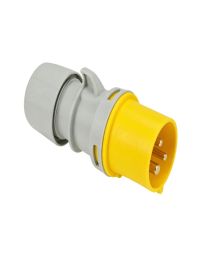
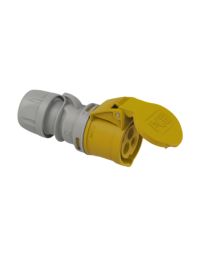
IEC 60309 connectors are identified by colour, pin configuration, and current rating. For 110V CTE on UK construction sites:
- Colour: yellow. Always yellow for 110V CTE.
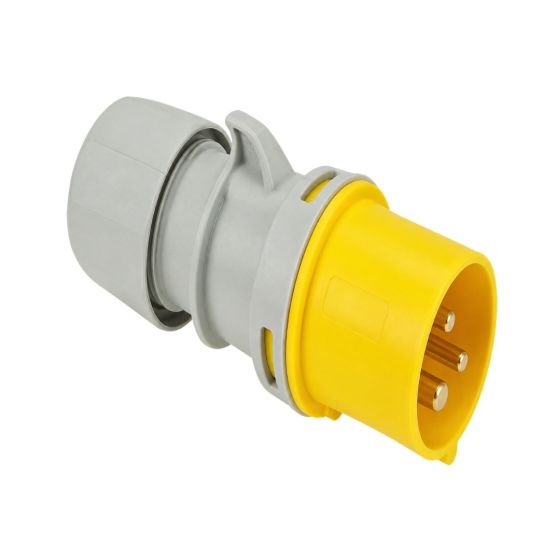
- Pin configuration: 2P+E. Two poles plus earth. Three pins in total.
- Current ratings: 16A or 32A. Physically different sizes. A 16A plug will not fit a 32A socket and vice versa. This is by design.
Plug vs socket: the key distinction
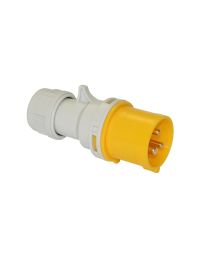
A plug is male. It has solid pins that insert into the socket. The plug is at the supply end of a cable. It goes into the transformer output, cable reel output, or splitter box output.
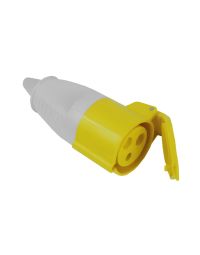
A socket (also called a coupler) is female. It has holes that receive the pins. The socket is at the equipment end of a cable. Tools and extension leads plug into it.
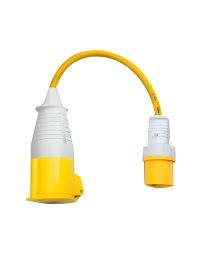
The fly lead: a vital adaptor
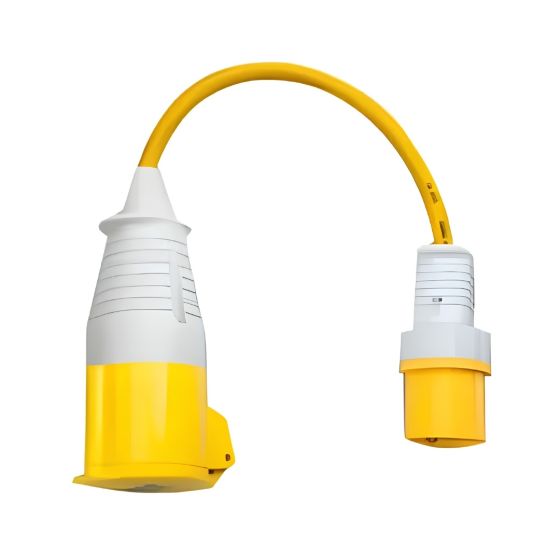
Sometimes the only available transformer output is 32A, but all your extension leads and tools use 16A connectors. The fly lead solves this.
It is a short (0.5m) adaptor cable. One end has a 32A coupler (female) that connects to the 32A transformer output. The other end has a 16A plug (male) that accepts a standard 16A extension lead or tool. Maximum current through the fly lead is 16A, determined by the 16A plug end.
The fly lead is IP67 rated, fully dust-tight and immersion-protected to 1 metre. Suitable for the harshest site conditions including flooded trenches.
16A vs 32A: The Complete Decision Guide
Every component in the 110V CTE chain is rated either 16A or 32A. Getting this right is essential. Here is how to decide.
How to calculate the current a tool draws
Find the wattage on the tool's rating plate. Divide by 110 to get the current in amps.
Example: a 1,100W angle grinder draws 1,100 / 110 = 10A. A 16A circuit is adequate.
Example: a 2,200W concrete vibrator draws 2,200 / 110 = 20A. A 32A circuit is needed.
Common tools and their current ratings
| Tool | Typical Wattage | Current at 110V | Rating Needed |
|---|---|---|---|
| Cordless tool charger | 100-300W | 1-3A | 16A |
| Site lighting (LED) | 100-500W | 1-5A | 16A |
| Drill (hammer) | 750-1,100W | 7-10A | 16A |
| Jigsaw | 650-1,000W | 6-9A | 16A |
| Circular saw (185mm) | 1,200-1,800W | 11-16A | 16A |
| Angle grinder (115mm) | 800-1,100W | 7-10A | 16A |
| Angle grinder (230mm) | 2,000-2,500W | 18-23A | 32A |
| Table saw (site) | 1,800-2,500W | 16-23A | 32A |
| Site compressor (small) | 1,500-2,000W | 14-18A | 32A |
| Concrete vibrator | 1,800-2,500W | 16-23A | 32A |
| Site lighting rig (large) | 2,000-3,500W | 18-32A | 32A |
When multiple tools run at the same time from a splitter box, add all the individual currents together. A splitter with two angle grinders (10A each) and two drills (8A each) draws 36A total, which requires a 32A input at minimum and still exceeds it. Calculate total load before connecting.
The physical incompatibility rule
16A and 32A IEC 60309 connectors are physically different sizes. A 16A plug cannot fit a 32A socket. A 32A plug cannot fit a 16A socket. This is a deliberate safety design. It prevents 32A supply from being accidentally connected to 16A equipment, which would overload the cable and create a fire risk.
Safety Rules Every Operative Must Know
The Electricity at Work Regulations 1989 require that all electrical equipment used at work is suitable for the environment and conditions of use, and that the risk of injury is reduced as far as reasonably practicable. Site managers are responsible for ensuring compliance. Non-compliance is a criminal offence.
The rules
- Never connect 110V site equipment to a 240V supply. The IEC 60309 connectors prevent most accidental connections, but never force or adapt any connection.
- Always unwind cable reels fully before use. This applies even when you only need part of the cable. The remaining cable must be unwound and laid on the floor.
- Never daisy-chain extension leads. Connect each lead directly to a transformer output or splitter box socket. IET Wiring Regulations (BS 7671) prohibit daisy-chaining.
- Match the current rating throughout. Every component from transformer to tool must be rated for the same current (16A or 32A). Do not mix ratings in a single run.
- Only competent persons wire loose connectors. Fitting a plug or socket requires correctly identifying and connecting line, neutral, and earth. Incorrect wiring is a shock hazard. Use a qualified electrician or competent site person.
- Inspect equipment before each use. Check cables for cuts, kinking, and abrasion. Check connectors for cracking and damage. Remove damaged equipment from service immediately.
- Use the correct IP rating for the environment. IP44 is the standard for outdoor site use. IP67 is required for wet trenches and immersion-risk environments.
- Disconnect from the transformer before rewinding cable reels. Never rewind under load.
- Allow thermal cutouts to cool before resetting. Pressing reset while the reel is still warm causes immediate re-trip. Allow 20 to 30 minutes cooling time.
Common Mistakes and How to Avoid Them
Using the reel wound under high load
The single most common cause of cable reel fires on site. Even a few minutes of full-load operation with the cable wound will trigger the thermal cutout. Repeated operation in this way shortens the cutout's life and risks cable insulation failure. Unwind the full cable. Always. Without exception.
Connecting a 16A lead to a 32A transformer output
The connector geometry prevents most mismatches, but using a fly lead or adaptor to bridge a 16A lead to a 32A supply and then running 32A equipment through it will overload the 16A cable. A 16A lead must only carry 16A maximum. Check every component in the chain.
Daisy-chaining extension leads to get more reach
Prohibited under IET Wiring Regulations. It overloads the first lead's socket and creates an unprotected connection point that can arc and overheat. If 14m is not enough, use a 25m or 50m cable reel. If you need multiple tool connections, use a splitter box.
Exceeding the total load on a splitter box
All four sockets on a splitter box share the input rating. Four tools at 500W each total 2,000W, which is about 18A at 110V. That exceeds a 16A splitter box. Calculate the combined load of every connected tool before switching on.
Using IP20-rated 240V cable reels outdoors or in damp conditions
IP20 provides no water protection whatsoever. A 240V cable reel rated IP20 must stay in dry indoor conditions only. Using it in a garage with condensation, a covered outdoor area, or near groundwater creates an immediate electrical safety risk. Check the IP rating of every reel before deploying it.
Step-by-Step Setup Guide
Here is how to set up a complete 110V CTE power distribution system on a standard construction site.
Survey the site and plan the layout
Identify all work positions that need 110V power. Measure the furthest distance from the nearest available 240V mains socket. This determines whether you need a 25m or 50m cable reel. Count how many tools need to run simultaneously. This determines whether you need a splitter box and which variant.
Position and connect the transformer
Place the site transformer close to the 240V mains source. Connect the 240V input plug to the mains socket. Check the transformer output socket rating (16A or 32A) before connecting anything downstream. The transformer sets the maximum current for everything that follows.
Lay out and connect the cable reel
Choose the reel. Place it near the transformer. Unwind the full cable length across the floor before connecting anything. Connect the reel input plug to the transformer output socket and lock the collar. Check the neon indicator confirms the reel is live.
Connect the splitter box (if needed)
If multiple work positions need simultaneous power, connect the splitter box input plug to the cable reel output socket. Match the splitter variant (16A or 32A) to the supply rating. Place the splitter box centrally in the work area using its A-frame legs. Do not drag it by the cable.
Run extension leads to each work position
Connect one 110V extension lead per work position to the splitter box output sockets. Each lead runs to the specific tool or work area. Keep cables routed along walls and clear of walkways where possible. Use cable ramps where leads must cross pedestrian or vehicle routes.
Calculate total load before switching on
Add the wattage of every tool that will run simultaneously. Divide the total by 110 to get the total current. Confirm this is within the input rating (16A or 32A). If the total exceeds the rating, remove a tool from the circuit or upgrade to a higher-rated supply.
Connect tools and begin work
Connect tools to the extension lead sockets. Switch on the transformer. Operatives can now use their tools safely from the 110V CTE supply. Check periodically that no additional tools have been added that push the combined load above the supply rating.
Frequently Asked Questions
UK construction sites use 110V CTE (centre-tapped earth) because it significantly reduces the risk of a fatal electric shock. The transformer centre-taps the secondary winding to earth, meaning neither conductor is more than 55V above earth. A shock from 55V is far less likely to cause cardiac arrest than one from 240V. HSE recommends 110V CTE for most portable tools on UK construction sites.
CTE stands for Centre Tapped Earth. A site transformer takes the 240V mains and outputs 110V AC with the neutral point of the secondary winding connected to earth. Neither conductor is more than 55V above earth potential. This is the safety basis of the whole system.
16A and 32A refer to the current rating of the connector and supply circuit. Most portable site tools (drills, grinders, jigsaws, circular saws) run on 16A at 110V, giving a maximum of 1,760W per circuit. High-draw equipment needs 32A, giving up to 3,520W. The connectors are physically different sizes to prevent accidental mismatching.
A wound cable cannot dissipate heat generated by current flowing through the conductors. Adjacent turns trap heat between them. Running significant load on a wound reel causes overheating, triggers the thermal cutout, and risks cable insulation damage. Always unwind the full cable from the drum before connecting any tools, even if you only need a short run.
No. Connecting one extension lead into another (daisy-chaining) is prohibited under IET Wiring Regulations (BS 7671). It creates an overloading risk at the first connection point and adds unprotected junctions. Use a cable reel to get the reach you need, and a splitter box if you need multiple connection points.
Yellow is the standard IEC 60309 colour code for 110V CTE site equipment. Blue indicates 240V single phase. Red indicates 415V three phase. The colour coding, combined with physically different connector sizes for each voltage, prevents accidental misconnection between voltage systems on a shared site.
A splitter box takes one transformer output socket and provides four independent output sockets. You need one when multiple tools must run simultaneously from a single transformer output, and using a single extension lead for each tool is not possible without connecting leads into each other (which is prohibited). The splitter connects directly to the cable reel or transformer output, keeping the installation compliant.
A fly lead is a short adaptor cable that bridges two different connector types. The most common site use is a 32A to 16A fly lead: it allows 16A extension leads and tools to be connected to a 32A transformer output when no 16A output socket is available. The fly lead is rated to 16A regardless of the 32A supply capacity.
Find the wattage on the tool's rating plate. Divide by 110 to get the current in amps. A 1,100W drill draws 10A, so a 16A circuit is fine. A 2,200W concrete vibrator draws 20A, so you need 32A. When running multiple tools simultaneously, add all individual currents together and compare the total against the supply rating.
Yes, provided the equipment carries an appropriate IP rating. CMT 110V cable reels and extension leads are IP44 rated, which protects against water splashes from any direction and makes them suitable for outdoor construction sites. The fly lead is IP67 rated for use in wet trenches. Do not use equipment rated below IP44 in outdoor or damp conditions.
Shop the Full 110V CTE Range at CMT Group
Everything you need for safe 110V CTE power distribution on UK construction sites. Next-day delivery on all stocked lines.