Most contractors own a manual resin applicator gun. Most have also squeezed one to exhaustion halfway through a large anchoring programme. This guide covers the practical differences between battery and manual resin guns: output consistency, operator fatigue, dosatron dosing, and a decision table for UK construction professionals.
Hybrid chemical anchor resin engineered for structural fixings into both concrete and masonry, covering solid, hollow and load-bearing substrates.
- Styrene-free hybrid formulation
- ETA approved for concrete and masonry
- Cracked and non-cracked concrete rated
- Solid and hollow masonry approved
- Fast setting and curing
- Suitable for wet and flooded holes
- Buy 12 for £7.75 £6.46 each and save 7%
- Buy 24 for £7.36 £6.13 each and save 12%
| BULK DISCOUNT | 12 | 24 |
|---|---|---|
| Price | £6.46 £7.75 | £6.13 £7.36 |
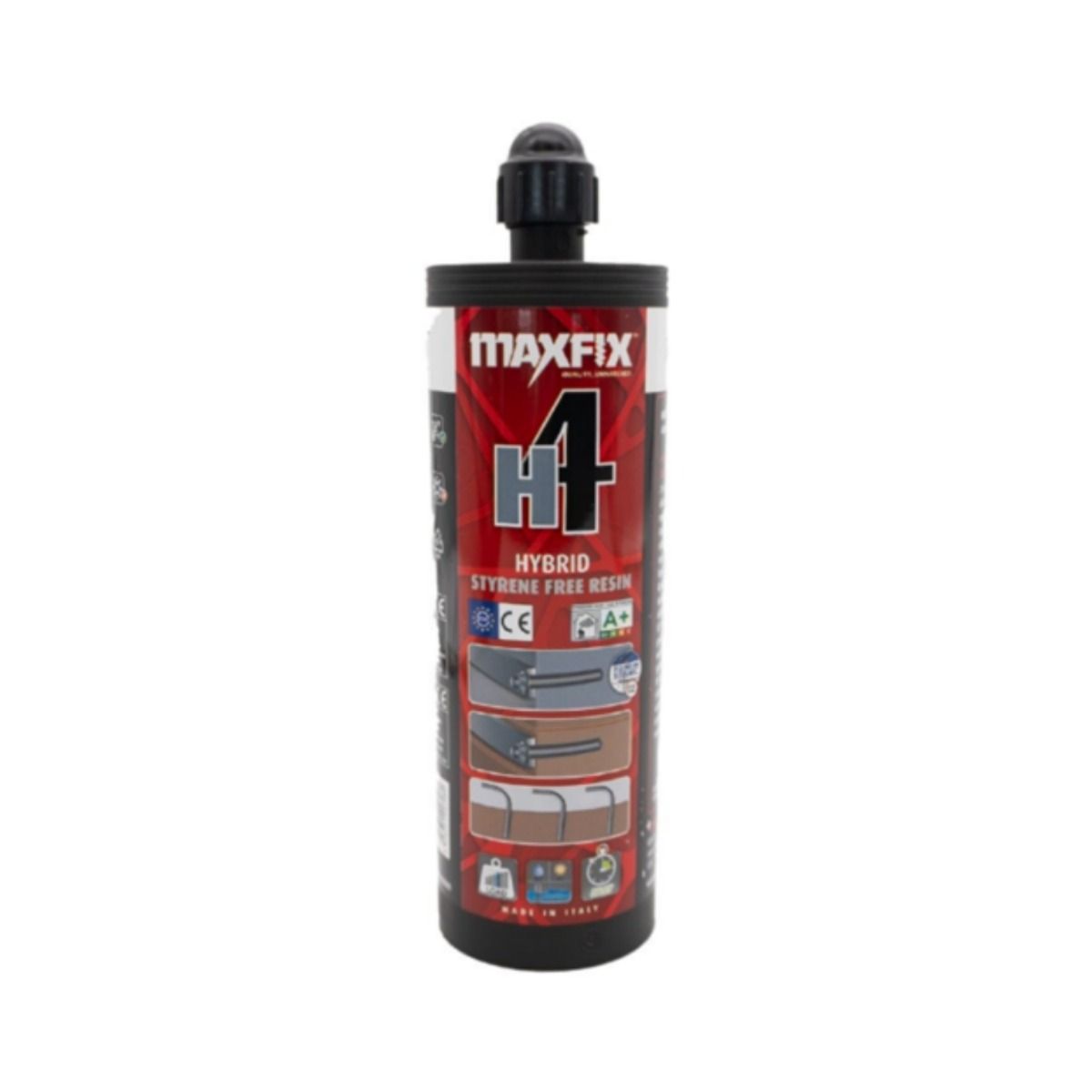
MAXFIX H4 Hybrid Chemical Anchor Resin 400ml Styrene-Free
Hybrid chemical anchor resin built to move between concrete and masonry on the same job, without switching products. The styrene-free formulation sets and cures quickly, with dedicated ETA approval for both cracked and non-cracked concrete and a separate approval for solid and hollow masonry. It suits load-bearing walls, plaster repair and general concrete fixing where flexibility across substrates matters more than maximum load capacity.
How dual ETA approval saves switching resins between concrete and masonry
Most styrene-free hybrid resins are approved for one substrate type, concrete or masonry, but not both, so a job moving between materials means stocking two different products. Carrying two resins for one job adds cost, storage space and the risk of grabbing the wrong cartridge partway through a fixing run. This resin holds ETA-25/0084 for cracked and non-cracked concrete and ETA-25/0079 for solid and hollow masonry, so one cartridge covers both without a substrate-specific swap.
Key Features
-
Dual substrate approval: Covers concrete under ETA-25/0084 and masonry under ETA-25/0079 from a single cartridge
-
Fast setting: Working and curing times are shorter than typical structural resins, cutting time per fixing on repeat installation runs
-
Thixotropic consistency: Stays in place on vertical and overhead fixings without sagging
-
Flexible anchorage depth: Up to 20 times the rod diameter, adjustable to the specific load and substrate
-
Wide service temperature range: Rated from -40°C to +50°C once cured
-
Versatile repair use: Suitable for load-bearing wall reinforcement, plaster repair and general refilling work
Who is this for
Trades and roles:
-
Groundworkers and steel fixers
-
General builders and renovators
-
Masonry and brickwork contractors
Industries:
-
Structural construction
-
Masonry and restoration
-
Civil engineering
Specifications
| Specification | Detail |
| Product Name | MAXFIX H4 Hybrid Chemical Anchor Resin 400ml - Styrene-Free |
| SKU / Product Code | FI100001 |
| Product Type | Hybrid Chemical Anchor Resin |
| Cartridge Volume | 400ml |
| Resin Type | Bi-component, styrene-free hybrid |
| Concrete ETA Approval | ETA-25/0084, Option 1 (Cracked) and Option 7 (Non-Cracked) |
| Masonry ETA Approval | ETA-25/0079, solid and hollow masonry |
| CE Marking | CE marked |
| Seismic Qualification | C1 (M12 to M16), C2 (M12 only) |
| Threaded Rod Range | M8 to M24 (concrete); M8 to M16 (masonry) |
| Rebar Range | Ø8mm to Ø16mm |
| Anchorage Depth | Flexible, up to 20 times rod diameter |
| Hole Conditions | Dry, wet, flooded (threaded bars only) |
| Certified Service Temperature | -40°C to +40°C (long-term max 24°C); -40°C to +50°C (long-term max 40°C) |
| Installation Temperature Range | Base material -5°C to +40°C; cartridge minimum +5°C |
| Consistency | Thixotropic |
| VOC Emissions | Class A+, LEED compliant |
Compatibility
| Application or condition | Status |
| Cracked concrete (ETA-25/0084) | ✓ Compatible |
| Non-cracked concrete (ETA-25/0084) | ✓ Compatible |
| Solid masonry (ETA-25/0079) | ✓ Compatible |
| Hollow masonry / hollow brick (ETA-25/0079) | ✓ Compatible |
| Natural stone | ✓ Compatible |
| Cellular aerated concrete (AAC) | ✓ Compatible |
| Dry, wet and flooded holes (threaded bars) | ✓ Compatible |
| Rebar above Ø16mm | ✗ Not recommended |
| Threaded rod above M24 | ✗ Not recommended |
| Cartridge temperatures below +5°C | ✗ Not recommended |
Typical Users and Projects
General builders and renovation contractors working across mixed concrete and masonry structures, where a single resin needs to cover both substrate types on one job. Masonry and brickwork specialists use it for load-bearing wall reinforcement, lintel replacement and structural repair on solid or hollow brick and block. Groundworkers and steel fixers use it for general concrete fixings where fast setting speeds up a repeat installation run.
Typical applications
-
Reinforcing load-bearing walls in solid or hollow masonry
-
Fixing threaded rod into concrete for general structural work
-
Plaster repair and refilling on existing masonry structures
-
Installing handrails, brackets and fixtures across mixed substrates
-
Rebar dowelling into concrete up to Ø16mm diameter
-
Fixing in damp, wet or flooded holes with threaded bars
How to use
Step 1: Drill the hole to the correct diameter and depth for the substrate and rod size.
Step 2: Clean the hole using a brush and blow-out pump, repeating three to four times until clear.
Step 3: Attach the mixer nozzle and extrude to waste until an even colour is achieved.
Step 4: Fill the hole from the bottom, to one third or one half full.
Step 5: Insert the rod or rebar by hand with a twisting motion.
Step 6: Allow the resin to cure per the setting times table for the base material temperature.
Step 7: Attach the fixture and tighten to the recommended installation torque.
Common mistakes
-
Using masonry-rated diameters in concrete or vice versa: the two ETA approvals have different diameter limits, so a fixing approved in one substrate isn't automatically approved in the other
-
Applying below +5°C cartridge temperature: cure performance isn't guaranteed below this threshold
-
Rushing the hole cleaning step: even with a fast-setting resin, skipping the brush and blow-out sequence reduces bond strength
-
Ignoring the sleeve size requirement in hollow masonry: hollow substrates need the correct sleeve size, not just the right drill bit
Safety
Wear hand and eye protection when handling the two-part resin. Confirm which ETA approval and diameter limit applies before use, concrete and masonry ratings are not interchangeable. Avoid application below the minimum +5°C cartridge temperature.
Maintenance
No maintenance once cured. Store cartridges upright between 15°C and 25°C, away from heat and direct sunlight, and use within the 16 month shelf life.
Frequently Asked Questions
Q: Can this resin be used on both concrete and masonry?
A: Yes. It holds ETA-25/0084 for cracked and non-cracked concrete and a separate ETA-25/0079 for solid and hollow masonry, so the same cartridge covers both substrate types. Threaded rod approval extends to M24 in concrete but only to M16 in masonry, so always check the substrate-specific diameter limit before specifying. Rebar approval is limited to Ø8mm to Ø16mm across both substrates.
Q: What's the difference between the concrete and masonry ETA approvals?
A: ETA-25/0084 covers concrete performance, split into Option 1 for cracked concrete and Option 7 for non-cracked concrete, with threaded rod from M8 to M24 and rebar from Ø8mm to Ø16mm. ETA-25/0079 is a separate assessment specifically for solid and hollow masonry, limited to threaded rod from M8 to M16 with defined sleeve sizes for hollow substrates. The two approvals carry different diameter limits and load data, so a fixing specified for masonry can't simply be assumed to carry the same rating in concrete, or vice versa.
Q: What is this resin NOT suitable for?
A: This resin isn't approved for threaded rod above M24 or rebar above Ø16mm under either ETA. Masonry use is limited to M16 threaded rod maximum, even though the concrete approval extends to M24. It shouldn't be applied when cartridge temperature is below +5°C, and it's not intended for non-masonry substrates such as timber or plastic.
Q: Why choose this hybrid resin over a dedicated vinylester or epoxy system?
A: This resin's main advantage is substrate flexibility, one cartridge is approved for concrete and masonry, where many vinylester and epoxy systems are certified for concrete only. It sets and cures faster than typical structural resins, useful on jobs with a high number of repeat fixings. Where a job needs maximum load capacity, larger diameters or full seismic C1 and C2 coverage across the range, a dedicated vinylester system carries higher ratings.
Q: Which rod and rebar sizes does this resin support?
A: Threaded rod is supported from M8 to M24 in concrete, but only up to M16 when used in solid or hollow masonry. Rebar is supported from Ø8mm to Ø16mm across both substrates. Always confirm hole diameter and embedment depth against the setting parameters table for the specific rod or rebar size and substrate combination being used.
Q: How long can cartridges be stored before use?
A: Cartridges have a shelf life of 16 months when stored correctly. Keep them upright in a cool, dry location between 15°C and 25°C, away from direct sunlight and heat, and ensure the cartridge stays sealed between uses. Avoid freezing temperatures, which can affect the resin's chemical properties.