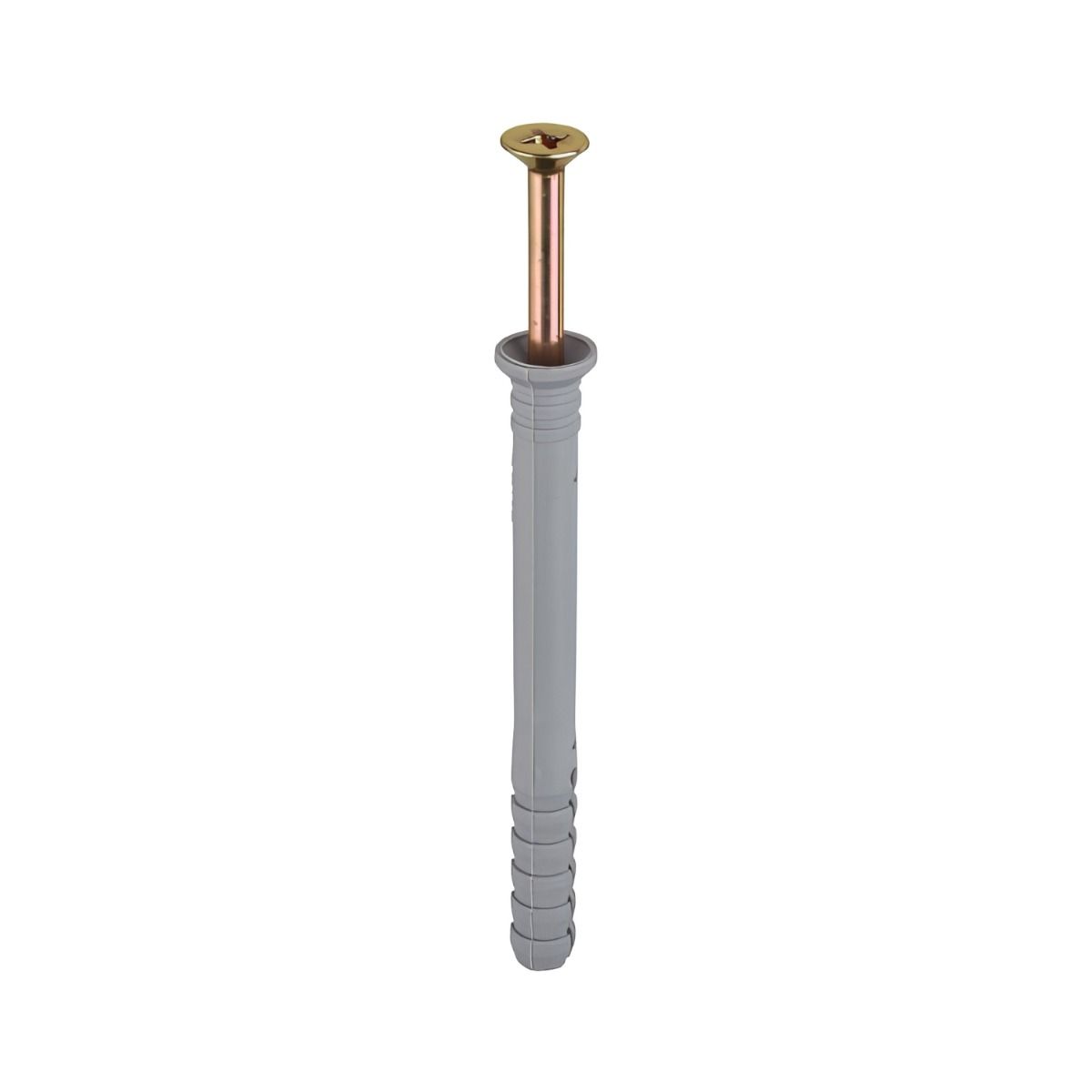

Zinc yellow plated nylon hammer fixings with a countersunk head, for fast through fixing of battens, trims, frame ties and conduit clips into masonry.
- Countersunk head for a flush finish
- Ribbed PA6 nylon plug
- Hammer-in through fixing
- Zinc plated and yellow passivated drive screw
- Available in multiple sizes (The first number is the plug diameter, which is also the drill size. The second number is the plug length.)
Sizes marked (TO ORDER) may not be available from stock for same-day or next-day delivery. Please contact our team to confirm delivery dates.
Zinc Yellow Plated Nylon Hammer Fixing - Countersunk Head
Zinc yellow plated nylon hammer fixings with a countersunk head, for fast through fixing of battens, trims, frame ties and conduit clips into masonry.
- Countersunk head for a flush finish
- Ribbed PA6 nylon plug
- Hammer-in through fixing
- Zinc plated and yellow passivated drive screw
- Available in multiple sizes (The first number is the plug diameter, which is also the drill size. The second number is the plug length.)
Sizes marked (TO ORDER) may not be available from stock for same-day or next-day delivery. Please contact our team to confirm delivery dates.
Zinc Yellow Plated Nylon Hammer Fixing
Nylon hammer fixings combine a ribbed PA6 nylon plug with a zinc yellow plated drive screw, set with a hammer instead of a screwdriver. Carpenters, drylining contractors and electricians use them for light, repetitive fixings into concrete and masonry. The countersunk head finishes flush, so battens and trims sit flat.
How Hammer-In Fixing Speeds Up Repetitive Battening
A standard plug and screw needs marking out, drilling, plugging and then screwing at every point. Across hundreds of batten and trim fixings, that turns into hours of extra work and holes that drift out of line. Hammer fixings go straight through the fixture into the drilled hole and are driven home with a hammer, so each point takes a few seconds.
Key Features
-
Countersunk head: sits flush with the fixture surface, so boards, linings and trims fit flat over battens.
-
Hammer-in drive screw: sets the fixing in one action with a hammer, with no screwdriver step.
-
Through fixing: drilled through the fixture in its final position, so the hole and fixing always line up.
-
Ribbed PA6 nylon plug: the ribs grip the hole wall and stop the plug turning as the screw is driven.
-
Zinc yellow plated screw: zinc plating with yellow passivation protects the steel screw in internal conditions.
-
Pozi 2 recess: a standard Pozi 2 recess in the countersunk head.
Who is this for
Trades and roles
-
Carpenters and joiners
-
Drylining contractors
-
Electricians
-
Suspended ceiling installers
-
Shopfitters
-
Maintenance teams
Industries
-
Construction
-
Housebuilding
-
Commercial fit-out
-
Building services
-
Facilities management
Specifications
| Specification | Detail |
| Product name | Zinc Yellow Plated Nylon Hammer Fixings - Countersunk Head |
| Product code | NHS |
| Product type | Nylon hammer-in fixing (plug and drive screw) |
| Plug material | PA6 nylon, ribbed |
| Screw | Steel drive screw, zinc plated and yellow passivated (ZYP) |
| Head | Countersunk collar, Pozi 2 recess |
| Installation | Through fixing, hammer-in |
| Drill hole diameter | Same as plug diameter, 6mm or 8mm |
| Brand | JCP |
| Plug diameters | 6mm, 8mm |
| Plug lengths | 40mm to 140mm |
Size Selection
| Product code | Size | Max fixture thickness | Min hole depth | Rec. tensile load, 30 N/mm2 concrete | Rec. tensile load, solid brickwork | Rec. tensile load, concrete block |
|---|---|---|---|---|---|---|
| NHS06040 | 6mm x 40mm | 10mm | 35mm | 0.18 kN | 0.14 kN | 0.12 kN |
| NHS06060 | 6mm x 60mm | 30mm | 35mm | 0.18 kN | 0.14 kN | 0.12 kN |
| NHS06070 | 6mm x 70mm | 40mm | 35mm | 0.18 kN | 0.14 kN | 0.12 kN |
| NHS08080 | 8mm x 80mm | 40mm | 45mm | 0.22 kN | 0.18 kN | 0.14 kN |
| NHS08100 | 8mm x 100mm | 60mm | 45mm | 0.22 kN | 0.18 kN | 0.14 kN |
| NHS08120 | 8mm x 120mm | 80mm | 45mm | 0.22 kN | 0.18 kN | 0.14 kN |
| NHS08140 | 8mm x 140mm | 100mm | 45mm | 0.22 kN | 0.18 kN | 0.14 kN |
Compatibility
| Base material, use or condition | Suitability |
|---|---|
| Reinforced concrete | Suitable |
| Solid brickwork | Suitable, loads are guidance only |
| Dense concrete block | Suitable, loads are guidance only |
| Natural stone | Suitable |
| Aerated concrete block | Suitable with restrictions, load limited by block strength |
| Hollow brick and block | Suitable with restrictions, limited by wall thickness |
| Plasterboard | Not recommended, not a listed base material |
| Loads above the recommended values | Not recommended, use a metal anchor |
| Fixings that must perform in a fire | Not recommended, use a steel fixing |
Typical Users and Projects
Fit-out, drylining and electrical trades use nylon hammer fixings on housing, refurbishment and commercial interiors. Most fixings go into block, brick and concrete walls, with long runs of battens, trims and clips fixed in a single visit. Installers choose them where speed matters and loads are light.
Typical applications
-
Fixing timber battens to block and brick walls before dry lining or cladding.
-
Securing frame ties for door and window frames into masonry reveals.
-
Fixing electrical back boxes and conduit clips to concrete and masonry walls.
-
Fixing suspended ceiling perimeter trim and wall angle to masonry walls.
-
Fixing skirting grounds and timber grounds before second fix joinery.
How to use
Step 1: Choose the size by fixture thickness, using the max fixture thickness in the Size Selection table.
Step 2: Drill through the fixture into the base material with a drill the same diameter as the plug, 35mm deep for 6mm fixings and 45mm deep for 8mm fixings.
Step 3: Clean the hole by brushing and blowing out the dust.
Step 4: Push the fixing through the fixture into the hole until the collar sits on the fixture.
Step 5: Hammer the screw into the plug until the head sits flush.
Common mistakes
-
Drilling with a bit larger than the plug diameter, so the plug cannot grip.
-
Drilling shallower than the minimum hole depth, leaving the screw proud.
-
Choosing a length too short for the fixture, so too little plug sits in the wall.
-
Using nylon hammer fixings for heavy, overhead or fire-critical fixings.
Safety
Wear eye protection when drilling and hammering. Drilling concrete and masonry releases respirable crystalline silica dust, so use on-tool extraction and suitable RPE in line with HSE guidance. Recommended loads are light, from 0.12 kN to 0.22 kN, and brick and block figures are guidance only. Do not use a nylon fixing as the only support where fire performance is required.
Maintenance
Store fixings dry in their pack until use. Inspect battens and trims during maintenance and refix any that have worked loose.
Frequently Asked Questions
Q: Which size of nylon hammer fixing do I need?
A: Pick the size by the thickness of the item being fixed. The 6mm range takes fixtures up to 10mm, 30mm or 40mm thick, and the 8mm range up to 40mm, 60mm, 80mm or 100mm. Choose 8mm fixings for thicker battens and slightly higher loads.
Q: What does 6mm x 40mm mean on a hammer fixing?
A: The 6mm is the plug diameter, which is also the drill bit size you need. The 40mm is the length of the plug. A set depth of plug must sit in the wall, 35mm for 6mm fixings and 45mm for 8mm, so the rest of the length is the thickest item it can fix.
Q: What are nylon hammer fixings not suitable for?
A: They are not suitable for heavy loads, overhead hanging loads or fixings that must hold in a fire. Use a metal anchor or steel nail in anchor for those jobs. They are also not designed for plasterboard.
Q: Why use hammer fixings instead of a plug and screw?
A: Hammer fixings go through the fixture and are driven with a hammer, which is much faster across long runs of battens and trims. There is no separate plugging and screwing step, and the hole always lines up with the fixture. The countersunk head also finishes flush for boarding over.
Q: Which base materials can I fix into?
A: They suit reinforced concrete, solid brickwork, dense concrete block and natural stone. They can also be used in aerated block and hollow brick or block, but the load is limited by the block strength and wall thickness.
Q: What load can a nylon hammer fixing hold?
A: In 30 N/mm2 concrete, the recommended tensile load is 0.18 kN for 6mm fixings and 0.22 kN for 8mm fixings, roughly 18kg and 22kg. In solid brickwork and concrete block the loads are lower, and these figures are guidance only. They are designed for light fixings such as battens, trims and clips.
Q: Can I use them to fix cables or ceiling trims?
A: They suit conduit clips, electrical boxes and suspended ceiling perimeter trim on walls. Where cables or ceilings must stay supported in a fire, use a steel fixing instead, as nylon can soften in high heat.
Q: Can nylon hammer fixings be used outdoors?
A: The zinc yellow plated screw is best suited to internal and dry conditions. In wet or exposed locations the screw can corrode, so check conditions before fixing.