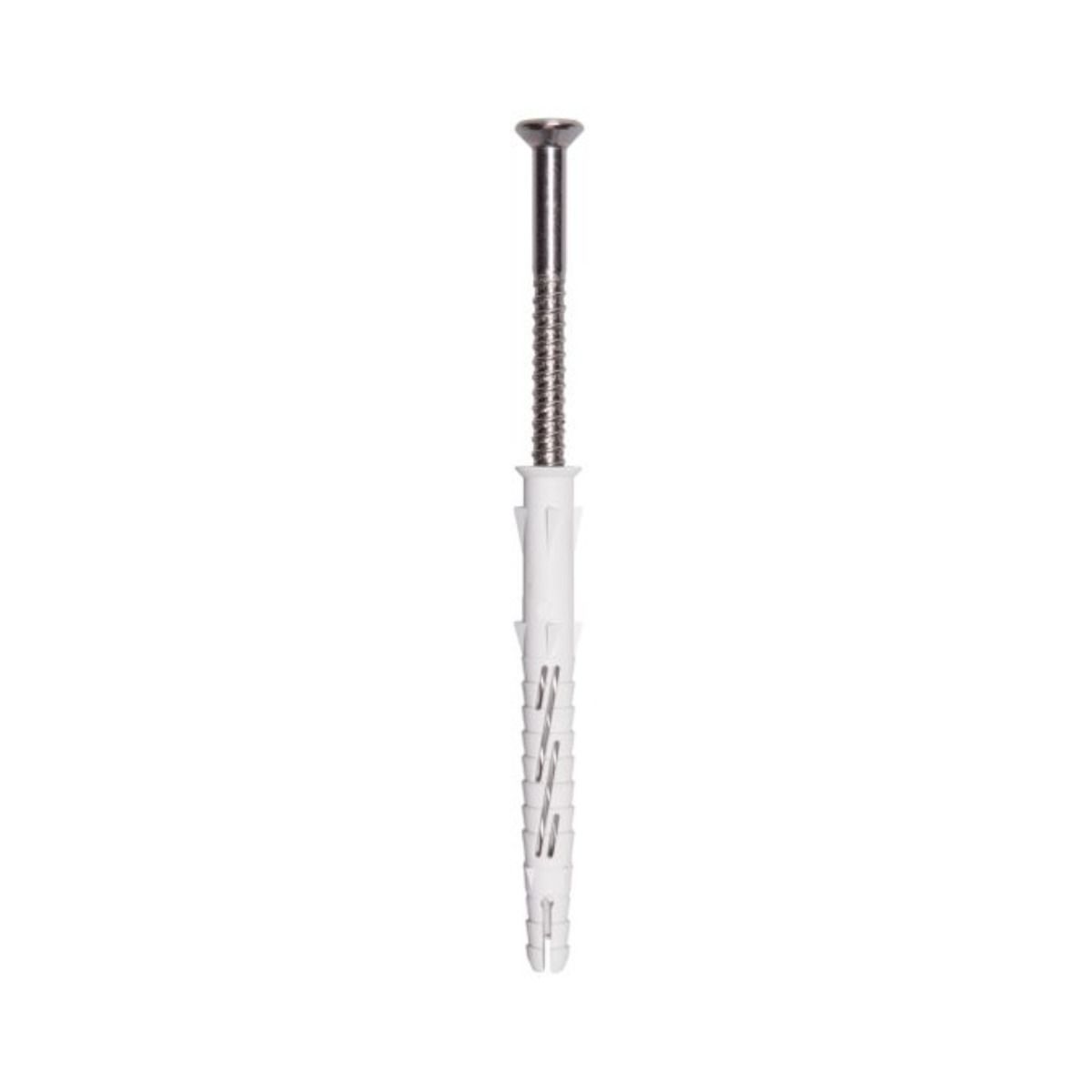
A4 stainless steel ETA nylon frame fixings for fixing window frames, door frames and battens to concrete and masonry on exposed and coastal sites.
- ETA to ETAG 020-01, CE marked
- A4-316 stainless steel screw
- Countersunk head, Torx T30 drive
- Concrete, solid and hollow masonry
- Fixtures up to 70mm thick
- Supplied in a pack of 50
- 8mm x 140mm (The first number is the fixing diameter, which is also the drill size. The second number is the total length of the fixing.)
A4 Stainless Steel ETA Nylon Frame Fixing - Countersunk Head 8mm x 140mm
A4 stainless steel ETA nylon frame fixings for fixing window frames, door frames and battens to concrete and masonry on exposed and coastal sites.
- ETA to ETAG 020-01, CE marked
- A4-316 stainless steel screw
- Countersunk head, Torx T30 drive
- Concrete, solid and hollow masonry
- Fixtures up to 70mm thick
- Supplied in a pack of 50
- 8mm x 140mm (The first number is the fixing diameter, which is also the drill size. The second number is the total length of the fixing.)
Order 1x to earn 129 FASTPoints
Order to earn 129 FASTPoints
Log in to access trade discounts8mm x 140mm A4 Stainless Steel ETA Nylon Frame Fixings - Countersunk Head
A4 stainless steel ETA nylon frame fixings pair a PA6 nylon sleeve with a pre-assembled A4-316 stainless steel countersunk screw. Window installers, cladding contractors and carpenters use them to fix frames and battens through to concrete and masonry. The ETA approval gives specifiers documented performance for non-structural fixings.
How an ETA Approved Stainless Fixing Holds Up to Specification and Exposure
Frame fixings without an ETA have no assessed performance data, and plated screws rust once they are exposed. On site, that can mean a fixing rejected at sign-off, or rust staining and loosening on external frames within a few years. This fixing combines an ETA to ETAG 020-01 with an A4-316 stainless screw, so it meets the specification and resists corrosion outdoors and on the coast.
Key Features
-
ETA to ETAG 020-01: assessed for multiple use in non-structural applications, with documented performance for specifiers and building control.
-
A4-316 stainless steel screw: the molybdenum content resists corrosion in coastal, marine and exposed locations where A2 can mark.
-
Fixes up to 70mm thick: the 140mm length takes timber frames, packed frames and thick battens in one fixing.
-
Solid and hollow masonry: one fixing covers concrete, brick and block, including hollow and perforated units.
-
Countersunk head: sits flush in the fixture, so frames and battens take beads, trims and boards without obstruction.
-
Torx T30 drive: holds the bit firmly as the screw is driven home, cutting cam-out on long screws.
Who is this for
Trades and roles
-
Window and door installers
-
Cladding and rainscreen installers
-
Carpenters and joiners
-
Curtain wall and facade contractors
-
Specifiers and site engineers
Industries
-
Construction
-
Housebuilding
-
Facade and envelope contracting
-
Marine and coastal construction
-
Refurbishment
Specifications
| Specification | Detail |
| Product name | A4 Stainless Steel ETA Nylon Frame Fixings - Countersunk Head 8mm x 140mm |
| Product code | NFF08140ETASS |
| Product type | Nylon frame fixing with pre-assembled screw |
| Approval | European Technical Assessment (ETA) to ETAG 020-01, CE marked |
| Approved use | Plastic anchor for multiple use in non-structural applications |
| Screw | A4-316 stainless steel |
| Head | Countersunk |
| Drive | Torx T30 |
| Sleeve material | PA6 nylon |
| Installation | Through fixing |
| Base materials | Concrete, solid masonry, hollow masonry |
| Size | 8mm x 140mm |
| Drill hole diameter | 8mm |
| Min hole depth | 90mm |
| Max fixture thickness | 70mm |
Compatibility
| Base material, use or condition | Suitability | |
|---|---|---|
| Concrete | Suitable | |
| Solid brick and dense block | Suitable | |
| Hollow and perforated brick or block | Suitable, drill without hammer action | |
| External and exposed fixings | Suitable, A4-316 stainless steel screw | |
| Coastal and marine environments | Suitable, A4-316 stainless steel screw | |
| Aerated concrete block | Not recommended, not a confirmed base material for this fixing | |
| Plasterboard and timber stud walls | Not recommended, use a cavity fixing | |
| Structural or single-point fixings | Not recommended, approved for multiple use in non-structural applications only | |
| Fixings that must perform in a fire | Not recommended unless confirmed by the ETA fire data | |
| Fixtures thicker than 70mm | Not recommended, too little embedment left in the base material |
Typical Users and Projects
Envelope, glazing and joinery contractors use these fixings on new build housing, commercial facades and refurbishment work. Many projects are on coastal or exposed sites, where the specification calls for A4 stainless and an approved anchor. The installers are competent fixers working to a fixing schedule or RAMS that names an ETA approved product.
Typical applications
-
Fixing timber and PVCu window and door frames into masonry reveals on coastal housing developments.
-
Fixing timber battens for rainscreen or timber cladding to concrete and block walls.
-
Fixing packed-out frames up to 70mm thick where a shorter frame fixing would leave too little embedment.
-
Fixing timber framing for external signage and screens into brick and hollow block on exposed sites.
-
Fixing counter battens and sub-frames in multiple-fixing layouts on refurbishment projects.
How to use
Step 1: Check the fixture is no thicker than 70mm.
Step 2: Drill an 8mm hole through the fixture into the base material, at least 90mm deep. In hollow brick or block, drill without hammer action.
Step 3: Clean the hole by brushing and blowing out the dust.
Step 4: Push the fixing through the fixture and tap the sleeve in until the head sits on the fixture.
Step 5: Drive the screw with a Torx T30 bit until the countersunk head sits flush. Do not overtighten.
Common mistakes
-
Drilling hollow masonry with hammer action, which breaks the internal webs the sleeve needs to grip.
-
Using the fixing alone for a structural or single-point load, outside its ETA use category.
-
Fixing through more than 70mm of material, leaving too little sleeve in the wall.
-
Choosing A2 stainless on coastal sites, where A4-316 is the safer grade.
Safety
Wear eye protection when drilling. Drilling concrete and masonry releases respirable crystalline silica dust, so use on-tool extraction and suitable RPE in line with HSE guidance. Use within the edge distances, spacings and loads in the ETA, and confirm with the designer where fire performance is required.
Maintenance
Store fixings dry in their pack until use. Inspect external frames and battens during planned maintenance and refix any that have worked loose.
Frequently Asked Questions
Q: How thick an item can an 8mm x 140mm frame fixing hold?
A: It fixes items up to 70mm thick. Drill an 8mm hole through the fixture, at least 90mm deep into the base material. Check the fixing schedule if the frame is packed out, as packers count towards the 70mm.
Q: What does the ETA to ETAG 020-01 approval mean?
A: An ETA is a European Technical Assessment, an independent assessment of how a construction product performs. ETAG 020 is the guideline for plastic anchors used in concrete and masonry. This fixing is assessed for multiple use in non-structural applications. That means it is used in groups, such as along a frame or batten, where the load can transfer to other fixings if one fails. The ETA sets out the approved loads, spacings and base materials for design.
Q: What does 8mm x 140mm mean on a frame fixing?
A: The 8mm is the fixing diameter, which is also the drill bit size you need. The 140mm is the total length. Around 70mm sits in the wall, so the remaining length sets the 70mm maximum fixture thickness.
Q: What is this fixing not suitable for?
A: It is not suitable for structural or single-point fixings, plasterboard or timber stud walls. Aerated concrete block is not a confirmed base material for this fixing. Where fixings must perform in a fire, check the ETA fire data with the designer first.
Q: Why choose A4 stainless over A2 or zinc plated frame fixings?
A: Zinc plated screws suit dry interiors but rust outdoors. A2-304 stainless suits most external work, but can tea-stain or pit near the sea. A4-316 adds molybdenum for better resistance to chlorides, so it suits coastal, marine and exposed sites.
Q: Can I use it in hollow brick and block?
A: Yes, the fixing is approved for hollow masonry as well as concrete and solid masonry. Drill without hammer action, so the internal webs stay intact for the sleeve to grip.
Q: What bit do I need to drive the screw?
A: The screw has a Torx T30 drive. A T30 bit in an impact driver or drill driver sets it quickly without cam-out.
Q: Do stainless frame fixings need any maintenance?
A: The A4 stainless screw needs no routine maintenance. Check external frames and battens during planned inspections and refix any that have worked loose.