The complete UK buyer's guide to road traffic cones for construction sites, highway works, and traffic management. Covers Chapter 8 height requirements, BSI Kitemark certification, one-piece versus two-piece construction, colour-coded site conventions, specialist hazard cones, and no waiting parking cones. Includes the full CMT Group cone range with next-day delivery across the UK mainland.
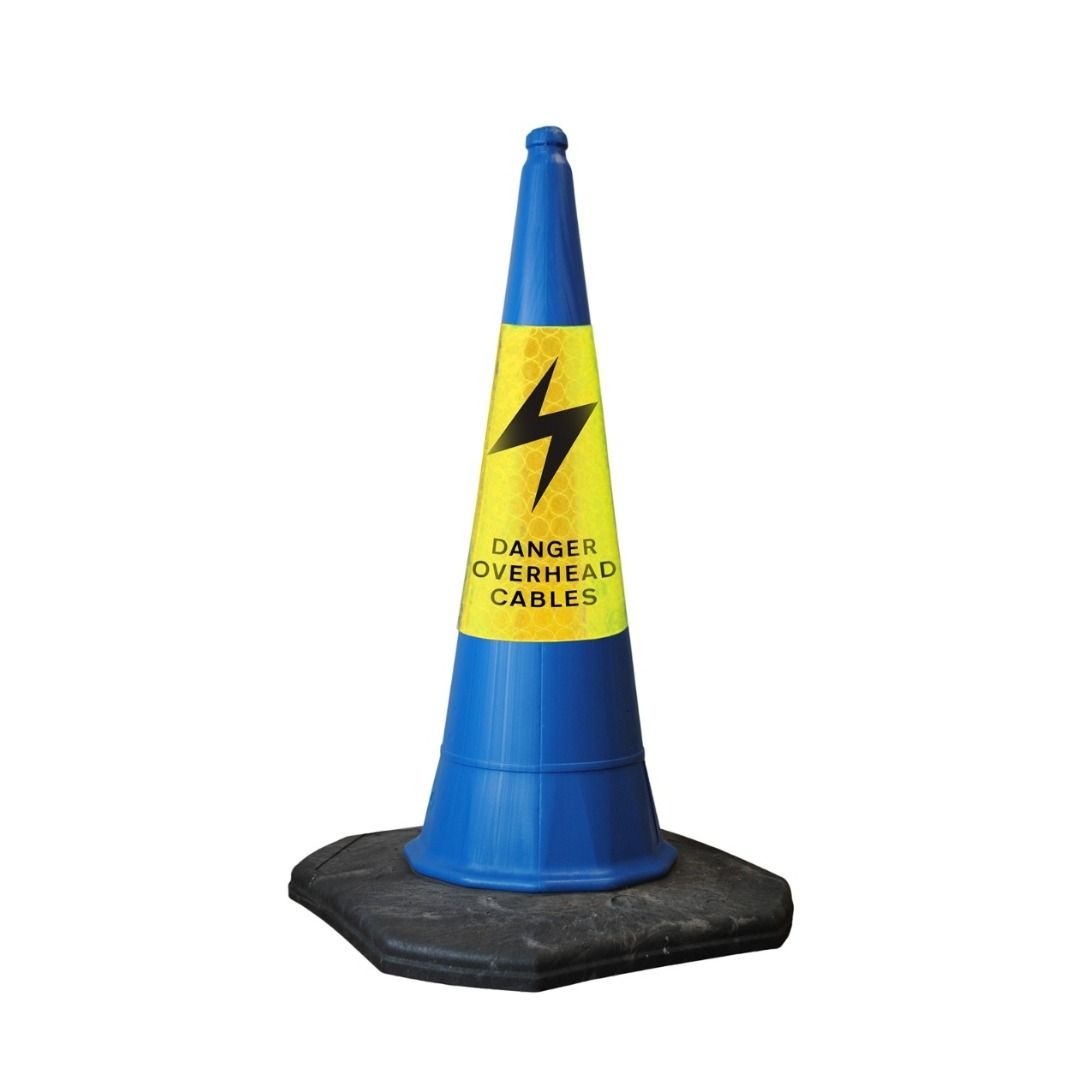
A Melba Swintex 750mm two-piece blue road traffic cone with a yellow Danger Overhead Cables warning sleeve for deployment near overhead power lines, electrical cables, and overhead structures on UK construction sites, utility works, and highway schemes.
- Yellow Danger Overhead Cables sleeve with lightning bolt symbol fitted as standard
- Blue cone body signals utility and infrastructure works area
- Pocketed prismatic sleeve delivers superior daytime and night-time visibility
- BSI Kitemarked to BS EN 13422
- 750mm Chapter 8 compliant height for single carriageway roads up to 50mph and dual carriageways up to 40mph
- Two-piece construction allows independent replacement of damaged centre or base
- 100% recycled thermoplastic PVC anti-slip base
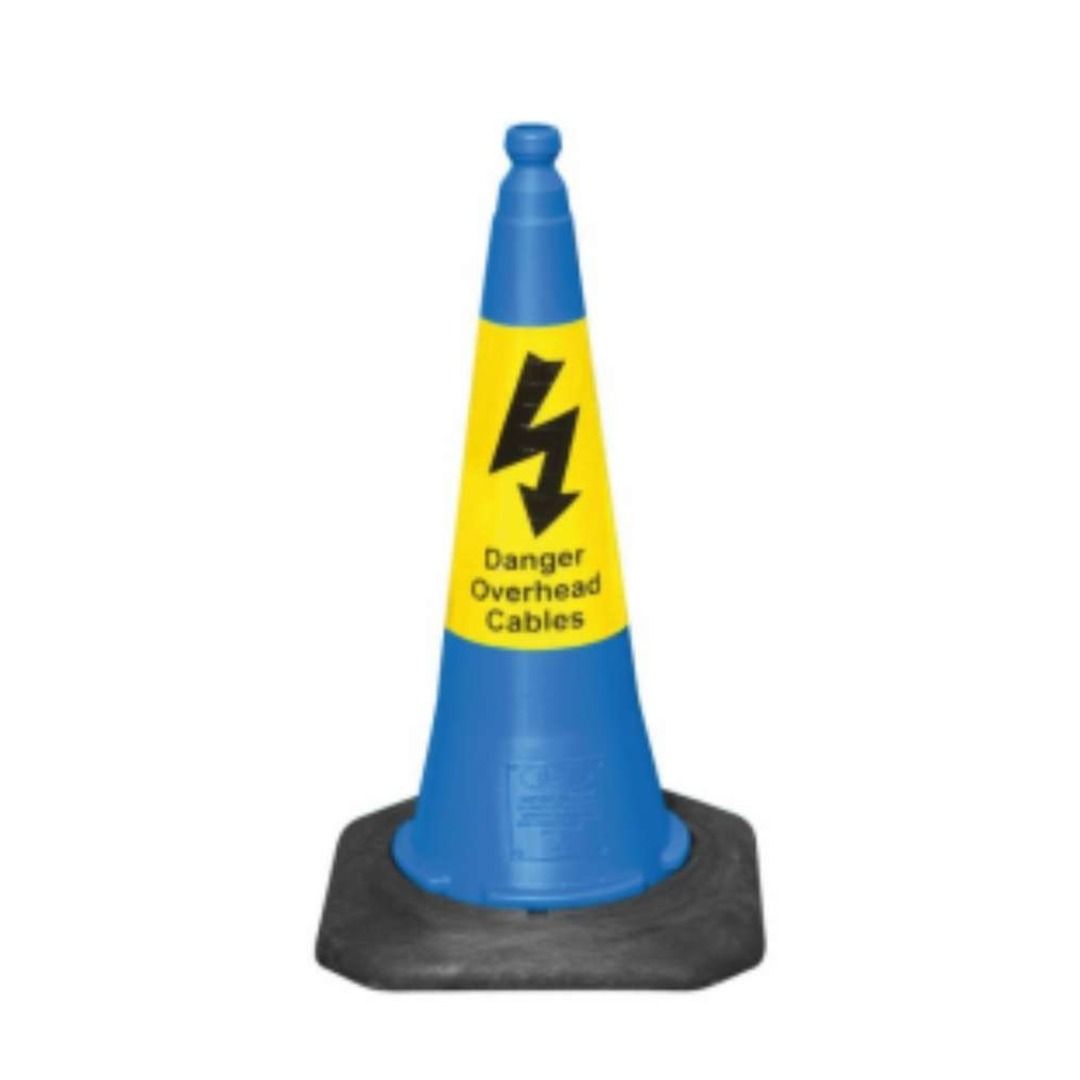
A Melba Swintex 750mm two-piece blue road traffic cone with a yellow Danger Overhead Cables warning sleeve for deployment near overhead power lines, electrical cables, and overhead structures on UK construction sites, utility works, and highway schemes.
- Yellow Danger Overhead Cables sleeve with lightning bolt symbol fitted as standard
- Blue cone body signals utility and infrastructure works area
- Pocketed prismatic sleeve delivers superior daytime and night-time visibility
- BSI Kitemarked to BS EN 13422
- 750mm Chapter 8 compliant height for single carriageway roads up to 50mph and dual carriageways up to 40mph
- Two-piece construction allows independent replacement of damaged centre or base
- 100% recycled thermoplastic PVC anti-slip base
- Buy 50 for £21.97 £18.31 each and save 6%
- Buy 125 for £20.38 £16.98 each and save 13%
| BULK DISCOUNT | 50 | 125 |
|---|---|---|
| Price | £18.31 £21.97 | £16.98 £20.38 |
Order 1x to earn 19 FASTPoints
Order to earn 19 FASTPoints
Log in to access trade discounts750mm Danger Overhead Cables Road Traffic Cone - Two-Piece
Two-piece road traffic cone built specifically for deployment near overhead power lines, electrical cables, and overhead structures on UK construction sites, utility works, and public highway schemes. The blue LDPE and HDPE centre carries a yellow pocketed prismatic Danger Overhead Cables sleeve fitted as standard, combining the utility works colour convention with the recognised overhead electrical hazard warning format in a single ready-to-deploy unit. BSI Kitemarked to BS EN 13422 under licence KM649097. At 750mm, it meets the Chapter 8 height requirement for single carriageway roads up to 50mph and dual carriageways up to 40mph. The 100% recycled thermoplastic PVC base supports ISO 14001 and sustainability procurement requirements.
How the blue body and yellow sleeve communicate two hazards simultaneously
A standard orange traffic cone at an overhead cable hazard tells operatives and road users only that there is a works area ahead. It communicates nothing about the nature of the hazard above. The combination of a blue cone body and a yellow Danger Overhead Cables sleeve resolves this in a single unit. Blue identifies the area as a utility and infrastructure works site, consistent with the established UK site colour convention for service works. The yellow sleeve with black lightning bolt and Danger Overhead Cables text is the recognised warning format for overhead electrical hazards in the UK, legible at approach speed in daylight and at night through the pocketed prismatic optics. Together they communicate two facts simultaneously: this is a utility works area, and there is an active overhead electrical hazard above you. No additional signage, no separate sleeve fitting on site, and no operative briefing required to read the cone correctly.
Key Features
-
Yellow Danger Overhead Cables sleeve with lightning bolt, fitted as standard: The recognised overhead electrical hazard warning format for UK construction and utility sites. Yellow background, black lightning bolt symbol, and Danger Overhead Cables text delivered in a pocketed prismatic sleeve for superior daytime luminance and night-time retroreflectivity. Arrives ready to deploy, no separate sleeve sourcing or fitting required on site.
-
Blue centre for utility works identification: Blue identifies the cone as a utility and infrastructure marker, consistent with the established UK site colour convention for below-ground and above-ground service works. Combined with the yellow warning sleeve, the cone communicates both work type and specific hazard at a glance.
-
Pocketed prismatic Starlux sleeve optics: The yellow warning sleeve uses pocketed prismatic optics, delivering greater retroreflectivity and daytime luminance than a standard flat reflective sleeve. The hazard text and lightning bolt symbol remain legible at approach speed in wet conditions and after dark.
-
BSI Kitemarked to BS EN 13422: Independently assessed and certified by BSI under licence KM649097. Meets local authority and Highways England framework requirements where self-declared conformance is not accepted.
-
750mm Chapter 8 compliant height: The correct height for single carriageway roads up to 50mph and dual carriageways up to 40mph. Suitable for the majority of UK utility and construction site deployments near overhead cable hazards.
-
Two-piece Mastercone construction: Centre manufactured from recyclable LDPE and HDPE. Base is 100% recycled thermoplastic PVC with anti-slip profile. Centre and base replace independently when one component is damaged.
-
100% recycled base: The thermoplastic PVC base is manufactured from 100% recycled material, relevant for contractors operating under ISO 14001 or sustainability-scored procurement frameworks.
Who is this for
Trades and roles:
-
Electrical contractors and overhead line teams
-
Utilities and street works operatives
-
Civil engineering operatives working near overhead infrastructure
-
Site managers and CDM coordinators on sites with overhead cable hazards
-
Traffic management contractors on highway schemes near overhead power lines
-
Principal contractors with overhead cable exclusion zone requirements
Industries:
-
Electricity distribution and overhead line maintenance
-
Utilities: gas, water, and telecoms working near overhead electrical infrastructure
-
Civil engineering and infrastructure
-
Construction sites with overhead cable proximity
-
Highways and local authority maintenance on routes with overhead power lines
Specifications
| Specification | Detail |
|---|---|
| Product Name | 750mm Danger Overhead Cables Road Traffic Cone - Two-Piece Blue |
| SKU / Product Code | RS2DOC750 |
| Height | 750mm |
| Construction | Two-piece, separate centre and base |
| Centre Material | Recyclable LDPE and HDPE combined, blow-moulded |
| Base Material | 100% recycled thermoplastic PVC, anti-slip |
| Warning Sleeve | Yellow Danger Overhead Cables with lightning bolt symbol, pocketed prismatic, fitted as standard |
| Sleeve Grade | Pocketed prismatic retroreflective |
| Cone Colour | Blue centre with yellow Danger Overhead Cables warning sleeve |
| Weight (approximate) | 5.00kg |
| Chapter 8 Suitability | Single carriageway roads up to 50mph; dual carriageways up to 40mph |
| Certification | BSI Kitemarked, licence KM649097 |
| Standard | BS EN 13422 |
| Further Compliance | Chapter 8 Traffic Signs Manual; Traffic Signs Regulations and General Directions; The Red Book 2013 |
| Recyclability | 100% recyclable |
Compatibility
| Application / Accessory | Status |
|---|---|
| Deployment near overhead power lines and overhead electrical cables | ✓ Compatible |
| Chapter 8 single carriageway roads up to 50mph | ✓ Compatible |
| Chapter 8 dual carriageways up to 40mph | ✓ Compatible |
| Construction sites with overhead cable exclusion zones | ✓ Compatible |
| Utility and infrastructure works near overhead electrical infrastructure | ✓ Compatible |
| Skipper retractable tape unit (SKIPPER01) | ✓ Compatible |
| Telescopic demarcation poles (RSTDP-RW) | ✓ Compatible |
| Flashing beacon, requires RSMULCB bracket | ✓ Compatible with bracket |
| Roads with posted speed limit of 60mph and above | ✗ Use 1000mm cone |
| One-piece road cone range (RS1RC series) | ✗ Not interchangeable |
| Substitute for certificated overhead line safety equipment | ✗ Not suitable |
Who is this for
This cone is used by electrical contractors, overhead line teams, civil engineers, and traffic management contractors who need a single ready-to-deploy unit that combines a Chapter 8 compliant 750mm cone with the recognised Danger Overhead Cables warning format for deployment near overhead power lines, electrical cables, and overhead structures on UK construction sites, utility works, and public highway schemes. It is equally suited to principal contractors and site managers who need to establish and communicate overhead cable exclusion zones without sourcing and fitting separate warning sleeves on site, and to procurement teams on local authority and Highways England frameworks where BSI Kitemark certification is a contractual minimum.
Typical applications
-
Marking overhead cable exclusion zone boundaries on construction sites where plant and machinery must maintain safe clearance distances from overhead power lines.
-
Deployment on Chapter 8 highway schemes near overhead electrical infrastructure where both traffic management and overhead hazard communication are required simultaneously.
-
Utility street works on routes with overhead power lines where the Danger Overhead Cables warning must be communicated to all road users and operatives throughout the deployment.
-
Agricultural and rural construction sites where overhead electricity distribution lines cross the working area and plant operators need a clear, visible exclusion zone marker.
-
Civil engineering and infrastructure projects near overhead electrical infrastructure including railway electrification, traction power lines, and high-voltage distribution networks.
-
Temporary works near overhead cables during building demolition, scaffolding erection, and crane and plant operations where overhead cable proximity is a specific risk in the method statement.
-
Overnight and low-light deployments near overhead electrical hazards where the pocketed prismatic sleeve maintains legible Danger Overhead Cables text and lightning bolt visibility at approach speed after dark.
How to use
Step 1: Check the yellow Danger Overhead Cables sleeve is correctly seated on the blue cone body and the centre is fully engaged with the base before deployment.
Step 2: Refer to HSE guidance GS6 (Avoiding danger from overhead power lines) to establish the correct exclusion zone dimensions for the voltage and type of overhead line present. The cone marks the boundary, the exclusion zone dimensions are determined by the voltage level and proximity of the work, not by the cone itself.
Step 3: Place cones consistently around the perimeter of the overhead cable exclusion zone. On highway works, place at spacings consistent with the approved traffic management plan and Chapter 8 Table A1.3 for the road type and speed limit.
Step 4: Before overnight or low-visibility deployment, confirm the prismatic sleeve is clean. The warning text and lightning bolt symbol must remain clearly legible at approach speed after dark.
Step 5: Where a flashing beacon is required for the deployment, fit the appropriate bracket before attaching the beacon to the cone apex.
Step 6: Stack cones for transport with centres nested and sleeves protected. Store away from prolonged direct UV exposure when not in active use.
Step 7: Before redeployment, inspect each cone. Replace damaged centres and bases independently — only the damaged component needs replacing.
Common mistakes
-
Using this cone as the sole control measure for overhead cable hazard: The Danger Overhead Cables cone communicates the hazard and marks the exclusion zone boundary. It is not a substitute for a safe system of work under HSE GS6, a method statement, a permit to work, or certificated goal posts and proximity warning devices where those are specified in the risk assessment. The cone is a warning and demarcation device, not a safety system.
-
Deploying without establishing the correct exclusion zone dimensions: The exclusion zone around overhead power lines is determined by the voltage level and the nature of the work being carried out, not by the size or number of cones. Refer to HSE GS6 and the network operator's guidance before establishing the cone boundary.
-
Using the 750mm cone on 60mph or above roads: On roads with a speed limit of 60mph or above, a 1000mm cone is required under Chapter 8. The 750mm height does not meet the requirement for motorway or high-speed dual carriageway deployments.
-
Deploying with a fouled or obscured sleeve: On construction and agricultural sites, the yellow sleeve can become obscured by mud, dust, or vegetation. The warning text and lightning bolt symbol must be legible at all times. Clean the sleeve before redeployment and replace if the text is permanently obscured or damaged.
-
Replacing the entire cone when only one component is damaged: The two-piece construction allows independent replacement of the blue centre or the base. A damaged centre replaced with a new centre restores the cone to full service without discarding the undamaged base.
Safety
Working near overhead electricity cables requires a specific safe system of work under HSE guidance GS6 (Avoiding danger from overhead power lines) and the Electricity at Work Regulations 1989. This cone communicates the overhead cable hazard and marks the exclusion zone boundary, it does not replace the requirement for a method statement, permit to work, or certificated proximity warning equipment where those are specified by the network operator or the risk assessment. On Chapter 8 highway deployments, deploy in accordance with the Traffic Signs Manual and the approved traffic management plan. Operatives placing or recovering cones on live carriageways must wear EN ISO 20471 Class 3 high-visibility clothing as a minimum. Do not use road traffic cones as a substitute for certificated overhead line goal posts, height restriction barriers, or other physical protection measures where those are specified.
Maintenance
Check the yellow warning sleeve for displacement, tears, contamination, or legibility loss before each deployment. The Danger Overhead Cables text and lightning bolt symbol must be clearly legible at approach speed, replace the sleeve if text is permanently obscured, torn, or faded. Wipe the sleeve with a damp cloth if contaminated with mud, dust, or road debris. Replace cone centres that are cracked or deformed. Replace bases that have lost structural integrity or anti-slip profile. Both components are 100% recyclable at end of service life. Store away from prolonged direct UV exposure when not in active use.

Frequently Asked Questions
Q: What does the Danger Overhead Cables cone communicate that a standard orange cone does not?
A: A standard orange traffic cone communicates only that there is a works area or demarcated zone. It provides no information about the nature of the hazard. The yellow Danger Overhead Cables sleeve with lightning bolt symbol communicates a specific hazard, overhead electrical cables, to every operative, road user, and plant operator who sees it, without a sign, a briefing, or any additional communication. The blue cone body simultaneously identifies the area as a utility and infrastructure works zone, consistent with the established UK site colour convention. In a single cone, both the work type and the specific hazard above are communicated at a glance.
Q: Is this cone a substitute for a safe system of work near overhead power lines?
A: No. The cone communicates the hazard and marks the exclusion zone boundary, but it does not replace the safe system of work required under HSE guidance GS6 (Avoiding danger from overhead power lines) and the Electricity at Work Regulations 1989. A method statement, risk assessment, and permit to work are required for work near overhead power lines. Where the network operator or risk assessment specifies certificated goal posts, height restriction barriers, or proximity warning devices, those measures must be in place in addition to the cone boundary. The cone is a warning and demarcation device that supports but does not constitute a complete safe system of work.
Q: What exclusion zone dimensions should I use when deploying these cones near overhead power lines?
A: Exclusion zone dimensions are determined by the voltage level of the overhead line and the nature of the work being carried out, not by the cone specification. HSE guidance GS6 and the relevant network operator's guidance set out the minimum safe clearance distances for different voltage levels. The cone marks the established boundary, the boundary dimensions must be determined by the competent person responsible for the safe system of work before cones are placed.
Q: Is this cone Chapter 8 compliant for highway works near overhead cables?
A: Yes. The cone is BSI Kitemarked to BS EN 13422 under licence KM649097 and at 750mm meets the Chapter 8 height requirement for single carriageway roads up to 50mph and dual carriageways up to 40mph. On roads with a speed limit of 60mph or above, the 1000mm cone is required by the Traffic Signs Manual. The Danger Overhead Cables sleeve does not affect the Chapter 8 compliance of the 750mm height.
Q: What is this cone NOT suitable for?
A: This cone must not be used as a substitute for certificated overhead line goal posts, height restriction barriers, or proximity warning devices where those are specified in a risk assessment or by the network operator. It is not suitable for roads with a speed limit of 60mph or above. It is not a complete safe system of work for overhead cable hazard management. Accessories from the one-piece RS1RC cone range are not interchangeable with this two-piece construction.
Q: Can I use this cone alongside standard orange two-piece cones in the same Chapter 8 layout?
A: Yes. The 750mm height and BSI Kitemark certification are consistent across this cone and the standard 750mm two-piece orange range. In a Chapter 8 layout where both traffic management and overhead cable hazard communication are required, placing Danger Overhead Cables cones at the overhead cable boundary and standard orange cones elsewhere in the layout is a common and compliant approach.
Q: How quickly can I get these cones delivered to site?
A: Order by 7pm for next-day delivery to UK mainland sites. CMT Group operates its own fleet covering over 95% of the UK mainland with live order tracking, real-time ETAs, and What3Words integration for delivery to a specific site entrance or compound gate. Contact the sales team on 020 8311 1144 for time-critical or volume requirements.