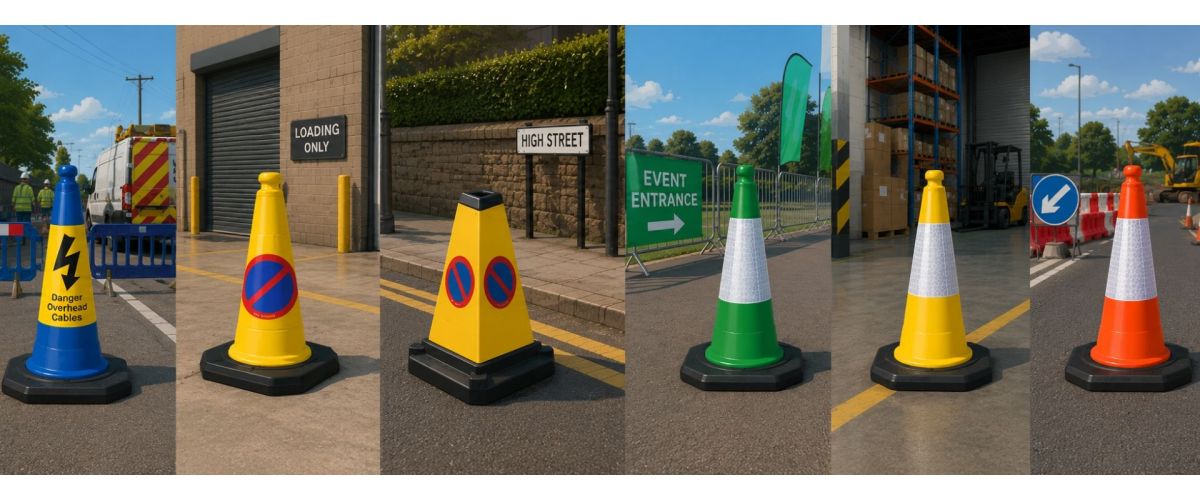
The UK Buyer's Guide to Road Traffic Cones: Construction, Highways and Traffic Management
Everything site managers, procurement teams, and traffic management contractors need to know about specifying the right cone: from Chapter 8 compliance and BSI Kitemark certification to height requirements, colour conventions, and one-piece versus two-piece construction.
The Basics
What Are Road Traffic Cones?
A road traffic cone is a portable temporary delineation device used to direct, warn, and separate traffic and pedestrians on UK roads and construction sites. They communicate to drivers and operatives where they should and should not be, marking the boundary between a live carriageway and a working area, separating vehicle routes from pedestrian zones, or identifying a specific hazard that requires attention before passing.
In the UK, road traffic cones are governed by BS EN 13422, the British and European standard covering the design, retroreflectivity, and dimensional requirements for portable road traffic signs including cones and cylinders. Cones used on public highways under Chapter 8 of the Traffic Signs Manual must meet this standard. Cones carrying a BSI Kitemark have been independently assessed and certified. This is a distinction that matters significantly on local authority and Highways England framework contracts where self-declared conformance is not accepted.
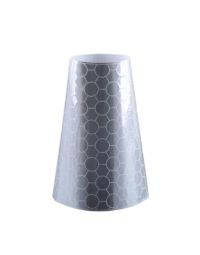
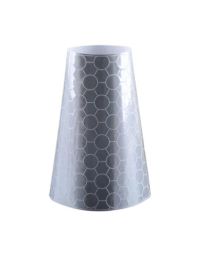
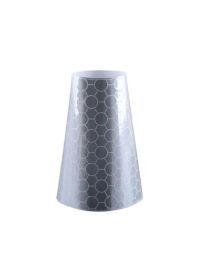
Every traffic cone has two elements: the cone body and the reflective sleeve. The body provides physical presence and height. The sleeve provides daytime luminance and night-time retroreflectivity. Higher-specification cones use pocketed prismatic sleeves that deliver greater retroreflectivity across a wider angle than standard flat reflective sleeves, which is relevant for overnight deployments and high-speed approach conditions.
Applications
How Traffic Cones Are Used on UK Sites and Roads
Traffic cones serve three broad functions: delineation (marking the boundary between a working area and a live carriageway), hazard communication (identifying a specific risk), and restriction enforcement (communicating parking or access controls).
Highway and Chapter 8 Applications
Chapter 8 of the Traffic Signs Manual sets out the requirements for temporary traffic management on UK public roads, including the cone heights required for different road types and speed limits, cone spacing for tapers and lane closures, and the standards cones must meet. Every contractor carrying out works on a live public carriageway must comply with Chapter 8, and cones used must meet the dimensional and retroreflectivity requirements of BS EN 13422.
Construction Site Internal Traffic Management
CDM 2015 places a duty on principal contractors to plan and manage traffic routes on construction sites, separating vehicle routes from pedestrian zones and identifying hazardous areas. Traffic cones are the most widely used device for site internal traffic management because they are portable, visible, and immediately understood. Colour-coded systems allow zone types and specific hazards to be communicated across a complex site layout without additional signage.
Utility Street Works
Gas, water, electricity, and telecoms contractors use traffic cones as part of their traffic management arrangements on street works under the New Roads and Street Works Act 1991. Colour-coded cones identify which service type is being worked on in each excavation, reducing the risk of accidental damage to adjacent services on complex multi-contractor sites.
Car Park and Parking Management
On private land and in managed car parks, cones are used for temporary bay reservation, loading bay control, emergency access route protection, and no-waiting restriction communication. Specialist no-waiting cones carrying the statutory circular symbol communicate the restriction clearly without additional signage or boards.
Construction Types
One-Piece vs Two-Piece Traffic Cones
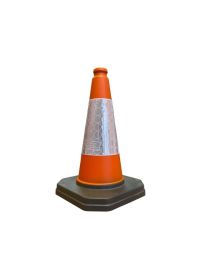
The most important structural choice in traffic cone specification is whether to use a one-piece or two-piece construction. The two types perform differently in different site environments and have different whole-life cost profiles.
- No base separation: Single moulded unit with no joint to separate on vehicle impact on a live carriageway.
- Engineered flexibility: Designed to flex and recover on impact rather than crack or shatter.
- Simpler stacking: Stack as a single unit, no separate component management.
- Lower unit cost: More cost-effective for large volume fleet procurement.
- 100% recycled options: Available in Ultra grade recycled material, fully recyclable at end of life.
- Component replacement: Replace only the damaged top or base, delivering significant whole-life cost saving on large fleets.
- Prismatic sleeve: Typically supplied with pocketed prismatic D2 sleeves for superior retroreflectivity at night and in wet conditions.
- Weighted base: Heavy recycled PVC base for stability on exposed highway sites.
- Colour variants: Full range of colours: orange, yellow, blue, and green for colour-coded site systems.
- Premium durability: Built for sustained daily deployment across long highway and utility schemes.
For high-turnover highway schemes where vehicle strikes are frequent and base separation on the carriageway is an operational risk, the one-piece flexible cone removes that failure mode entirely. For long-running utility and civils schemes where whole-life replacement cost is a primary concern, the two-piece component replacement model delivers measurable cost savings. For overnight and high-speed deployments, the two-piece cone with pocketed prismatic sleeve is the higher-specification choice.
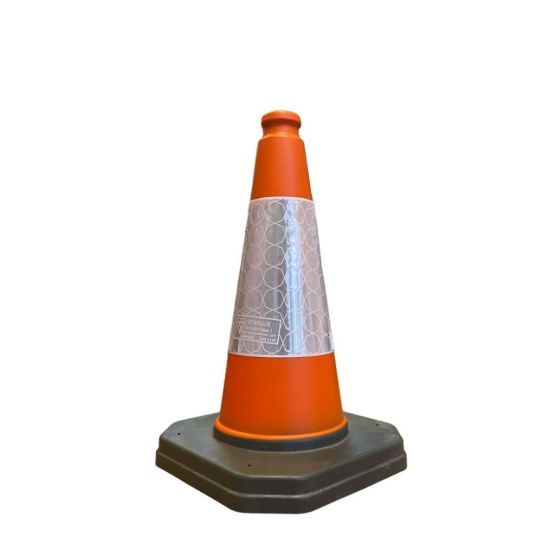
One-piece cones from CMT Group
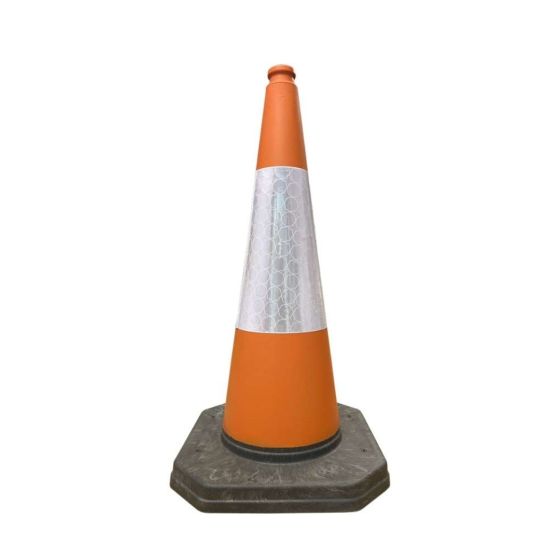
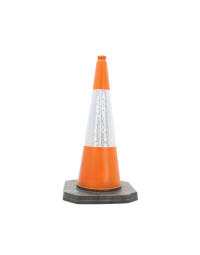
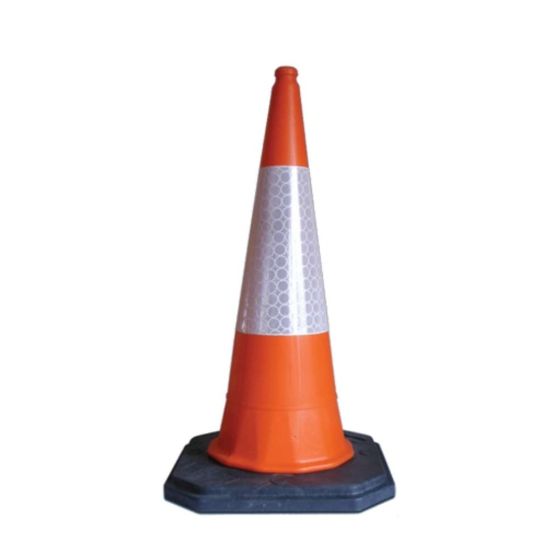
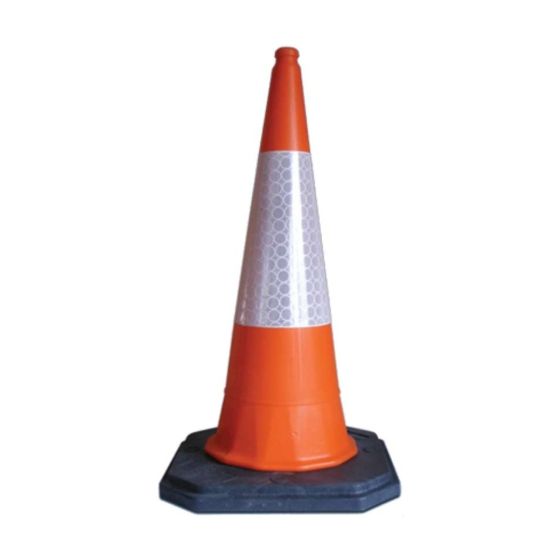
Two-piece orange cones from CMT Group
Chapter 8 Compliance
Traffic Cone Heights: What Chapter 8 Requires and When
Chapter 8 of the Traffic Signs Manual sets minimum cone heights for UK highway works based on road type and posted speed limit. Using the wrong height cone is a compliance failure regardless of certification status, and on a 70mph road, a 750mm cone where a 1000mm is required creates a genuine safety risk as well as a contractual liability.
| Cone Height | Chapter 8 Suitability | Typical Applications |
|---|---|---|
| 450mm | Lower-speed environments | Construction site demarcation, car parks, facilities management, event sites, pedestrian areas |
| 750mm | Single carriageway up to 50mph; dual carriageway up to 40mph | A-road lane closures, utility street works, construction site access roads, footway diversions |
| 1000mm | 60mph and above, motorway approaches, all UK road types | Motorway lane closures, high-speed dual carriageway works, trunk road maintenance |
Contractors managing mixed-speed road networks often standardise on the 1000mm cone to eliminate the compliance risk of deploying the wrong height on a high-speed road. The 1000mm meets Chapter 8 requirements for every UK road type and speed limit. The trade-off is a slightly higher unit cost and fewer cones per stack.
Colour Conventions
Colour-Coded Traffic Cones: What Each Colour Means on a UK Site
Orange is the statutory colour for Chapter 8 highway traffic management cones under the Traffic Signs Manual. All other colours are established industry conventions, not statutory requirements, but they are widely recognised across UK construction, utility, and facilities management sectors as a practical system for communicating zone type and hazard without additional signage.
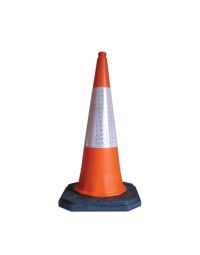
Standard highway and Chapter 8 traffic management. General construction site demarcation. The default cone colour for public road works.
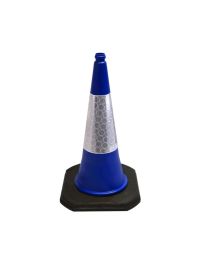
Electrical works, overhead cable hazard zones, H&S warning boundaries in warehouses and industrial facilities.
Water mains, potable water services, subterranean utility works. Identifies water service corridors on multi-utility sites.
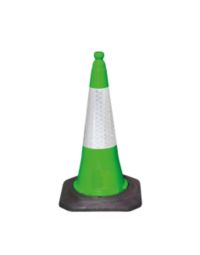
Ecological protection zones, TPO root protection boundaries, welfare area boundaries, low-risk zones.
Colour conventions work only when they are briefed. Every operative on a colour-coded site must understand what each colour means before the system is deployed. Include cone colour conventions in site inductions, toolbox talks, and the site safety management plan.
Colour-coded cones from CMT Group

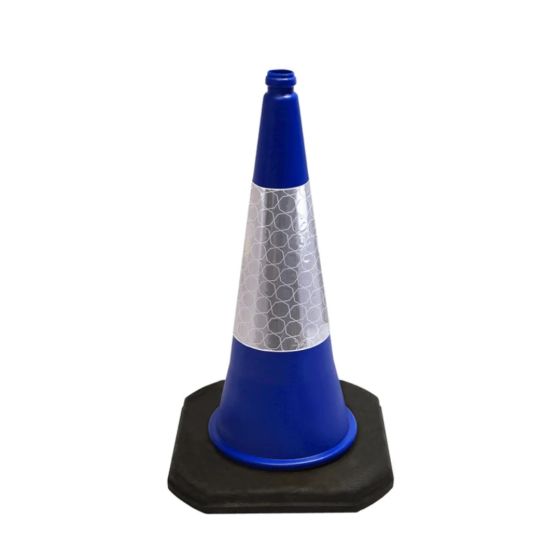
Electrical hazard zones, cable risk corridors, industrial H&S boundaries.
Water main excavations, utility service corridors, subterranean works.
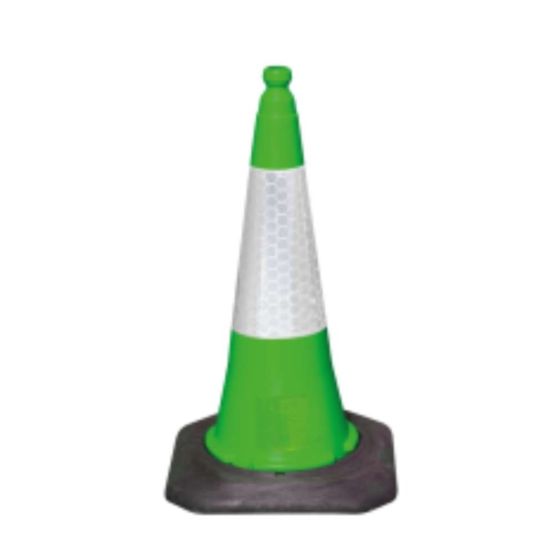
Ecological protection zones, TPO boundaries, welfare area demarcation.
Certification
BSI Kitemark and BS EN 13422: What They Mean for Procurement
BS EN 13422 is the British and European standard for portable road traffic signs including cones and cylinders. It sets requirements for cone dimensions, retroreflective sleeve performance, colour, and stability. Any cone used on a UK public highway under Chapter 8 must meet this standard.
The critical distinction for procurement teams is the difference between self-declared conformance and BSI Kitemark certification. A self-declared cone is one where the manufacturer has assessed their own product against the standard. A BSI Kitemarked cone has been independently assessed and certified by BSI under an ongoing licence requiring regular audits and product testing.
Many local authority and Highways England framework contracts specify BSI Kitemark certification as a contractual minimum. Self-declared BS EN 13422 conformance is not accepted on those contracts. Always confirm the cones you are ordering carry the Kitemark before procuring for framework use.
All two-piece cones in the CMT Group range, orange, yellow, blue, green, and the Danger Overhead Cables specialist cone, are BSI Kitemarked to BS EN 13422 under licence KM649097. The one-piece cones are also BSI Kitemarked with sleeve conforming to BS EN 13422.
Specialist Applications
Specialist Traffic Cones for Specific Hazards
Standard orange or colour-coded cones communicate zone type and general hazard. For specific hazards that require immediate, unambiguous communication, specialist cones combine a traffic cone with a purpose-specific warning sleeve that eliminates the need for additional signs or boards.
Danger Overhead Cables Cones
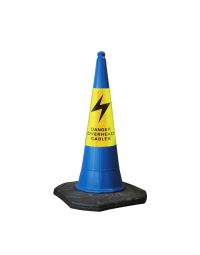
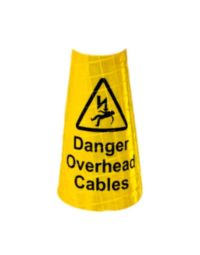
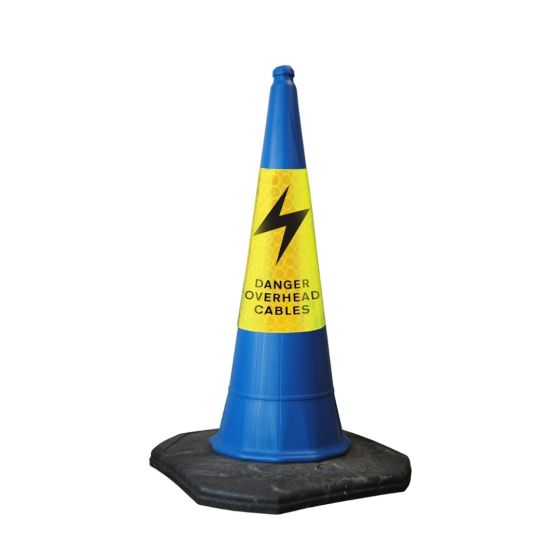
Working near overhead electricity cables requires specific warning measures under HSE guidance GS6 (Avoiding danger from overhead power lines) and the Electricity at Work Regulations 1989. The Danger Overhead Cables cone combines a blue cone body with a yellow pocketed prismatic sleeve carrying the recognised warning format: a black lightning bolt symbol and Danger Overhead Cables text, clearly legible at approach speed in daylight and after dark. It arrives ready to deploy with no separate sleeve fitting required on site.
This cone communicates two facts simultaneously: this is a utility works area, and there is an active overhead electrical hazard above you. It does not replace the safe system of work required under HSE GS6 - a method statement, permit to work, and certificated proximity warning equipment where required must be in place alongside the cone boundary.
Parking Management
No Waiting Cones: Communicating Parking Restrictions Clearly
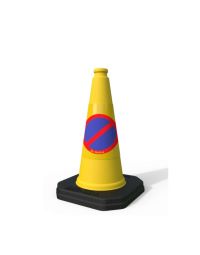
A plain yellow cone at a parking restriction tells a driver only that an area is marked. It communicates nothing about the nature of the restriction. Specialist no waiting cones carry the statutory circular blue and red No Waiting disc, the same format used on roadside signs for yellow line restrictions under the Traffic Signs Regulations and General Directions. Drivers recognise it immediately without additional signs or boards.
The Legal Position
A no waiting cone communicates a restriction but does not create a legal restriction on a public highway by itself. Statutory no waiting enforcement on a public road requires a Traffic Regulation Order (TRO) or a Section 14 temporary order under the Road Traffic Regulation Act 1984. On private land including car parks,, event sites, managed estates, and enforceability depends on the parking policy and supporting legal framework in place.
Circular vs Triangular No Waiting Cones
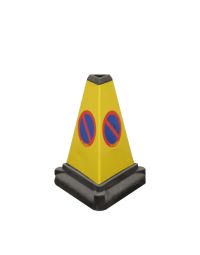
A round no waiting cone carries the symbol on one face. In a busy car park where drivers approach from multiple directions simultaneously, the symbol must be oriented towards each approaching driver, impractical when approach directions are unpredictable. A three-sided triangular cone carries the No Waiting symbol on all three faces, ensuring the restriction is visible from every approach angle without any orientation requirement. For managed car parks and multi-entrance loading bays, the triangular construction is the more effective specification.
No waiting cones from CMT Group
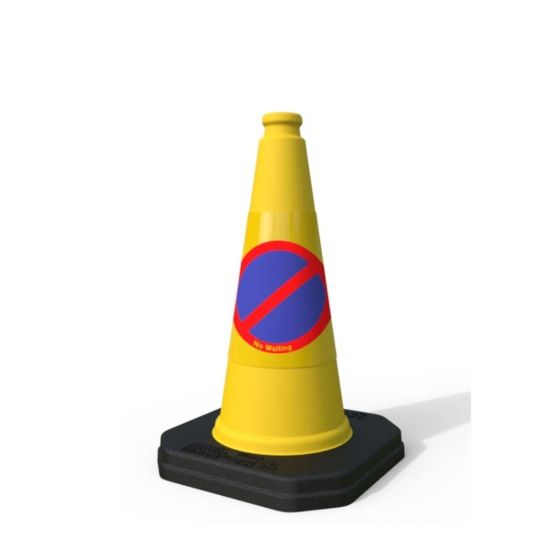
100% recycled. Lightweight. Car parks, event sites, general parking control.
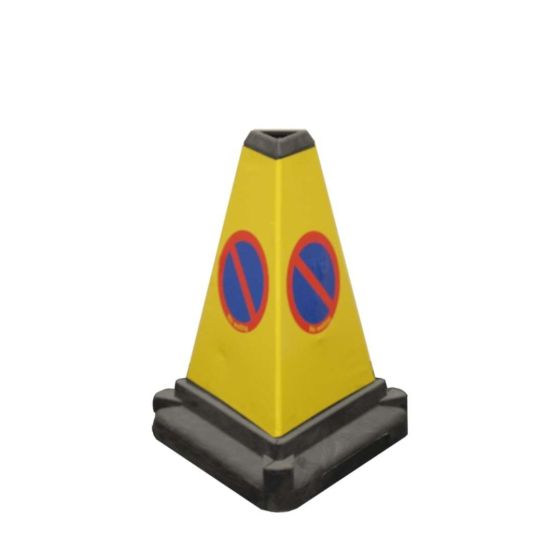
Symbol on all three faces. Omnidirectional visibility. Dual branding. Managed car parks.
Common Questions
Frequently Asked Questions
Need to Specify Cones for Your Next Project?
CMT Group stocks the full range of BSI Kitemarked traffic cones for Chapter 8 highway works, construction site traffic management, utility street works, and parking management. Next-day delivery on all stocked lines when ordered by 7pm.