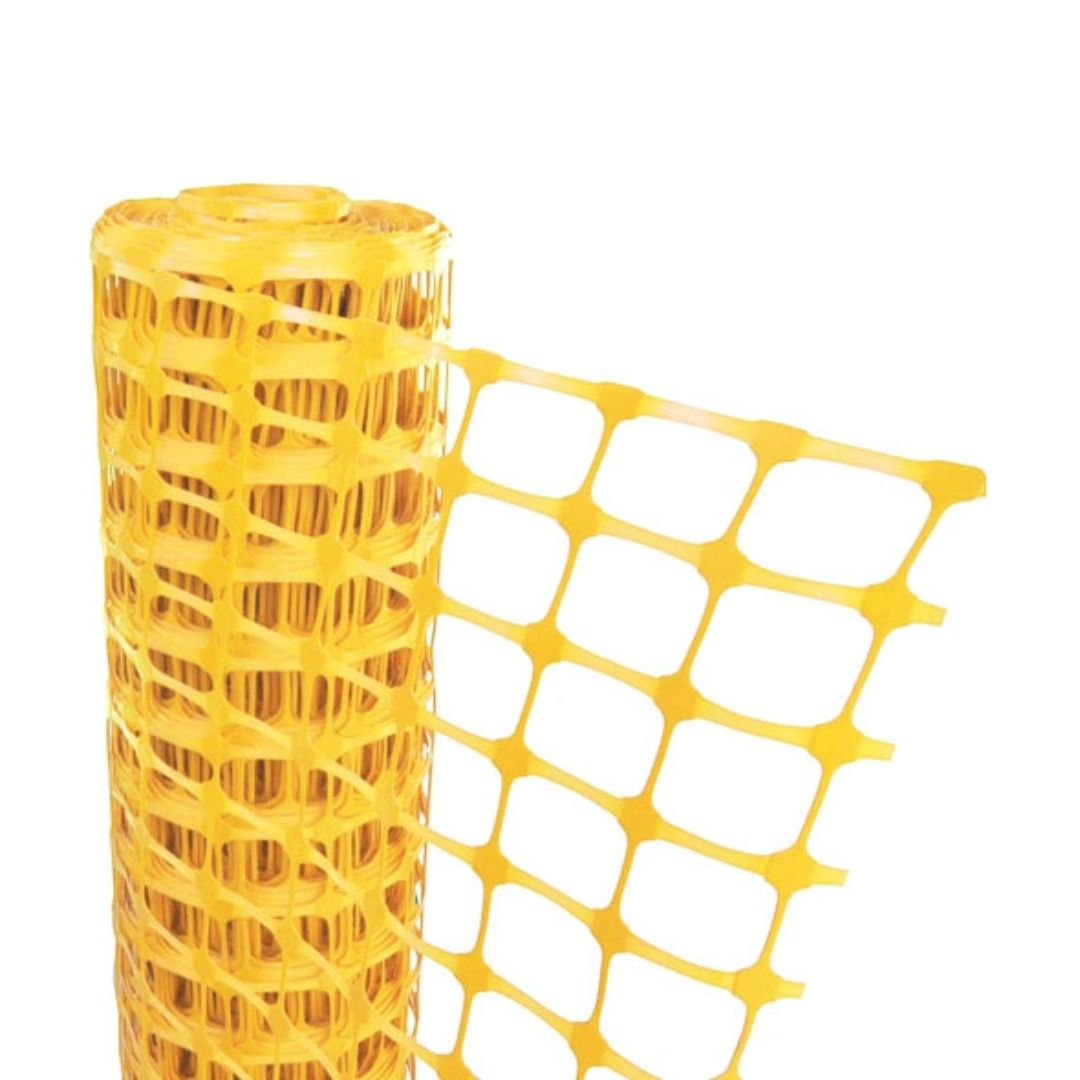


Yellow high-density polyethylene mesh barrier fencing for temporary demarcation around utility works, underground services, gas, electricity, and water service zones on UK construction and highways sites.
- HDPE construction, weatherproof and UV-resistant for extended outdoor deployment
- Yellow colouring is the recognised utility and services demarcation colour on UK sites
- Flat oval mesh, lightweight
- Reusable and rollable for storage and redeployment across multiple utility projects
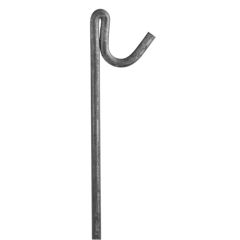
- Attaches to T-posts, timber stakes, fencing pins, or existing site structures
- Fencing pins sold separately, one pin per 5 metres recommended
- Available in a 1m x 50m roll
Yellow Mesh Barrier Fencing - 1m x 50m Utility and Services Demarcation
Yellow high-density polyethylene mesh barrier fencing for temporary demarcation around utility works, underground services, gas, electricity, and water service zones on UK construction and highways sites.
- HDPE construction, weatherproof and UV-resistant for extended outdoor deployment
- Yellow colouring is the recognised utility and services demarcation colour on UK sites
- Flat oval mesh, lightweight
- Reusable and rollable for storage and redeployment across multiple utility projects
- Attaches to T-posts, timber stakes, fencing pins, or existing site structures
- Fencing pins sold separately, one pin per 5 metres recommended
- Available in a 1m x 50m roll
- Buy 6 for £23.35 £19.46 each and save 7%
- Buy 12 for £21.56 £17.97 each and save 14%
| BULK DISCOUNT | 6 | 12 |
|---|---|---|
| Price | £19.46 £23.35 | £17.97 £21.56 |
Order 1x to earn 20 FASTPoints
Order to earn 20 FASTPoints
Log in to access trade discountsYellow Mesh Barrier Fencing - 1m x 50m
Yellow HDPE mesh barrier fencing used by utility contractors, highways teams, gas and water operatives, and civils crews to establish temporary boundaries around underground service excavations, utility works zones, and services demarcation areas on UK construction and highways sites. Each roll covers 50 metres at 1 metre height and attaches to standard T-posts, fencing pins, timber stakes, or existing site structures using cable ties or wire fixings. Yellow is the recognised demarcation colour for utility and services zones across UK construction, highways, and infrastructure sectors, distinguishing services-related boundaries from general site demarcation (blue), active hazard warning (orange), and environmental exclusion zones (green).
How yellow barrier fencing establishes clear services demarcation on utility and highways sites
On sites where multiple trades are working concurrently, the ability to distinguish a utility services zone from a general construction boundary or hazard warning area at a glance is critical for operative safety and compliance. A site where all barrier fencing is the same colour forces operatives to read signage before understanding which boundary they are approaching. Yellow barrier fencing communicates the services demarcation function instantly at distance, reducing the risk of inadvertent encroachment on live service excavations or utility apparatus by operatives from other trades working on the same site.
Key Features
-
High-density polyethylene construction: Extruded HDPE delivers UV resistance, impact tolerance, and dimensional stability across extended outdoor deployment on utility and highways sites in all weather conditions. The mesh retains its shape and colour without becoming brittle during long-duration utility works programmes.
-
Yellow services demarcation colouring: Yellow is the standard colour for utility and services zone demarcation across UK gas, electricity, water, and telecommunications infrastructure works. Clearly distinguishable from blue general demarcation, orange hazard warning, and green environmental boundaries at the distances required on active utility sites.
-
Flat oval mesh aperture, 100 x 26mm: The elongated oval opening reduces wind load on the fence line, maintaining stability when attached to lightweight fencing pins on exposed highways and utility sites.
-
Reusable roll format: Unrolls for rapid deployment and re-rolls for storage without damage to the mesh structure. Suitable for repeated use across multiple utility contracts and service works programmes, reducing per-project cost.
-
Universal attachment compatibility: Secures to T-posts, timber stakes, round steel pins, scaffold tube, and existing site structures using cable ties or wire fixings. Compatible with standard utility works street works equipment.
-
Lightweight handling: At approximately 4kg per 50m roll, a single operative can carry, unroll, and fix the complete roll without mechanical assistance on urban utility works sites.
Who is this for
Trades and roles:
-
Gas and water service operatives
-
Electricity and telecommunications contractors
-
Highways maintenance teams
-
Civils and utilities contractors
-
Street works supervisors and permit holders
Industries:
-
Gas distribution and transmission
-
Water and wastewater utilities
-
Electricity distribution
-
Telecommunications infrastructure
-
Highways and local authority
Specifications
| Specification | Detail |
| Product name | Yellow Mesh Barrier Fencing - 1m x 50m Utility and Services Demarcation |
| SKU | RSMFY |
| Material | High-density polyethylene (HDPE) |
| Colour | Yellow |
| Mesh type | Flat oval openings |
| Mesh aperture | Approximately 100 x 26mm |
| Roll width (height) | 1.0m |
| Roll length | 50m |
| Approx. weight | 4kg per roll |
| UV resistance | Yes — aging and corrosion resistant |
| Weatherproof | Yes — suitable for outdoor use in all conditions |
| Reusable | Yes |
| Installation method | T-posts, timber stakes, fencing pins, or existing structures |
| Recommended pin spacing | Minimum 1 fencing pin per 5 metres |
| Fencing pins included | No — sold separately |
| Pack format | Single roll, clear polybag with label |
Colour options
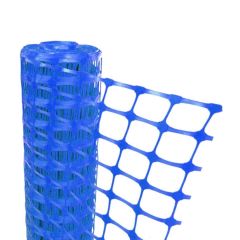
| Blue (standard) | RSMFB |
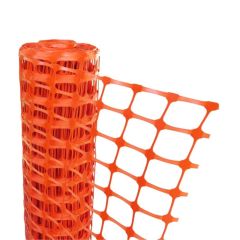
| Orange | RSMFO |
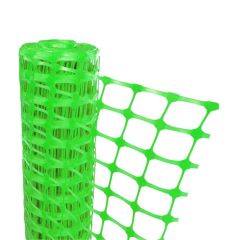
| Green | RSMFG |
| Yellow | RSMFY |
Barrier fencing colour guide: UK construction and site use
| Colour | Primary use | Typical applications | Sectors |
|---|---|---|---|
|
Blue
|
General site demarcation and controlled access zones | Site compound perimeters, access restriction boundaries, railway possession limits, pedestrian exclusion zones | Construction, civil engineering, railway, utilities |
|
Orange
|
Active hazard warning boundaries | Excavation zones, overhead work areas, live service exposures, roadwork hazard zones | Construction, highways, utilities, gas and water |
|
Green
|
Environmental and low-profile boundaries | Tree protection zones, environmental exclusion areas, landscaping boundaries, countryside and agricultural use | Landscaping, environmental, agriculture, local authority |
|
Yellow
|
Utility and services demarcation | Gas, electricity and water service exclusion zones, underground services surface marking, specific safety zone demarcation | Utilities, gas, electricity, water, highway |
! Colour coding conventions vary by principal contractor and sector. Always refer to the site safety plan or RAMS documentation for the colour convention applicable to your specific project.
Compatibility
| Application or condition | Status |
| Underground services excavation demarcation | ✓ Compatible |
| Gas, electricity, water, and telecoms utility works zones | ✓ Compatible |
| Highways maintenance and street works demarcation | ✓ Compatible |
| Utility apparatus and plant exclusion zones | ✓ Compatible |
| Construction site services zone demarcation | ✓ Compatible |
| Temporary pedestrian diversion boundaries | ✓ Compatible |
| Active hazard warning zones requiring maximum visibility | ✗ Use orange for hazard warning |
| Tree protection or ecological exclusion zones | ✗ Use green for environmental demarcation |
| Permanent perimeter security fencing | ✗ Not suitable |
| Vehicle impact containment | ✗ Not suitable |
Who is this for
Yellow HDPE mesh barrier fencing at this specification is used by gas distribution operatives, water and wastewater contractors, electricity and telecommunications teams, and highways maintenance crews who need to establish a clearly colour-coded temporary boundary around underground service excavations, utility apparatus, and services works zones on UK streets, highways, and construction sites. Street works supervisors and permit holders operating under the New Roads and Street Works Act 1991 specify yellow barrier fencing to distinguish services-related boundaries from general site demarcation, ensuring that operatives from other trades working concurrently on the same site can identify the utility zone immediately without reading signage. Procurement teams managing utility frameworks and term maintenance contracts order yellow barrier fencing in roll quantities alongside blue and orange for multi-zone sites requiring colour-coded demarcation throughout a works programme.
Typical applications
-
Demarcating underground service excavation zones around gas, electricity, water, and telecommunications apparatus during planned maintenance, renewal, and emergency repair works on UK streets and highways.
-
Establishing utility apparatus exclusion zones around live service plant, valve chambers, and above-ground utility equipment during construction and civil engineering works where other trades are operating concurrently.
-
Creating temporary pedestrian diversion boundaries around street works on urban footways and shared pedestrian and cycle routes where the works zone must be clearly distinguished from the pedestrian route.
-
Defining services demarcation zones on large construction sites where multiple utilities are being installed or diverted concurrently and colour-coded boundaries are required to identify each service type.
-
Cordoning off highways maintenance works areas during carriageway, drainage, and kerb works where a temporary lightweight demarcation fence is required alongside traffic management.
-
Protecting exposed utility apparatus and open service trenches from inadvertent access by site operatives and members of the public during phased utility works programmes.
-
Providing temporary boundary demarcation around electricity substation and transformer works zones on construction sites and public highways where access to live electrical apparatus must be clearly restricted.
How to use
Step 1: Determine the fence line around the utility works zone and calculate the number of fencing pins or T-posts required. Use a minimum of one fixing point per 5 metres. On busy urban streets or sites with high pedestrian pressure against the fence line, reduce the spacing to one fixing point per 3 metres.
Step 2: Insert fencing pins or T-posts into the ground at measured intervals along the fence line. On hard standing where ground penetration is not practicable, attach the mesh to existing street furniture, barriers, or site structures using cable ties.
Step 3: Attach the leading edge of the mesh roll to the first pin or post using cable ties or wire fixings at top, middle, and base of the mesh. Always fix at three points per support, not a single point at the top.
Step 4: Unroll the mesh along the fence line, attaching to each subsequent pin or post at three fixing points as you progress. Keep the mesh taut between supports to maintain a visible, upright fence line around the works zone.
Step 5: At corners and changes of direction, use an additional pin or post at the turning point to prevent the mesh from pulling away from the fence line under tension.
Step 6: At the conclusion of works, remove all fixings, re-roll the mesh from one end, and secure the roll with cable ties for storage and redeployment on subsequent utility works.
Common mistakes
Using yellow where a hazard warning colour is required: Yellow is a services demarcation colour, not a primary hazard warning colour. For active excavation hazard zones and high-risk work areas where maximum boundary visibility is the priority, use orange barrier fencing. Mixing yellow and orange on the same site without a clear colour coding convention in the site safety plan creates confusion about boundary function.
Under-pinning on urban streets: On busy footways and pedestrian areas, contact pressure from passing pedestrians and cyclists against the fence line requires closer pin spacing than on open construction sites. One pin per 3 metres is more appropriate than the minimum 5-metre spacing in high-pedestrian-traffic urban environments.
Single-point fixing at the top only: Attaching the mesh with a single cable tie at the top allows the lower section to billow outward and disengage from the support. On utility works sites where pedestrians are passing close to the fence line, a lower mesh that has detached from its fixing creates a trip hazard. Always fix at top, mid, and base at every support point.
Failing to maintain the fence line during phased works: Utility works programmes often involve multiple phases of excavation and reinstatement. A fence line installed for Phase 1 that is not adjusted or maintained as the works zone changes no longer accurately demarcates the active zone and may leave live excavations unprotected. Inspect and adjust the fence line at each phase change.
Leaving mesh in contact with reinstatement materials: Tarmac, concrete, and resin-bound reinstatement materials can bond to the base of the mesh if the fence line is left in contact with fresh reinstatement. Lift the base of the mesh clear of any fresh reinstatement surface until it has cured.
Safety
Yellow HDPE mesh barrier fencing is a demarcation product for utility and services zones. It defines a boundary and deters casual access. It does not physically prevent determined entry, provide vehicle containment, or substitute for rigid barriers, Armco, or traffic management equipment where vehicle restraint is required under the New Roads and Street Works Act 1991 or the Traffic Management Act 2004. Street works operations must comply with the Safety at Street Works and Road Works Code of Practice. The use of barrier fencing on any street works site should be specified in the traffic management plan and works notification as appropriate.
Maintenance
After each deployment, remove all cable ties and wire fixings before re-rolling. Inspect the full roll for tears, cuts, or areas of UV degradation before reuse. Rinse with clean water to remove tarmac residue, mud, and site contamination before storage. Re-roll firmly and store in covered conditions away from prolonged direct sunlight between utility works deployments.
Frequently Asked Questions
Q: Why is yellow the correct colour for utility and services demarcation on UK sites?
A: Yellow is the recognised demarcation colour for utility and services zones across UK gas, electricity, water, and telecommunications infrastructure works. It distinguishes services-related boundaries from general construction demarcation (blue), active hazard warning (orange), and environmental exclusion zones (green). On sites where multiple trades are working concurrently, colour-coded barrier fencing allows operatives to identify the function of each boundary zone instantly at distance without reading signage, reducing the risk of inadvertent encroachment on live service excavations or utility apparatus.
Q: Is this fencing suitable for use on street works sites under the New Roads and Street Works Act 1991?
A: Yellow HDPE mesh barrier fencing is used on UK street works sites to demarcate utility works zones and temporary pedestrian diversion boundaries. Its use on any street works site must comply with the Safety at Street Works and Road Works Code of Practice and be specified in the traffic management plan submitted with the works notification. Barrier fencing alone does not constitute compliant traffic management for carriageway works where vehicle restraint or pedestrian segregation from moving traffic is required. Rigid barriers, pedestrian barriers, and traffic management equipment are required for those functions.
Q: What is this fencing NOT suitable for?
A: This fencing is not suitable for vehicle impact containment, traffic management, or any application requiring a structural barrier. It does not physically prevent determined access by adults and must not be used as the sole protection around live excavations accessible to the public without additional safeguards. It is not appropriate for permanent perimeter security or anti-climb applications. For active hazard warning where maximum visibility is required, use orange barrier fencing. For tree protection and environmental exclusion, use green barrier fencing.
Q: Can this fencing be attached to existing street furniture rather than ground pins on hard standing?
A: Yes. On urban streets and hard-standing utility sites where driving ground pins is not practicable due to buried services, block paving, or surface protection requirements, yellow HDPE mesh attaches readily to lamp columns, traffic sign posts, hoarding frames, and existing barriers using cable ties or wire fixings. Ensure fixings do not damage highway authority assets and that attachment points are agreed with the relevant highway authority or asset owner where required.
Q: How does yellow barrier fencing differ from the other colours in the range?
A: All colours in the barrier fencing range share the same HDPE construction, 100 x 26mm flat oval mesh aperture, 1m x 50m roll format, and weatherproof specification. The difference is the demarcation function each colour serves. Yellow is for utility and services zone demarcation. Blue is for general construction and railway demarcation. Orange is for active hazard warning. Green is for environmental, landscaping, and tree protection demarcation. Using the correct colour for each zone type on a multi-trade site allows operatives to identify boundary functions at a glance.
Q: How many fencing pins do I need for a 50m roll on an urban street works site?
A: The minimum is one fencing pin per 5 metres, giving 10 pins for a full 50m roll. On busy urban footways and streets with high pedestrian contact pressure against the fence line, reduce the spacing to one pin per 3 metres, requiring approximately 17 pins per roll. Always fix the mesh to each pin at three points — top, mid, and base — rather than a single top-only fixing that allows the lower mesh to disengage and create a trip hazard.
Q: Can this fencing be reused across multiple utility works contracts?
A: Yes. The HDPE construction and UV-resistant yellow colouring allow the mesh to be re-rolled, stored, and redeployed across multiple utility works contracts and maintenance programmes. Service life depends on handling during installation and recovery and on storage conditions between uses. Inspect the full roll before each redeployment and replace any roll showing significant tearing, brittleness, or loss of mesh integrity.
Q: Why buy yellow mesh barrier fencing from CMT Group?
A: CMT Group operates its own delivery fleet covering over 95% of the UK mainland. Order by 7pm for next-day delivery nationwide, with live tracking, real-time ETAs, and What3Words integration for precise delivery to any street works site or utility compound. For utility contractors and highways teams managing ongoing works programmes, the EDGE portal provides contract pricing, bulk ordering, role-based spending controls, and full delivery visibility from a single account.