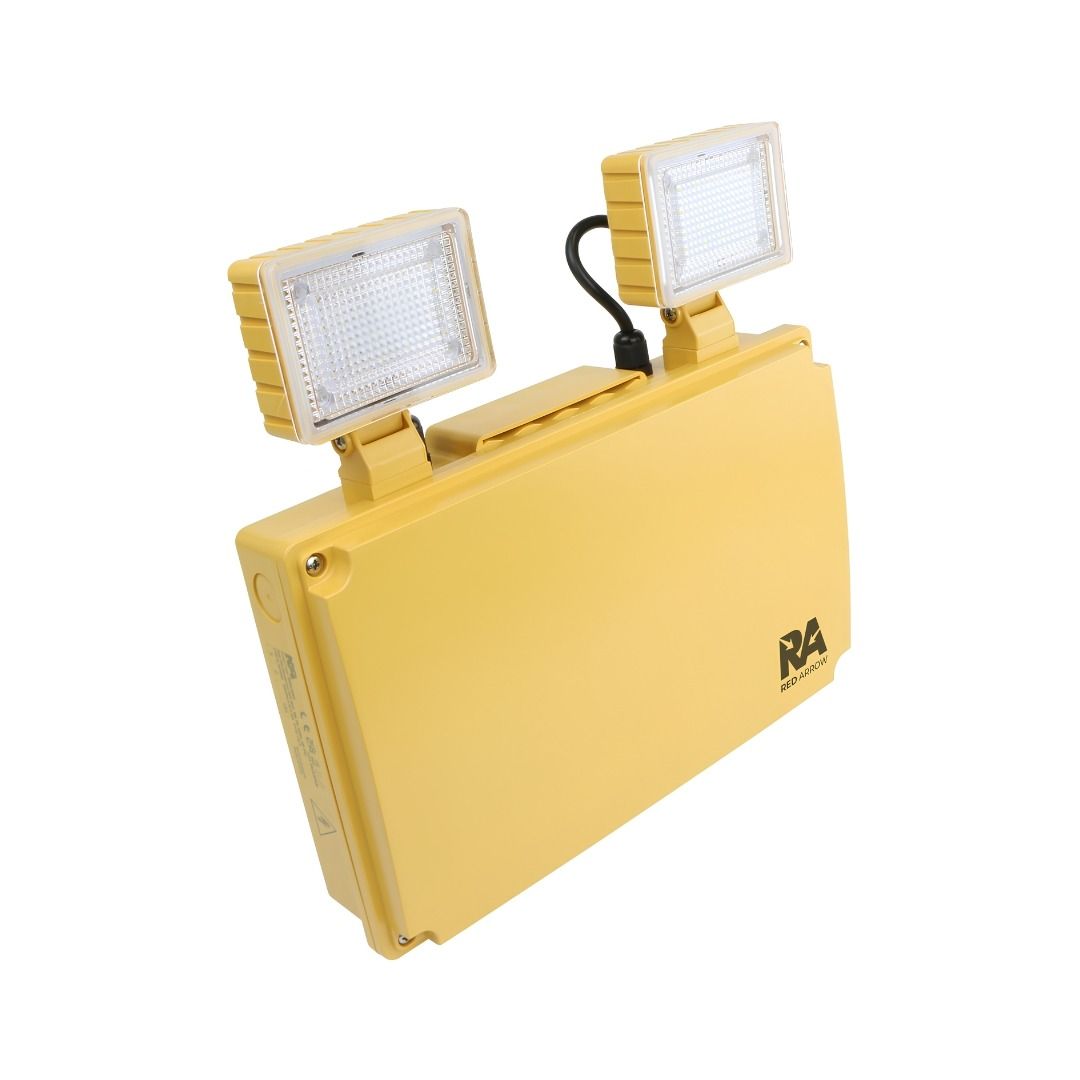
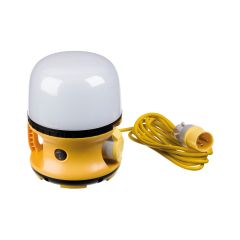
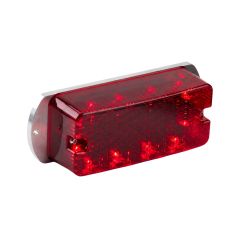
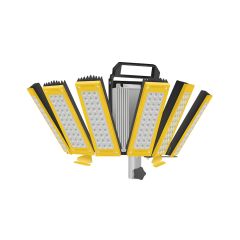
110V site emergency LED twin spotlight for non-maintained emergency lighting on construction sites, delivering 500lm for a minimum of 3 hours on LiFePO4 battery power.
- Non-maintained, activates automatically on mains failure
- 3-hour emergency duration on LiFePO4 battery
- 500lm from 4W at 125 lm/W efficacy
- Twin independently adjustable LED spotlight heads
- IP65 and IK08 rated for site conditions
- Selectable self-test or manual test function
- 5-year warranty on both unit and battery
110V Site Emergency LED Twin Spotlight - 4W 500lm
110V site emergency LED twin spotlight for non-maintained emergency lighting on construction sites, delivering 500lm for a minimum of 3 hours on LiFePO4 battery power.
- Non-maintained, activates automatically on mains failure
- 3-hour emergency duration on LiFePO4 battery
- 500lm from 4W at 125 lm/W efficacy
- Twin independently adjustable LED spotlight heads
- IP65 and IK08 rated for site conditions
- Selectable self-test or manual test function
- 5-year warranty on both unit and battery
Order 1x to earn 74 FASTPoints
Order to earn 74 FASTPoints
Log in to access trade discounts110V Site Emergency LED Twin Spotlight - 4W
110V site emergency LED twin spotlight for non-maintained emergency lighting on construction sites running from a 110V transformer supply. The fitting sits dormant during normal mains operation, with its LiFePO4 battery on continuous charge, and activates automatically when mains power is interrupted, delivering 500lm for a minimum of 3 hours. Two independently adjustable LED heads allow the output to be aimed at specific escape routes and hazard areas as the installation design requires.
Why LiFePO4 matters for emergency lighting on a construction site
Lead-acid and NiCd batteries in standard emergency lights degrade noticeably over 3 to 4 years, with some failing to deliver the full 3-hour duration well before the warranty period ends. On a construction site where emergency lighting is a statutory requirement under the Regulatory Reform (Fire Safety) Order 2005, a failing battery means a non-compliant installation, discovered only when the light fails its annual duration test. LiFePO4 delivers significantly more charge cycles than lead-acid, with no memory effect, and is backed here by a 5-year battery warranty that matches the unit warranty.
Key Features
-
Non-maintained operation: The LED heads are normally off during standard mains-powered operation. Solid state circuitry activates them automatically when the mains supply is interrupted. This is the correct operational mode for emergency escape route lighting under BS 5266 Part 1.
-
LiFePO4 battery with 3-hour emergency duration: Lithium Iron Phosphate chemistry delivers more charge cycles and more consistent capacity over time than lead-acid or NiCd. The 3-hour duration meets the BS 5266 minimum requirement for most UK emergency lighting applications.
-
Twin independently adjustable spotlight heads: Each head rotates and tilts independently, allowing coverage to be precisely aimed at escape routes, stairwells, or specific hazard areas from a single wall mounting point.
-
Selectable self-test or manual test: In self-test mode, the fitting performs the routine monthly function test automatically. In manual test mode, the push button on the fitting initiates the test. Both modes support BS 5266 compliance testing requirements.
-
IP65 and IK08 rated: Fully weatherproof and impact resistant. Suited to wet or dusty construction environments, plant rooms, and partially enclosed site spaces.
-
5-year warranty on unit and battery: Both the fitting and the LiFePO4 battery are covered for 5 years, which is notably longer than the 1 to 3 years typically available at this product tier.
-
Class II double insulated: No earth connection is required or should be connected.
Who is this for
Trades and roles:
-
Site electricians and emergency lighting installers
-
M&E contractors
-
Site safety officers
-
CDM coordinators and principal contractors
-
Site managers with fire safety responsibilities
Industries:
-
Construction and groundworks
-
Civil engineering and tunnelling
-
Industrial and plant maintenance
-
Infrastructure and utilities
-
Temporary works and welfare
Specifications
| Specification | Detail |
| Product Name | 110V Site Emergency LED Twin Spotlight – 4W 500lm |
| SKU | EL060009 |
| Emergency Type | Non-Maintained (NM) |
| Voltage | 110V |
| Wattage | 4W |
| Lumen Output | 500lm |
| Emergency Lumen Output | 500lm (3-hour duration) |
| Efficacy | 125 lm/W |
| Colour Temperature | 6500K (daylight white) |
| Colour Rendering Index | Ra>80 |
| IP Rating | IP65 |
| IK Rating | IK08 |
| Emergency Battery Type | LiFePO4 |
| Emergency Duration | 3 hours |
| LED Lifetime | L70B50 36,000 hours |
| Electrical Class | Class II (double insulated, no earth required) |
| Power Factor | >0.3 |
| Driver Type | Fixed |
| Frequency | 50/60Hz |
| Approval | UKCA and CE |
| Working Temperature | 0°C to +45°C |
| Test Function | Selectable self-test or manual test (push button) |
| LED Indicators | Charge (green), Lamp Healthy (green) |
| Spotlight Heads | Twin, independently adjustable (rotate and tilt) |
| Fixing Options | 4x screw fixing or central BESA box fixing |
| Material | Polycarbonate |
| Warranty (Unit) | 5 years |
| Warranty (Battery) | 5 years |
| Dimensions | H:288mm x W:300mm x D:69mm |
| Net Weight | 1.21 kg |
Compatibility
| Application or condition | Status |
| 110V site transformer supply | ✓ Suitable – 110V only |
| Non-maintained emergency escape route lighting | ✓ Suitable – NM type, activates automatically on mains failure |
| Wet and dusty construction site environments | ✓ Suitable – IP65 and IK08 rated |
| BS 5266 Part 1 compliant emergency lighting installation | ✓ Suitable – 3-hour duration, LiFePO4 battery |
| Areas requiring independently aimed emergency spotlights | ✓ Suitable – twin heads rotate and tilt independently |
| Operating temperature 0°C to +45°C | ✓ Suitable |
| 240V mains supply | ✗ Not suitable – 110V only |
| Maintained emergency lighting (light on during normal operation) | ✗ Not suitable – NM type only, normally off |
| Outdoor environments below 0°C (sub-zero ambient temperatures) | ✗ Not suitable – minimum working temperature 0°C |
| Installation without a qualified electrician | ✗ Not permitted – BS7671 and BS 5266 compliance required |
| Connection to a switched supply | ✗ Not suitable – requires unswitched permanent live for continuous battery charging |
Who is this for
M&E contractors and site electricians installing emergency lighting on 110V construction sites under BS 5266 Part 1 and the Regulatory Reform (Fire Safety) Order 2005. The non-maintained type is the correct specification for escape route lighting in most construction site applications. Site safety officers and CDM coordinators specifying emergency lighting as part of the site's fire safety strategy are the other key audience.
Typical applications
-
Emergency escape route lighting on 110V construction sites where loss of mains power must trigger automatic illumination of egress paths.
-
Plant room and confined space emergency egress lighting where a 3-hour duration is required for safe evacuation.
-
Site welfare unit emergency lighting required under fire safety regulations where a 110V supply is the only available source.
-
Tunnelling and underground site work where escape route lighting from an independent power source is mandatory.
-
Stairwell and corridor egress lighting within partially constructed buildings where permanent emergency lighting is not yet installed.
-
Any enclosed site area where the Regulatory Reform (Fire Safety) Order 2005 requires emergency lighting and the available supply is 110V.
How to use
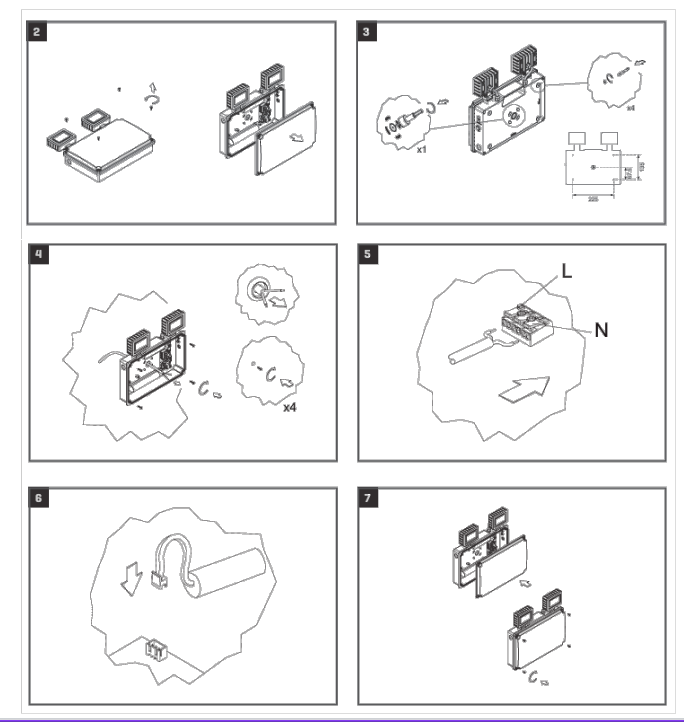
Step 1: Isolate the mains supply before starting any installation work.
Step 2: Remove the front cover by loosening the screws at each corner.
Step 3: Select and drill out the preferred fixing points: four corner screw fixing points, or the central BESA box fixing. Drill the cable entry point at the centre or either side of the fitting.
Step 4: Fix the body to the wall, passing the supply cable through the cable entry point. Fit a suitable cable gland and washers to seal the entry and maintain the IP65 rating.
Step 5: Connect the supply cable to the terminal block. Connect Live (L) and Neutral (N) only. No earth connection is required.
Step 6: Plug the battery cable into the white connector on the PCB.
Step 7: Replace the front cover and fully tighten all corner screws to ensure a good seal.
Step 8: Restore the mains supply. Confirm the green "Charge" LED is illuminated.
Step 9: Leave connected for 24 to 36 hours to achieve a full initial battery charge before commissioning.
Step 10: After the full charge period, interrupt the supply and confirm the LED heads activate immediately. Check after 3 hours that the heads are still illuminated. Record the commissioning date and result.
Step 11: Adjust each spotlight head by rotating and tilting to aim coverage at the specific escape routes or hazards the design requires.

Common mistakes
-
Not sealing the cable entry: IP65 is only maintained when the cable entry is sealed with a suitable cable gland. An unsealed entry allows moisture ingress and voids the ingress protection rating.
-
Connecting to a switched supply: the fitting requires an unswitched permanent live. A switched circuit interrupts charging whenever the switch is off, reducing battery capacity and causing false emergency activations.
-
Not completing the full 24 to 36 hour initial charge before commissioning: a partially charged battery will not deliver the full 3-hour duration on the commissioning test. Allow the full initial charge period before testing.
-
Failing to maintain a test record: BS 5266 requires monthly and annual tests to be recorded. The installation instructions include a test record sheet. Complete and retain it throughout the fitting's service life.
Safety
This fitting must be installed by a qualified electrician in compliance with IEE Wiring Regulations (BS7671) and the emergency lighting installation requirements of BS 5266 Part 1. The working temperature range is 0°C to +45°C. Do not install in areas where ambient temperatures may fall below 0°C. Confirm the unswitched permanent live is connected correctly before energising. At end of life, recycle through local authority or an appropriate WEEE scheme.
Testing schedule required by BS 5266:
Daily: check the green charge indicator is illuminated. Monthly: interrupt the supply briefly and confirm the LED heads activate; restore the supply and confirm the indicator is illuminated. Annual: interrupt the supply for the full 3-hour rated duration; confirm the light is still illuminated at the end of the period; restore supply and confirm indicator is illuminated. Record all test dates and results.
Maintenance
Clean the polycarbonate housing with a dry or lightly damp cloth. In dusty, painted, or welding environments, clean more frequently to prevent surface build-up. Do not use solvents, aggressive detergents, or abrasives. The light source and driver can be replaced at end of life by a competent person. If the battery no longer delivers the full 3-hour duration after a routine test, follow the battery replacement procedure in the installation instructions supplied with the fitting.
Frequently Asked Questions
Q: What does non-maintained mean for emergency lighting and when is it the correct specification?
A: Non-maintained means the LED heads are normally off during standard mains-powered operation. The battery charges continuously while mains power is present. When the mains supply fails, solid state circuitry switches the heads on automatically. Under BS 5266 Part 1, non-maintained is the correct type for most escape route and emergency lighting applications in construction and industrial settings. Maintained lighting, where the light is on during normal operation, is typically specified for cinemas, theatres, and similar public assembly venues where it serves as both general and emergency lighting.
Q: Why does this use LiFePO4 batteries rather than lead-acid or NiCd?
A: LiFePO4 delivers significantly more charge cycles than lead-acid or NiCd alternatives, with no memory effect and consistent capacity over the service life. Traditional emergency light batteries often fail to deliver the full rated duration by year 3 or 4, resulting in a failed annual duration test and a non-compliant installation. LiFePO4 maintains reliable capacity for longer, and the 5-year battery warranty reflects this. It also charges and operates more consistently between 0°C and 45°C than lead-acid chemistry.
Q: What is this fitting NOT suitable for?
A: This fitting is 110V only and must not be connected to a 240V mains supply. The working temperature range is 0°C to +45°C. It must not be installed in areas where ambient temperatures fall below 0°C, which may affect compliance in exposed outdoor UK site locations during winter. It is a non-maintained fitting and is not appropriate where maintained emergency lighting is specified. It requires an unswitched permanent live supply and must not be connected via a switching circuit.
Q: How does the self-test function support the BS 5266 testing schedule?
A: When set to self-test mode, the fitting automatically performs the brief monthly function test required by BS 5266 without manual intervention, and indicates the result via the LED indicators. This removes the need for an electrician to visit and manually interrupt the supply each month on high-density installations. The annual full-duration test, requiring 3 hours of continuous emergency operation, must always be performed manually regardless of mode. Record all test results.
Q: What does the commissioning process involve after installation?
A: After installation, restore the supply and confirm the green charge LED is illuminated. Leave the fitting connected for 24 to 36 hours to achieve a full initial charge. Then interrupt the supply and confirm both LED heads activate immediately. After 3 hours, confirm the heads are still illuminated. Restore the supply and confirm the charge indicator returns to green. Record the commissioning date and result on the test record sheet supplied with the fitting.
Q: What should I do if the battery no longer delivers 3 hours during a test?
A: First, fully discharge the battery by leaving the fitting in emergency mode until it extinguishes, then reconnect the supply and charge for 24 hours before retesting. If the battery still fails to deliver 3 hours, a replacement battery pack is required. Isolate the supply, remove the front cover, unplug the battery lead from the PCB, write the date on the new battery, fit the new pack, reconnect, and restore the supply. Allow 24 hours to charge, then carry out a full 3-hour commissioning test before returning the fitting to service.
Q: Can the LED heads be aimed independently at different escape routes?
A: Yes. Each of the two LED heads rotates and tilts independently. After completing the installation, adjust each head to direct light at the specific escape route, stairwell, or hazard area required by the emergency lighting design. The two heads can cover different directions simultaneously from a single wall-mounted fitting.