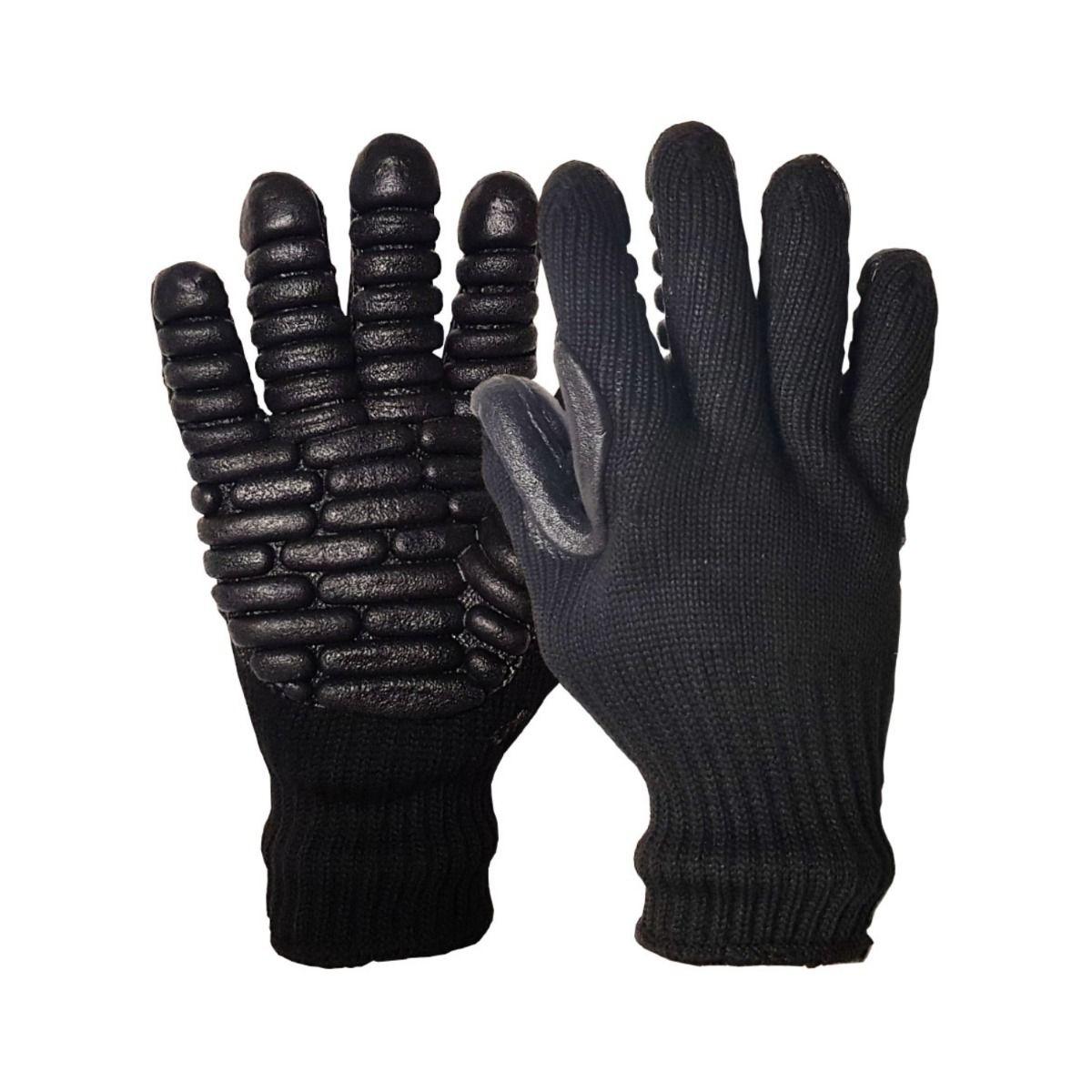
Anti vibration gloves with a padded rubber palm and fingers, helping absorb shock from power tools, for drilling, breaking and mining crews.
- Padded black rubber palm and fingers
- EN 388:2016 X243X, PPE Category II
- Tear level 4, puncture level 3
- Rubber coating gives a firm grip
- Seamless cotton and polyamide knit liner
- Elasticated knitted wrist for a secure fit
- Available in multiple sizes
Anti-Vibration Gloves - Rubber Padded Palm and Fingers
Anti vibration gloves with a padded rubber palm and fingers, helping absorb shock from power tools, for drilling, breaking and mining crews.
- Padded black rubber palm and fingers
- EN 388:2016 X243X, PPE Category II
- Tear level 4, puncture level 3
- Rubber coating gives a firm grip
- Seamless cotton and polyamide knit liner
- Elasticated knitted wrist for a secure fit
- Available in multiple sizes
Anti-Vibration Gloves
Anti vibration gloves are work gloves with a padded coating that sits between the hand and a vibrating tool handle. These have a seamless knitted cotton and polyamide liner, with a black rubber coating moulded into raised pads across the palm and fingers. They are used for drilling, breaking, grinding and other work with handheld power tools.
How Padded Rubber Takes the Sting Out of Tool Handles
A standard knitted work glove puts almost nothing between the palm and a hammering tool handle. On site, that means jarring shocks, aching hands and tired grip by the end of a shift on a breaker or drill. The raised rubber pads on these gloves cushion the hand against the handle, helping absorb shock while keeping the fingers free to grip and control the tool.
Key Features
-
Padded rubber coating: raised pads across the palm and fingers help absorb shock and vibration from tool handles.
-
Firm grip: the rubber coating holds tool handles securely without needing to squeeze hard.
-
Tear level 4: the highest EN 388 tear rating, so the gloves hold up to rough handling.
-
Puncture level 3: good resistance to sharp points such as wire ends and splinters.
-
Seamless knitted liner: no seams across the fingers to rub or cause pressure points over long shifts.
-
Elasticated knitted wrist: a secure fit that helps keep dust and debris out of the glove.
Who is this for
Trades and roles
-
Groundworkers
-
Demolition operatives
-
Concrete breakers and drillers
-
Road and utilities crews
-
Mining and quarry workers
-
Plant and tool operators
Industries
-
Construction
-
Civil engineering
-
Demolition
-
Mining and quarrying
-
Oil and gas
-
Utilities
Specifications
| Specification | Detail |
|---|---|
| Product name | Anti-Vibration Gloves - Rubber Padded Palm and Fingers |
| Product code | SAGV |
| Product type | Anti-vibration work gloves |
| Mechanical standard | EN 388:2016, X243X |
| Abrasion resistance | X, not tested |
| Cut resistance (coupe test) | Level 2 of 5 |
| Tear resistance | Level 4 of 4 |
| Puncture resistance | Level 3 of 4 |
| Cut resistance (TDM test) | X, not tested |
| PPE category | Category II |
| Marking | CE |
| Coating | Black rubber, padded palm and fingers |
| Liner | Seamless knit, cotton and polyamide |
| Cuff | Elasticated knitted wrist |
| Colour | Black |
Size Selection
| Product code | Size | Typical hand circumference | Typical hand length |
|---|---|---|---|
| SAGV-09 | 9 (Large) | 229mm | 192mm |
| SAGV-10 | 10 (XL) | 254mm | 204mm |
Other Variations in the Range, Contact to Order
| Product code | Size | Typical hand circumference | Typical hand length |
|---|---|---|---|
| SAGV-08 | 8 (Medium) | 203mm | 182mm |
Compatibility
| Base material, tool or condition | Suitability |
|---|---|
| Drills, breakers, grinders and compactors | Suitable, padding helps absorb shock from the handle |
| Drilling, boring and mining work | Suitable |
| Cold outdoor work with vibrating tools | Suitable, helps keep hands warm |
| Handling materials with sharp points | Suitable, puncture level 3 |
| Relying on gloves alone to control vibration exposure | Not recommended, follow your vibration risk assessment and exposure limits |
| Sharp edges, glass and sheet metal | Not recommended, cut level 2 only, use a cut-resistant glove |
| Heavy abrasive handling, such as rough blocks and slabs | Not recommended, abrasion not tested |
| Impact to the back of the hand | Not recommended, no impact rating |
| Chemicals, oils and solvents | Not recommended, no chemical protection rating |
| Hot work and welding | Not recommended, no heat or flame rating |
| Fine precision work | Not recommended, the padding reduces fingertip feel |
Typical Users and Projects
Groundworkers, demolition crews and utilities teams wear anti vibration gloves on jobs that involve long spells with handheld power tools. Typical projects include breaking out concrete, drilling and coring, road and trench works, and mining and quarry operations. They suit experienced operatives who use tools daily and want better comfort and grip through a full shift.
Typical applications
-
Breaking out concrete and masonry with a handheld breaker.
-
Drilling and coring into concrete with rotary and SDS drills.
-
Compacting trenches and sub-bases with plate compactors and rammers.
-
Grinding and cutting with angle grinders on site.
-
Drilling and boring work in mining and quarrying.
-
Winter tool work outdoors, where cold hands reduce grip and comfort.
How to use
Step 1: Measure your hand and choose the nearest glove size from the Size Selection table.
Step 2: Check the gloves for splits in the coating or worn padding before each use.
Step 3: Put the gloves on fully so the fingertips sit at the end of each finger.
Step 4: Grip the tool firmly but without squeezing harder than needed, as a tight grip passes more vibration into the hand.
Step 5: Take regular breaks from vibrating tools in line with your risk assessment.
Step 6: Remove the gloves and let them dry after use if they are damp.
Common mistakes
-
Treating the gloves as the main control for hand-arm vibration, instead of tool choice and limiting exposure time.
-
Wearing gloves that are too large, which reduces grip and control of the tool.
-
Using them on sharp edges or rough abrasive materials, where a cut or abrasion-rated glove is needed.
-
Carrying on with worn or flattened padding.
-
Wearing wet gloves in the cold, which chills the hands.
Safety
The Control of Vibration at Work Regulations 2005 require employers to assess vibration risks and keep exposure as low as reasonably practicable. HSE advises that gloves should not be relied on to protect against vibration, but keeping hands warm and dry helps circulation. Use these gloves alongside low-vibration tools, job rotation and limits on trigger time.
Maintenance
Store the gloves dry and out of direct sunlight. Replace them when the padding is worn flat or the coating splits.
Frequently Asked Questions
Q: Do anti vibration gloves protect against hand-arm vibration syndrome?
A: They help absorb shock and some vibration from tool handles, and keep hands warm, which supports circulation. HSE advises that gloves should not be relied on as the main protection against vibration. Control exposure first, with low-vibration tools, shorter trigger times and job rotation.
Q: What do Size 9 and Size 10 mean on these gloves?
A: The number is the glove size, based on the circumference of your hand around the palm. Size 9 is Large, for a hand of around 229mm, and Size 10 is XL, for around 254mm.
Q: What does EN 388:2016 X243X mean?
A: EN 388 rates gloves against mechanical risks, one character per test. The first X means abrasion was not tested, and the 2 is coupe cut resistance level 2 of 5. The 4 is tear resistance at the top level of 4, and the 3 is puncture resistance level 3 of 4. The final X means the straight blade (TDM) cut test was not carried out.
Q: What are these gloves not suitable for?
A: They are not suitable for sharp edges, glass or sheet metal, as the cut level is only 2. Abrasion has not been tested, so they are not for heavy abrasive handling. They also offer no chemical, heat or back-of-hand impact protection.
Q: Why choose padded anti vibration gloves over standard work gloves?
A: A standard knitted glove puts almost nothing between the hand and the tool handle. The raised rubber pads cushion the palm and fingers, which makes long spells on drills and breakers more comfortable.
Q: What are these gloves made of?
A: The liner is a seamless knit of cotton and polyamide fibres. A black rubber coating covers the palm and fingers, moulded into raised pads that cushion the hand and grip the tool.
Q: How tightly should I grip the tool?
A: Grip firmly enough to control the tool safely, but no tighter. A harder grip passes more vibration into the hand and tires the forearm faster.
Q: How do I know when to replace the gloves?
A: Replace them when the rubber pads are worn flat or the coating has split. Flattened padding no longer cushions the hand properly.