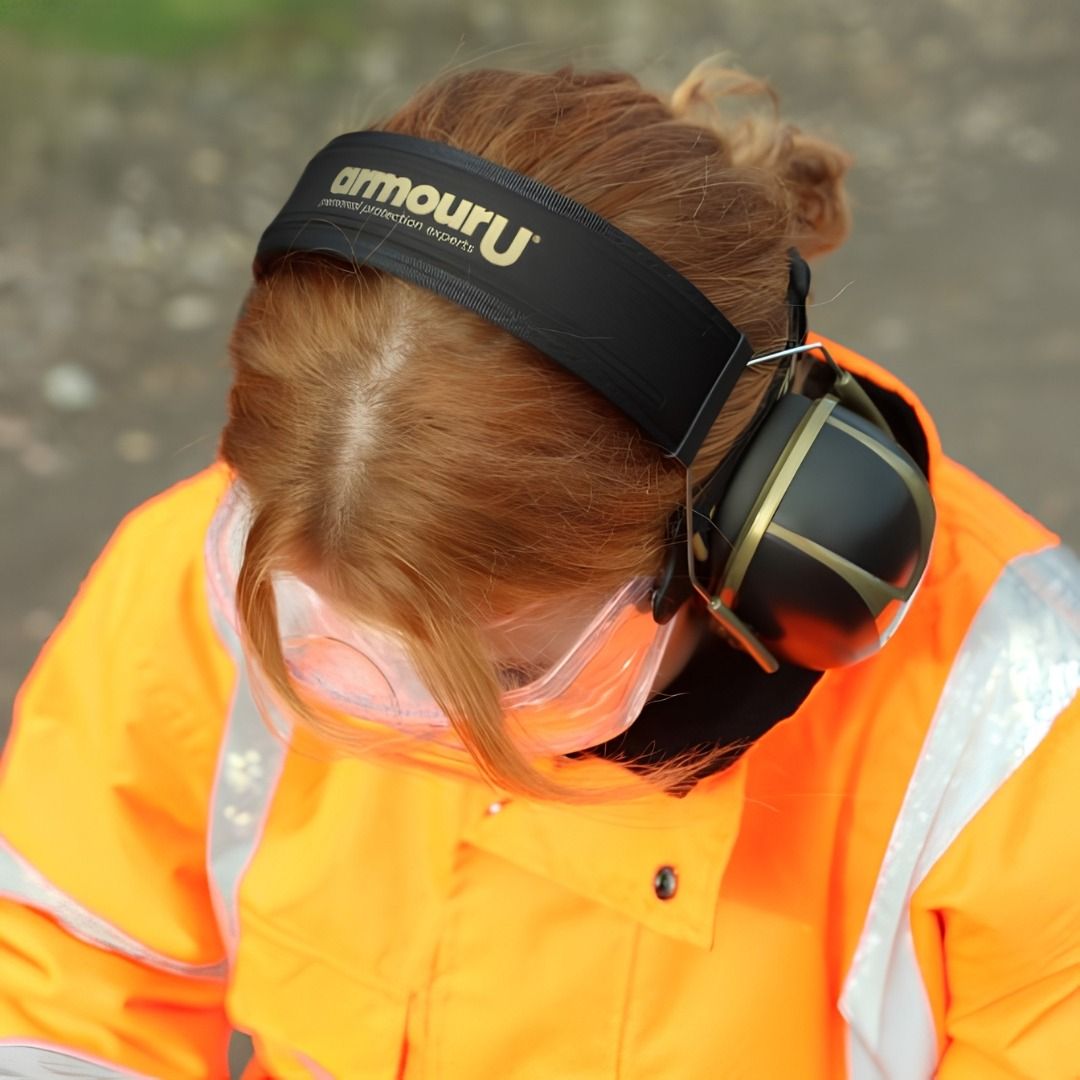
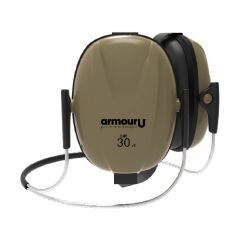
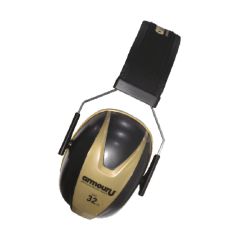
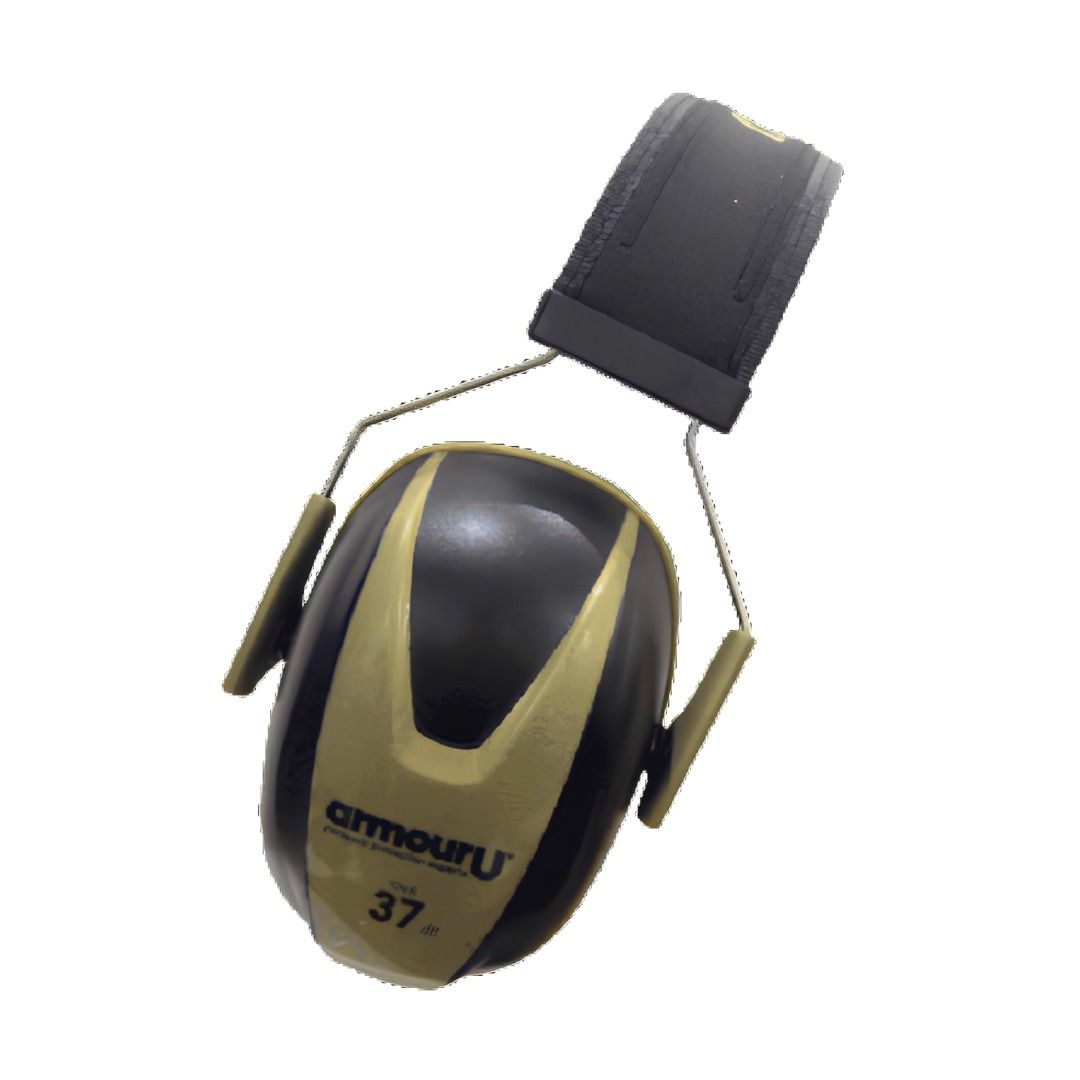
High attenuation ear defenders gold and black memory foam large cup front view SNR 37dB | CMT Group UK
High attenuation ear defenders gold and black memory foam large cup front view SNR 37dB | CMT Group UK Ear defenders SNR 37dB gold and black large cup side view showing adjustable metal arc headband | CMT Group UK

High attenuation ear defenders with SNR 37dB and memory foam cushions for construction, industrial, and manufacturing operatives working in extremely noisy environments.

  • EN 352-1 certified, SNR 37dB (H=39dB, M=35dB, L=27dB)
  • Extra-soft memory foam ear cushions for more comfort 
  • Memory foam padded headband, distributes pressure across long shifts
  • High attenuation large cup, easily adjustable for a secure individual fit
  • Robust construction, approximately 370g
  • Recycled polyester storage bag

armourU El Capitan Ear Defenders - SNR 37dB Memory Foam EN 352-1

Code
AEDHAL37
1690+ In Stock

High attenuation ear defenders with SNR 37dB and memory foam cushions for construction, industrial, and manufacturing operatives working in extremely noisy environments.

  • EN 352-1 certified, SNR 37dB (H=39dB, M=35dB, L=27dB)
  • Extra-soft memory foam ear cushions for more comfort 
  • Memory foam padded headband, distributes pressure across long shifts
  • High attenuation large cup, easily adjustable for a secure individual fit
  • Robust construction, approximately 370g
  • Recycled polyester storage bag
£38.23 £31.86
  • Buy 10 for £34.67 £28.89 each and save 9%
  • Buy 20 for £30.59 £25.49 each and save 20%
  • BULK DISCOUNT 10 20
    Price £28.89 £34.67 £25.49 £30.59

Order 1x to earn 31 FASTPoints

Order to earn 31 FASTPoints

Log in to access trade discounts
1690+ In Stock

armourU El Capitan Ear Defenders - SNR 37dB

High attenuation ear defenders built for construction workers, quarry operatives, and heavy industrial workers in extremely noisy environments where SNR 37dB protection and all-day wearing comfort must be delivered simultaneously. The extra-soft memory foam ear cushions and memory foam padded headband adapt to individual anatomy, distributing pressure evenly and eliminating the discomfort that drives operatives to remove cheaper ear defenders before the shift ends, the compliance gap where the real hearing damage risk sits. Certified to EN 352-1 with SNR 37dB attenuation and tested to AS/NZS and ANSI international standards.

How memory foam in both headband and cushions solves the wearing compliance problem

Standard ear defender foam and PVC cushions maintain a fixed shape against the head, they do not adapt to individual anatomy, creating pressure points behind the ears and across the headband arc that accumulate into significant discomfort across a long shift. Fitting memory foam to the ear cushion only reduces seal pressure but leaves the headband as a source of ongoing discomfort. The El Capitan fits memory foam to both the ear cushions and the headband simultaneously, removing both primary comfort failure points so that the rated 37dB attenuation remains in effect for the duration of the shift, not just the first two hours.

Key Features

  • Extra-soft memory foam ear cushions: The memory foam adapts to individual ear anatomy, creating a consistent acoustic seal that maintains attenuation performance throughout the shift. Unlike standard foam or PVC cushions, memory foam does not harden or generate fixed pressure points during extended wear.

  • Memory foam padded headband: The headband padding distributes arc pressure across the crown without the localised pressure that bare metal or standard foam headbands create over long periods. Combining memory foam in both the cushions and the headband removes the two principal comfort failure points simultaneously.

  • SNR 37dB, high attenuation: At the maximum end of the passive ear defender scale (H=39dB, M=35dB, L=27dB), the El Capitan provides certified protection in the noisiest construction and industrial environments. SNR 37 is the rating specified for quarrying, airports, heavy demolition, and paper mill environments.

  • High attenuation large cup design: The large cup creates a wider acoustic seal area across a greater range of head and ear profiles without compromising attenuation performance. Easily adjustable cups allow independent adjustment on each side for a secure, stable fit.

  • EN 352-1 certified: Tested to the UK and European standard for ear muffs, confirming the SNR, H, M, and L values under standardised octave-band measurement. Also tested to AS/NZS and ANSI international standards.

  • Robust construction: Built for construction and industrial sites where ear defenders are repeatedly removed, stored, and refitted across a shift. The metal headband arc and large cup design withstand the daily handling conditions of site PPE.

Who is this for

Trades and roles:

  • Construction and civil engineering operatives

  • Quarry and aggregate workers

  • Heavy industrial and manufacturing operatives

  • Airport ground crew and maintenance operatives

  • H&S leads managing site hearing protection programmes

Industries:

  • Construction and demolition

  • Quarrying and mining

  • Heavy manufacturing and paper mills

  • Airports and aviation ground operations

  • Utilities and infrastructure

 Specifications

Specification Detail
Product Name armourU El Capitan Ear Defenders - SNR 37dB Memory Foam EN 352-1
SKU AEDHAL37
Product Type Ear defenders (ear muffs) — passive, over-ear
EN Standard EN 352-1
SNR Rating 37dB
H (High frequency attenuation) 39dB
M (Mid frequency attenuation) 35dB
L (Low frequency attenuation) 27dB
Attenuation Level High attenuation — suitable for extremely noisy environments
Additional Certifications AS/NZS and ANSI (international standards)
Cup Type High attenuation large cup
Cup Adjustment Easily adjustable for individual fit
Ear Cushion Material Extra-soft memory foam
Headband Padding Memory foam
Headband Construction Metal arc with memory foam padding
Weight Approximately 370g
Storage Recycled polyester storage bag

Compatibility

Environment and typical noise level SNR 37dB appropriate?
Quarrying and rock breaking — 100 to 115 dB(A) ✓ Appropriate
Airport ground operations — 95 to 115 dB(A) ✓ Appropriate
Heavy demolition and pneumatic breaking — 100 to 115 dB(A) ✓ Appropriate
Paper mills and heavy manufacturing — 95 to 110 dB(A) ✓ Appropriate
Chainsaw operation — 100 to 115 dB(A) ✓ Appropriate
Concrete cutting and disc cutting — 95 to 110 dB(A) ✓ Appropriate
Heavy construction machinery — 90 to 100 dB(A) ✓ Appropriate
General construction site — 85 to 95 dB(A) ⚠ Consider lower SNR to avoid over-protection
Light manufacturing or workshop — 80 to 90 dB(A) ✗ Over-protection risk — lower SNR recommended
Office or light assembly — below 80 dB(A) ✗ Hearing protection not required under NoWR 2005


Who is this for

High attenuation ear defenders used by construction operatives, quarry workers, airport ground crew, and heavy industrial workers in environments where noise levels reach or exceed 100 dB(A) and where the duration of exposure across a full shift makes wearing comfort as important as the rated 37dB attenuation. H&S leads and procurement teams managing site hearing protection programmes specify SNR 37 where the noise risk assessment confirms extremely high ambient noise levels, concrete breaking, heavy demolition, quarrying, and paper mill environments, and where standard SNR 25 to 30 defenders are insufficient to bring personal exposure below the 85 dB(A) mandatory action level.

Typical applications

  • Quarrying and aggregate extraction operations where continuous rock-breaking, crushing, and screening machinery produces sustained noise levels above 100 dB(A).

  • Airport ground operations including aircraft marshalling, engine maintenance, and ramp activities where jet blast and engine noise routinely exceed 100 dB(A).

  • Heavy demolition and concrete breaking using pneumatic breakers, disc cutters, and hydraulic crushers generating sustained high-frequency noise above 95 dB(A).

  • Paper mill and heavy manufacturing environments with continuous machinery noise at high and mid frequencies across full production shifts.

  • Chainsaw, petrol disc cutter, and heavy groundworks machinery operation in civil engineering and utilities where single-tool noise regularly exceeds 100 dB(A).

  • Construction site PPE programmes where the noise risk assessment specifies SNR 35 or above and a single defender model is issued to all operatives in a high-noise zone.

How to use

Step 1: Hold the ear defenders by the headband arc and extend the cups downward until the memory foam ear cushions sit over both ears, covering the full outer ear.

Step 2: Adjust each cup independently using the adjustable sliding mechanism so the memory foam cushion contacts the skin evenly around the full perimeter of the ear without gaps. An incomplete seal significantly reduces attenuation below the rated 37dB.

Step 3: The metal arc headband should sit across the top of the head. The memory foam headband padding distributes this pressure, the pad should contact the crown, not the back of the skull.

Step 4: When removing, pull both cups outward simultaneously from the ear rather than pulling the headband forward, pulling the headband distorts the arc over time.

Step 5: Store in the supplied recycled polyester bag when not in use to protect the memory foam cushions from dust and contamination.

Common mistakes

  • Wearing the headband arc at the back of the neck or back of the head: a correctly worn ear defender headband sits on the crown of the head. Neck-band or rear-band positioning may feel comfortable but breaks the ear cushion seal and reduces attenuation far below the rated SNR 37.

  • Wearing spectacles or safety glasses under the ear cushions: the arm of safety glasses or spectacles breaks the memory foam seal between cushion and face, significantly reducing measured attenuation. Operatives who wear prescription glasses should be aware of this and factor it into their noise risk assessment. Thin-arm safety glasses minimise but do not eliminate this effect.

  • Assuming SNR 37 is appropriate for all sites: SNR 37 in a moderate-noise environment (85 to 90 dB(A)) reduces ear exposure to around 48 to 53 dB(A), below the level where operatives can reliably hear safety-critical signals such as reversing alarms and verbal warnings. Match SNR to the measured noise level, not to the noisiest possible scenario. Use the noise environment guide for initial matching and confirm against a noise risk assessment.

  • Allowing foam cushions to deteriorate: memory foam ear cushions harden and crack with age, reducing both the acoustic seal and the acoustic absorption that contribute to attenuation performance. Replace cushions when cracking, hardening, or deformation is visible, do not attempt to restore them.

Safety

These ear defenders are certified to EN 352-1 with SNR 37dB, H=39dB, M=35dB, L=27dB. They provide passive attenuation of airborne noise reaching the ear, they do not protect against bone-conducted sound, pressure waves from blast events, or hearing loss caused by repeated acoustic shock. Under the Control of Noise at Work Regulations 2005, employers must provide hearing protection where noise exposure reaches the lower exposure action value of 80 dB(A), and hearing protection use is mandatory at the upper exposure action value of 85 dB(A). Always select hearing protection based on the results of a competent noise risk assessment. Do not select SNR 37 where the measured noise level is below 90 dB(A), the over-protection risk reduces awareness of safety-critical signals.

Maintenance

Wipe the memory foam ear cushions and the inner cup surfaces with a damp cloth after each use to remove sweat, skin oils, and debris. Do not submerge in water or use solvent-based cleaners on the memory foam. Inspect the cushions before each use, replace when hardening, cracking, or deformation is visible. Inspect the metal headband arc for deformation and the cup adjustment mechanism for smooth operation. Store in the supplied recycled polyester bag.

Frequently Asked Questions

Q: What does SNR 37dB mean and how do I use it for noise assessment?
A: SNR (Single Number Rating) is the standardised measure of how many decibels of noise attenuation an ear defender provides, tested and certified under EN 352-1. SNR 37dB means that at the exposure levels used for testing, the El Capitan reduces noise reaching the ear by approximately 37dB. In practice, the HSE recommends applying a real-world correction: subtract half the SNR from the measured noise level to estimate actual ear exposure. For example, at 110 dB(A) site noise, estimated ear exposure with SNR 37 defenders is approximately 110 minus 18.5 = 91.5 dB(A),  below the 85 dB(A) upper exposure action value. Always confirm calculations against your noise risk assessment and any HSE guidance on attenuation correction.

Q: What are the H, M, and L values and when do I use them?
A: H (39dB), M (35dB), and L (27dB) are octave-band attenuation values measured under the HML method, which provides more accurate matching to the frequency content of workplace noise than SNR alone. H is the attenuation at high frequencies (2000 to 8000 Hz), relevant for noise dominated by machinery whine, grinders, and saws. M covers mid-range frequencies (500 to 2000 Hz), most speech, general machinery. L covers low frequencies (63 to 500 Hz), relevant for low-frequency dominated noise such as heavy engines and fans. For workplaces where noise is predominantly high-frequency, use the H value in your assessment; where predominantly low-frequency, use L. The HSE noise calculator and your H&S advisor can guide HML application for your specific assessment.

Q: What environments are these defenders NOT appropriate for?
A: SNR 37dB defenders are not appropriate for environments below 90 dB(A), over-protection reduces awareness of safety-critical signals including reversing alarms, machinery fault warnings, and verbal communication. They provide no protection against bone-conducted noise, blast events, or acoustic shock. They are passive defenders with no communication, level-dependent, or Bluetooth capability, for sites requiring inter-operative communication alongside hearing protection, electronic or level-dependent defenders must be specified instead.

Q: Why does memory foam in both the cushion and the headband matter for all-day site wear?
A: Standard ear defender foam and PVC cushions hold a fixed shape, they apply consistent pressure against the anatomy they contact, which accumulates into headache-inducing discomfort after two to three hours. Memory foam deforms under pressure and slowly returns to shape when that pressure is relieved, adapting to individual anatomy rather than imposing a fixed geometry. Fitting memory foam only to the cushions leaves the headband arc as a source of ongoing crown pressure. Fitting memory foam to both, as the El Capitan does, removes both principal pressure failure points simultaneously, allowing the defenders to be worn across a full shift without the discomfort-driven removal that leaves operatives unprotected.

Q: How do safety glasses affect the attenuation of these ear defenders?
A: The arm of any spectacle or safety glass frame breaks the memory foam seal between the ear cushion and the face, creating a gap through which sound bypasses the acoustic attenuation. Even thin spectacle arms measurably reduce attenuation below the rated 37dB, the wider the arm, the greater the gap and the greater the reduction. Operatives who wear prescription glasses or safety glasses must factor this into their noise risk assessment. Thin-arm safety glasses minimise the reduction. For very high-noise environments where the full SNR 37 is required, over-ear or wrap-around eye protection that does not pass through the ear cushion seal should be specified.

Q: How do I know when to replace the memory foam ear cushions?
A: Memory foam cushions should be replaced when hardening, cracking, permanent deformation, or visible deterioration of the foam or the outer fabric cover is present. Deteriorated cushions no longer create a reliable acoustic seal and attenuation performance drops below the certified SNR 37dB without any visible indication on the cup shell. Inspect the cushions before each shift in high-noise environments and replace at the first sign of material change, do not continue using defenders with visibly deteriorated cushions in extremely noisy environments.

Q: How quickly can I get replacement ear defenders to site for an urgent hearing protection requirement?
A: Order by 7pm for next-day delivery nationwide. CMT Group operates its own fleet covering over 95% of the UK mainland, live order tracking from despatch to drop-off, with What3Words integration for precise delivery to a specific site entrance, compound gate, or welfare unit without a postcode. For the most time-critical requirements, VIP 2-hour depot delivery is available.

CMT Equipment Ltd