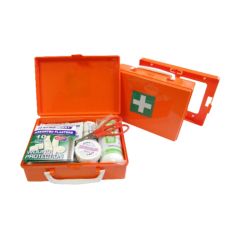
Not sure which first aid kit your workplace needs? This guide compares HSE and BS 8599-1 kits, explains kit sizes by headcount and hazard level, and covers travel kits for drivers and lone workers. Use our kit finder to match your team to the right kit in seconds.
Large workplace first aid kit to BS 8599-1:2019 for factories, warehouses, large offices and construction projects with big workforces.
- Contents to BS 8599-1:2019
- Low hazard - one kit per 100 people
- High hazard - one kit per 25 people
- Green case with carry handle
- 15 item types including 2 resuscitation aids and 3 foil blankets
- Large British Standard First Aid Kit
Large Workplace First Aid Kit - BS 8599-1 Compliant
Large workplace first aid kit to BS 8599-1:2019 for factories, warehouses, large offices and construction projects with big workforces.
- Contents to BS 8599-1:2019
- Low hazard - one kit per 100 people
- High hazard - one kit per 25 people
- Green case with carry handle
- 15 item types including 2 resuscitation aids and 3 foil blankets
- Large British Standard First Aid Kit
- Buy 5 for £50.28 £41.90 each and save 9%
- Buy 10 for £46.14 £38.45 each and save 16%
| BULK DISCOUNT | 5 | 10 |
|---|---|---|
| Price | £41.90 £50.28 | £38.45 £46.14 |
Order 1x to earn 45 FASTPoints
Order to earn 45 FASTPoints
Log in to access trade discountsLarge Workplace First Aid Kit
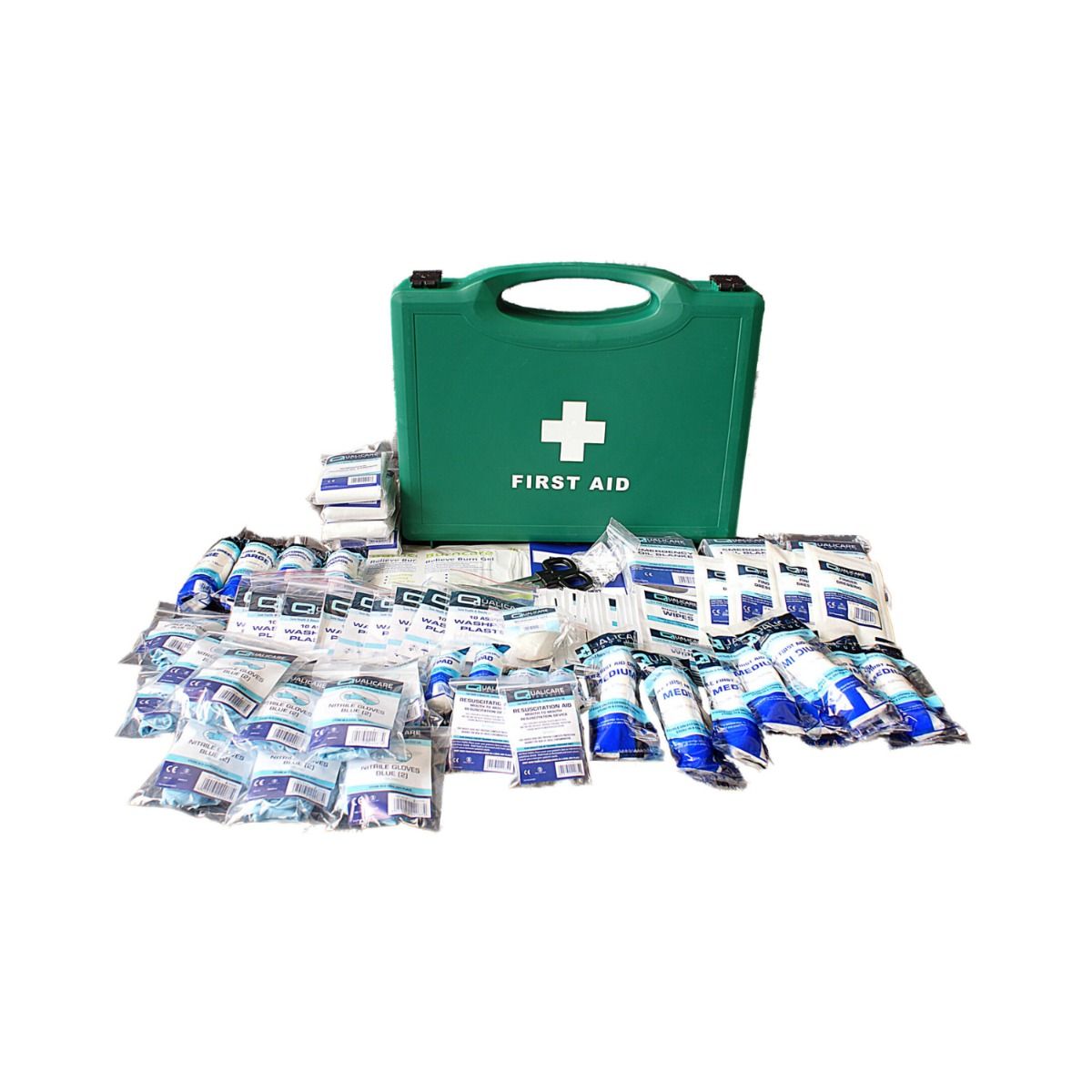
A large workplace first aid kit stocked to the BS 8599-1:2019 contents list for the large kit size. One kit covers up to 100 people in low hazard work or up to 25 people in high hazard work. Dressings, bandages, burn dressings, gloves, foil blankets and two resuscitation aids are packed in a green plastic carry case with a handle and clip latches.
How Large Kit Quantities Cover More Than One Casualty
Falls from height, vehicle strikes and machinery incidents can injure more than one person at once. A smaller kit then runs out of resuscitation aids, foil blankets or dressings before every casualty is treated. The large kit carries two resuscitation aids, three foil blankets and more dressings, so first aiders can treat several people from one kit.
Key Features
-
Large kit quantities: one kit per 100 people in low hazard work, or per 25 people in high hazard work.
-
Two resuscitation aids: two first aiders can give rescue breaths at the same time.
-
Three foil blankets: keeps several casualties warm while waiting for ambulances.
-
Twelve pairs of nitrile gloves: enough for a team of first aiders across repeated incidents.
-
100 assorted plasters: keeps up with the minor cuts that come with a large workforce.
-
Green case with white cross and handle: easy to spot at the first aid point and quick to carry to an incident.
Who is this for
Trades and roles
-
First aiders
-
Appointed persons
-
Site managers
-
Health and safety managers
-
Facilities managers
-
Production and operations managers
-
Procurement teams
Industries
-
Construction and civil engineering
-
Manufacturing and engineering
-
Warehousing and logistics
-
Facilities management
-
Education and public sector
-
Large offices and retail
Specifications
| Specification | Detail |
|---|---|
| Product name | Large Workplace First Aid Kit - BS 8599-1 Compliant |
| Product code | AKWL |
| Product type | Workplace first aid kit |
| Standard | BS 8599-1:2019 Workplace first aid kits - Specification for the contents of workplace first aid kits |
| Kit size | Large |
| Size guidance (BS 8599-1:2019) | Low hazard: one kit per 100 people. High hazard: one kit per 25 people |
| Item types | 15 |
| Case | Green plastic carry case with handle, two clip latches and white cross |
| Case dimensions | 29cm x 35cm x 8cm |
| Brand | Qualicare |
| Colour | Green |
Kit Contents
| Item | Quantity |
|---|---|
| Burn Dressing 10cm x 10cm | 2 |
| Cleansing wipes | 40 |
| Conforming bandage | 2 |
| Finger dressing | 4 |
| Foil blanket | 3 |
| Gloves nitrile (pair) | 12 |
| Guidance note | 1 |
| HSE eyepad dressing | 4 |
| HSE large dressing | 2 |
| HSE medium dressing | 8 |
| Microporous tape | 1 |
| Plasters assorted | 100 |
| Resuscitation Aid | 2 |
| Scissors tuffcut | 1 |
| Triangular bandage | 4 |
| Total | 186 pieces (If each glove counts separately, it’s 198) |
Compatibility
| Workplace or condition | Suitability |
|---|---|
| Low hazard workplace, over 100 people (offices, shops, libraries) | Suitable, one large kit per 100 people |
| High hazard workplace, over 25 people (construction, warehousing, engineering) | Suitable, one large kit per 25 people |
| Smaller teams (low hazard under 100, high hazard under 25) | Suitable, though a small or medium kit meets the standard’s guidance |
| Workforce spread over several floors, buildings or zones | Not recommended as a single kit, add kits so each area has one close by |
| Vehicles and travelling workers | Not recommended, use a vehicle or travel kit |
| Risk of eye contamination from dust or chemicals | Not recommended on its own, add an eye wash station |
| Serious bleeding or major trauma risk | Not recommended on its own, add a trauma kit |
Typical Users and Projects
Large kits are bought for factories, distribution centres, major construction projects and large public buildings. They usually serve as the main kit in a medical room or main welfare unit, with smaller kits placed around the site. A team of trained first aiders often shares them across shifts.
Typical applications
-
Stocking the main first aid room in a factory or production site.
-
Equipping the main welfare unit on a construction project with a crew of up to 25 per kit.
-
Covering a distribution centre floor where vehicles and manual handling raise the hazard level.
-
Supplying a large office, campus or public building with one kit per 100 people.
-
Replacing a large kit stocked to the superseded 2011 contents list.
-
Providing the central kit that smaller kits around a site are restocked from.
How to use
Step 1: Complete a first aid needs assessment and work out how many large kits your headcount and hazard level need.
Step 2: Place the kit at the main first aid point, and display a first aid sign.
Step 3: Add smaller kits in outlying areas so first aid is close to every team.
Step 4: In an incident, put on nitrile gloves before touching any wound, then follow the guidance note.
Step 5: Record each incident and the items used in the accident book.
Step 6: Replace used items straight away.
Common mistakes
-
Buying one large kit for a high hazard workforce of more than 25 people.
-
Relying on one central kit on a large site where some teams work a long way from it.
-
Taking items out to restock smaller kits without replacing them.
-
Keeping sterile items past their expiry date.
-
Relying on the kit for eye contamination without an eye wash station nearby.
Safety
Only trained first aiders or appointed persons should treat casualties. Wear gloves for every treatment and dispose of used items safely. For serious injuries, call 999 first. The Health and Safety (First Aid) Regulations 1981 and HSE guidance L74 require employers to assess their first aid needs, including the number of kits and first aiders.
Maintenance
Check the kit monthly, after every use and at shift handovers on busy sites. Replace used items and anything past its expiry date or with damaged packaging. Store the kit in a cool, dry place.
Frequently Asked Questions
Q: How many large first aid kits do I need?
A: BS 8599-1:2019 suggests one large kit for every 100 people in a low hazard workplace. In a high hazard workplace, it suggests one large kit for every 25 people. A factory of 300 low hazard staff would need three, and a construction site with 60 workers would need three. Your first aid needs assessment should confirm the final number.
Q: What does Large mean on a BS 8599-1 first aid kit?
A: Large is the biggest of the three workplace kit sizes in BS 8599-1. It holds the highest quantity of each item, including two resuscitation aids. The size relates to headcount and hazard level, not to the case dimensions.
Q: What does BS 8599-1:2019 stand for?
A: BS is short for British Standard, and 8599 is the number of the first aid kit standard. The -1 marks Part 1, which covers workplace kits, while Part 2 covers vehicle kits. 2019 is the year of the current edition, which replaced the 2011 edition.
Q: What is a large kit not suitable for?
A: One large kit is not enough for low hazard workplaces over 100 people or high hazard teams over 25. It is not a vehicle or travel kit. It has no eye wash or catastrophic bleeding items, so add an eye wash station or trauma kit where those risks exist.
Q: Should I buy a large kit or two medium kits?
A: A large kit suits one main first aid point serving a big team. Two medium kits suit a workforce split between two areas, as each area gets its own kit. Check which option meets your needs assessment and keeps first aid close to every team.
Q: Is a large kit enough for a construction site?
A: Construction is usually assessed as high hazard, so one large kit covers up to 25 workers. A site with more workers needs more kits. Keep the main kit in the welfare unit, and place others near work areas that are far from it.
Q: How should we manage a large kit used across shifts?
A: Name one person to own the kit and check it at each shift handover on busy sites. Replace used items straight away and keep a short record of each check. That keeps the kit complete for the next shift.