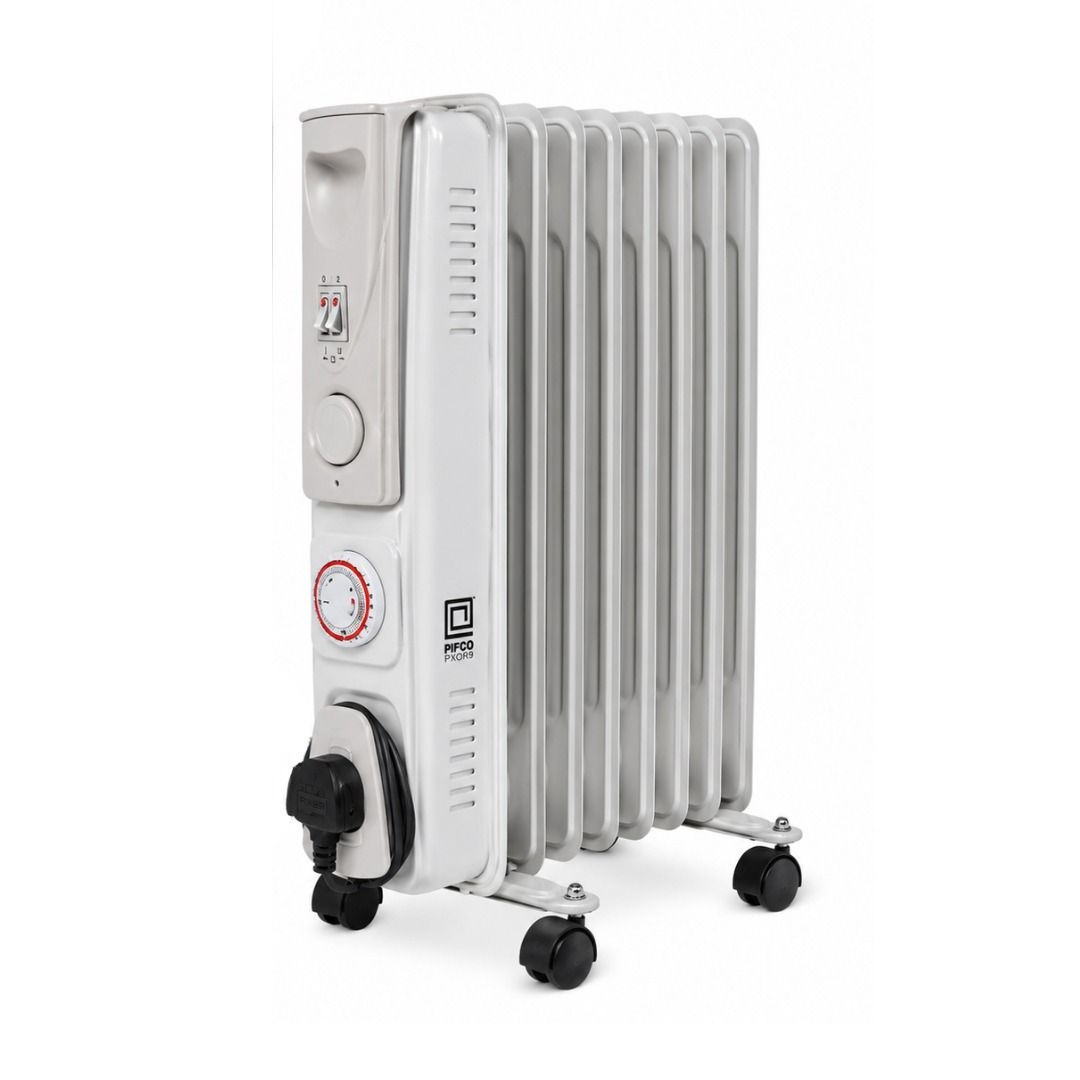
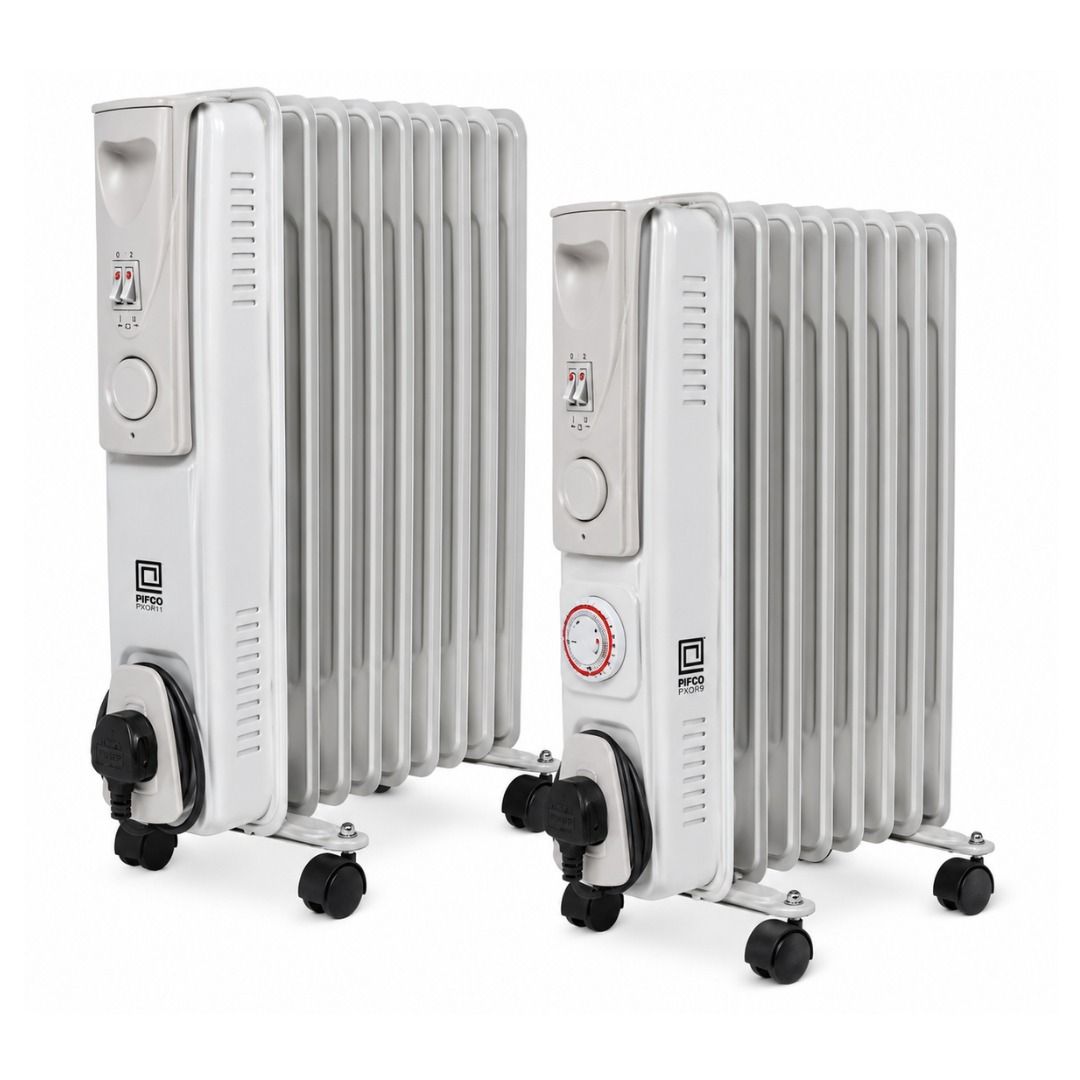
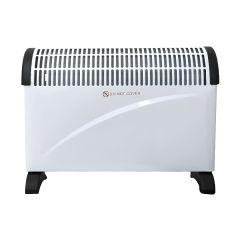
Portable oil filled radiator with a 24-hour mechanical timer for programmed heating of site offices, welfare cabins, and portakabins on 240V mains supply.
- 24hr mechanical timer for scheduled on and off periods
- 3 confirmed heat settings: 0.8kW, 1.2kW, and 2.0kW maximum
- Adjustable mechanical thermostat for automatic temperature maintenance
- Overheat protection and tip-over protection, both with automatic shut-off
- Castor wheels, integrated carry handle, and cord storage
- CE marked, 220-240V AC mains connection
240V Portable Oil Filled Radiator 2kW - 24hr Timer
Portable oil filled radiator with a 24-hour mechanical timer for programmed heating of site offices, welfare cabins, and portakabins on 240V mains supply.
- 24hr mechanical timer for scheduled on and off periods
- 3 confirmed heat settings: 0.8kW, 1.2kW, and 2.0kW maximum
- Adjustable mechanical thermostat for automatic temperature maintenance
- Overheat protection and tip-over protection, both with automatic shut-off
- Castor wheels, integrated carry handle, and cord storage
- CE marked, 220-240V AC mains connection
- Buy 3 for £162.00 £135.00 each and save 9%
- Buy 6 for £154.80 £129.00 each and save 13%
| BULK DISCOUNT | 3 | 6 |
|---|---|---|
| Price | £135.00 £162.00 | £129.00 £154.80 |
Order 1x to earn 149 FASTPoints
Order to earn 149 FASTPoints
Log in to access trade discounts240V Portable Oil Filled Radiator 2kW - 24hr Timer and Tip-Over Protection
Portable oil filled radiator with a 24-hour mechanical timer for welfare cabins, portakabins, and site offices where heating needs to follow a shift pattern without manual intervention. Three confirmed heat settings of 0.8kW, 1.2kW, and 2.0kW give site managers the flexibility to match output to the size of the space and the season. Tip-over protection provides an additional automatic safety shut-off if the unit is knocked or displaced, alongside the standard overheat cut-off.
How a 24-hour timer removes cold starts and wasted heat from site welfare
Without a timer, a welfare cabin heater is either left running through unstaffed periods, burning energy overnight or over weekends, or switched off entirely, leaving operatives to a cold cabin at the start of each shift. Neither outcome is acceptable on a well-managed site. The 24-hour mechanical timer allows the heating schedule to be aligned with the site's shift pattern: set it to begin warming the cabin 30 to 60 minutes before operatives arrive and cut off automatically at the end of the working day. The cabin is warm when it needs to be, off when it does not, and no manual action is required at either end of the shift.
Key Features
-
24-hour mechanical timer: Push-down segment dial allows heating periods to be programmed in 15-minute intervals across a full 24-hour cycle. Set it to the site shift pattern and leave it, no daily intervention required.
-
Tip-over protection: An automatic cut-off activates if the unit is knocked over or displaced, which is a meaningful safety feature in welfare cabins where space is tight and operatives are moving around. This is in addition to the overheat protection.
-
Three confirmed heat settings: 0.8kW for mild conditions in small spaces, 1.2kW for medium load, and 2.0kW maximum for cold starts or larger enclosures. Selecting a lower setting once the cabin is at temperature reduces running costs across a full shift.
-
Adjustable mechanical thermostat: Works in combination with the timer, the thermostat cycles the element on and off within the programmed heating window to hold the cabin at the set temperature without continuous power draw.
-
Overheat protection: Independent of the tip-over protection, this thermal cut-off shuts the unit off if internal temperatures exceed safe limits regardless of position or obstruction.
-
4 castor wheels and integrated carry handle: Allows repositioning within or between welfare facilities without lifting. The carry handle supports two-person transport across site.
-
Integrated cord storage: Cable stows on the unit during storage and transit, reducing trip hazard risk in confined welfare cabin spaces.
Who is this for
Trades and roles:
-
Site managers
-
Welfare facilities managers
-
Facilities managers
-
Site supervisors
-
Security and gatehouse personnel
Industries:
-
Construction
-
Civil engineering
-
Utilities
-
Facilities management
-
Events and temporary structures
Specifications
| Specification | Detail |
| Product Name | 240V Portable Oil Filled Radiator 2kW - Site Office and Welfare Cabin |
| SKU | SOFR20 |
| Product Type | Portable freestanding oil filled radiator |
| Rated Power | 2000W (2kW) |
| Voltage | 220-240V AC |
| Frequency | 50/60Hz |
| Heat Settings | 3 settings: 0.8kW (low), 1.2kW (medium), 2.0kW (maximum) |
| Thermostat | Adjustable mechanical thermostat |
| Number of Fins | 9 |
| Safety Features | Overheat protection with automatic shut-off |
| Mobility | 4 castor wheels, integrated carry handle |
| Cord Management | Integrated cord storage |
| Mains Plug | UK Type G (BS 1363) |
| Setup Required | Castor feet attachment before first use |
| Certification | CE marked |
| Compliance | WEEE registered |
| Use Environment | Indoor use only |
| Colour | White |
Compatibility
| Application or condition | Status |
| Site welfare cabins and rest facilities | ✓ Suitable |
| Modular site offices and portakabins | ✓ Suitable |
| Site canteens and meal break areas | ✓ Suitable |
| Security and gatehouse cabins | ✓ Suitable |
| Drying rooms for PPE and workwear | ✓ Suitable |
| Domestic rooms and small home offices | ✓ Suitable |
| Enclosed spaces up to approx. 20m² | ✓ Suitable |
| Outdoor use | ✗ Not suitable |
| Wet or damp environments | ✗ Not suitable |
| Areas with flammable liquids or gases | ✗ Not suitable |
| Use with extension lead or external timer | ✗ Not suitable |
| Large, open, or poorly insulated spaces | ✗ Not suitable |
| Primary heat for large welfare complexes | ✗ Not suitable |
Who is this for
The portable oil filled radiator with 24-hour timer is used primarily by site managers and welfare facilities managers who need heating in welfare cabins, portakabins, and site offices to follow a fixed shift pattern without daily manual operation. It suits projects where the welfare cabin is unstaffed for significant periods, overnight, at weekends, or between shifts, and where leaving a heater running through those periods is not acceptable from an energy management or site safety perspective. It is equally relevant to security and gatehouse cabins where personnel work rotating shifts and the cabin needs pre-warming before each changeover.
Typical applications
-
Pre-heating a site welfare cabin before the morning shift starts, using the timer to begin heating 30 to 60 minutes before operatives arrive, so the space is at temperature when the first break falls.
-
Programming automatic shut-off at the end of the working day in a site office or welfare facility, eliminating the risk of the heater being left on overnight through oversight.
-
Reducing energy waste in portakabin site offices over weekends by setting the timer to run only on weekday hours, rather than leaving heating on a continuous manual setting throughout the project.
-
Providing programmed background heating in security and gatehouse cabins between shift changeovers, where the cabin would otherwise cool rapidly during unmanned intervals.
-
Supplementing welfare cabin heating on domestic and small commercial projects where a scheduled rather than continuous heating approach is required.
-
Providing background heat in drying rooms where PPE and workwear are hung overnight, using the timer to maintain a drying temperature during off-hours without continuous supervision.
How to use
Step 1: Attach the castor feet before first use. Lay the unit upside-down on a stable, scratch-free surface and fit each castor mounting plate using the U-bolts and wing nuts supplied. Do not overtighten.
Step 2: Set all switches and the thermostat to the OFF position before inserting the mains plug into a 240V wall socket directly. Do not use an extension lead.
Step 3: Set the current time on the 24-hour timer dial. Rotate the dial until the arrow or marker aligns with the current time on the dial face.
Step 4: Programme the heating periods by pressing down the segments on the timer dial for each 15-minute interval during which heating is required. Segments left raised will be OFF periods. Segments pressed down will be ON periods. Set ON segments to cover the shift period plus 30 to 60 minutes before operatives arrive.
Step 5: Rotate the thermostat knob to the maximum position and select the required heat setting. 0.8kW suits small, well-insulated spaces; 1.2kW suits medium cabins; 2.0kW suits larger spaces or cold-start conditions.
Step 6: Once the cabin reaches the target temperature, dial the thermostat back slowly until the indicator light goes out. The thermostat will now cycle automatically within the programmed ON periods to hold that temperature without running at full power continuously.
Step 7: The timer will switch the unit on and off automatically according to the programmed pattern. No further daily input is needed unless the shift pattern changes.
Common mistakes
-
Not setting the current time on the timer dial: The timer runs relative to the position of the dial. If the dial is not set to the correct current time before programming, the heating periods will be offset from the intended schedule and the cabin will heat at the wrong times.
-
Programming ON periods without setting the thermostat: The timer controls when the heater can operate, but the thermostat controls whether the element actually runs within that window. If the thermostat is left at minimum or off, the heater will not produce heat even during programmed ON periods.
-
Selecting maximum output for the entire shift: Running at 2.0kW continuously when 0.8kW or 1.2kW would maintain the required temperature significantly increases running costs over a full project. Select the lowest setting that keeps the cabin at the required temperature once it is up to temperature.
-
Covering the unit during programmed overnight periods: If combustible materials are placed near or over the unit during unmanned hours, the timer will activate the heater against an obstruction. Maintain the 1 metre clearance at all times regardless of whether the timer is set for overnight periods.
-
Using the timer in place of the tip-over protection: The timer schedules operation but does not detect displacement or obstruction. Tip-over protection activates on a physical trigger. Both systems operate independently and neither replaces correct positioning on a stable, flat surface.
Safety
The oil filled radiator with timer is designed for indoor use on 240V mains supply only. Do not use outdoors, in wet or damp environments, or where flammable liquids or gases are present. Do not connect via an extension lead. Tip-over protection shuts the unit off automatically if it is displaced from the upright position. Overheat protection shuts it off if internal temperature exceeds safe limits. Both systems are secondary safety measures and do not replace correct positioning and the mandatory 1 metre combustible clearance at the front of the unit, and clear of the sides and rear. When programming the timer for unmanned periods, ensure the unit is on a flat stable surface and all clearances are maintained before leaving the space. The mains cord must not be run under floor coverings or across traffic routes. If the cord shows any damage, remove from service immediately and arrange replacement through a qualified service agent.
Maintenance
Unplug from the mains and allow the unit to cool fully before cleaning. Wipe external surfaces with a soft, slightly damp cloth only. Do not use detergents, solvents, or abrasive materials. Do not direct water at the unit or immerse it. The oil system is factory-sealed and requires no maintenance under normal operating conditions. The timer mechanism requires no lubrication or servicing. If the timer fails to switch on or off at the programmed times, check that the current time is correctly set on the dial before contacting a service agent. At end of life, dispose of in accordance with WEEE regulations and local authority guidance on oil-containing electrical equipment.
Frequently Asked Questions
Q: How do I set the 24-hour mechanical timer correctly?
A: First, rotate the timer dial until the current time aligns with the marker or arrow on the dial face, this sets the clock. Then press down the segments around the dial for every 15-minute interval during which you want the heater to operate, and leave raised any segments that should be off periods. The dial rotates continuously with time, switching the heater on when a pressed-down segment reaches the marker and off when a raised segment reaches it. Set your ON window to begin 30 to 60 minutes before the cabin is occupied so the space is at temperature when operatives arrive.
Q: What are the three heat settings and when should each be used?
A: The three confirmed output levels are 0.8kW (low), 1.2kW (medium), and 2.0kW (maximum). The 0.8kW setting is sufficient to maintain temperature in a small, well-insulated cabin once it has reached the target temperature. The 1.2kW setting suits medium-sized welfare cabins or mild cold conditions where the lower setting cannot keep up. The 2.0kW maximum is appropriate for cold starts in larger spaces or during the pre-heat period before a shift begins. For energy management across a long project, dropping to a lower setting once the cabin is up to temperature makes a meaningful difference in running costs.
Q: What is the difference between tip-over protection and overheat protection on this unit?
A: They are two independent safety systems that respond to different situations. Tip-over protection is a physical trigger that shuts the unit off automatically if it is knocked over or displaced from the upright position, it is particularly relevant in welfare cabins where the unit may be near operatives moving in a confined space. Overheat protection is a thermal trigger that monitors internal temperature and shuts the unit off if any part of the radiator exceeds safe operating limits, including if airflow around the fins becomes obstructed. Both systems cut power automatically without requiring manual intervention.
Q: What is this radiator not suitable for?
A: This unit is for indoor use in dry, enclosed spaces on 240V mains supply only. It must not be used outdoors, in bathrooms, shower facilities, or any area exposed to water ingress or moisture. It is not suitable for areas where flammable liquids, gases, or vapours are present. It must not be connected via an extension lead, and it must not be used with external remote control systems beyond its own built-in timer and thermostat. It will not maintain adequate temperature in large, open, or poorly insulated spaces, and is not a substitute for a dedicated commercial heating system in large welfare complexes.
Q: Does the timer and the thermostat work together or does one override the other?
A: Both operate in combination, not in competition. The timer determines when the heater is allowed to run at all, controlling the on and off schedule across a 24-hour period. The thermostat operates within those programmed windows, cycling the heating element on and off to hold the cabin at the set temperature without running at full power continuously. Outside the timer's programmed ON window, the heater does not run regardless of thermostat position. Within the ON window, the thermostat takes over moment-to-moment temperature control. Setting both correctly is what delivers efficient and comfortable welfare cabin heating.
Q: Can I use the timer to pre-heat the cabin before the site opens without being on site?
A: Yes, this is the primary practical application of the timer in a site welfare context. Set the ON period to begin 30 to 60 minutes before your first operatives arrive and the cabin will be at temperature when the site opens. Ensure before leaving the previous day that the unit is correctly positioned with 1 metre clearance from all combustibles, the castor feet are stable on a flat surface, and the mains cord is clear of floor coverings and traffic routes.
Q: How long does a unit typically last under regular site welfare use?
A: The oil system is factory-sealed and the mechanical timer and thermostat have no consumable parts requiring replacement under normal use. Service life depends primarily on how the unit is handled during relocation between site spaces and on whether maintenance steps, wiping down after use, correct storage, cord inspection, are followed consistently. The most common causes of early failure are physical damage during transit and continued use with a damaged mains cord. Inspect the cord before each shift season begins.