Self-Drill Plasterboard Fixings with Screws | CMT Group UK
Self-Drill Plasterboard Fixings with Screws | CMT Group UK Self-drill plasterboard fixing in bright zinc alloy with drill point | CMT Group UK Zinc alloy drywall anchor with needle point and coarse thread | CMT Group UK Nylon self-drill plasterboard fixing with wide thread | CMT Group UK Zinc alloy Plasterboard fixing with screw holding a timber batten to a stud wall | CMT Group UK Nylon Plasterboard fixing with screw holding a timber batten to a stud wall | CMT Group UK

Self-drill plasterboard fixings in zinc alloy and nylon for light fixings into plasterboard walls, for electricians, drylining and fit-out trades.

  • Self-drilling, no pilot hole needed
  • Recommended tensile 0.06 kN, shear 0.18 kN
  • Zinc alloy and nylon versions
  • Pozi No2 drive
  • Supplied with 4.5mm screws
  • Available in multiple sizes (The first number is the plug length. The screw size is the thread diameter x screw length)

    Sizes marked (TO ORDER) may not be available from stock for same-day or next-day delivery. Please contact our team to confirm delivery dates.

J-Plug Self-Drill Plasterboard Fixings - With Screws

Code
JJP
In stock

Self-drill plasterboard fixings in zinc alloy and nylon for light fixings into plasterboard walls, for electricians, drylining and fit-out trades.

  • Self-drilling, no pilot hole needed
  • Recommended tensile 0.06 kN, shear 0.18 kN
  • Zinc alloy and nylon versions
  • Pozi No2 drive
  • Supplied with 4.5mm screws
  • Available in multiple sizes (The first number is the plug length. The screw size is the thread diameter x screw length)

    Sizes marked (TO ORDER) may not be available from stock for same-day or next-day delivery. Please contact our team to confirm delivery dates.
Grouped product items
J-Plug Self-Drill Plasterboard Fixing Metal - 4.5 x 35mm - Box of 100 Code JJP15
£15.78 £13.15
Bulk Discounts
J-Plug Self-Drill Plasterboard Fixing Metal - 4.5 x 50mm - Box of 100 Code JJP30
£18.35 £15.29
Bulk Discounts
J-Plug Plasterboard Fixing 30mm x 40mm - Box of 100 Code JJP30A
£16.61 £13.84
Bulk Discounts
J-Plug Plasterboard Fixing 15mm x 25mm - Box of 100 Code JJP15A
£15.10 £12.58
Bulk Discounts
J-Plug Plasterboard Fixing - 4.5mm x 30mm - Box of 100 Code JJPN10A
£6.78 £5.65
Bulk Discounts

Self-Drill Plasterboard Fixings 

Self-drill plasterboard fixings cut their own thread into plasterboard, so items can be fixed to stud partitions and dry-lined walls without drilling a pilot hole. Electricians, drylining contractors and fit-out trades use them for light fixings such as electrical fittings, curtain rods and skirting. Zinc alloy and nylon versions cover fixture thicknesses from 10mm to 30mm.

How a Self-Drilling Thread Holds Where Standard Plugs Crumble

A standard wall plug relies on expanding against a solid hole wall, and plasterboard is too soft for that. On site, the plug spins or crushes the gypsum, the fixture pulls loose and the board needs patching. A self-drill fixing screws in with a wide, coarse thread that grips a larger area of board, so the load is spread instead of resting on a crumbling hole.

Key Features

  • Self-drilling point: the fixing screws straight into the board, so there is no drill and no pilot hole.

  • Wide coarse thread: grips a larger area of plasterboard than an expanding plug, spreading the load.

  • Zinc alloy and nylon versions: both carry the same recommended loads, so choose by fixture thickness.

  • Pozi No2 drive: one bit drives both the plug and the screw.

  • Published tensile and shear loads: separate figures for pull-out and for weight hanging down the wall.

Who is this for

Trades and roles

  • Electricians

  • Drylining contractors

  • Carpenters and joiners

  • Shopfitters

  • Decorators

  • Maintenance teams

Industries

  • Construction

  • Housebuilding

  • Commercial fit-out

  • Facilities management

  • Social housing maintenance

 Specifications

Specification Detail
Product name Self-Drill Plasterboard Fixings - With Screws
Product code JJP
Product type Self-drill plasterboard fixing
Base material Plasterboard
Installation Self-drilling, no pilot hole
Recommended tool Hand screwdriver, Pozi No2
Drive Pozi No2, fixing and screw
Screw thread diameter 4.5mm
Screw head diameter 9mm
Rec. tensile load 0.06 kN
Rec. shear load 0.18 kN
Plug materials Zinc alloy, nylon
Plug lengths 29mm, 32mm, 37mm

Size Selection

Product code Plug material Plug length Screw size Max fixture thickness
JJPN10A Nylon 29mm 4.5mm x 30mm 10mm
JJP15A Zinc alloy 32mm 4.5mm x 35mm 15mm
JJP30A Zinc alloy 32mm 4.5mm x 50mm 30mm
JJP15 Zinc alloy 37mm 4.5mm x 35mm 15mm
JJP30 Zinc alloy 37mm 4.5mm x 50mm 30mm

Size key: in 32mm with a 4.5mm x 35mm screw, 32mm is the plug length. The screw size is the thread diameter x screw length.

Compatibility

Base material, tool or condition Suitability
Plasterboard Suitable
Hand screwdriver Suitable
Power screwdriver Not recommended at speed, can strip the thread in the board, use low speed and torque
Light wall fixings Suitable within the recommended loads
Solid masonry Not recommended, use a wall plug
Heavy items such as TVs or wall cupboards Not recommended, fix into a stud or use a rated cavity fixing
Overhead or safety-critical fixings Not recommended, use a cavity fixing rated for the load


Typical Users and Projects

Second fix, fit-out and maintenance trades use self-drill plasterboard fixings on new build housing, office fit-outs and refurbishment. Most fixings go into stud partitions and dry-lined walls where there is no timber or metal stud behind the fixing point. They are chosen for speed on light fixings, where drilling and plugging would take longer.

Typical applications

  • Fixing surface mounted electrical fittings and trunking to plasterboard walls between studs.

  • Fixing curtain rod and blind brackets to dry-lined walls and reveals.

  • Fixing skirting boards to plasterboard partitions where studs do not line up.

  • Hanging pictures and notice boards in offices, schools and housing.

  • Refixing loose light fittings during maintenance and refurbishment work.

How to use

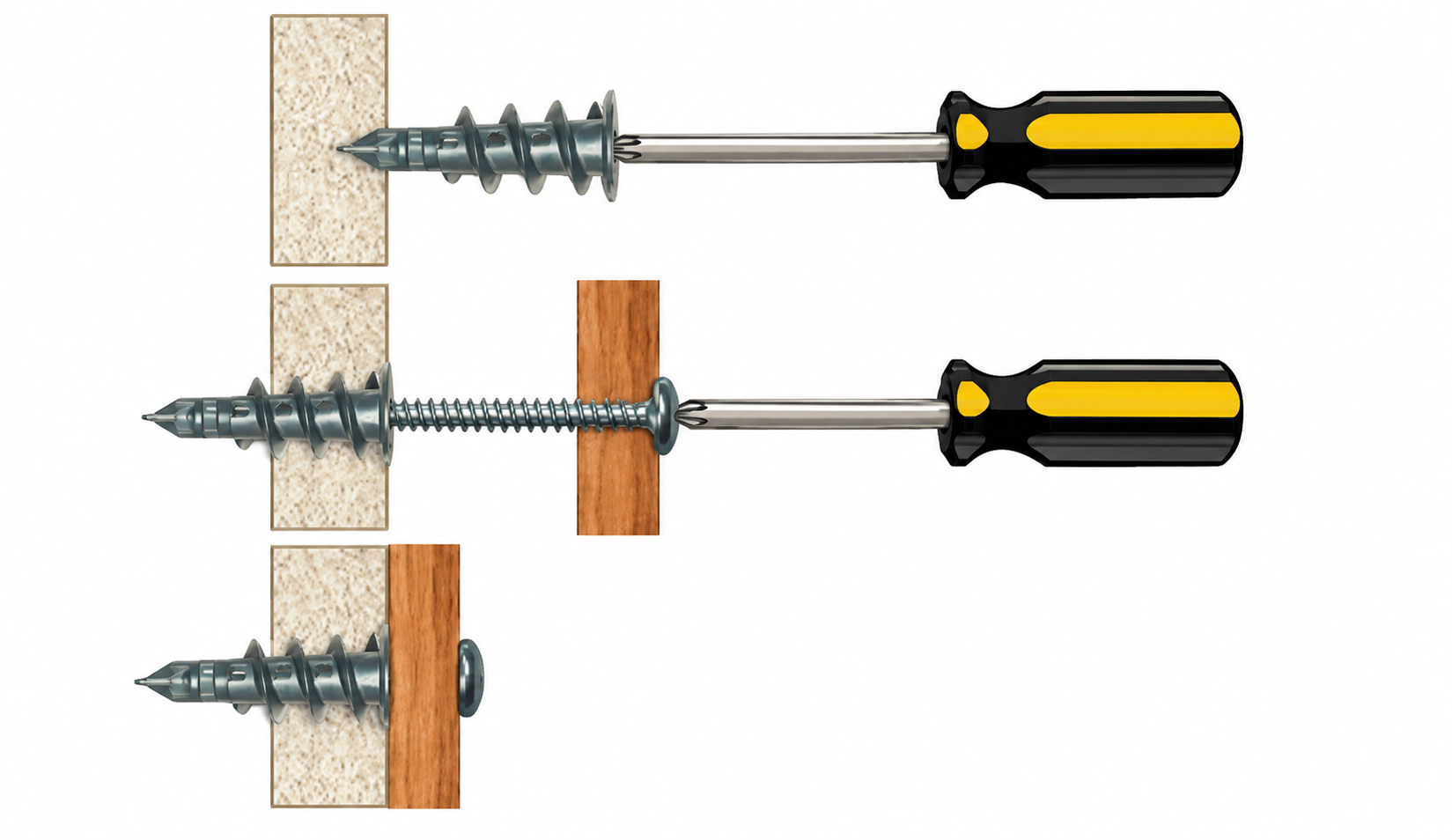
Step 1: Choose the size by the thickness of the item being fixed, using the Size Selection table.

Step 2: Check for cables and pipes behind the board at the fixing point.

Step 3: Press the point into the board and screw the fixing in with a Pozi No2 hand screwdriver until the head sits flush.

Step 4: Hold the item in place and insert the screw through it into the fixing.

Step 5: Tighten by hand until secure. Do not overtighten.

Common mistakes

  • Driving the fixing in with a power screwdriver, which can strip the thread in the board.

  • Overtightening the screw, which spins the fixing and loosens its grip.

  • Using a size too short for the fixture, so the screw does not fully engage the fixing.

  • Hanging heavy items such as TVs or wall cupboards from plasterboard fixings alone.

  • Using plasterboard fixings in solid masonry, where a wall plug is needed.

Safety

Check for hidden cables and pipes before fixing, using a detector where needed. Keep within the recommended tensile and shear loads. For heavy, overhead or safety-critical fixings, fix into a stud or use a cavity fixing rated for the load.

Maintenance

Store fixings dry in their pack until use. Check fixtures during planned maintenance and refix any that have worked loose in a fresh position.

Frequently Asked Questions

Q: Which size self-drill plasterboard fixing do I need?
A: Choose by the thickness of the item being fixed. The 29mm nylon fixing takes items up to 10mm thick. The zinc alloy fixings with 35mm screws take up to 15mm, and those with 50mm screws take up to 30mm.

Q: What do 32mm and 4.5mm x 35mm mean on a plasterboard fixing?
A: The 32mm is the length of the fixing that goes into the board. The 4.5mm x 35mm is the screw, with a 4.5mm thread diameter and a 35mm length. The screw length sets the maximum thickness of the item you can fix.

Q: How much weight can a self-drill plasterboard fixing hold?
A: Each fixing has a recommended tensile load of 0.06 kN, about 6kg, and a recommended shear load of 0.18 kN, about 18kg. Tensile is a pull straight out of the wall, and shear is weight hanging down the wall. Use several fixings to share the load on wider items.

Q: What are these fixings not suitable for?
A: They are not suitable for solid masonry, heavy items such as TVs or wall cupboards, or overhead and safety-critical fixings. For those, fix into a stud or use a cavity fixing rated for the load.

Q: Should I choose zinc alloy or nylon plasterboard fixings?
A: Both have the same recommended loads. The nylon fixing suits items up to 10mm thick. The zinc alloy fixings take thicker items, up to 15mm or 30mm depending on the screw.

Q: Can I use a power screwdriver?
A: The manufacturer's installation instructions use a hand screwdriver for both the fixing and the screw. A power screwdriver can drive too fast and strip the thread in the board, so set any driver to a low speed and torque.

Q: Do I need to drill a pilot hole?
A: No. The self-drilling point cuts its own way into plasterboard, so the fixing screws straight in with a Pozi No2 screwdriver.

Q: How do I remove a self-drill plasterboard fixing?
A: Take out the screw, then unscrew the fixing anticlockwise with a Pozi No2 screwdriver. Fill and sand the hole before redecorating.

CMT Equipment Ltd