A practical 2026 guide to choosing the right wheelbarrow, sack truck, drum lifter, or pallet truck for your site, comparing every CMT Group model side by side so you can specify with confidence and avoid costly downtime.
Heavy duty steel frame sack trucks with knuckle guard handles and fixed toe plate, built for transporting heavy goods in commercial, construction, and industrial environments.
- Knuckle guard handles for hand protection and secure grip
- Fixed toe plate for structural robustness
- In-built axle for durability under repeated daily loading
- SCT02: pneumatic rubber tyres for uneven and outdoor site surfaces
- SCT04: solid compound wheels with starlock clips, stove enamelled toe plate for smooth floor environments
Heavy Duty Sack Truck - Steel Frame and Knuckle Guard Handles
Heavy duty steel frame sack trucks with knuckle guard handles and fixed toe plate, built for transporting heavy goods in commercial, construction, and industrial environments.
- Knuckle guard handles for hand protection and secure grip
- Fixed toe plate for structural robustness
- In-built axle for durability under repeated daily loading
- SCT02: pneumatic rubber tyres for uneven and outdoor site surfaces
- SCT04: solid compound wheels with starlock clips, stove enamelled toe plate for smooth floor environments
Heavy Duty Sack Truck - Steel Frame
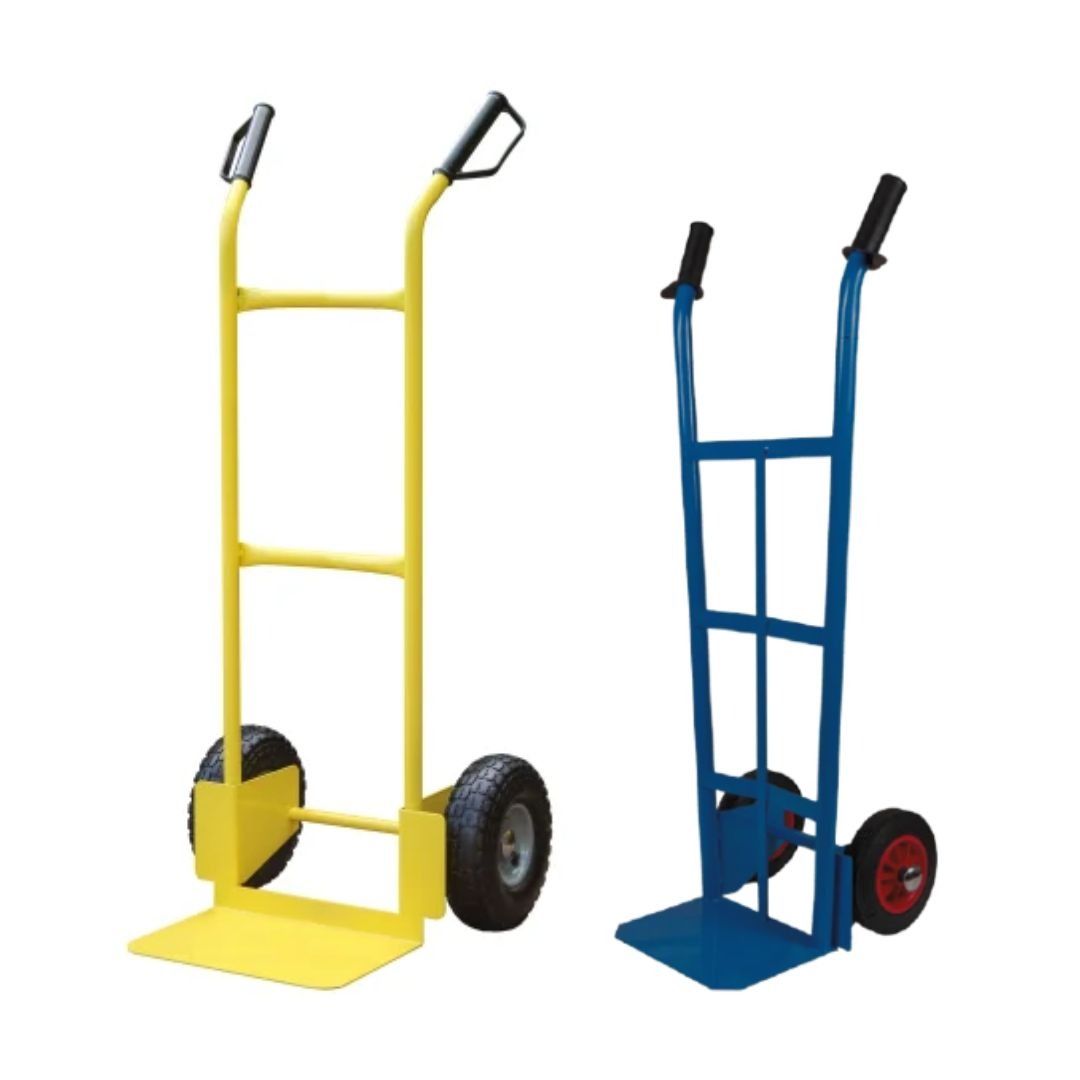
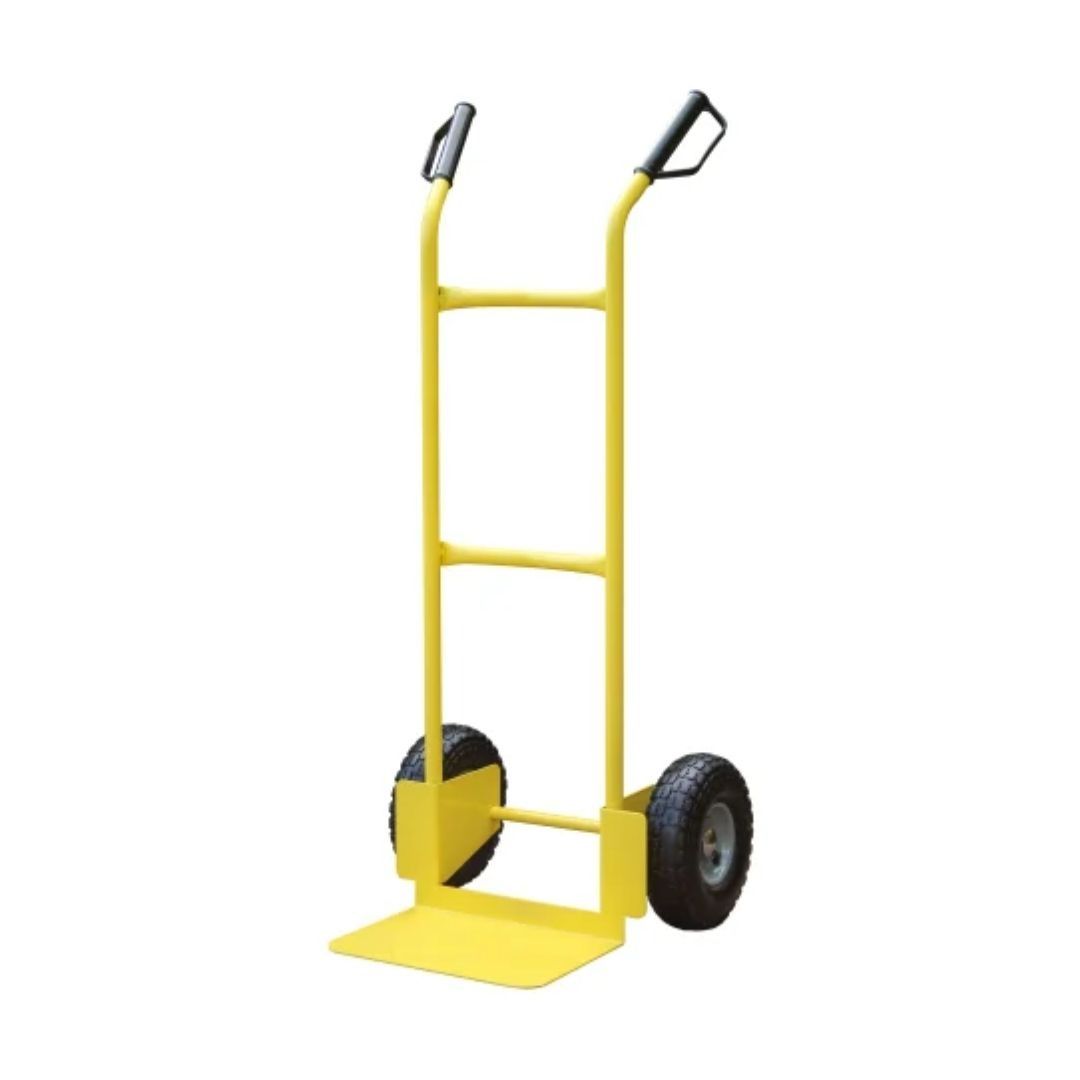
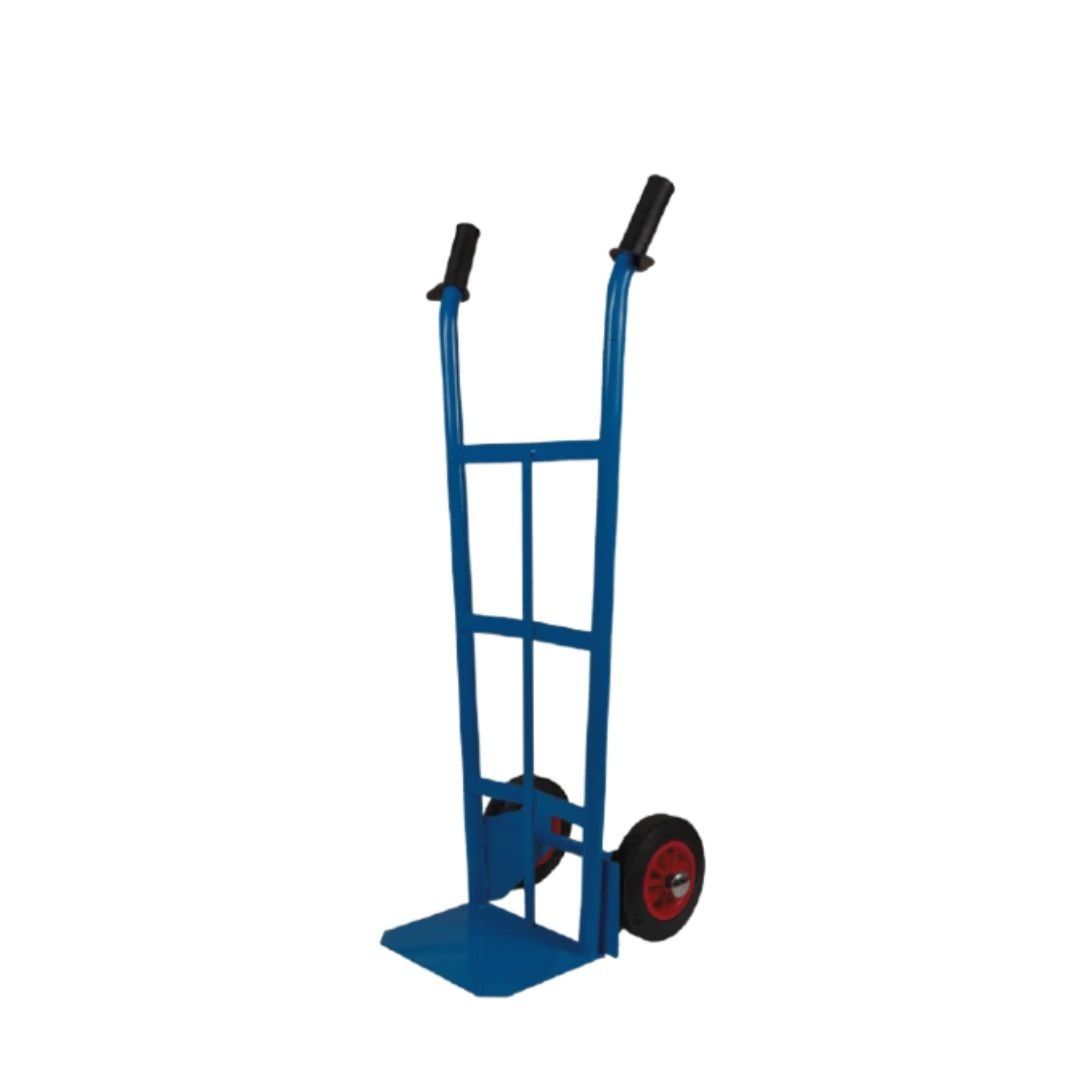
Heavy duty steel frame sack trucks built for contractors, site operatives, warehouse teams, and commercial handlers moving heavy goods in construction, industrial, and commercial environments. Two variants cover the two primary sack truck use cases on a professional site: the SCT02 with pneumatic rubber tyres and 200kg capacity for uneven ground, outdoor site use, and rough terrain, and the SCT04 with solid compound wheels and 150kg capacity for smooth indoor floor environments where puncture risk or tyre maintenance is not acceptable. Both share the same fixed toe plate, knuckle guard handles, in-built axle, and yellow zinc coating that signals site-grade construction at a glance.
How a fixed toe plate and knuckle guard handles outperform folding alternatives under contractor use
Most sack trucks on the UK market are designed around a folding toe plate and height-adjustable handles for delivery driver and domestic convenience. A folding toe plate has a pivot joint that is the highest-stress point on the truck under heavy repeated loading. Under sustained contractor use with loads approaching the rated maximum, that joint flexes and eventually fails, either bending or snapping at the pivot point. A fixed toe plate eliminates that failure mode entirely by removing the pivot. The knuckle guard handles protect the operative's hands from impact with walls, shelving, and door frames during load transport in confined commercial and site environments, a hazard that a standard straight handle leaves entirely unaddressed.
Key Features
-
Fixed toe plate: Solid fixed construction eliminates the pivot joint failure mode of folding alternatives under sustained heavy contractor use. Structurally robust under repeated loading at or near the rated maximum capacity.
-
Knuckle guard handles: Guard plate on the handle protects the operative's knuckles from impact with walls, door frames, shelving, and tight corners during load transport in commercial, warehouse, and site environments.
-
In-built axle for durability: Axle formed as an integral part of the frame construction rather than a bolt-on component, providing greater durability and resistance to axle loosening or failure under sustained daily professional use.
-
Yellow zinc coating: Zinc coating provides corrosion resistance and the high-visibility yellow finish improves operative awareness on construction sites and industrial areas where site safety and equipment visibility matter.
-
SCT02 pneumatic rubber tyres: Air-filled tyres absorb ground shock on uneven, rutted, and rough site surfaces, maintaining load stability and reducing operative fatigue on outdoor and mixed-surface construction environments.
-
SCT04 solid compound wheels with starlock clips: 200mm solid compound wheels require no inflation and carry no puncture risk, making them the correct specification for smooth indoor floors, warehouses, and commercial environments. Starlock clips secure the wheels reliably to the in-built axle.
-
SCT04 stove enamelled toe plate: Stove enamelled coating on the 300mm x 225mm x 3mm mild steel toe plate provides a harder, more durable surface finish than standard paint under the abrasion of repeated load sliding and placement.
Who is this for
Trades and roles:
-
Site operatives and labourers
-
Warehouse and stores operatives
-
Commercial and facilities handlers
-
Delivery and logistics operatives
-
Plant and depot stores controllers
Industries:
-
Construction and civil engineering
-
Warehousing and logistics
-
Commercial and retail
-
Facilities management
-
Industrial manufacturing
-
Plant hire and equipment depots
Specifications
| Specification | Detail |
|---|---|
| Product Name | Heavy Duty Sack Truck - Steel Frame and Knuckle Guard Handles |
| SKU / Product Code | SCT |
| Handle Type | Knuckle guard handles for protection and grip |
| Axle | In-built axle for durability |
| Weight (both variants) | 10kg approx. |
Variant Comparison
| Feature | SCT02 - Heavy Duty | SCT04 - Solid Tyre |
|---|---|---|
| Load capacity | 200kg | 150kg |
| Wheel type | Pneumatic rubber | Solid compound, 200mm |
| Puncture risk | Yes - pneumatic tyre | None - solid wheel |
| Inflation required | Yes | No |
| Best surface | Uneven, outdoor, rough terrain | Smooth indoor floors |
| Toe plate finish | Fixed steel | Stove enamelled coating |
| Wheel fixing | In-built axle | Starlock clips |
| Dimensions (LxWxH) | 500x470x1175mm | 300x225x1300mm |
| Colour | Yellow | Blue |
| Best for | Construction sites, outdoor, rough ground | Warehouses, smooth floors, indoor |
Compatibility
| Application / Environment | Recommended Variant |
|---|---|
| Outdoor construction site use on uneven ground | ✓ SCT02 - pneumatic tyres |
| Rough terrain and rubble-strewn surfaces | ✓ SCT02 - pneumatic tyres |
| Indoor warehouse smooth floor use | ✓ SCT04 - solid wheels |
| Commercial and retail environments | ✓ SCT04 - solid wheels |
| Loads up to 200kg | ✓ SCT02 only |
| Loads up to 150kg on smooth floors | ✓ SCT04 |
| Sites with nails and sharp debris (pneumatic) | ✗ SCT02 puncture risk - use SCT04 |
| Loads exceeding 200kg | ✗ Exceeds rated capacity of both variants |
Who is this for
These sack trucks are used by site operatives, warehouse teams, and commercial handlers who move heavy goods regularly in construction, industrial, and commercial environments where load capacity, handle protection, and frame robustness matter more than folding convenience. The SCT02 suits outdoor construction sites, rough terrain, and mixed-surface environments where pneumatic tyres absorb ground shock under 200kg loads. The SCT04 suits indoor warehouses, smooth commercial floors, and environments where a solid wheel with no puncture risk and no inflation requirement is the correct specification for the surface and load type.
Typical applications
-
Transporting bagged cement, aggregates, and site materials across a construction site using the SCT02 pneumatic variant on compacted, uneven, or rubble-strewn ground.
-
Moving heavy boxed equipment, tools, and supplies from delivery vehicles to site stores and working areas on construction and commercial projects.
-
Warehouse order picking and stock movement on smooth concrete or warehouse floor surfaces using the SCT04 solid wheel variant without puncture risk or inflation maintenance.
-
Transporting heavy goods in commercial retail, hospitality, and facilities environments where the SCT04 solid wheel maintains floor surface protection and requires no tyre maintenance.
-
Moving drums, cylinders, and heavy industrial containers in depot and plant hire environments alongside drum handling equipment.
-
Delivery and logistics operations in commercial areas where the knuckle guard handles protect operatives moving loads through narrow doorways, corridors, and tight storage areas.
-
Construction site stores management, moving materials, equipment, and supplies between delivery points, storage areas, and working zones throughout the shift.
How to use
Step 1: Select the correct variant for the surface and load. Use SCT02 on uneven, outdoor, or rough terrain up to 200kg. Use SCT04 on smooth indoor floors up to 150kg.
Step 2: Position the toe plate under or against the base of the load before tilting. Ensure the load is stable on the toe plate before lifting clear of the ground.
Step 3: Tilt the truck back toward the operative, keeping both hands on the knuckle guard handles throughout. The load should balance over the wheel axle with minimal forward effort once the tipping point is reached.
Step 4: Push or pull the truck at a controlled walking pace to the destination. Keep the path clear before moving and maintain awareness of the load's forward projection, particularly in doorways and narrow spaces.
Step 5: At the destination, tilt the truck forward progressively to lower the load to the ground. Do not drop the load abruptly. Control the descent to the ground surface throughout.
Step 6: For SCT02: check tyre pressure at the start of each shift and inflate to the correct operating pressure. For SCT04: inspect the solid wheels and starlock clips for wear or loosening at regular intervals.
Common mistakes
-
Exceeding the rated load capacity: The SCT02 is rated to 200kg and the SCT04 to 150kg. Overloading either variant stresses the frame, axle, and toe plate and creates a tipping and handling hazard. Always confirm the load weight before selecting the variant and loading.
-
Using the SCT02 on smooth indoor floors expecting the same performance as the SCT04: Pneumatic tyres on very smooth floors can feel less stable than solid wheels under heavy loads. The SCT02 is optimised for uneven and outdoor surfaces. For smooth warehouse floors, the SCT04 is the correct specification.
-
Neglecting tyre pressure on the SCT02: An underinflated pneumatic tyre under 200kg loads increases rolling resistance and reduces stability on uneven ground. Check pressure at the start of each shift.
-
Sliding loads onto the toe plate from height: Dropping or sliding a heavy load onto the toe plate from above can bend or deform the plate over time. Position the toe plate under the load base progressively rather than forcing it under a dropped load.
-
Operating in narrow spaces without checking knuckle clearance: The knuckle guard handles protect the operative, but the load width may still exceed the doorway or corridor width. Always check clearance before entering a confined space with a loaded truck.
Safety
Never exceed the rated load capacity of the variant in use: 200kg for SCT02, 150kg for SCT04. Inspect the frame, toe plate, handles, axle, and wheels before each use. Do not use a truck with a bent or cracked frame, a deformed toe plate, or a damaged wheel. Operatives should wear appropriate PPE including safety footwear when loading and transporting heavy goods. When manoeuvring in areas with pedestrian or vehicle traffic, maintain awareness of the load's projection and follow site traffic management procedures under CDM 2015 where applicable.
Maintenance
For SCT02: check and inflate pneumatic tyres to the correct pressure at the start of each shift. Inspect tyres for cuts, embedded debris, and sidewall damage at regular intervals.
For SCT04: inspect solid wheels for surface wear and cracking and check starlock clips for secure fixing at regular intervals. Both variants: inspect the frame, toe plate, knuckle guard handles, and in-built axle for deformation or cracking under sustained heavy use.
Touch up any chips in the zinc coating promptly to slow corrosion at exposed steel points. Store in a covered, dry location when not in use.

Frequently Asked Questions
Q: What is the difference between the SCT02 and SCT04 and how do I choose the right one?
A: The key differences are load capacity, wheel type, and intended surface. The SCT02 carries up to 200kg on pneumatic rubber tyres, making it the correct choice for construction sites, outdoor use, and uneven or rough terrain where the tyre absorbs ground shock and maintains load stability. The SCT04 carries up to 150kg on solid compound wheels with no puncture risk and no inflation requirement, making it the correct choice for smooth indoor floors, warehouses, and commercial environments where tyre maintenance is not acceptable. Both share the same fixed toe plate, knuckle guard handles, in-built axle, and zinc-coated steel frame construction.
Q: What does the knuckle guard handle protect against?
A: The knuckle guard is a steel plate that wraps around the back of the handle grip, protecting the operative's knuckles from impact with walls, door frames, shelving uprights, and tight corners during load transport. Without a knuckle guard, a standard straight handle leaves the back of the hand exposed to impact in confined spaces, which is a frequent cause of hand injuries during repeated sack truck use in warehouses, corridors, and site stores. The guard does not restrict grip or handle operation in any way.
Q: What does "in-built axle" mean and why does it matter?
A: An in-built axle is formed as an integral part of the steel frame rather than bolted on as a separate component. A bolt-on axle has fixings that can loosen under the vibration and impact loading of daily heavy sack truck use, eventually leading to axle movement or failure under load. An in-built axle eliminates those fixings, providing a structurally continuous connection between the wheels and the frame that maintains its integrity under sustained daily professional use.
Q: What is this sack truck NOT suitable for?
A: Neither variant is suitable for loads exceeding their rated capacity: 200kg for SCT02 and 150kg for SCT04. The SCT02 pneumatic tyre variant is not suitable for use on sites with heavy nail, rebar, or sharp debris contamination at ground level where puncture risk is high. The SCT04 solid wheel variant is not optimised for heavily uneven outdoor terrain where the pneumatic tyre of the SCT02 provides better ground shock absorption. Neither variant is designed for stair climbing or use on inclined ramps beyond the operative's safe manual handling limit.
Q: Why is a fixed toe plate better than a folding toe plate for heavy contractor use?
A: A folding toe plate has a pivot joint at the highest-stress point on the truck: the junction between the toe plate and the frame. Under repeated heavy loading with loads approaching the rated maximum, that pivot flexes progressively and eventually fails, either bending at the joint or snapping entirely. A fixed toe plate removes that joint entirely, providing a structurally continuous connection between the plate and the frame that absorbs load without a failure point. For occasional or light domestic use a folding plate is a convenient space-saving feature. For daily heavy contractor use, the fixed plate is the more durable specification.
Q: What does the yellow zinc coating do beyond visibility?
A: The zinc coating provides corrosion resistance to the steel frame by applying a sacrificial zinc layer that continues to protect the underlying steel even when the surface is scratched or abraded during site use. It also provides the high-visibility yellow finish that improves operative awareness on construction sites and industrial areas. The zinc coating is more durable than a standard paint finish under the abrasion and impact of daily professional handling use.